
Combination attacks
We have spoken so far about simple attacks and basic parries. These of course can be combined in an infinite number of ways, just as the 26 letters of the alphabet can be combined to form all of the words in the dictionary, and then those words can be combined to form sentences and paragraphs. String the paragraphs together and you have a story. Good choreography will tell an interesting story through the expression of the strategy and tactics used by both combatants. This story is told through the expressive use of combination attacks. Settling for less than that is simply bashing away until someone loses.
When the same fighter performs two or more consecutive attacks, that is a combination. The idea is that perhaps only the last attack was the real intention; the others were feints or attempts to open up a poorly defended part of the opponent’s body or simply taking advantage of a sudden opening. One form of a combination attack is a compound attack. A compound attack is an even more skilled combination, where the blade may attack more than one target but the arm has made only one thrusting motion forward. Compound attacks are fencing techniques, always done with a straight elbow, and should be learned under the guidance of an on-site instructor. These are wonderful finesse moves, but if learned incorrectly will look very sloppy. I’m going to go ahead and describe the four safest ones here if only because they are so often used onstage. You should have at least a passing familiarity with them before the fight director arrives. The fancier versions must only be practiced under direct supervision or they will detract from the show.
¨ same-side shifting-heights – let’s try thrusting to high right (that’s your own right side; your partner’s left). Since your partner has responded by blocking with the tip up, he’s left the lower part of the body open, so a follow-up would be to pull your arm back and then thrust low. That’s a fine combination, but we’re going to turn it into a compound attack by not pulling the arm back.
If you are a right-handed actor, perform that high right thrust with the palm down (prone). At the moment your attack is parried, keep your arm perfectly straight and roll your arm from the shoulder until the palm is up (supine). Your blade tip will almost magically spin around and end up directly underneath your partner’s hand. Wait for the parry low, then roll your arm again so your palm turns down (prone) and your blade tip is now attacking the high line again. There you are: a triple compound attack high-low-high, with only one thrust but the hand turning prone-supine-prone. The defender is going to have to move awfully fast to pick-off all three threats.
Now try the other side of the body (your left, your partner’s right). You also want to try a compound high-low-high attack, but now you will thrust with the hand supine, then turn it prone, then supine again. We’ve arbitrarily stopped at three, but it could continue on as long as you wish. And if you wanted to start with the low attack on the left, then you would simply start with the hand prone, etc. No matter what, these same-side compound attacks work because the arm is kept straight and the forearm rotates to automatically change the attack targets for the blade tip.
¨ degagé [Fr. = disengage] This one goes from high line to opposite high line. Let’s try that thrust again to the high right, and this time the hand is going to stay supine. As the defender starts to make contact, relax the grip. As the tip of the sword dips slightly, going under the defender’s hand, draw your arm slightly across to the left. Then re-grasp the sword with strength and the tip will pop back up to the high target level. The arm stays straight throughout, merely moving straight across from side to side. Only the wrist will move slightly to help guide the tip around. The degagé only works when the parries have the tip pointing up.
¨ coupé [Fr. = cut] Also called the cutover, for this is similar to the degagé except that the tip goes over the defender’s hand rather than under. How? With a tiny wrist flick, a little salute, a lifting up of the fingers just as the parry connects. This one works whether the parries are high or low, but of course if the parries are high the cutover must be more exaggerated so as to clear the defender’s blade. Again, the arm stays straight on this, merely moving straight across from side to side.
¨ doublé [Fr. = doubled] This compound attack always goes right back to the same target, merely by making a small circle around the defender’s hand as he attempts to make the parry. (For some inexplicable reason, the Society of American Fight Directors sometimes considers it a doublé if two circles are made. They are alone in this.)
The obvious defense is to chase that sword around in a full circle, in what’s known as the counterparry, circular parry or universal parry.
Combination Defenses
I mentioned earlier that when doing combination attacks, one doesn’t need to bring the sword back to the en guard position between each move. The same holds true for defenses. Obviously, if someone is attacking you four times in a row, you’re not going to waste time moving your hand back to en guard in between each move. I also said that even as an attack develops, you want to hold your last position until the very last possible second. You must wait until the attack is 90% developed, and then make a lightening fast move to pick off the incoming threat. However …
… when moving from one block to another you still have to make sure that the center of the body is covered before you land at the next position or you might accidentally find your block outside of the attack. Here’s an example: you are attacked with a vertical head cut followed by a thrust to your right shoulder. Naturally on the first block your arm will rise straight up, elbow pointing right. Now, for the second block, if you just drop your elbow down in an arc to the next block position, you have only a 50-50 chance of being on the correct side of the incoming blade. So what you need to do from the vertical head block is drop your hand to the center of your body first before you swing it out to the right, picking off the second attack.
You have to carefully look to this every time you have two or more consecutive defensive moves. We’ll come back to this in a few pages, but I want you to ruminate about it first.
Attacks on the blade
There are times when a fighter finds it necessary to use his own blade to move the opponent’s sword out of the way in order to expose a target for attack. They are mainly used in fights where the blades are light enough to quickly respond to wrist movements (they tend to look clunky when performed with heavy swords), and are especially used during the initial moments of a duel when the participants are testing each other. Small or large, these attacks work best when the opponent has already extended his arm on a prior attack. Just as with the unarmed fighting techniques, the opponent does the real work of moving his own blade, the attacker merely following the movement and both working together to sell the illusion.
Attacks on the blade should be kept to a minimum, and when used, performed with great precision, as actors tend to overdo them and ruin the believability. Some attacks on the blade are listed below, in ascending order of force required. Remember, on none of these moves should either blade tip ever cross in front of someone’s face.
¨ Prise de Fer: [French term meaning “taking the iron”] From a successful parry, the attacker moves the opponent’s blade to a new position while both blades maintain contact. The opponent must keep the arm and blade straight if the audience is going to have any hope of understanding what is going on. It also helps if the attacker can use the forte against the opponent’s foible. It is neither an attack nor a defense, merely a preparatory move from which one intends to initiate a successful attack. There are three kinds of prise de fer, namely;
1 Croisé: [pronounced – k(r)wa-say’] from the French, meaning “crossed” the blade is moved from high to low or low to high, but on the same side of the body, not diagonally across like a bind. (You would think that something called a “cross” would have a cross shape, but there you are.)
2 Bind: the blade is moved only in a half circle, ending diagonally opposite from where is started – for example high-left to low-right.
3 Envelopment: the blade is moved in a complete circle right back to where it started. If large, the opponent’s tip is directed around the body; if small then only around the hand – never across the face. Why is this not a counterparry (or circular parry)? Because the envelopment is controlling the movement.
¨ Beat Attack: a sharp tap with the forte or middle part of one’s blade against the middle or weak part (foible) of the opponent’s blade – to remove a threat, open a line for attack, or to provoke a reaction.
¨ Glissade: also “glide”. A flowing attack on the sword that displaces the opposing blade by gently sliding down the weapon, foible to forte, pushing the sword out of the way. It can be combined with an attack if, at the same time as the glide, the tip is pointed at a thrusting target. The corresponding move to the glissade is the yield parry, (also called the ceding or yielding parry). The glissade is normally a thrust, but can also be used as a cutting attack, the important thing being that the sword blades stay in contact during the entire move. If the glissade is supposed to be especially forceful, it is called a pressure glide.
¨ Throw-off. Immediately following a block, the incoming sword is pushed even further away. The throw-off is always under the control of the person whose sword is being thrown off.
¨ Disarm. The ultimate attack on the blade, in that it removes it from the actor’s possession. There are hundreds of variations on disarms, and some of them even have some relation to actual moves. I am only going to describe one that is both simple and believable to the audience:
Let’s assume that Actor A has thrust to Actor B, and that the attack landed low and to the right of B. B parries with tip down and sword to the right. Actor A simply remains in place, and points his sword backward and to his left. Actor B merely follows the movement, pushing his parry in a glissade along A’s blade, his own sword moving as one unit. B’s hand can even lead a little bit. When the glissade reaches the end, A allows his sword to drop from his hand, gently landing on the ground.
No matter what the specific disarm is, don’t violate some basic rules. 1) the person being disarmed is the person who controls the movement from start to finish. 2) Have the energy slow down. 3) Have the energy move upstage. That last thing you want is a weapon freely traveling toward the audience.
Pommel Attacks
I’m a little leery of including mention of pommel attacks, but I also know that they are popular, so first let me again strongly suggest that you get someone with experience to teach these to your actors. These are attacks delivered with the pommel of a weapon, and that means that the actors are going to have to move in close to each other. So we have the danger of unarmed techniques augmented by the danger of unforgiving contact with a ball of steel. If you get hit with a blunt blade tip it can smart: if you get hit with the pommel it can knock you out.
Because of the heightened danger, the most important aspect of a pommel attack is to make sure that every element of the simulation keeps the victim out of danger. Let’s go through the most common one, the blocked pommel attack to the face.
Set up: both actors on the same plane and lined up parallel to the proscenium, facing each other. Since this is a blocked attack, it doesn’t matter who is on what side, left or right. The victim (let’s say) steps in to close the distance between the actors.
Picture: The aggressor’s right hand moves up to his own right ear, allowing the sword tip to move safely behind him. The pommel is now aimed at a spot to one side or the other of the victim’s head.
Action: The pommel is pushed in a straight line to that spot either up or downstage of the victim’s head.
Reaction: Only the victim has a reaction here, and that is to have an open palm rise up and meet the aggressor’s hand, providing the illusion that the pommel attack was successfully blocked. Do not ever try to block the pommel itself or you risk some nasty damage to the blocking hand. To add a little more realism, slightly shift the head away from the attack at the moment of the block. In a larger house, you may need to add a body lean so that the audience can follow the action.
From here you can probably imagine many variations, but the concept is always the same.
Feint Attack
When an attack is begun but not completed, the intention being to provoke a response by the opponent, it is referred to as a feint. Most often it is an attempt to have the opponent begin to block in a certain direction, with the hope that in so doing he’ll leave a part of the body open and unprotected. During that moment an attack to that newly exposed spot might be all but impossible to defend against. Most of sport fencing has a lot of feint attacks, but it is difficult for the audience to see the difference between a feint and a simple combination attack (as it is very difficult for fencers as well). For stage we have to exaggerate the feint slightly, but by all means we need to read the expression of panic on the defender’s face when he realizes that in making a block for an attack that isn’t real he has made a grave mistake. For the same reason, use of the feint must be kept to an absolute minimum.
Punto Reverso
In historical as in modern fencing, most thrusts were aimed to the center of the body. But especially in rapier fighting, since the defending hand was not held in front of the center of the body but was a little bit closer to the outside (for most people, their right side) most thrusts by default were “inside” thrusts. Thrusts to the outside were considered risky because they usually either were easily blocked or merely nicked the forearm. The Italians gave outside thrusts their own name – punta riversa – literally “reverse point”. Shakespeare rendered the fashionable fencing term as punto reverso in Romeo and Juliet, and that is the form we will use here.
Since the right side, the outside” is so well guarded, why would anyone try a punto reverso? For a clever fencer, it can be the very effective culmination of a series of thrusts or cuts that continually land to left of center. If the opponent is over-eager, after a while he may let his natural guard drift from right or even center to a ready position which is decidedly left of center. Once the opponent has been conditioned to this left-side protecting guard, the right side becomes vulnerable to a strong thrusting attack to his right. The punto reverso. As the name implies, it is always a thrust, never a cut.
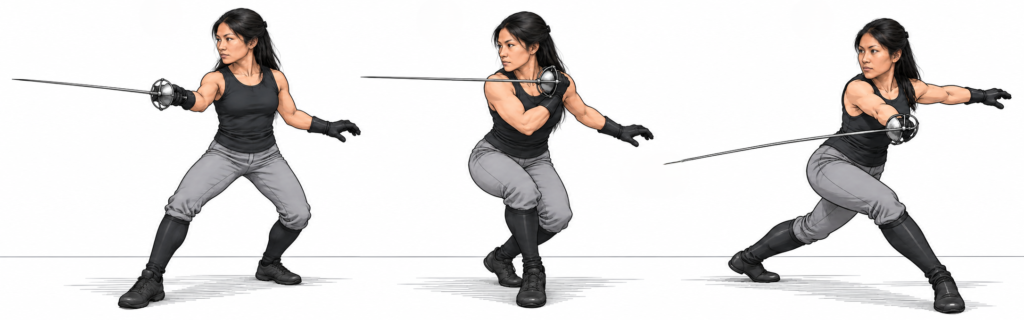
Of course, in stage combat we thrust both inside and outside with equal frequency, so punto reverso has taken on a slightly different meaning. It is still a thrust to the outside, but exaggeratedly so, so that the thrust is delivered almost sideways into the victim’s flank. Imagine a thrust aimed so that it runs through the pelvic girdle, right hip to left hip. In order to do that, the aggressor must take a deep crossing step to the left and forward with the right foot, practically a lunge. This is really an all-or-nothing move; if unsuccessful, the aggressor is left very vulnerable to counterattack.
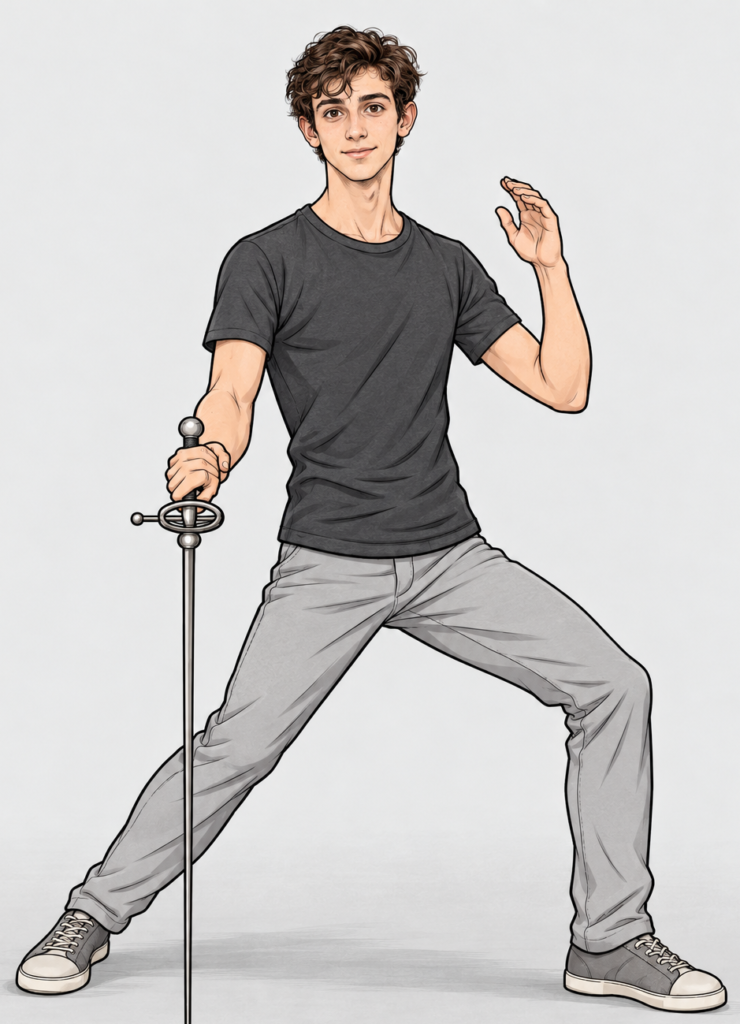
The defender can’t only block here, or her incoming point will reach around his defending blade. So he must literally move his butt! He blocks the attack while taking a step to the left and very slightly forward with his left foot. This moves both participants in a slight clockwise turn. If they continue trading puntos back and forth, they will naturally move in a large circular pattern. The defense is always performed while taking a deep side step with the left foot. The attack is always accompanied by the right crossing step.
To learn the attack itself, it helps to think of the movement in two parts: compress, expand. This is how I usually call it out in class: “Compress: expand. Compress: expand.” Eventually the two parts must flow together into one smooth action, but they are easier to learn separately.
On the compression, the right foot sweeps in a large clockwise semicircle toward the left foot. At the midpoint the feet have not yet crossed; they have drawn into a tight position something like a cat stance or ballet third position, one foot just in front of the other. At the same time both knees bend into almost a demi-plié and the body sinks. The torso begins to rotate, while the sword arm contracts sharply at both elbow and wrist and is carried across the body until the guard touches, or nearly touches, the opposite shoulder. Despite all of this contraction, the point must remain threatening the opponent. The entire body should have the feeling of being wound like a spring.
Then comes the expansion. The right foot continues through into the deep crossing step, the body opens, and the sword arm straightens explosively into the punto reverso. The thrust travels almost sideways across the opponent’s body while the aggressor drops forward and slightly to the left. To the left? Yes. Otherwise the two combatants will wind up too close together to make a convincing thrust with the tip of the sword.
At first this will feel like two separate movements. That is intentional. Learn the compression. Learn the expansion. Then gradually remove the pause between them until compress–expand becomes one continuous, fluid explosive attack.
Stabbing/ Thrust-kills with the Sword
Have I mentioned before that less is more? Nowhere more so than in finally finishing the fight and killing off a character. Always remember that the sword or knife is just a prop, and the audience gets its information from the actor’s eyes and body language.
Keep it a firm rule never to have the audience see the sword go “through and through” the victim. It has been used in so many movies that it is now merely a cliché, and often provokes laughter rather than an honest gasp.
Where a character has been wounded is shown by the reaction of the victim more than the placement of the blade. If the actor can perform a movement isolation, pushing that part of the body slightly in line with where the force supposedly penetrated, the actual sword can be safely placed upstage of the actor. The audience has no depth perception, so they’ll never know the difference.
The simplest thrust kill effect is a perfection of the old sword under the arm bit. The aggressor should initiate a slightly angled thrust to upstage of the midsection. The hand is aimed towards the stomach, but the tip is moved to outside of the body outline. When the tip of the sword has just passed the front of the victim’s stomach, then the aggressor’s blade can strongly slap the side of the victim, then press forward with the rest of the thrust. Only two or three inches of the blade should disappear upstage of the victim. Never allow the blade tip to appear on the other side of the victim: it destroys the illusion – and gets a laugh. As long as the victim doesn’t turn in the direction of the actual blade going upstage, but stays focused and reacts to the imaginary blade hitting him dead center, the illusion will be effective. A slight contraction of the stomach muscles adds realism. When the blade is removed, the victim can perform a reverse of the prior stomach movement, as a real sword would find a good deal of resistance in both going into and coming out of the body.
If the audience is close to or surrounding the action (and the blade is flexible enough), the victim can bend the blade with his forearms to make it appear that the blade has gone right into the center of the belly. The downstage hand reaches out towards the opponent, hiding the upstage forearm which presses against the blade. Opening the fingers (not grabbing the blade) helps sell the illusion. It is amazing how realistic this simple technique can appear.
Other kill-thrusts involving placing the tip directly on-line with the victim must only be attempted under the direction of an extremely competent and experienced professional fight master.
Slicing/Cutting kills with the sword
There are two kinds – contact and distance. Believe it or not I am actually going to suggest that you stay away from the distance kills and use the contact variety. Contact slicing is a simple matter of placing the middle of the (dull) blade along the intended body part to be cut and then pulling the sword across the body. This must not be rushed, for not only is it safer to go slow, but the audience needs a little change of timing here so they can be prepared for an important change in the storyline.
At the end of the cutting motion, the sword is carefully placed with the flat of the blade right on the body part, preferably the stomach or a large muscle and not on a joint. Whether the sword is then pulled directly out [a side cut] or across the body [a drawing cut] the aggressor pulls the sword hand back to his own body center, removing the energy away from the victim. As always, keep the sword away from the head at all times. In fact, add in a slightly downward course for the blade instead of rising or even strictly horizontal. If anything goes wrong, the tip has a better chance of dipping towards the floor than popping up to someone’s face.
There are times when a joint is the intended target, especially behind the knee. This bit is often used where one character has to deal with multiple attackers. A quick cut to tendons of the leg and one attacker is immobilized. Be especially careful if you do this bit that you don’t smack the joint but instead very carefully lay the blade against it without any pressure, or better yet lay the sword just above the joint. By the way, here is some information which you might find interesting but won’t be able to use. Normally, the above bit is done and the reaction of the victim is to bend the “cut” leg and kneel to the floor. This is exactly what the audience expects so you shouldn’t stray from that. It’s just that you should know that that isn’t what really happens.
Our limbs move because of the opposing action of complementary muscles. A muscle can only contract and then relax; that means it can only pull a bone, not push it. So in the leg, for example, the quadriceps in the front of the thigh straighten the leg at the knee and the hamstring behind the thigh bends the leg at the knee. If the tendons are cut behind the knee, that muscle behind the leg contracts immediately but isn’t connected, so no bending. The quads on the front of the leg aren’t damaged, so the leg straightens and stays straight. But that looks really odd and the audience thinks that the actor got it wrong, so don’t do that reaction. (Just another example of how reality can get in the way of telling a story.)
Cutting kills in which the actors are out of distance from each other and the sword is swung in an arc that simulates the slash must not be performed without expert supervision. It is different than the common slashing described in prior pages and very dangerous for it requires precise placement of both actors on the set. It’s great for film work, but they have the time to take a half hour to set up the shot and do several takes to get it right. They also have better liability coverage than you do.
Corps à Corps
From the French, literally “body to body”. This is when the two actors close distance so that literally the bodies are practically touching, chest to chest and face to face. This is usually the moment in a movie fight where one character will say something to the other along the lines of “You’ve come to Nottingham once too often.”
In order to keep this safe, we just have to make sure that the sword hilts are kept away from the participants faces. The easiest way of doing that is to have the weapons go hilt to hilt and keeping the arms straight, low, and off to one side. You would think that something so simple wouldn’t require actual actor instruction. You would be wrong.
Throwing and Catching the Sword
Here is a safe way to toss a sword to another actor – safe so long as you practice. Grab the sword by the blade with a gloved hand and then lower your hand to your side. Point the hilt towards the floor so that the blade rests against the back of your arm. Then gently point to the spot that you want the sword to go as you relax your grip. Your gloved hand will guide the blade as it is tossed, and with just a little practice the sword will gently arc to your partner without tumbling, hilt first for an easy catch. But this is critical: toss the sword upstage of your target. That way, if you partner misses the grab and bats the sword instead, it will fly upstage rather than out into the house.
Catching the sword should be fairly easy, so long as the sword is moving slightly upstage of where you are standing. If it starts to drift downstage, then move quickly to keep it to your upstage side. Why is this so important? Because again, more dangerous than missing the catch is to bobble the catch. If the sword drifts downstage of you and it bounces off of your catching hand, it could be accidentally swatted out into the audience. Better instead that your energy be turning towards an upstage toss when your hand makes contact with the sword.