
While no formal census exists, the volume of stage slaps executed annually in the United States is likely measured not in thousands, but in hundreds of thousands. A reasonable estimate suggests that actors rehearse and perform face slaps more than a quarter of a million times each year, and perhaps substantially more.
Some directors and performers still insist that stage slaps should make actual contact. This is poor practice, poor acting, and poor stage combat.
It is also physically irresponsible.
A real slap to the face is not harmless theatrical roughness. Even relatively light impacts can injure the jaw, strain the neck, rupture the eardrum, damage teeth, irritate the eyes, or contribute to concussion symptoms. Worse still, stage violence is repeated over many rehearsals and performances. What might be shrugged off once can become cumulative damage over time.
A real slap does not improve the illusion of violence. It damages it.
When someone is genuinely struck, the body responds involuntarily. Eyes blink. Focus disappears. Speech changes. Timing collapses. Emotion shifts away from the scene and toward self-protection. The actor is no longer performing the moment; they are enduring it.
This is not realism. It is the breakdown of performance.
No serious fight director would suggest stabbing actors during knife scenes or striking them with baseball bats because the script contains violence. The same principle applies here. Stage combat exists to create the illusion of violence while protecting the actors and preserving the story.
A stage slap must never devolve into a real slap delivered carefully. It is a theatrical illusion specifically designed to appear violent while remaining safe, repeatable, and dramatically controlled.
The Illusion
A convincing stage slap depends on three things working together:
- the visual picture
- the sound
- the reaction
The audience combines these elements into a single perceived impact.
The hand itself normally passes just in front of the face rather than striking it directly. Proper positioning between the actors conceals the gap from most viewing angles, allowing the audience’s imagination to complete the illusion.
This is important because the audience does not experience the slap from a single fixed perspective. Every spectator views the action from a slightly different angle. The choreography must therefore create a broad theatrical illusion rather than attempting to fool one exact location.
Positioning the Actors
The receiver generally stands slightly upstage and angled so the audience cannot clearly see the space between hand and face. Small adjustments in body position matter enormously, with the goal of hiding the moment of impact.
The striking hand normally travels past the face rather than toward it directly. The motion should remain relaxed and continuous. Avoid excessive muscular tension or visible preparation.
One of the most common beginner mistakes is “announcing” the slap before it occurs. Real violence often appears sudden and emotionally impulsive. The stage version should therefore emerge naturally from the dramatic moment rather than looking like a choreographed cue.
Ideally, the movement feels as though the hand reacted emotionally before the character consciously decided to strike. The energy should appear to originate from the emotional impulse of the scene, not from mechanical preparation.
Creating the Sound
The sound of impact is usually created separately from the apparent point of contact.
Many methods exist:
- chest slap
- hand clap
- thigh slap
- partner-assisted sound
The exact technique matters less than consistency, safety, and timing.
The sound must occur at precisely the same moment the audience believes contact occurred. Even a slight mismatch weakens the illusion.
The Reaction
The reaction often sells the slap more effectively than the swing itself.
The receiver’s response communicates:
- force
- emotional meaning
- relationship dynamics
- social consequences
A slap between lovers carries different emotional weight than a slap from a military officer, a parent, a servant, or a terrified subordinate. The mechanics may remain nearly identical while the dramatic meaning changes completely.
The receiver must therefore react not only to apparent force, but to what the slap means within the story.
Because stage combat isn’t about violence. It’s about acting.
Final Thoughts
A successful stage slap appears immediate, dangerous, and emotionally truthful while remaining entirely simulated.
Actors should never be asked to endure actual strikes for the sake of “realism.” A performer who feels genuinely endangered, startled, or hurt cannot fully devote attention to storytelling, listening, timing, emotional connection, and partner trust.
The goal is not real violence.
The goal is the convincing theatrical illusion of violence.
* * * *
Action: The hand, and only the hand, moves quickly here from right ear to left ear. Along the way, as it disappears from view, it scoops down to the target hand, makes contact with a light slapping sound, and then continues to its final position. Think of slapping water out of a bowl being held by the left hand, and throwing the water over your left shoulder. Do not move either elbow, don’t move your body, and you don’t need to move the target hand either. This is a tiny little movement; not an action that has the force to drive someone through a wall, but just enough to turn the face slightly.
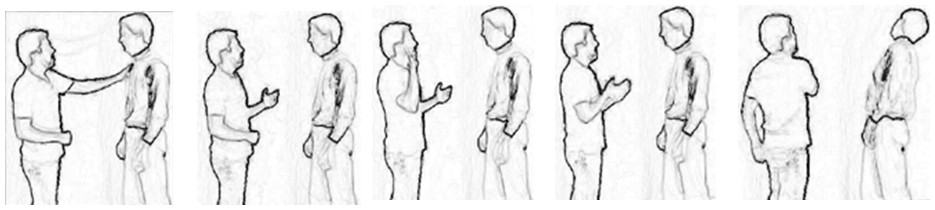
ASM’s view, self slip-hand knap. Notice how far the victim is from the action The slapping hand never goes near the victim’s face.
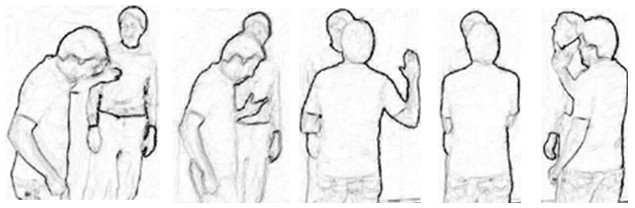
audience view of same
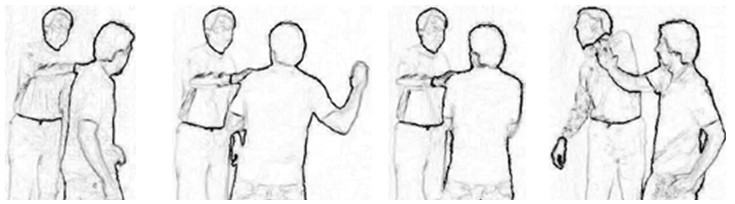
A more aggressive slap, audience view, shared slip-hand knap. Notice how the elbow starts away from the body, suggesting more premeditation.
[Since this piece was first written, further medical research has confirmed that even blows which don’t seem serious — the so-called subconcussive impacts — can cause measurable changes in the brain. A slap jars the head violently enough for the brain to collide with the skull, a coup/contrecoup effect. That is a real injury mechanism, whether or not the victim reports dizziness, blurred vision, or “seeing stars.” In addition, the face and ear are remarkably fragile. Ruptured eardrums, sudden hearing loss, and facial disfigurement have all been documented from a single slap.]
Selected References
- Bailes, J. E., & Petraglia, A. L. (2019). Subconcussive impacts in sports: A growing concern. Neurosurgery, 85(5), 909–913.
- Meaney, D. F., & Smith, D. H. (2011). Biomechanics of concussion. Clinics in Sports Medicine, 30(1), 19–31.
- Wilson, M. H., et al. (2023). Neurological injury in slap fighting: An observational study. Frontiers in Neurology, 14, 115702.
- McCready, R. J., & Hyde, J. E. (1987). Sudden hearing loss after a slap injury: Case report. Journal of Laryngology & Otology, 101(3), 308–310.
- McKee, A. C., et al. (2016). The spectrum of disease in chronic traumatic encephalopathy (CTE). Brain, 139(3), 922–933.