

This video provides an overview of unarmed stage combat, focusing on safety, illusion, and the core VINO and SPAR principles.
The basic techniques of unarmed stage combat are simple movements combined to create the illusion of violent contact. They are not violence itself.
That distinction must remain absolute. The actors are not attempting to hit, kick, throw, or overpower one another safely. They are constructing an event in which the audience believes those things have happened, while the actors perform an entirely different series of controlled movements.
You perform the stage combat. The audience creates the violence.
Unarmed combat is often more dangerous than weapon work because the actors must work in close proximity. There may be no blade between them, but there are hands, elbows, knees, feet, teeth, eyes, and joints—all moving at performance speed. Familiarity can create a false sense of safety. A punch looks simple because everyone knows what a punch looks like. That does not mean everyone knows how to simulate one.
The techniques described here contain built-in safeguards, but no technique is sacred. Bodies differ. Costumes, scenery, audience placement, and performance spaces differ. If a movement can be made safer for a particular actor or production, it should be changed.
These pages can explain the principles of unarmed stage combat, but they cannot replace direct physical instruction from a qualified teacher or fight choreographer.
All unarmed stage combat works because of consistent limitations in human perception:
Poor eyewitness accuracy
Perception and memory routinely fill in details that were never actually seen. The brain supplies familiar explanations for unclear images.
Difficulty tracking movement
Motion attracts attention but is rarely observed accurately. Audiences often believe they have seen more than actually occurred.
Limited depth perception
Vision is largely interpretive. Distance is judged through comparison and context, not precise measurement.
The need for narrative
The brain organizes movement into story. We assign intention, cause, and result automatically.
These tendencies are useful in life but invaluable on stage. They allow us to construct convincing illusions.
From Reality to Illusion: 3D → 2D → Safe 3D
To create a successful simulation, you must understand the reality you are imitating.
You are taking a three-dimensional event, compressing it into two dimensions to understand what the audience actually sees, and then rebuilding it in three dimensions with safety built in.
This is possible because the audience cannot accurately judge the precise distance separating two moving bodies—particularly when one passes across the other along the audience’s line of sight.
VINO: The Governing Principles
When I began teaching stage combat, I developed two acronyms that actors could use to evaluate their own work, even when I was not present. The first is VINO:
- V — Victim stays in control
- I — Interactive flow of energy
- N — Non-contact techniques
- O — Off-line targets
Victim Stays in Control
The victim is whichever character is receiving the violent action at that particular moment. It is not a designation of innocence, weakness, or moral worth. The roles of aggressor and victim may change repeatedly during a fight.
The victim determines whether the technique proceeds. The recipient controls the distance, accepts or rejects the physical arrangement, and may stop the action whenever anything feels uncertain. No concern needs to be justified in the moment.
The victim is never actually pushed, pulled, thrown, tripped, slapped, or otherwise forced through the movement. The audience may believe that the aggressor controls what happens. The actors must know that the recipient does.
Interactive Flow of Energy
A stage fight is not a series of techniques traded back and forth. Both actors participate in creating every apparent action.
The aggressor supplies intention, direction, and the visible source of the apparent force. The victim completes the illusion by showing where that force lands, how it travels through the body, and what effect it produces. The two performances must agree. A small action cannot produce an enormous reaction unless the style of the production justifies it; a tremendous blow cannot receive a casual response without looking false.
Energy is not actually transferred between the actors. Its apparent transfer is jointly performed.
Non-Contact Techniques
Whenever possible, apparent violence should be created without forceable contact.
This does not mean the actors can never touch. A hand may rest on a shoulder, an arm may be guided, or partners may support each other through a carefully constructed movement. But the contact must not create the apparent force. The victim is never made safe by trusting the aggressor to stop at the last possible instant.
Contact is not realism. It is merely contact—and every unnecessary contact introduces another opportunity for injury.
Off-Line Targets
Every aggressive movement must travel away from the intended target.
A punch passes beside, above, or below the face rather than toward it. A kick travels along a line that cannot intersect the partner. A charge follows a parallel path rather than driving directly into another body.
The apparent target and the actual target are therefore two different things. The character attacks the face. The actor sends the fist into empty space.
—
SPAR: Constructing the Simulation
VINO governs the safety of the work. SPAR describes how the illusion is constructed:
- S — Set-up
- P — Picture
- A — Action
- R — Reaction
These are not four frozen poses, nor should the audience consciously recognize them as separate steps. In performance, some may last only a fraction of a second. Each must nevertheless occur. When a simulation looks muddy, weak, or unconvincing, one of these elements has usually been rushed or omitted.
Set-up
The actors establish the exact distance, position, balance, and mutual readiness required for the technique. Whenever possible, they arrive there several lines before the violent action so that the audience does not notice the adjustment.
The set-up includes the final confirmation between the actors that both are prepared to continue. This will often be a moment of eye contact concealed within the characters’ confrontation.
Picture
The picture presents the audience with a clear image of the violence about to occur. It may be a raised fist, a lifted weapon, a shift of weight, or some other recognizable preparation.
The picture gives the audience enough information to anticipate the action. That anticipation is important: once spectators expect a punch, they require surprisingly little visual information to believe they have seen one.
Action
The action is the safe physical mechanism that represents the violent event. It includes the movement, masking, off-line path, and—in most techniques—the creation of an impact sound.
The actor does not reproduce the dangerous action and merely stop short. The actor performs a different action designed to create the same visible result.
Reaction
The reaction confirms what the audience believes has happened.
It shows the location, direction, force, pain, surprise, and emotional consequence of the apparent impact. Without a specific reaction, the preceding movement is only a fist passing through the air.
The reaction is not an ornamental flourish added after the technique. It completes the technique.
The Right Cross: SPAR in Practice
Let us use a single face-punch simulation—a broad theatrical right cross—to see how VINO and SPAR operate together.
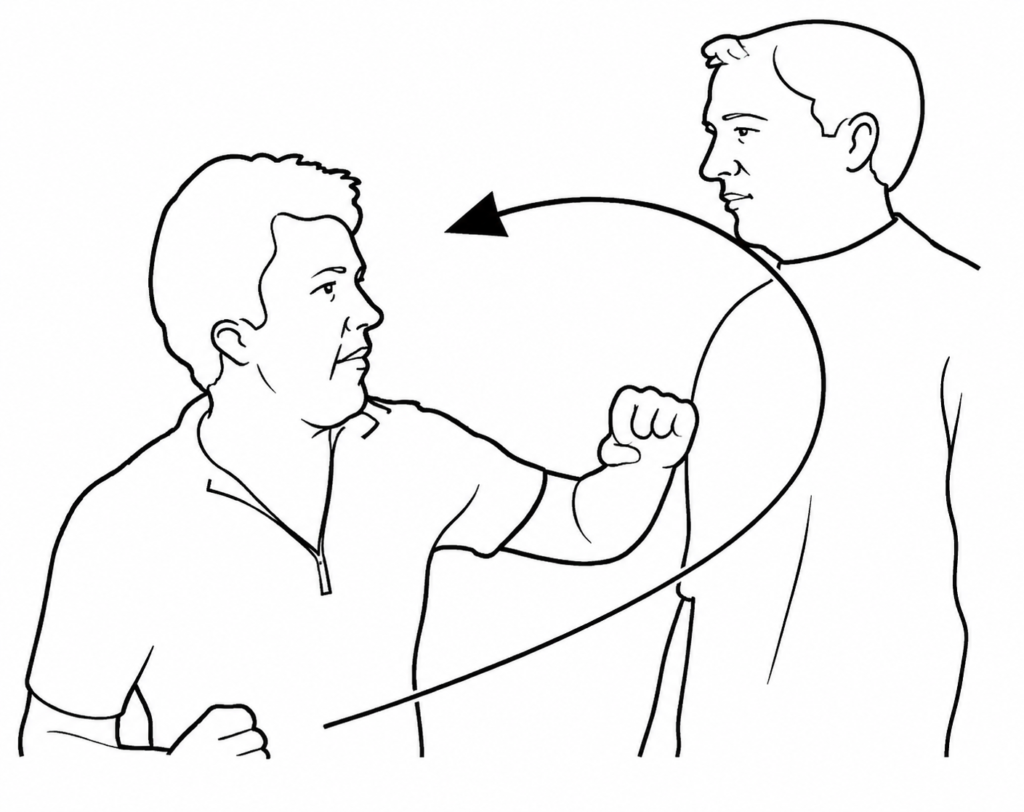
For purposes of the scene, an argument has escalated until one character crosses the boundary from words into physical violence. The audience is meant to see a large right-hand punch land against the left side of the other character’s jaw.
Before designing the simulation, consider the reality being imitated. In an actual punch, the aggressor prepares the striking hand, turns the torso, transfers weight, drives the hand toward the victim, makes contact, and follows through. Force enters the victim at a particular point and travels through the head, shoulders, torso, balance, and feet.
We need the audience to perceive that sequence. We do not need to create it.
This particular version is designed for an audience seated primarily on one side of the playing area. The aggressor stands downstage with his back to the audience. The victim stands directly upstage of the aggressor, facing downstage. From the audience’s viewpoint, the aggressor’s body conceals both the safe distance between the actors and the handclap used to create the sound.
If the audience surrounds the actors, or sees the action from a substantially different angle, the technique must be redesigned. Any simulation is safe and effective only within the conditions for which it was created.
Set-up
During the lines preceding the punch, the actors move to their predetermined positions. Ordinary variations may have occurred during the argument, but the fight itself can brook no variation. Both actors must arrive at the distance and alignment established in rehearsal.
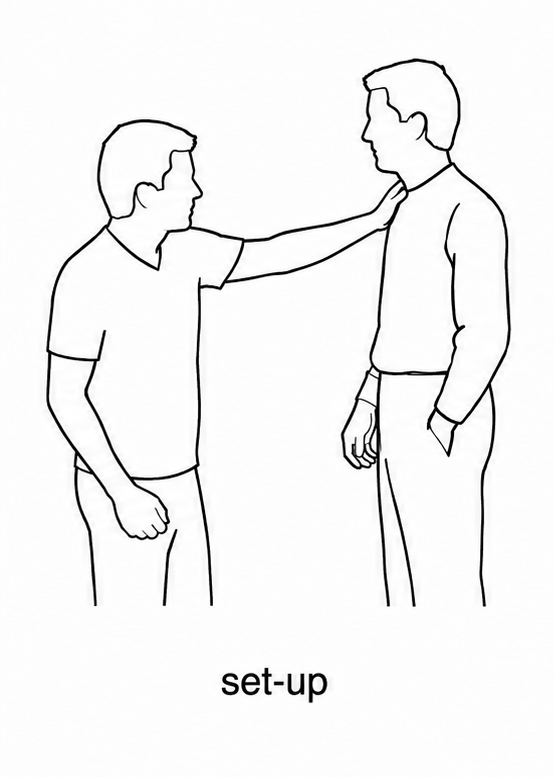
The aggressor places the left—the non-punching—hand lightly on the victim’s shoulder. The arm remains almost fully extended, creating as much distance as possible between the actors. The hand rests on the shoulder; it does not grip, restrain, or pull.
This contact must arise naturally from the scene. The character may be preventing the other person from turning away, emphasizing a threat, or drawing them back into the confrontation. The dramatic justification may vary. The physical arrangement may not.
Once the hand is in place, the actors establish eye contact. This is contact between the performers even though it remains fully justified between the characters. It confirms that both actors are present, properly placed, and prepared to continue.
If the victim dislikes the distance, cannot establish eye contact, has lost balance, sees a costume problem, or senses anything unexpected, the victim steps away. The aggressor releases the shoulder, and the punch does not occur.
That is VINO’s first principle in operation: the victim stays in control.
Once the final position has been accepted, neither actor moves the feet until the action begins.
Picture
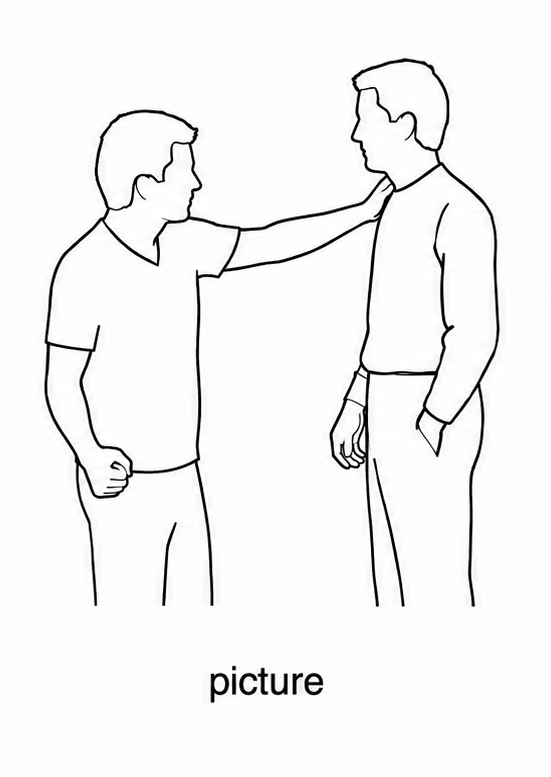
Keeping the hips and shoulders generally square to the victim, the aggressor places the right fist out to the right side, presenting the audience with the recognizable preparation for a punch.
The aggressor does not draw the fist far behind the body, lean backward, or wind the torso into an actual blow. Those movements would store real energy and make the eventual path harder to control. The actor provides the two-dimensional picture of preparation without creating the three-dimensional mechanics of a genuine punch.
The picture may last only an instant, but it must be clear. The audience sees the fist and completes the thought: That person is about to be hit.
Action
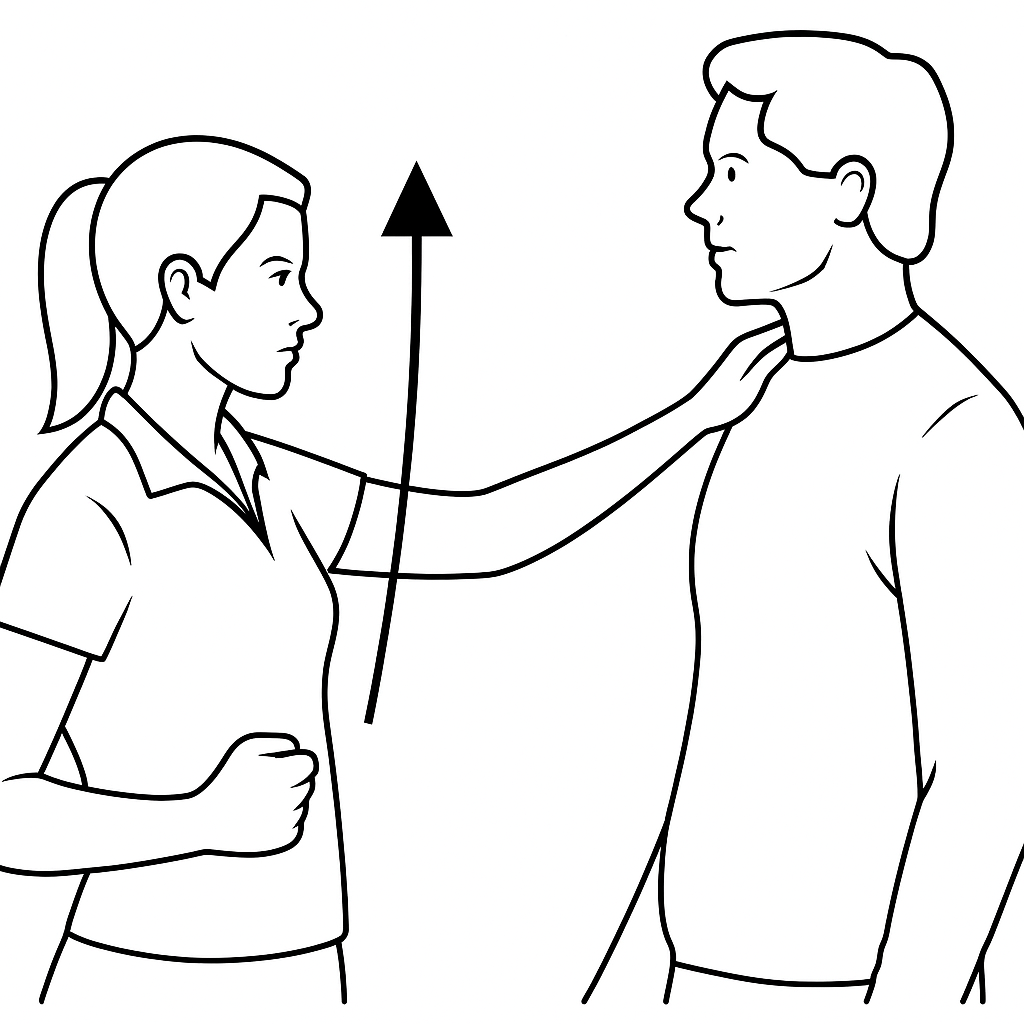
The right fist does not travel toward the victim’s face.
Instead, the aggressor releases the left hand from the victim’s shoulder and brings both hands directly to a point roughly three inches in front of the aggressor’s own chest. The hands travel in a straight line to this safe position, well below the victim’s chin.
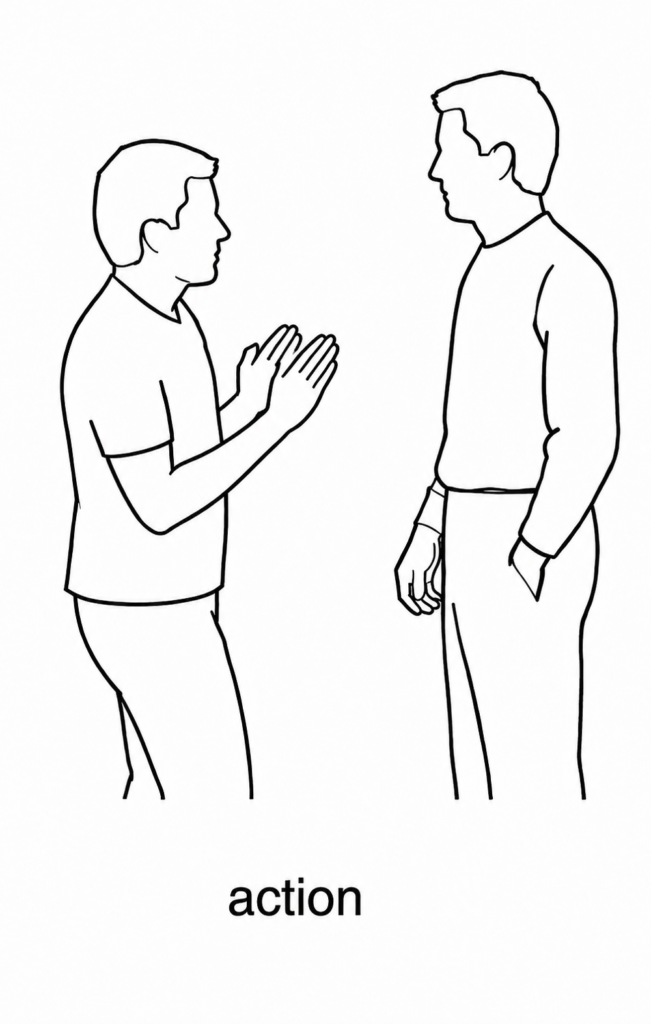
Once hidden from the audience by the aggressor’s body, the right hand opens and meets the left palm in a controlled clap. This creates the sound of impact. Because only the striking hand moves into the stationary palm at the final instant, this is known as a slip-hand knap.
Do not drive a closed fist into the opposite hand. It produces a poor sound and merely transfers the abuse from the victim to the aggressor’s hand. The clap is made with open hands. Immediately after the sound, the right hand closes into a fist again and continues along its harmless line of follow-through.
From the audience’s position, the fist appears to sweep across the victim. In physical reality, it never approaches the face. The actual movement occurs close to the aggressor’s chest, on a line that cannot intersect the victim.
The torso may pivot enough to continue the visual action, but the aggressor does not lean or drive body weight into the partner. The feet remain grounded. The apparent punch exists in the audience’s interpretation, not in the physical relationship between the actors.
This is both a non-contact technique and an off-line target.
Both performers should accompany the action with the involuntary-looking exhalation associated with sudden physical effort or impact. The knap supplies the percussive sound, but breath gives the action life. A silent fight often looks pantomimed no matter how carefully its mechanics have been arranged.
Reaction
The victim reacts only after hearing the knap. Reacting early separates the physical response from the sound and exposes the illusion. Waiting for the sound also gives both actors a shared cue that keeps the action synchronized.
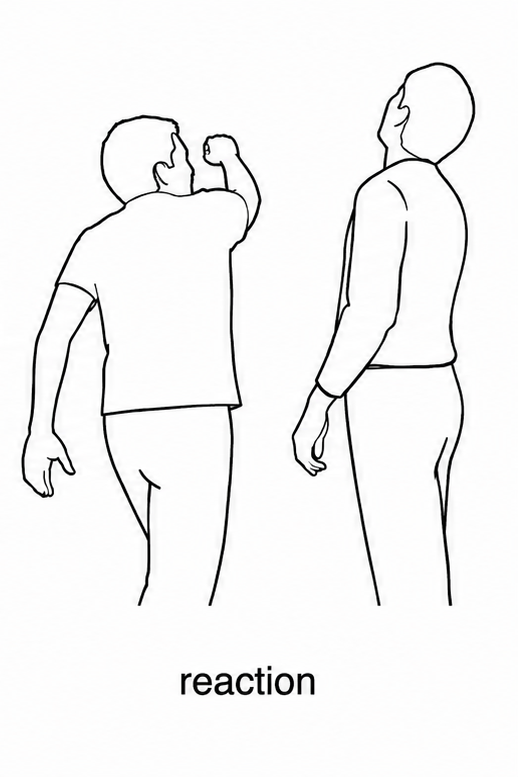
The victim has already decided exactly where the imaginary fist lands. In this case, it strikes the left side of the jaw. The jaw and face begin the response toward the victim’s right. The head follows, then the shoulder and torso. If the apparent force is large enough, the shift continues through the balance and into one or more steps backward and to the right.
This progression must be performed without violently snapping the neck or throwing the body out of control. The actor releases the movement through the body in sequence, creating the appearance that force is traveling through it.
At the same time, the aggressor completes the visual follow-through along the established safe line. The fist never travels over the victim’s shoulder or closer to the head. The two performers move apart rather than together.
The scale of the reaction determines the apparent power of the punch. A slight turn of the head suggests a glancing blow. A full-body displacement suggests much greater force. Whatever choice is made, the aggressor and victim must perform the same event.
That agreement demonstrates VINO’s interactive flow of energy. The aggressor does not actually supply the force. The victim does not invent an unrelated response. Together they create one continuous cause-and-effect action.
The Right Cross and VINO
The completed simulation contains all four VINO principles:
| Principle | How it operates |
|---|---|
| Victim stays in control | The victim accepts the distance and alignment and may end the action simply by stepping away. |
| Interactive flow of energy | The aggressor’s apparent force and the victim’s reaction are calibrated as one event. |
| Non-contact technique | The fist never touches or approaches the victim’s face. |
| Off-line target | The actual path travels below the chin and toward the aggressor’s own chest. |
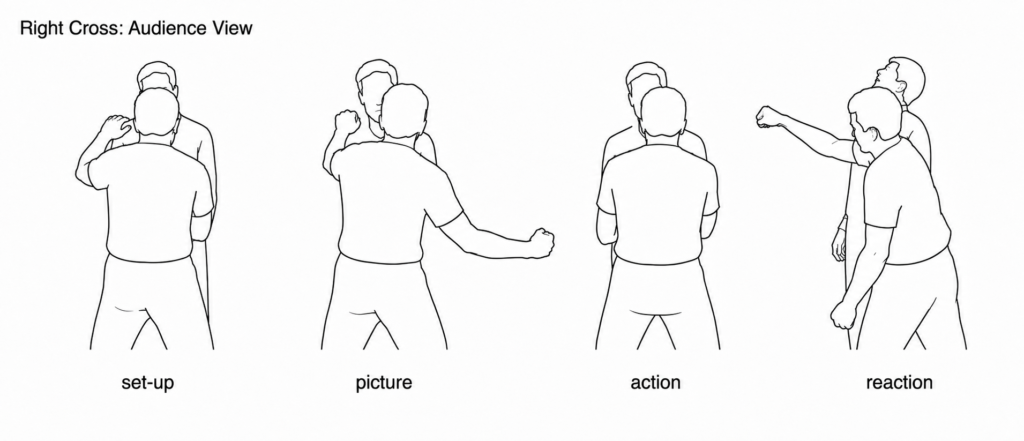
It also contains every element of SPAR:
- The actors establish distance, position, eye contact, and readiness during the set-up.
- The raised fist gives the audience the picture of the impending punch.
- The hidden clap and off-line movement create the action.
- The victim’s sequential response completes the reaction.
None of those elements can be omitted merely because the actors want the punch to happen faster. Speed does not create violence. Clear intention, precise rhythm, sound, and reaction create violence.
Key Reminders for Directors and Actors
Director’s Tip:
Skipping or rushing any SPAR step leaves the audience uncertain. The illusion will not land.Actor’s Reminder:
The reaction sells the violence. It confirms what the audience believes it has seen.
You perform the stage combat. The audience creates the violence.
—
Rehearsing the Technique
The right cross should first be rehearsed as four plainly separated sections: set-up, picture, action, reaction. The actors should be able to stop comfortably at each stage and confirm their position before continuing.
Once the mechanics are secure, the pauses are gradually removed. The four elements remain, but they begin to flow as a single impulse. Pace is added only after distance, masking, the off-line path, the knap, and the reaction remain consistent without conscious correction.
Do not confuse speed with intensity. A rushed punch is often less convincing because the audience cannot read its preparation or understand its result. The closer the performers are, the more time the eye needs to separate their movements.
The actors should also rehearse the technique at a greater distance than they intend to use in performance. If the intention, picture, sound, and reaction remain convincing with extra space between the bodies, the illusion does not depend upon dangerous proximity.
The technique must be checked again whenever costumes, shoes, scenery, lighting, or audience placement changes. A coat sleeve may restrict the punching arm. A hat may obscure eye contact. A different stage orientation may expose the knap or place the fist on a dangerous line.
Most importantly, if the predetermined agreement breaks down, the actors must never improvise their way through the action. They must stop, disengage, and omit the remaining movement. The moment the agreement is lost, the fight is over.
Beyond the Mechanics
The mechanics of the right cross can be learned quickly. Performing its consequences may require much more rehearsal.
The aggressor has crossed a boundary. The character may be shocked by what they have done, exhilarated by it, frightened by it, or already preparing to strike again. The punching hand may later become painful or stiff. The character’s breathing, posture, and ability to think may change under the effects of adrenaline.
The victim must determine not merely how far the head moves, but what the blow does to the character. There may be pain, disorientation, watery eyes, a damaged lip, momentary shock, humiliation, fear, or renewed anger. Those consequences should continue after the visible technique has ended.
Stage combat is acting. The set-up, picture, and action allow the audience to believe that a punch has landed. The reaction reveals what that punch means.