
Non-Firing Replicas
Number one rule: NEVER allow any firearm, prop or real, to be used or even seen outside of a controlled rehearsal or performance space.
- Do not use any prop weapon for “improvs”.
- Do not use any prop weapon for “promotional events”.
- Do not use any prop weapon within sight of the general public.
Actors have been shot by neighborhood “heroes” for rehearsing outdoors with rubber knives; they have been arrested for making violent gestures in public with rubber guns; they have been killed while holding very phony looking prop weapons.
Prop Firearm Protocols
When actors are given responsibility for a prop pistol or rifle for use in rehearsal and performance of a theatrical production, they need to be made aware of the limits that we have to place on them. Actors try to mimic the moves that they see in the movies, but they forget that guns constantly break down while on a film set. Film studios can afford to have several duplicates and a gunsmith on standby; theatres cannot.
While by all means we want the actor to feel comfortable working with the prop on stage, these cautionary points are prudent for them to keep in mind. Have them read a copy and sign it.
- First and foremost – Never point it at anyone at any time. I cannot more strongly stress the importance of developing sound firearms safety practice among this nation’s actors. Always treat every prop gun as though it were a true and loaded gun, and if necessary to give the illusion of pointing the weapon, aim upstage of the other actor. The audience will never know the difference, and perhaps slowly we can all work together to prevent more senseless tragedies from occurring. This can only start with each and every person who sees any weapon, real or fake, to simply assume that it is loaded, white-hot, and ready to kill.
- Second – Do not “dry-fire”, which is pulling the trigger when there is no blank in the chamber. Most guns break in rehearsal from actors dry-firing (playing) backstage. No gun, prop or real, is designed to be handled in this fashion. If it is necessary to the play that the gun dry-fire, then by all means rehearse as needed. But otherwise, why risk costly damage?
- Third – Don’t take it out of the theatre. Police respond with extreme seriousness to any possible incident involving firearms, and merely displaying a replica outside of a theatre can be charged as a felony in most states. Any use outside of a theatre (including any film-work) requires prior notification and consent of the local police.
- Fourth – The prop is not part of your costume. Your holster is, but not the gun. It is to be picked up from the stage manager just before your entrance, and returned immediately on your exit.
- Fifth – Perform a “chamber-check” with every hand-off. The person handing over the weapon to the actor opens the gun to show that there is no bullet or blank in the chamber or magazine, or some other proof that the prop is harmless. When the actor returns the gun, the chamber check is repeated.
- Sixth – Don’t drop it. Real or replica, these are delicate props, and simply can’t survive aggressive action. If the gun must be tossed or dropped, we suggest that you purchase several for the run of the show, for they will break. For the same reason, don’t “twirl” the gun or force the working parts.
Holding a firearm
For every action there is an equal and opposite reaction. For firearms, that means that if a bullet is coming out of the barrel in one direction, the gun is kicking back at you from the other. That reverse force from the gun, called recoil, has to be absorbed in some part of the body or the gun will simply fly in that reverse direction. So most of the techniques of holding a firearm have more to do with preparing for the recoil rather than aiming the shot.
The force of the recoil is in a straight line coming backwards from the path of the bullet. If the center of your hand could be in-line with the barrel, most of the force of a pistol shot could be easily captured by the forearm, so long as your arm is in line with the barrel when the gun is fired. Ah, there’s the rub, for most guns have barrels that ride higher than the hand, parallel to but usually a few inches above the forearm. When the gun is fired, the barrel wants to jump back, the force actually causing the grip to pivot in the palm, spinning the barrel up.
The force of the recoil is purely a factor of how much gunpowder was in the charge – more powder more blast, more recoil. But the effect of the recoil depends on many factors – weight (mass) of the gun, firmness of the shooter’s grip, bracing of the stock against the body, and even the internal mechanical action of the firearm. A well prepared soldier can prepare her stance so that the recoil from a high powered rifle shot can dissipate quickly through her body and into the ground. Someone ill-prepared can fire a small caliber handgun and have the thing fly backwards out of his hand, even hitting him in the face.
Longarms
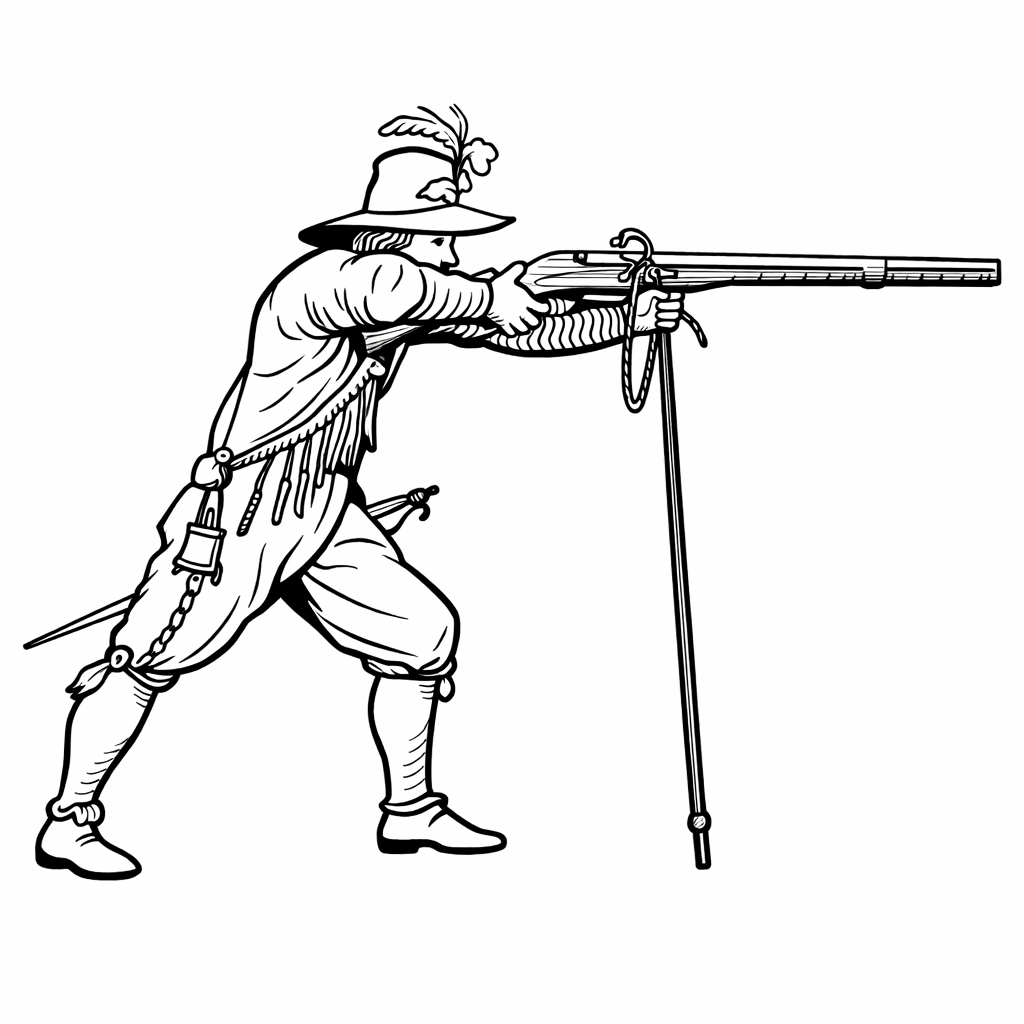
The earliest muskets and arquebuses caused such tremendous recoil that it could dislocate the arm if the gun was braced against the shoulder. From the early 1500’s to the late 1600’s, the correct stance had the shooter standing with the left leg forward, knee slightly bent. The right leg was back and completely straight, ready to take the force of the recoil, but the weight distribution before firing was 70% left leg and only 30% right. The butt of the musket was braced against the chest just slightly off-center, specifically against the right pectoral muscle, and both shoulders faced the target. Both arms were needed to support the weight of the gun, with the elbows angled slightly down at about 45 degrees from vertical. (By the late 1500’s and especially during the early 1600’s as the musket grew considerably, a four foot pole, the musket rest, was used to support most of the weight of the gun.) Once the gun was fired, the soldier attempted to have the recoil transfer down to the straight right leg and into the ground. Often the force would lift the left leg off the ground.
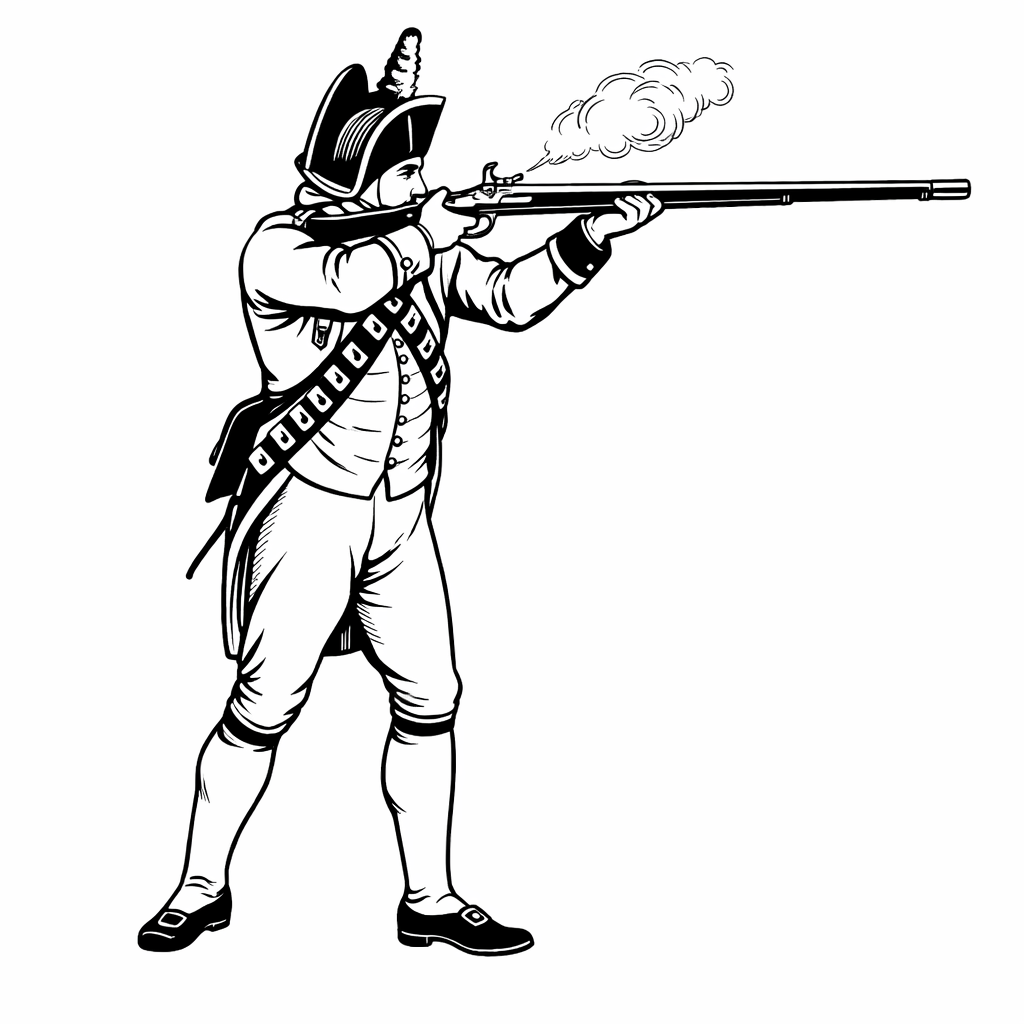
Muskets and rifles of the 18th through 20th centuries are so much lighter than their predecessors that musket rests and bracing against the chest is not necessary. All are held with the left hand holding the bulk of the weight and the right hand free to stay relaxed for an easy trigger pull. The left elbow rides directly underneath the gun, pointing straight down [left arm perpendicular to the floor]. This placement also keeps the left arm at the best position to pull the gun straight down against the recoil. The right hand presses the stock against the right cheek and the right elbow points straight out to the right [right arm parallel to the floor]. Novices tend to hold rifles loosely and with the elbows both pointing roughly 45 degrees down.
The butt of the gun rests against the shoulder. The left foot points to the target, right foot turned out slightly (about 45 degrees) and the weight is now slightly to the rear foot instead of the lead foot, about 60-40. But the larger military rifles could still pack quite a wallop, so much of the initial training of the soldier is in having him press the gun as tightly as possible against the body. If the rifle and the body can absorb the recoil at the same time, the effect is greatly dissipated. If the gun is held loosely, it will move a fraction before the body does, and the feeling is like getting whacked with a baseball bat.
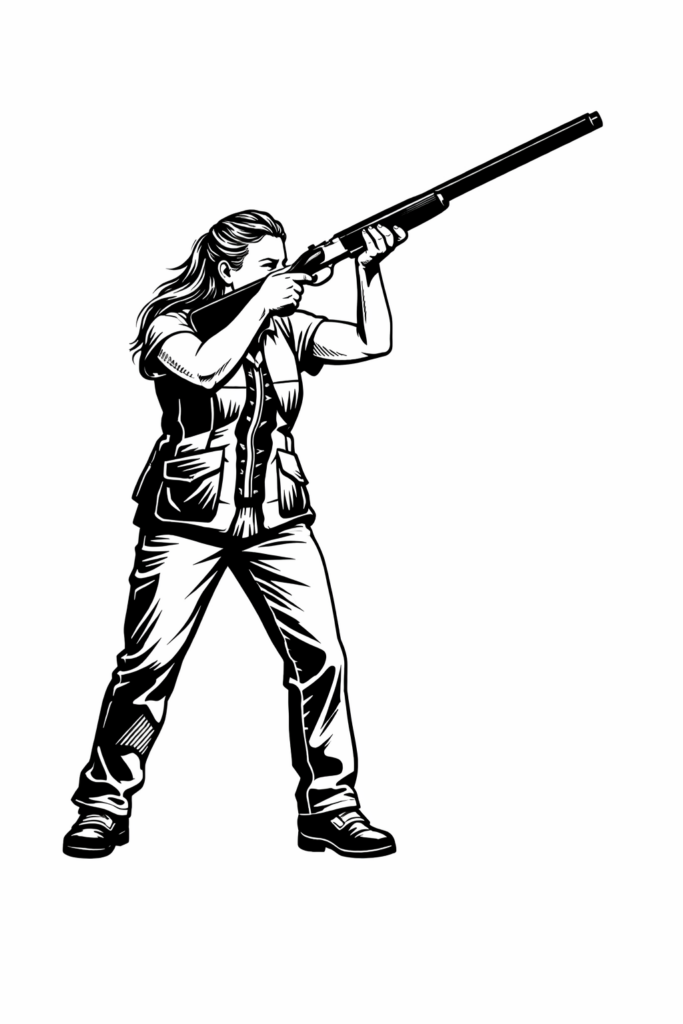
The basics of holding a shotgun are much the same, although there is a subtle difference in the nature of the shooter’s focus. Rifles and pistols are aimed, which is to say that the shooter looks down the barrel and aligns the target with the front sight and the rear sight. In proper shooting practice the eye concentrates primarily on the front sight, while the target itself remains slightly out of focus behind it. The gun is held firmly so that the sights remain steady while the trigger is pulled.
Shotguns, by contrast, are generally pointed rather than carefully aimed. There is no rear sight and usually only a small bead at the end of the barrel. This bead is not something the shooter carefully aligns with the target; it simply confirms that the gun is properly mounted and pointing in the correct direction. When shooting at a moving target such as a flying bird or running game, the shooter keeps both eyes focused on the target itself while the barrel moves with it. The bead remains only a reference point in the shooter’s peripheral vision, typically appearing just ahead of the moving target so that the shot meets it in flight.
The stance used with a shotgun is therefore slightly more relaxed than the classic rifle position. The butt of the gun still rests firmly against the shoulder and the cheek rests along the stock, but the elbows are usually allowed to drop somewhat, often at roughly a forty-five-degree angle rather than being held straight out to the sides. This posture allows the gun to swing smoothly with the motion of the target while still maintaining firm control of the weapon.
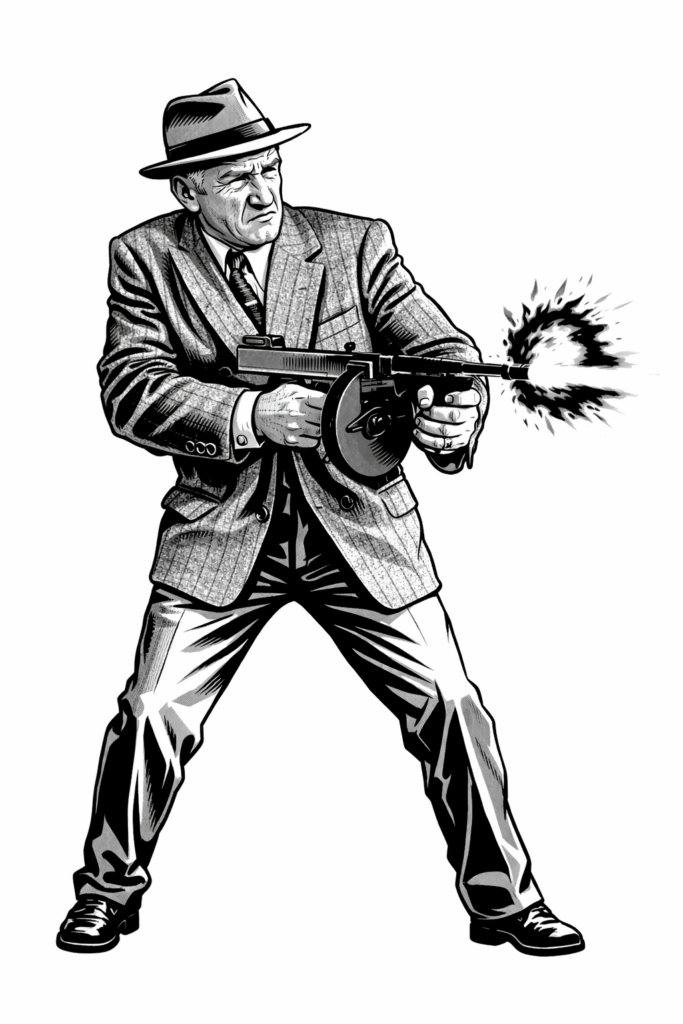
Military automatic rifles present a different problem. With so many rounds leaving the weapon so quickly, trying to counter the recoil becomes extraordinarily difficult. Early automatic weapons such as the Thompson submachine gun were heavy and hard to control when fired rapidly. As a result they were often fired from the hip, with both elbows pressed against the ribs so that the arms and torso created a tighter brace from which to fire. Even then the spray of bullets was erratic as the barrel climbed sharply upward under recoil.
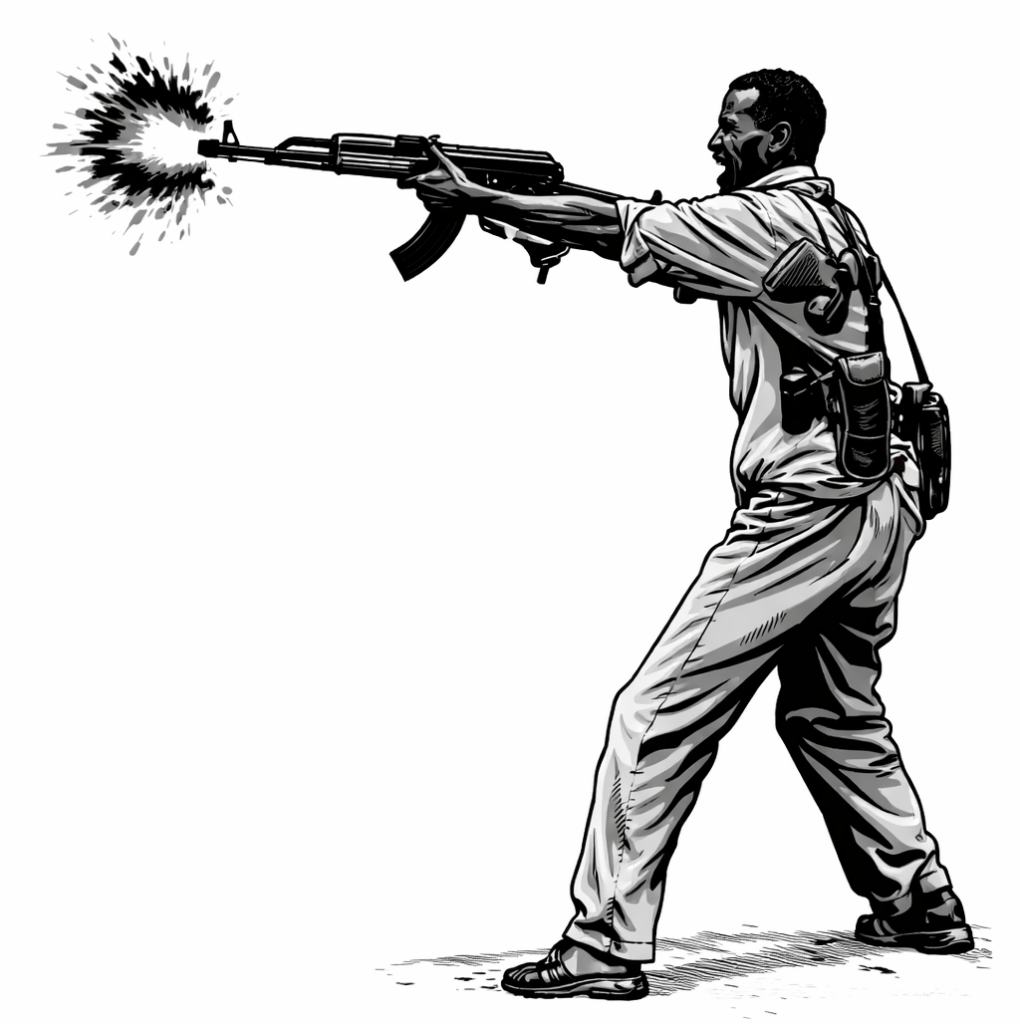
Later automatic rifles and submachine guns are somewhat easier to control because the barrel sits more nearly in line with the shoulder stock, allowing the recoil to travel more directly into the body. Even so, untrained shooters often experience a punishing pounding from the weapon. It is common to see images of insurgent soldiers firing their AK-47s with their arms fully outstretched, as if trying to hold the rifle away from the body in order to escape the recoil altogether.
Even very light submachine guns such as the Sten were sometimes braced against the right bicep instead of the shoulder. In such cases there was little attempt to aim the gun. The weapon was simply held tightly and fired in bursts so that the stream of bullets travels generally in the direction of the enemy.
I should mention a little something about simply carrying a prop rifle or shotgun, even completely false ones. Many actors will hold them any which way, sometimes even absent-mindedly allowing the barrel to point out into the house. That’s not really a safety concern, but it does freak the audience out. Therefore, do what hunters are supposed to do – always treat the barrel of the gun as though it could fire flaming death in that direction at any time. So if there is a line of three people holding shotguns, everyone points the barrel in a different direction, each away from the others in the group, the middle person towards the ground. If walking in a line, the person in front doesn’t let the barrel point back, the person in the back doesn’t let his point forward, and the person in the middle points it off to the side. Treat the gun barrel as though it is an infinitely long spear, one that must never cross in front of another actor and never in front of the audience.
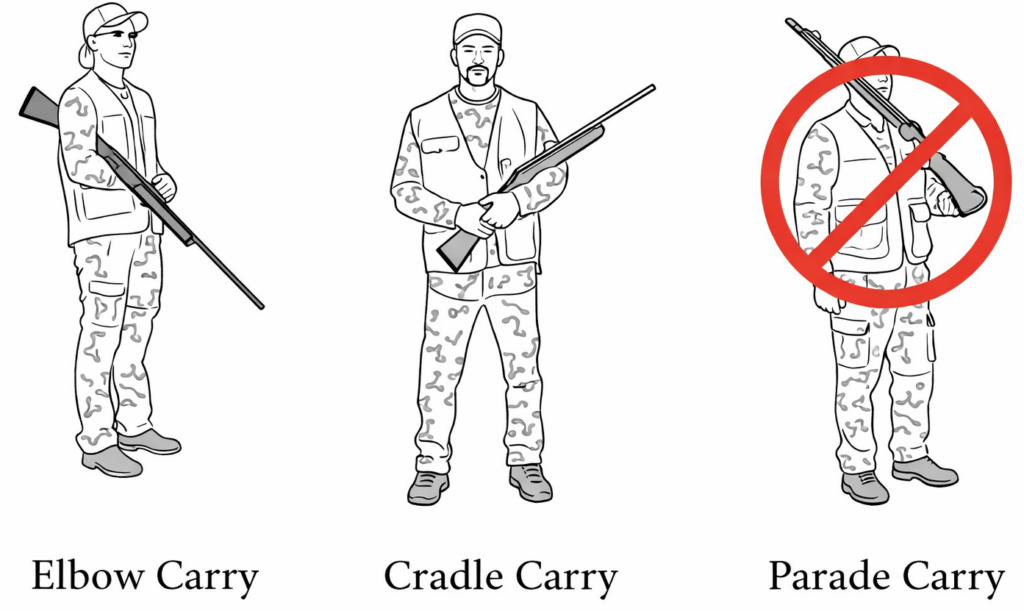
However, when moving props backstage or when coming onto the stage, make sure that you can see the entire prop at all times. So no parade carry.
One other little thing that happens is when an actor has a rifle or shotgun onstage for a while and absentmindedly starts to use it as a cane. No one who owns a real gun would ever do that. If the barrel rests against the ground and should fire, the barrel could fracture, or at the very least shrapnel will scatter at ankle level in every direction. If the butt of the gun rests against the ground and the barrel is pointing up, an accidental discharge would take the shooter’s head off. The safest carry is the “cradle carry”, where let’s say the right hand controls the butt of the gun (finger not on the trigger) and the barrel of the gun rest on the left forearm. This keeps the gun in front of you, barrel pointing up, off to the side but slightly forward, well within your peripheral vision. Switch it to the other side if someone walks into that danger zone.
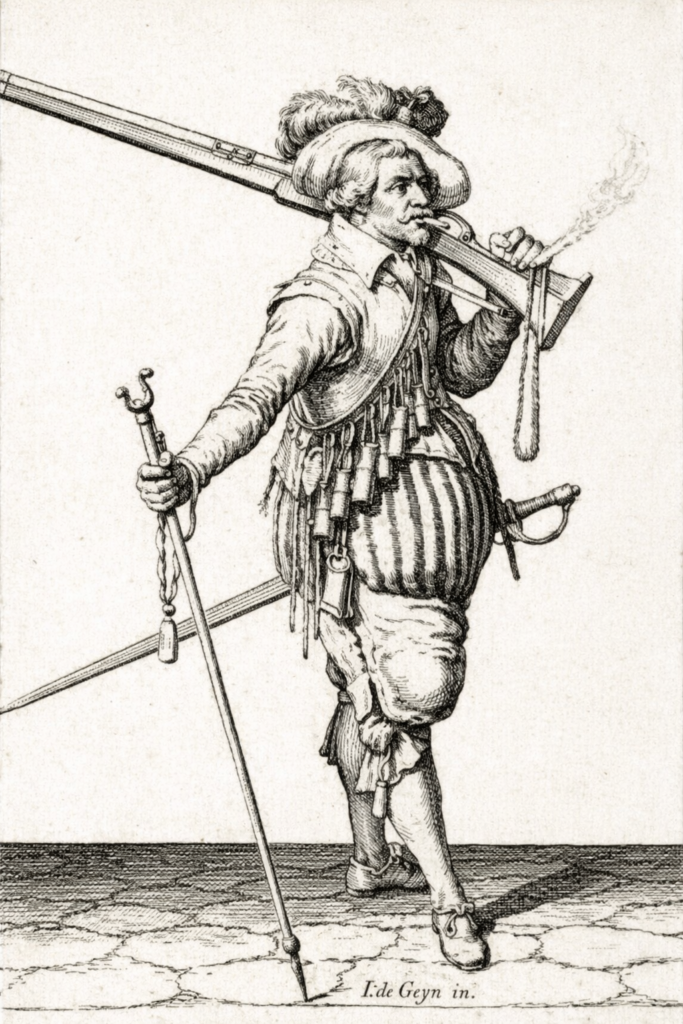
Naturally, if the rifle has a strap it can usually be slung over the shoulder, which conveniently keeps the barrel pointing safely upward. Not all firearms, however, were designed to be carried this way. The matchlock muskets of the sixteenth and seventeenth centuries were extremely long and heavy, and they were normally carried without a sling. Instead, the musketeer would rest the musket across the shoulder near the lock, allowing the butt to trail behind the back while the barrel projected forward. The forearm would then lie lightly across the barrel to steady it as the soldier walked. In this position the weight of the weapon rests on the trapezius muscle of the shoulder, rather than being borne by the arm, allowing the musketeer to carry the weapon for long periods without undue strain. (Notice that there is a short piece of match held in his mouth. A matchlock musket was only as useful as the burning match that ignited it, so musketeers almost always kept more than one length ready and glowing.)
Other firearms should also not be slung, even if the manufacturer has put strap loops on the gun. Straps put far too much pressure on the center of a gun, so lever-action rifles and break-open shotguns soon break down if slung over the shoulder. These items are only meant to be carried in one’s arms.
Pistols
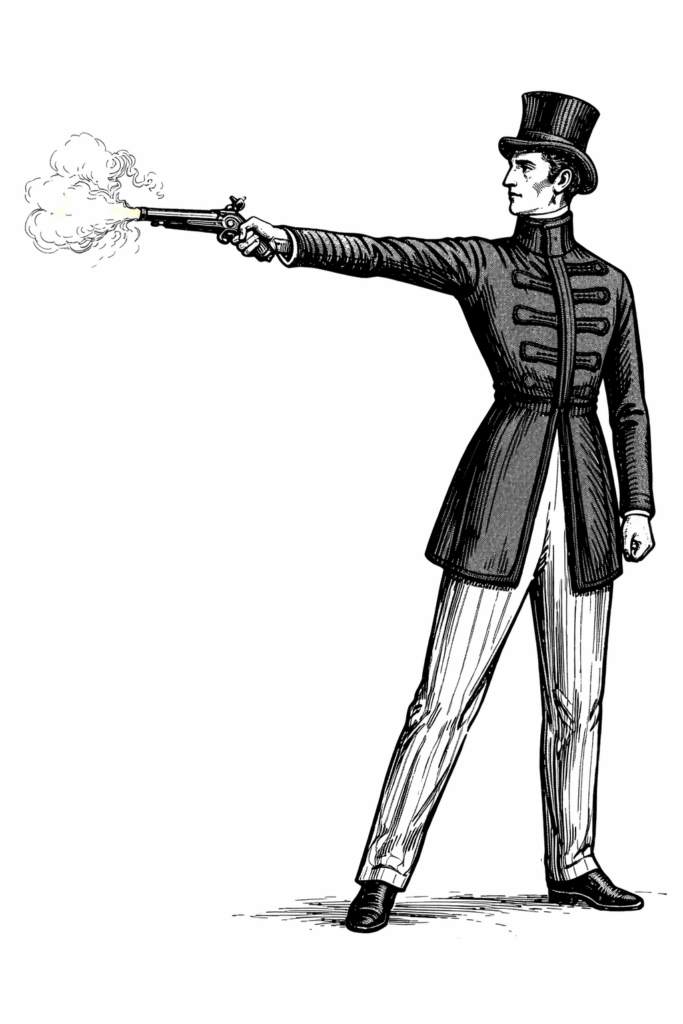
The earliest flintlock pistols had grips with a very shallow-angled drop. This helped align the gun with the forearm but left the wrist in a very uncomfortable position. The complete preferred stance for a pistol duel has the right leg forward, toes pointed at the opponent, and the left leg directly behind with the foot turned out at 90 degrees. The right toe, right heel and left heel should be on straight line. The weight is distributed 50-50, for the pistol of the time has relatively little recoil. The arm is extended fully straight from the shoulder, and the torso is turned as is the left foot, 90 degrees away from the opponent, providing the smallest possible target. As the guns were of limited power and the bullet flight was erratic, the chance of actually getting struck with a pistol ball in a duel was very small.
Wherever both sword and pistol were used in battle, the sword was the primary attack weapon, therefore used with the right hand. Military pistols, even the six-shot revolvers, were secondary and defensive weapons, used with the left hand and only at targets within a range of twenty yards.
Keep in mind that all pistols up until the 1870’s were muzzleloaders. For single shot pistols or poorly loaded six-shooters, there was always the chance that a loaded gun taken from a holster or from being stuck in a belt would fail to fire even if the cap ignited. I’m sure you’ve seen enough movies with duels in them to notice that the pistols, once loaded are held pointing straight up until the moment that the duelist fires. Why? For the same reason that these early flintlock guns were not worn in holsters. The general light movement of walking about would cause the ball to move slowly down the barrel, and the powder could always move down with it, making it harder for the sparks from the percussion cap to actually ignite the charge. A small chance, granted, but still possible, which is one reason why the pistols are held pointing straight up at the beginning of a duel – the other being good safety practice, for the hammer could always accidentally drop and fire the gun even if the trigger wasn’t touched.
When practical revolvers became available beginning in the 1850s, the stance and grip changed dramatically. The grip of the revolver drops down considerably compared with earlier single-shot pistols in order to make room for the larger frame and rotating cylinder. This lower grip naturally allows the elbow to bend slightly, taking some pressure off the wrist but increasing the pivoting motion of the gun during recoil. That pivoting motion is already encouraged by the higher barrel position required to accommodate the revolving chamber.
The situation becomes even more pronounced once revolvers move from percussion muzzle-loading designs to the far more convenient cartridge breech-loading models that appear widely in the 1870s. These later revolvers are quicker to fire and reload, and their stronger cartridges produce a lively recoil. The only real solution for the shooter is to develop enough arm strength and familiarity with the weapon to keep control of the gun after each shot.
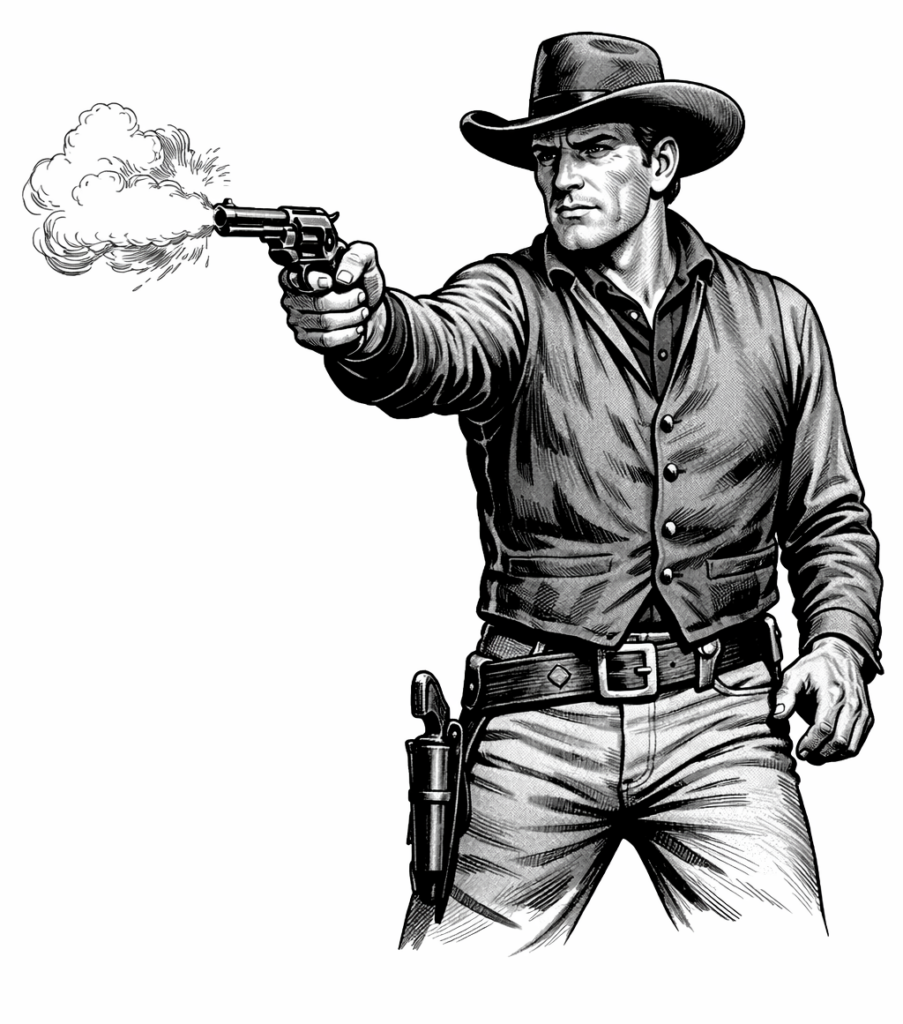
Civilian gunfights with revolvers therefore abandon the sideways stance commonly used by earlier single-shot duelists. Presenting a narrow target is less important when several bullets may be fired in rapid succession. The concern for the gunfighter becomes the effective delivery of multiple shots, especially the first ones. The shoulders therefore tend to square more directly toward the opponent, allowing the shooter to bring the revolver quickly on target and recover from recoil in time to fire again.
The gun may be raised for careful aiming, but in popular imagination the revolver is just as often fired from the hip. This posture became a staple of Western films and television, where the speed of the draw and the dramatic immediacy of the shot were considered more important than precise marksmanship. (It is probably no coincidence that the hand phasers on the original Star Trek series were fired in much the same way. The show was famously pitched as “Wagon Train in space,” and the design and use of the weapon clearly echo the cinematic cowboy. Compare this with the more restrained and almost domestic appearance of the phasers in Star Trek: The Next Generation, where the devices look about as threatening as a cellular phone.)
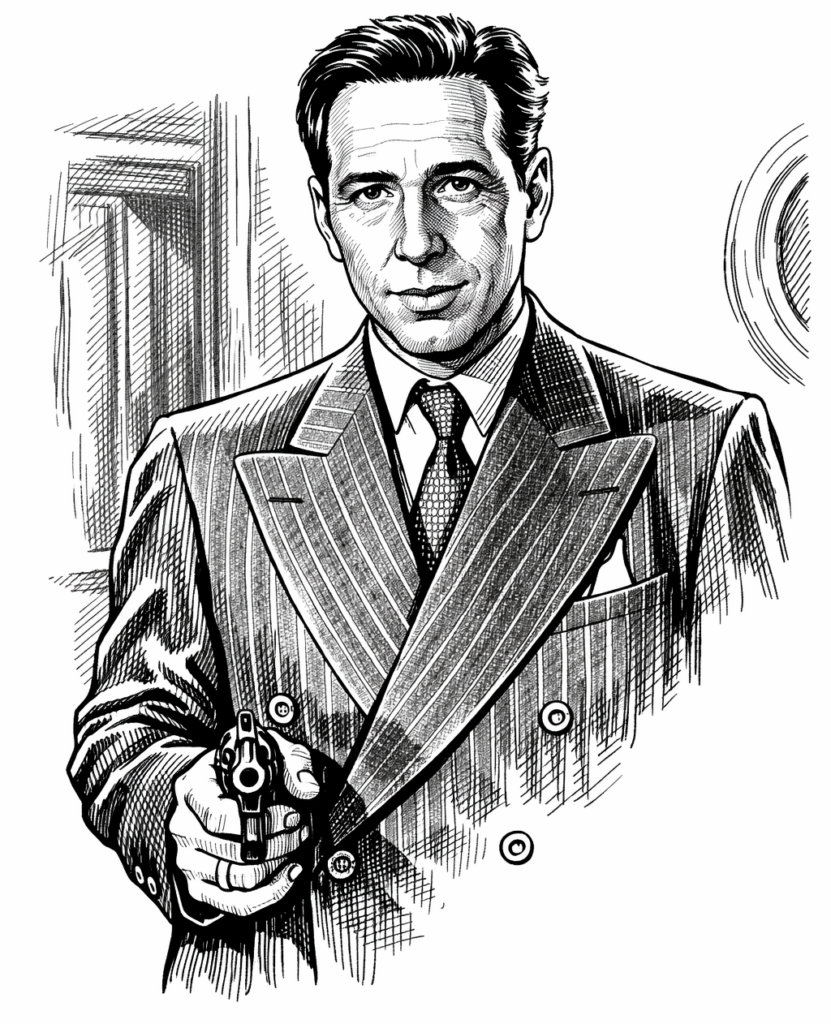
During the 1920’s, demand diminished for pistols with long-barrels. The accuracy that they provide is simply not a requirement for city dwellers, where the threat is more likely to be someone standing less than ten feet away. Not only is the gun fired without regard to careful aim, the gun is held close to the body so that any passing witness would barely notice that a gun is being held at all. This is the stance you see on all of those film-noir and gangster films of the 30’s and 40’s – fully erect body, gun held at waist level with the forearm tight against the hip.
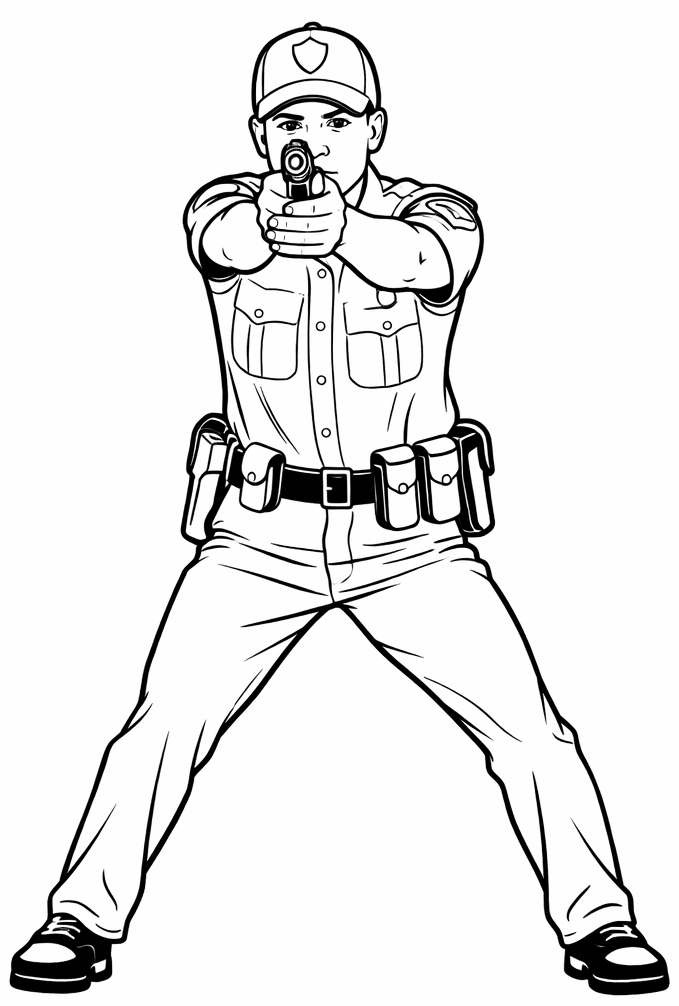
Mid-twentieth century police officers are taught a stance somewhat similar to that of the earlier gunslinger. But a two-handed grasp is used, often with the left hand underneath the right hand, bracing the butt and providing a base from which to fire and to assist in stabilizing the gun after recoil. It has been pointed out to me by a firearms instructor that some officers, influenced by what they see in film, point the barrel safely up until a threat is directly in sight. Modern instruction has the weapon always pointed directly at a possible threat or at most angled slightly down towards the ground if a sweep of an area is required. But either way, the knees are bent and the torso is slightly leaning forward. This stance remained the same even after the switch from revolvers to semi-auto pistols, which, since the barrel can be lowered to a mere inch above the hand, has a more controllable kick. Since the gun, as always, has the grip pointing down and the recoil pushes the barrel up, several shots fired quickly in a row will show a typical up-and-down pattern.
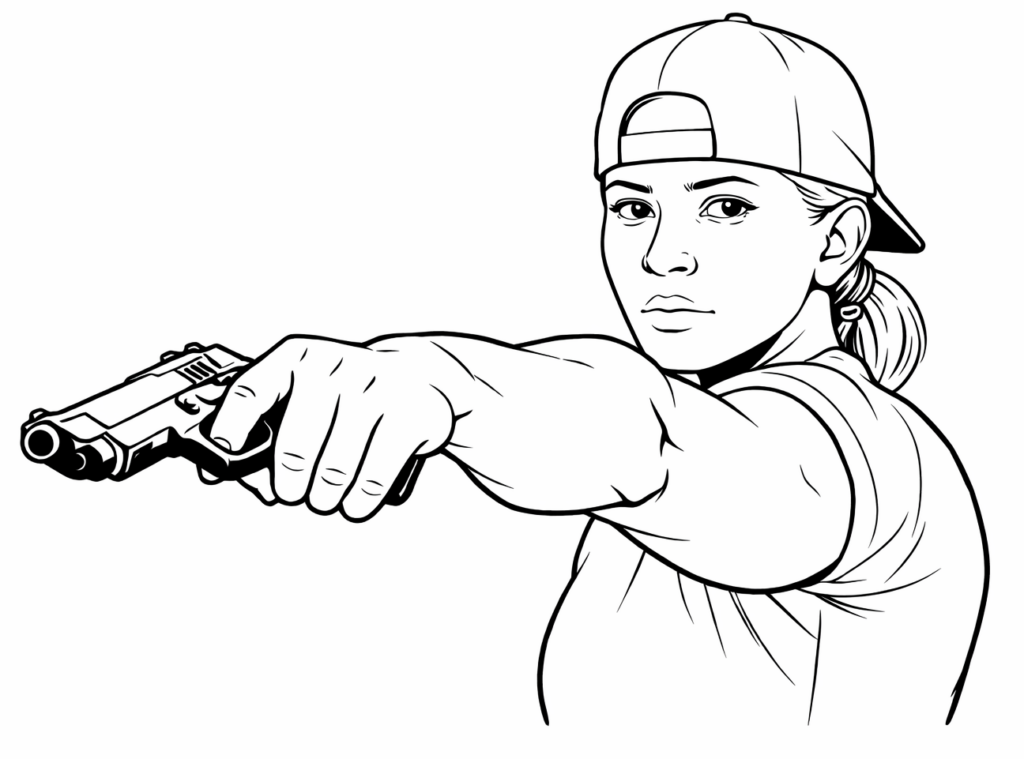
A very different position is seen from inner-city gang members. Also using semi-automatic pistols because of the larger ammunition capacity, the gun is often held “flat”, lying down, with the palm of the hand pointing down. This firing position means that the firing pattern will be side-to-side. This has a practical if cold-hearted purpose: the recoil will push the barrel around along a horizontal plane, with most of the bullets staying at a lethal height and a far greater chance of someone getting killed, though not always the intended victim. The police, on the other hand, with the vertical grip and the up-and-down firing pattern, tend to shoot high and low, but at least put innocent bystanders at a lower risk of getting hit.
Gun Twirling
Unless the stage directions call for it, don’t let the actors twirl the guns. Especially backstage, they like to play at being a gunslinger, but a twirled gun is a soon to be dropped gun, which then becomes a broken gun.
By the way, twirling should only be done, and would only have been done, with the single-action cartridge revolvers with six inch barrels, in other words the cowboy guns of the last quarter of the 19th century. No one would ever twirl the earlier blackpowder guns, even revolvers, because the powder would shift away from position and no longer fire. Anyway, the triggers on these percussion guns are rather thin with sharp ends, and can really cut up the finger during a twirl. Lastly, the weight of the chamber and length of the barrel makes the revolvers very unbalanced.
With the invention of cartridge revolvers, and especially the mass enthusiasm for the 1873 Colt 45 Peacemaker, all worries about shifting powder loads vanished, but other factors also abetted gunslingers to start twirling for showboating. The trigger was fatter, with smooth edges and a rounded tip, and the center of balance of the gun was closer to the trigger, so the gun was much easier to manage and not nearly so barrel-heavy as were the percussion revolvers.
During the first quarter of the 20th century, public taste shifted to a gun more appropriate for closer range. The long barrel of the Peacemaker was no longer as necessary, and this led to guns now being either grip-heavy or top heavy, so no longer as easy to twirl. Also, single-action guns lose favor to double-action, but this means that the natural safety inherent in the Peacemakers (the trigger won’t work until you pull the hammer back) is gone, making twirling a modern revolver positively foolhardy (the trigger can be accidentally pulled in the middle of the twirl, thereby firing the gun).
Firing Guns
In an earlier section we described some different kinds of blanks, so here I want to go over some protocols on how to use them, both backstage and on stage.
Under no circumstances should someone’s real gun be used for theatre, either as an onstage prop or backstage noisemaker. Grandpa’s old shotgun might look great as set dressing, or someone may offer the use of their pistol to save you money for creating a gunshot effect offstage. Kindly thank them for the offer and politely decline. A real gun can be loaded with a real bullet, and can cause a real tragedy. If you can’t afford to buy or rent a stage replica, do without or don’t do the show.
So when I speak of firing guns here, I mean only block-barrelled, blank-only stage-safe guns.
In addition to the warnings for non-fire weapons, firing guns need special treatment. I always advise keeping firing guns in a locked cabinet inside a locked room that has restricted access. These items are just too tempting, and theft is unfortunately too common. They are delicate props as well, so try not to have them used when a non-firing gun will do just as well.
Set a specific protocol for who handles the gun during the course of rehearsal and performance. Here is one example: the gun is made the responsibility of one person, who loads, cleans and keeps track of the weapons each night. This person, perhaps an assistant stage manager, checks out the guns and blanks from the technical director or props master, loads the gun and then keeps it at a spot where it is under direct view – not at the general props table. The gun is not handed to the actor until just before the actor’s entrance. A chamber check is performed, and the actor then takes possession of the gun. As soon as the actor exits the stage, the gun is returned immediately to the ASM.
When the performance is over, the ASM unloads the gun, checks for damage, and then thoroughly cleans and oils the gun before returning it to whoever is going to lock it up for the night. Remember – if the gun was fired it must be cleaned immediately after the show; it can’t wait until tomorrow.
It should be the props master who lays down the law concerning how the actors should treat the weapons. The following rules are to be added to the general rules concerning non-firing replicas. Be sure and go over these rules with the director early in the rehearsal process so that there are no surprises during tech week. The rules are:
1 Don’t trust a safety to keep the gun from firing
Safeties are very small mechanical devices within a gun that either keep the hammer from dropping or the trigger from moving. Mechanical devices can fail, and some of them can be overridden by a small amount of force. They are not fail-safe.
2 Don’t put your finger on the trigger until you are ready to shoot
Leave your index finger outside of the trigger guard unless you are in the act of firing the gun. In case the gun should slip slightly out of your grasp, the weight of most guns can cause it to fall forward, barrel end going down. If your finger is already within the trigger guard, this pivoting can quickly put the weight of the gun onto the finger. The weight of the gun can be enough to pull the trigger, firing the gun. And certainly trying to catch the gun before is slips out of your hand can do the same thing (this is how a lot of idiots shoot themselves in the leg with their own loaded pistol).
3 Don’t ever struggle with a loaded gun.
I shouldn’t have to point out that the gun can fall, or that during the struggle the trigger might be accidentally pulled, but it’s the more obvious things that people overlook.
4 Never allow a loaded gun to strike the floor or another object.
Many loaded gun can accidentally go off if jarred from being struck or dropped, even if the hammer isn’t cocked. And no gun can handle the damage of being struck. So you must never throw or drop a gun.
5 Never put a loaded gun near someone’s head.
And of course never fire a gun near someone’s head. There are shows in which a character is shot in the head in close proximity, but the discharge from the gun is simply too loud and too dangerous from even the softest blanks. Use an offstage sound.
6 Never fire the gun near flammable material.
That includes clothing. The discharge is so hot that it can ignite someone’s clothing. I’ve seen it happen – it’s terrifying.
7 Handle a loaded gun only from the grip, never from the barrel or frame.
Again, a loaded gun can go off at any time, and if your hand is anywhere but on the grip when that happens, you’re going to get some deeply penetrating and highly infectious wounds.
Maintain a safe distance from other actors when firing a blank. How far is a safe distance? It doesn’t exist. If you want to fire a gun safely, you’ll need to wear a face shield and ear protection, clear the room of all other persons, and remove all flammable material. Even with that, there is always a chance that the gun can explode and send shrapnel out in any direction. Blank-fire safety is a shifting compromise of different factors. If you are willing to accept more risk, you will have more choices in using blanks, but you will never be able to guarantee perfect safety. Some choices you can make might include, but not be limited to, the following:
It is safer to have the arm fully extended rather than having the elbow bent. The user will be that much further from the sound and the blast.
Find out where the discharge is going to go for the particular gun you are using and keep that area completely clear of all humans, animals and flammable materials. You’re not looking for a minimum diameter around the gun but rather a danger alley extending from the gun and all the way back to a stone wall, no matter how far away, which must be kept completely clear. Is that always possible to provide? No. In fact it is almost impossible to provide. But you should exhaust yourself in the attempt.
Have everyone in the space use ear protection. Unfortunately, you can’t hand out ear plugs along with the programs to your audience, and most of your actors will need to hear their cues. So at the very least, consider plugging the “near ear” of the shooter. Regular ear plugs are usually too visible, but you might find some in flesh tone. If that isn’t possible, a little dab of petroleum jelly might be enough to block the worst of the sound, though the stuff will get in the ear canal and can get messy and uncomfortable.
Have everyone in the space use high impact eye protection. Well, of course that is flat-out impossible. I mention it because eyes are vulnerable to the hot gases expelled by blanks, and it does us no good to ignore the danger.
Don’t shoot directly at someone. Now here is something that you actually can do. Well at least create the illusion of doing so. The audience’s depth perception is very limited. You can point a gun (or knife, or sword) slightly upstage of where the victim is standing and the audience will never know the difference. This is one suggestion that every theatre can implement immediately. Simply never point a gun at someone. Never. Any where, any time, for any reason. Onstage or off, real gun or toy. There are dozens of people who died prematurely because actors failed to learn this basic rule. Pointing a prop gun at someone should be cause for the immediate dismissal of that actor or stagehand from the company. You want to save lives? Implement this policy today.
“But what about scenes where a character has to commit suicide?” I was afraid you would ask that. All I can offer are some suggestions in making that action safer, but not completely safe. There are two considerations here: the discharge and the sound. Most blank fire guns for stage are block-barreled, so there will be no discharge traveling down the barrel, but the discharge has to go somewhere, and that is usually off to either side of the gun and slightly forward. But when a gun is held that close to someone, there really is no safe area – the burning gunpowder can hurt you at almost any angle. But even more important is the level of sound that hits the actor at that distance. If the ears are unprotected, each shot is causing hearing loss, even from low-level caps. The actor is at ground zero, and no ear plug is going to reduce the sound enough to bring it to a safe level.
Can you go to black-out just as the shot is supposed to occur? Then and only then do you have a chance to reduce the danger. As soon as the lights die down enough, have the actor point the gun directly upstage. The audience will see a flash, but it will appear from behind the actor’s head, and the look is very eerie. Can’t go to black-out? Then tape the sound or have someone fire a starter pistol from off or upstage.
Remove flammable materials from near the blank-fire gun. A blank fired inside a purse can ignite the purse. A handkerchief wrapped around a gun can ignite when the gun is shot. Remember that a gun can fire if the hammer is struck even if the trigger is not pulled, so a gun in a pocket is still dangerous. The pocket should be made fireproof. Is that always practical? No, but it is one more risk reduced.
If the gun is a semi-automatic pistol or a multishot rifle, the spent rounds will be ejected onto the set. For most guns, those empty cartridges will fly up and to the right of the gun, and they can be hot for about a minute. Keep that area clear when blocking the scene. Have a plan that covers dealing with the spent rounds and collecting them from the set. As long as they are on the floor, they act like free bearings, and anyone who steps on one can easily slip and fall.