
For an overview of this Weapons of Choice notation system, please look at this YouTube video. Starting at about 10:30, it fully describes the system I use.
As promised, I’m going to show you a much easier way to notate a fight than by using the French parry numbers. I have also found it to be the best way to memorize choreography. The system is based on the work of another instructor, but I have modified and expanded it considerably over the years. It uses numbers for what they do most efficiently: showing the sequence of moves through ordinary counting, because everyone knows how to count.
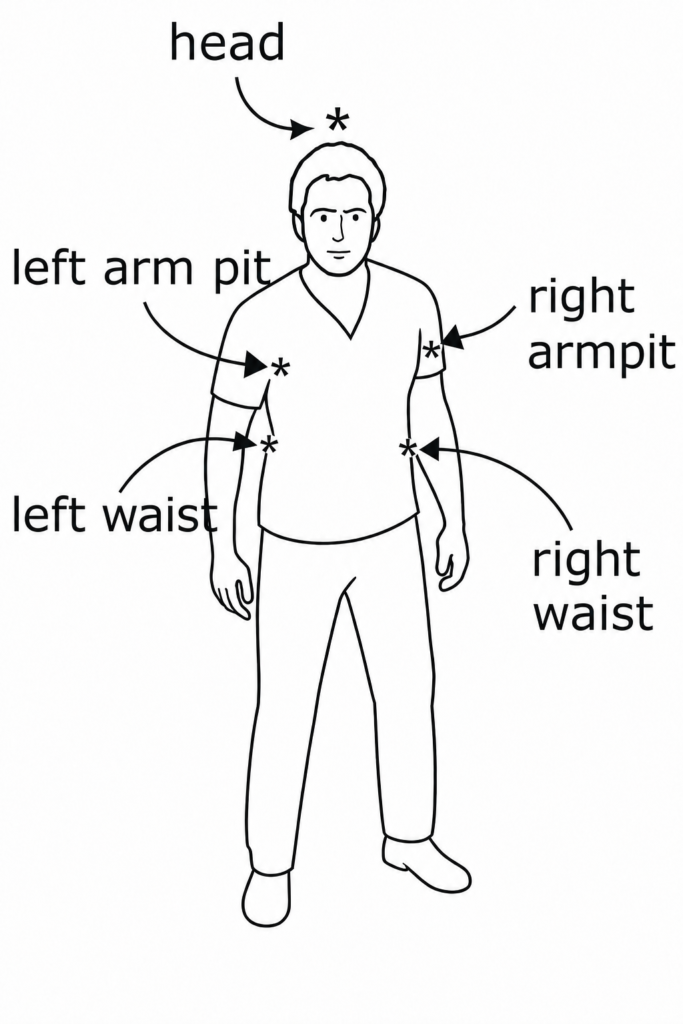
Imagine you are facing your partner. For theatrical fencing we mainly use only five different attack points throughout the choreography. Although in a real fight, the sword could strike anywhere, we are going to focus on these points, and learn to be very specific about them. I want you to be selfish, and describe everything that you see and what happens from your view of right and left. It will make things much easier to memorize.
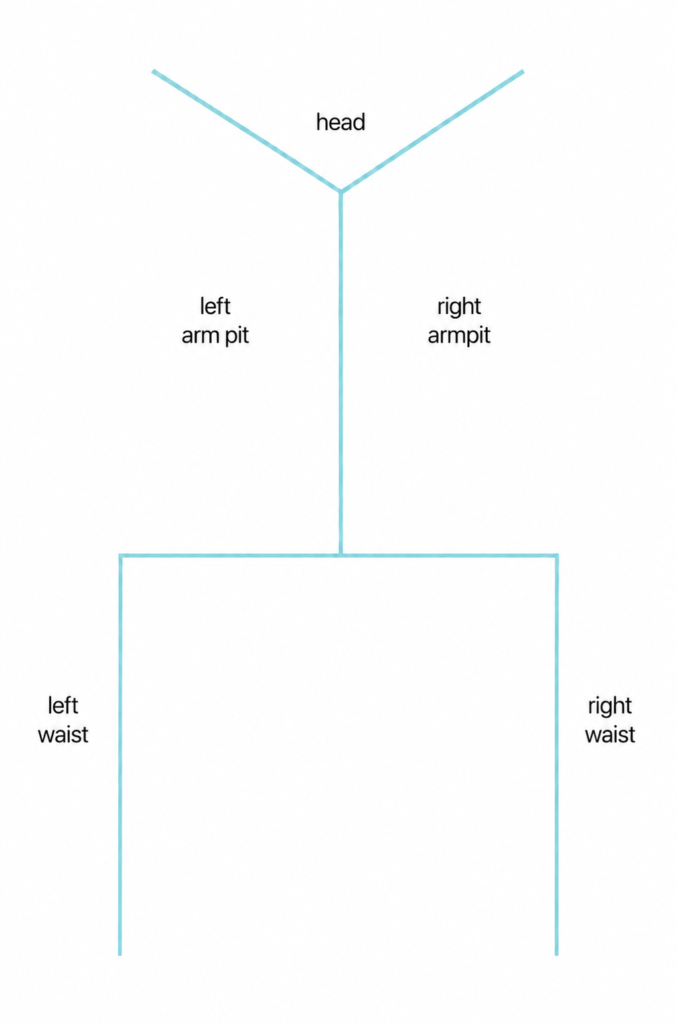
This little stick figure is not a poor representation of the human form, but instead a way to show the division of the five common target points for attacks and defenses. This is always going to be used to diagram your view of your partner. And the numbers are to indicate what you are going to do. Anything written in the upper V portion refers to an attack or defense for the head. Anything on either side of the center line is an attack or defense to the high line, and anything outside the vertical lines of the lower box refers to an attack or defense on the low line. [Remember that high line means exactly armpit level; low line means belly button level, not an inch or two above or below]. The inside of the box is left empty, and can be used to note those things not part of regular swordplay, such as attack to the foot, throwing a punch, etc.
When we fill in the numbers, they will be the sequence of moves for one phrase of the choreography. When there is a “+”, you are attacking (extending your arm); when there is a “-”, you are defending (bending your arm). If the defense is on the high line, you point your tip up. If the defense is on the low line, you point your tip down.
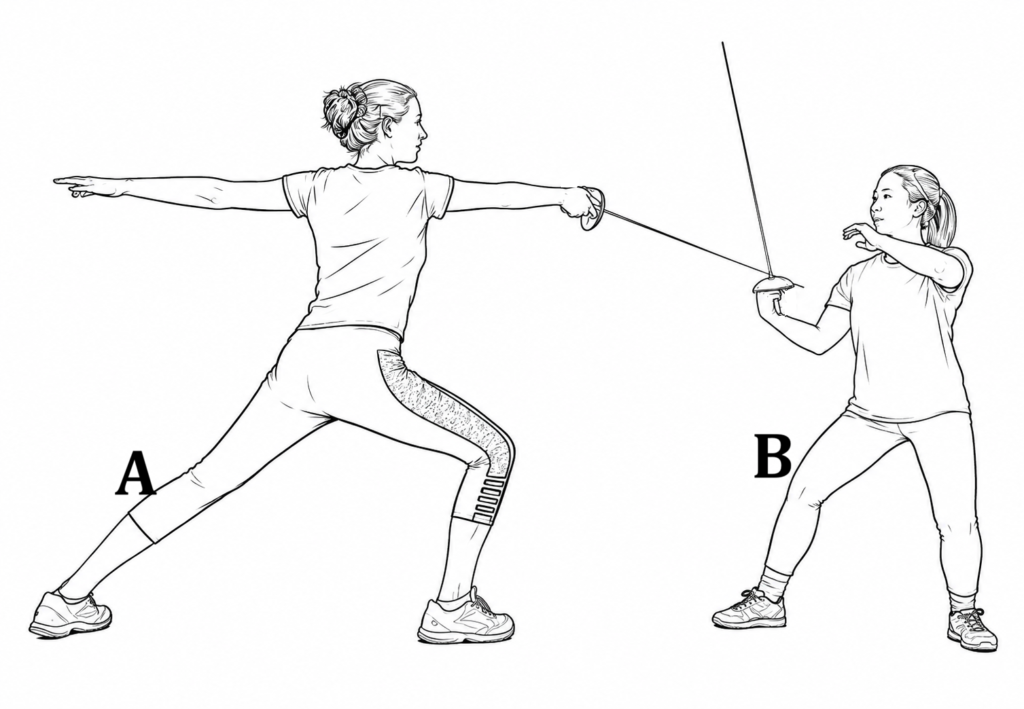
For example: Here is an image of two people creating a single attack with an appropriate defense. From her own point of view, Person A is thrusting her sword to the “left” at armpit level. Meanwhile, from her own vantage, Person B is defending to the right, at armpit level.
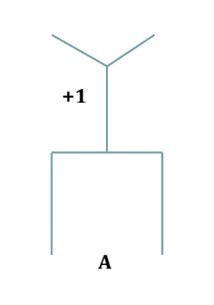
If we translate what “A” is doing onto our schematic, we would see this:
A is looking at B, so the first (and only) move is an attack toward the left. Again, this is from A’s point of view, so it is her own left that I’m talking about. The target is at armpit height, and she knows that it is an attack because there is a plus sign next to the number.
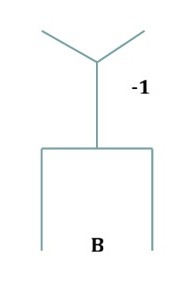
Of course, if we hand the choreography of the one-move fight to “B”, she would see it from her own point of view. Looking at A, she sees that the incoming thrust is at armpit level and arriving on the right side. She knows that her first (and only) move is to defend high and to the right. Since the attack is high, when B defends she will point her sword tip up. She knows that it is a defense because of that handy minus sign.
Notice that both actors use the same sequence number. The attack and its matching defense are not two separate moves; together they constitute move 1. Every actor therefore works from the same shared count. In a longer phrase, +4 on one actor’s diagram will be answered by −4 on another.
The diagram records only the information needed to preserve the basic combat phrase: the order of the moves, the line of each action, and whether the actor attacks or defends. It does not attempt to record every change of grip, foot movement, preparation, rhythm, or dramatic intention. Those details are learned while the choreography is taught and refined in rehearsal.
The following pages are intended to be read in the order listed. Each assumes familiarity with the conventions introduced before it and may not repeat them. Begin with Single Sword, which develops the basic system into a complete phrase. Rapier & Dagger adds a second weapon, Two against One adds another fighter, and Quarterstaff adapts the same principles to a different target diagram.