
For our limited purposes I have made no distinction between broadsword and rapier techniques. The careful application of the same actions can be used for both weapons, and I make the assumption that the director and actors will endow the weapons with the weight and speed that would be appropriate for each weapon. Naturally, within the choreography there will be fewer thrusts and parries in a broadsword fight, mainly because the very width and weight of the battle blades make them very ineffective thrusting tools. [To be blunt, a thick, wide blade gets held up by the victim’s bone and connective tissue.] And of course all of the fancy compound attacks are only meant for fencing weight weapons and are completely inappropriate for heavy battle weapons. But a cut is a cut, a thrust is a thrust, and the blocks are performed in the same way as the rapier.
For stage combat purposes, we need concern ourselves with only two varieties of broadsword: those wielded with one hand and those requiring two. The single-handed broadsword presents few difficulties beyond those already discussed. The actor should allow the apparent weight of the weapon to influence the size and speed of the movements, particularly when changing from one line of attack to another. A sword that seems substantial during an attack should not suddenly become weightless during the recovery. The actor must suggest the effort required to stop the blade and bring it back into position, without actually surrendering control of the weapon.
The two-handed broadsword requires some additional adjustments. The hands should work together, with the movement originating in the arms and shoulders and supported by the rotation of the torso. As much as possible, the non-dominant hand should take responsibility for bearing the weight of the sword, particularly when raising and lowering the blade. This leaves the dominant hand comparatively free of fatigue, allowing it to concentrate on the precise direction of the point and the alignment of the cutting edge. Think of the non-dominant hand as providing the power and support, while the dominant hand provides the guidance. The actor should avoid the temptation to use both arms simply to muscle the weapon through a cut. Two hands provide considerable leverage, and it is surprisingly easy to deliver a much harder blow than intended. The apparent power of the attack should come from the coordinated movement of the entire body, not from the actual force delivered by the blade.
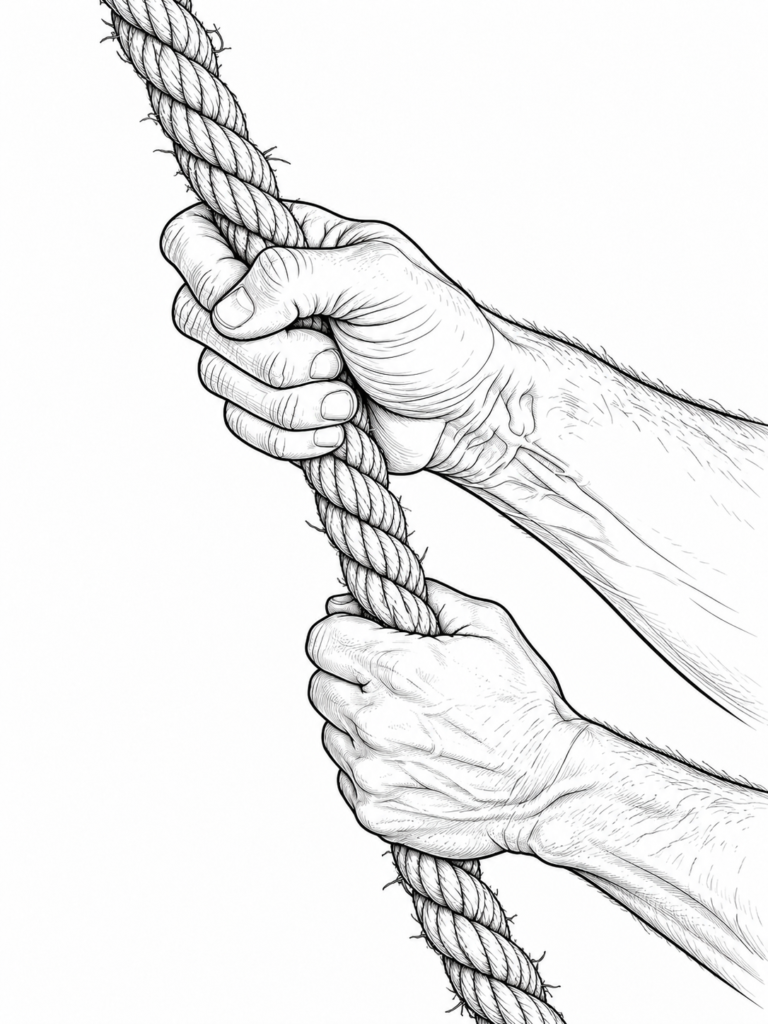
The way the hands grasp the sword is equally important. For stage combat, I prefer what might be called a painter’s grip, in which the fingers curl naturally around the hilt without clenching it into a rigid fist. This allows greater freedom of movement in the wrists and fingers, particularly when extending the sword for an attack. By contrast, the more familiar hammer grip, with the fingers closed firmly around the hilt, provides a stronger sense of solidity and is useful for close, powerful-looking parries. Neither grip is inherently right or wrong, and neither should be held rigidly. The actor must be able to move smoothly between them, allowing the hands to open and close as the demands of the choreography change. Remember that we are not trying to deliver the most powerful blow possible. We are trying to create the appearance of one while retaining complete control of the weapon, especially the ability to stop it.
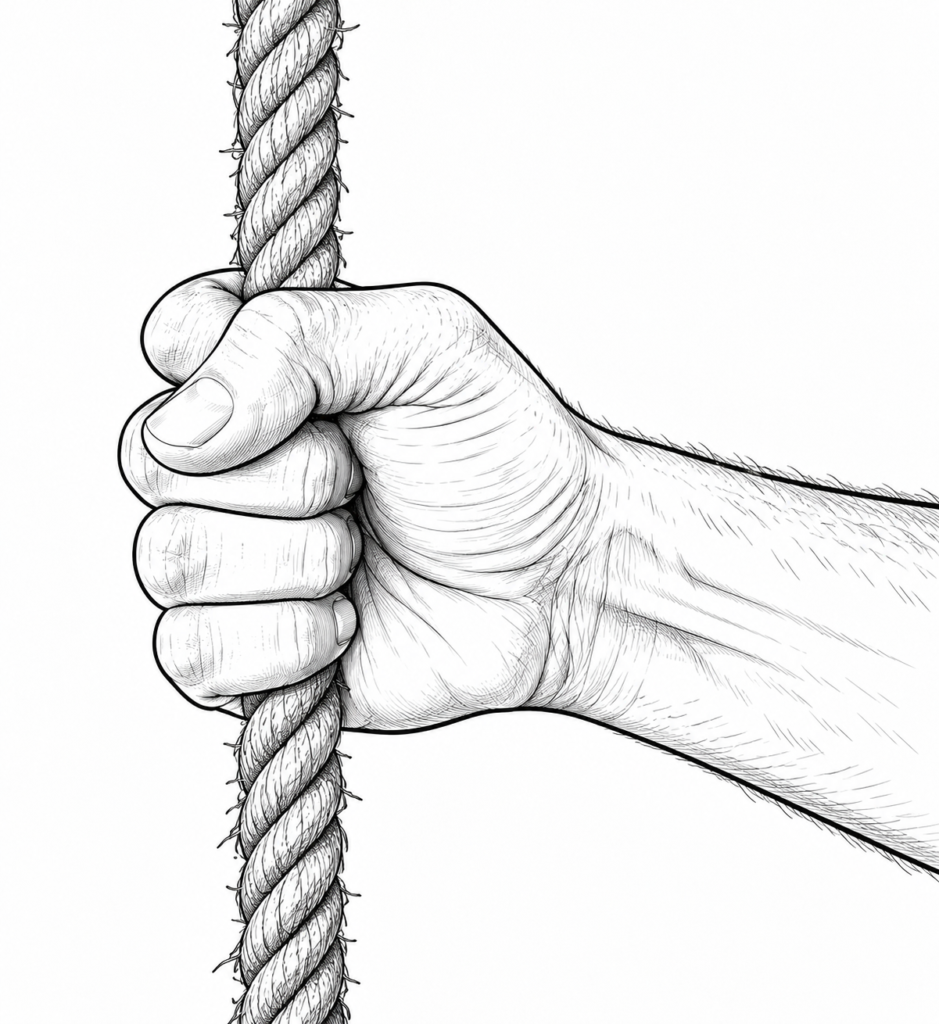
Actor-combatants frequently underestimate just how active their hands and fingers should be during a sword fight. Instead, they grab the hilt and squeeze the juice out of it—and practically the blood out of their fingers. The hands should never become passive clamps. The fingers are continually adjusting their pressure, extending, contracting, and responding to the changing balance and momentum of the sword. Sometimes the grip firms up; sometimes it relaxes. Both hands contribute, but they need not exert equal pressure, and neither should become a death grip. When a fight is going particularly well, my hands feel as though they’re playing a harp. Everything is relaxed, my fingers constantly moving, adjusting, extending, contracting—even caressing the sword. That is the sensation I want an actor to discover: not the struggle to control a heavy object, but the ease of guiding a familiar instrument.
The actor must also become accustomed to the restrictions imposed by having both hands on the hilt. With a single-handed sword, the weapon arm can move independently of the torso to a considerable extent. With two hands, the shoulders and upper body must participate much more in changing the direction of the blade. This may require a wider stance, adjustments in foot position, or a turn of the body to accommodate a defensive action. The performer should become comfortable making these adjustments without allowing the feet to become tangled or the upper body to pull the actor off balance.
Finally, remember that a large sword need not be moved slowly to appear heavy. A broad cut can be remarkably swift, but the beginning and ending of the movement should still suggest the weapon’s substantial mass. The audience must see the apparent momentum of the blade, while the actor retains the ability to stop it at any point, hold the position, and reverse the movement. That distinction between apparent power and actual control is particularly important when performing with two-handed weapons.
Short Sword
The short sword fight, on the other hand, will have a very different feel to it altogether. Here we’re talking about using the swords of ancient Greece or Rome, pirate cutlasses and machetes, and perhaps even the long bayonets of the First World War. For our purposes, we’re considering blades approximately 18 to 24 inches long. With such short blades, the actors are going to appear to be right on top of each other, so it will look strange to have them fight in a prolonged cut and thrust exchange of the sort we might expect in a rapier or broadsword fight. Some major adjustments have to be made.
First, the actor should expect to incorporate many more unarmed techniques, since punches, kicks, grabs and throws will be easily possible and even obvious at such short distances. The weapon must remain under control throughout these exchanges, even when the actor’s attention appears to be directed toward grappling with the opponent. The appearance of close quarters must never come at the expense of the working distance necessary to perform the choreography safely.
Secondly, the regular thrust coming from solar plexus level as we would with the rapier may no longer create the desired impression. For a short, heavy blade, we may want to suggest a more forceful action, with the thrust originating from the shoulder rather than the extension of the arm. One useful variation is the rising thrust, performed by holding the sword down by our side with the arm straight at the elbow, then swinging the arm forward and upward, directing the blade along a predetermined line to either the left or right of our opponent’s body. The point must remain safely outside the partner’s body line throughout the movement.
Arcing thrusts may also be performed with a straight arm held high and off to the side, the blade traveling approximately parallel to the ground toward the opponent’s flank. This seemingly simple move should be considered an advanced technique for stage combat. The movement brings the arc of the weapon from outside to inside, and the attacker cannot follow the track of the tip with sufficient certainty to guarantee the partner’s safety. The action must therefore be carefully established, with the point passing safely outside the partner’s body, and should only be performed under the direct supervision of a competent instructor.
Machete blades make fine weapons for a theatrical fight, but theatrical machete blades can be more flexible than standard stage combat weapons. A lighter hand during cuts is crucial, and augmenting the blocks with the second hand supporting the back edge near the foible can help considerably. The supporting hand should not be used to absorb the actual force of the attacking blade. Instead, it should arrive a split second after the blades make contact, completing the appearance of a particularly powerful defense without placing the hand in the path of the incoming weapon.
Military Sabre
Whereas the civilian fencing weapons of the eighteenth and nineteenth centuries could be extremely light and exquisitely balanced, resting almost as easily as a feather in one’s hand, the heavy military cutting sabre was a very different animal. With much of its weight carried forward in the blade and relatively little counterbalancing weight at the pommel, the sword, once in motion, could be remarkably difficult to stop or redirect. This was no accident. The weapon was designed to deliver devastating cuts in the maelstrom of battle, rather than for the delicate exchanges of an honorable duel. The qualities that made it so effective in a powerful cutting action were not necessarily the qualities that made it easy to maneuver.
For our purposes, we are concerned primarily with the curved cavalry sabres and the curved slashing swords of the Middle East. There were, of course, many different patterns of military sword, some considerably lighter and more agile than others. But we are not attempting to catalogue historical variations. We are concerned with the theatrical character of these particular weapons, and with the opportunities they offer the fight choreographer.
A curved sabre may be chosen because it is appropriate to the historical setting of the production, but that is hardly its only attraction. Sabre fighting offers some wonderful visual possibilities: broad, sweeping cuts, powerful defensive actions, and the apparent difficulty of arresting a blade once it has been set in motion. The choreographer should lean into these qualities rather than attempt to make the sabre behave like a rapier. Indeed, when several historically appropriate weapons are available, there may be good reason to favor the appearance of a heavy cutting sabre over that of a lighter, more versatile sword.
Even if the sword being used is perfectly balanced for fencing, the actor must endow it with the apparent difficulties of the heavier, more cumbersome weapon. We are not asking the performer to overcome the limitations of the sword, but to portray them, even when those limitations do not actually exist.
Military sabres were also used for fights of honor between officers. And in Shakespeare productions transferred to more modern military settings, the sabre may be an entirely appropriate choice. But the resulting fight should not simply reproduce rapier techniques with a different weapon in the hand. For stage combat, it may be useful to approach the sabre much as we would a single-handed broadsword, making allowances for the special characteristics we wish to portray.
The Guard
First, the sword should not appear to rest effortlessly in the hand. With much of its apparent weight carried forward in the blade, the tip continually wants to drop, requiring considerable hand and forearm strength simply to maintain its position.
The first adjustment, therefore, is to the en garde. Rather than maintaining a fully extended arm, the fighter may find it more appropriate to drop the arm somewhat, allowing the hand to remain at approximately waist height. The blade tip should rise to about shoulder level. This permits the hand to remain in a comparatively natural position while keeping the length of the blade available to defend the torso.
An alternate en garde is to raise the sword arm overhead, the elbow pointing back and the sword tip directed toward the opponent. This position threatens a powerful descending attack while allowing the blade to drop into a defensive position if needed. It also offers a striking silhouette, particularly when the performer allows the apparent weight of the sword to influence the posture.
Neither guard should appear effortless. The actor should convey the sense that the weapon possesses considerable substance, without introducing actual muscular strain that would interfere with control.
Thrusting
Assuming that the sabres you are working with have curved blades, you will soon discover that thrusting requires special attention. Unlike a straight sword, the tip of a curved sabre does not necessarily align with the direction in which the hand is traveling. The more pronounced the curve, the more noticeable this becomes.
Thrusts are certainly possible, but great care must be taken to track the tip. It can easily travel to a position considerably higher than the performer intended.
Turning the hand slightly so that the curved blade travels in a plane approximately parallel to the floor may help bring the point into the desired line. But this introduces another difficulty: the tip may arc inward toward the opponent’s body or outward away from the intended target. Neither is desirable in a carefully controlled simulation.
For this reason, thrusts with strongly curved sabres should be used selectively, and their trajectories carefully established during rehearsal. Whenever possible, the movement should be examined from the audience’s perspective, with particular attention to the actual path of the point.
There is also a theatrical consideration. A thrust is a comparatively direct movement, while a sweeping cut gives the audience a much greater impression of the sabre’s apparent weight and destructive potential. We need not eliminate thrusting from our choreography, but neither should we overlook the very qualities that make the cutting sabre so visually interesting.
Stance and Movement
The stance for sabre fighting should generally be rather wide and stable, allowing the fighter to remain underneath the apparent momentum of the cut rather than being pulled forward by it.
This does not mean that the performer should actually lose balance or allow the weapon to dictate the movement. Quite the contrary. The actor must remain sufficiently balanced and in control to stop the blade at any point in its trajectory, hold that position, and reverse the movement. The appearance of momentum is created by the coordination of the sword, arm, torso, and legs, never by surrendering control of the weapon. A broad cut may carry the body slightly into the movement, but the performer must never be dragged along by the weapon. The apparent commitment of the attack and the actual control of the attack are two entirely different things.
The recovery is equally important. If a sabre appears heavy during the cut but becomes weightless the instant the attack is completed, the illusion is lost. The performer should maintain the character of the weapon throughout the action, allowing the recovery to suggest that a considerable mass is being brought back under control. This need not make the fight slow. On the contrary, the contrast between a powerful cut, a controlled recovery, and the sudden initiation of the next attack can give sabre choreography a particularly vigorous rhythm.
Defensive Actions
Many of the defensive movements will resemble firm receiving blocks rather than the smaller, more economical deflections associated with lighter fencing weapons. The defender must appear to be intercepting a substantial blow, although the actual contact between the weapons should remain carefully controlled.
Because of the apparent inertia of the sabre, repeatedly moving the entire weapon from one defensive position to another may look unconvincingly effortless. Some shortcuts, and occasionally some deliberate exaggerations, can prove useful.
For example, when blocking high-line attacks from one side of the body to the other, you may find it easier to leave the tip of the sword hanging in space approximately six inches above head level on the center line and allow the hand to swing back and forth beneath it. The sword will resemble a giant suspended pendulum, and the hand can move considerably more quickly than if the entire weapon had to be shoved from side to side.
The unfortunate trade-off is that this produces a less structurally powerful block. The precise position of the blade, and the point at which it intercepts the attacking weapon, must therefore be carefully choreographed. This is a theatrical expedient, not an invitation to test the strength of the defense against an uncontrolled blow.
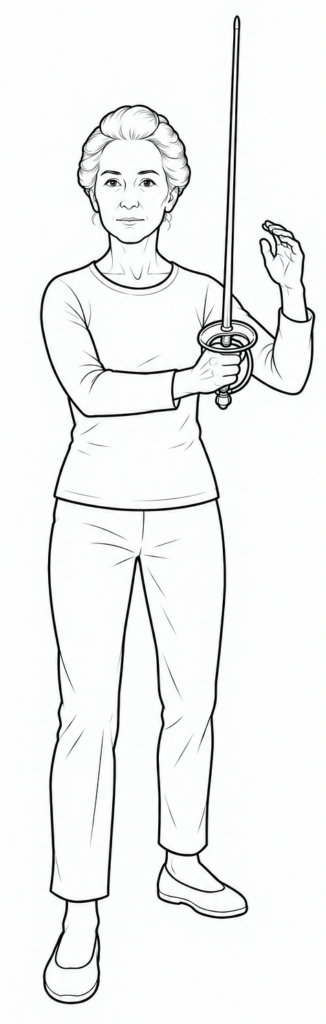
Another particularly useful variation occurs when defending the high inside line. Ordinarily, I teach the performer to keep the sword hand at approximately solar plexus height, with the tip elevated to intercept the incoming attack. This provides an economical defense and allows the sword to move readily into the next action. Perfect for rapier.
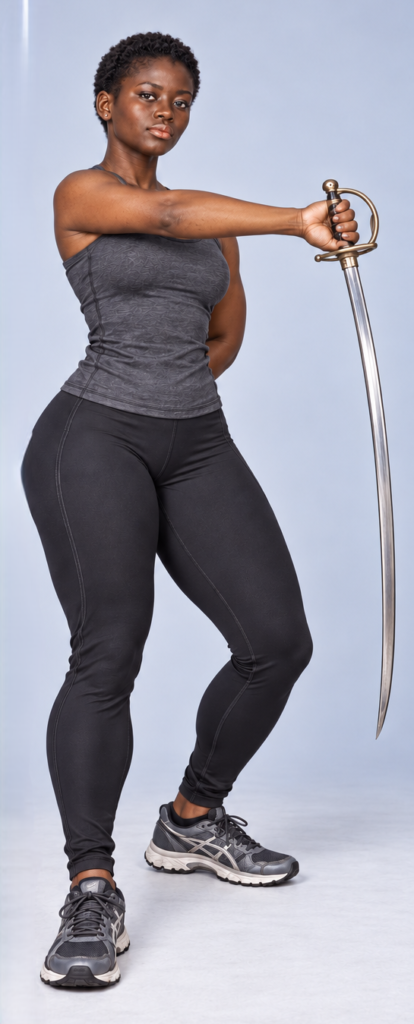
But sometimes this very economy works against us. Raising the tip so effortlessly can make the sabre appear much lighter and better balanced than we wish it to be. On occasion, a more dramatic alternative is the high prime. Instead of lifting the point, the performer raises the sword hand to approximately shoulder height, or slightly above it, while allowing the blade to hang downward. The defense presents a strikingly different silhouette: the hand rises, the tip remains low, and the apparent weight of the weapon becomes much more evident. This is sometimes called the “look at your watch” parry.
The high prime can be especially effective when it interrupts a series of more conventional defensive movements. The change in shape and scale makes the action stand out, while the recovery offers another opportunity to suggest the inertia of the blade.
Of course, the position must be adjusted to the trajectory of the incoming attack. A dramatic pose is of little value if it does not place the defensive blade where it needs to be, or if it requires the attacking performer to strike toward an unprotected part of the body.
These larger defenses should be used judiciously. A fight composed entirely of enormous movements will quickly become monotonous, and the audience may cease to appreciate the apparent power of any individual action. The contrast between economical movement and dramatic commitment is part of what gives a good sabre fight its character.
The Illusion of Weight
Ultimately, the success of sabre choreography depends less on the actual weight of the sword than on the way the actors handle it.
A lightweight stage sabre can appear immensely powerful in the hands of a performer who understands how to suggest its momentum. Conversely, a genuinely heavy weapon can appear almost weightless if it is moved without regard to the physical character we are trying to establish.
We should never increase the actual force of a cut merely to make it look more convincing. The impression of power comes from the size and timing of the movement, the apparent commitment of the attack, the reaction of the defender, and the effort suggested in the recovery. The combatants must remain in complete control throughout.
The choreographer’s task is to exploit the particular character of these weapons without sacrificing the safety and repeatability that stage combat demands.
I would ordinarily conclude by recommending instruction from a fight choreographer with extensive experience working with military sabres. Unfortunately, there are very few of them.
Moulinet
A strong cutting attack can be difficult to initiate from either of the opening guards previously described, so a movement particularly suited to the sabre was developed, known as the moulinet (French), molinello (Italian), molinete (Spanish), or windmill (English).
With the sword held out in front, and gravity tugging strongly on the blade, the hand is allowed to relax its grasp for an instant. The blade tip will immediately drop toward the ground. Even as this happens, the hand begins a tight inside turn and then quickly re-grips the handle, allowing the tip of the sword to swing closely past the hip and continue in a great circle past the left ear and forward toward the opponent, building momentum along the way. By driving the hand forward at the completion of this circle, the sabre can deliver a powerful cut without the necessity of drawing the entire arm backward in a conspicuous preparation. The movement makes use of the blade’s momentum, allowing the sword to gain speed as it completes its circular path.
This momentary relaxation and re-grasping of the handle is essential. Attempting to force the entire circular movement while maintaining a rigid grip can place unnecessary stress on the wrist and elbow. The blade must be allowed to follow its natural arc rather than being driven around by muscular force.
There is no need for a large movement of the elbow. Indeed, if the elbow drops substantially and the arm simply swings through a broad arc, you are no longer performing a proper moulinet, but merely a large cut. The rotation should be controlled principally through the hand and wrist, with the elbow remaining comparatively stable. Throughout the movement, the blade must follow a carefully established path, passing close to the body and head without threatening either.
The moulinet may be performed on either side of the body, and successive moulinets can be linked in several ways. The sword may repeat its circle on one side, alternate between right and left, or combine with the movement of a second sword. With two swords, chasing moulinets and parallel moulinets can make particularly spectacular displays.
I enjoy using these movements as an introduction to a fight, especially when a character armed with two swords is preparing to face several opponents. A brief succession of moulinets can establish confidence, apparent skill, and even a touch of bravado. It also gives the audience a chance to anticipate the fighting to come.
But I do not use moulinets during actual exchanges of blows. The blade travels through a large circular path, making precise control of its position considerably more difficult than during a conventional cut. Moreover, the movement depends upon building momentum, making the blade increasingly difficult to stop or redirect as it accelerates. Introducing another performer’s weapon into that path creates unnecessary danger, particularly when several opponents are involved. The risks are simply too great. For theatrical purposes, the moulinet is best performed as a flourish, with the other combatants remaining clear of the moving blade.
Historically, the moulinet served a more practical purpose. By allowing the sword to continue its circular movement after a cut, the fighter could prepare another attack without stopping the blade and drawing it back into a conventional guard. Particularly with a forward-balanced cutting sabre, this could make efficient use of the weapon’s existing momentum.
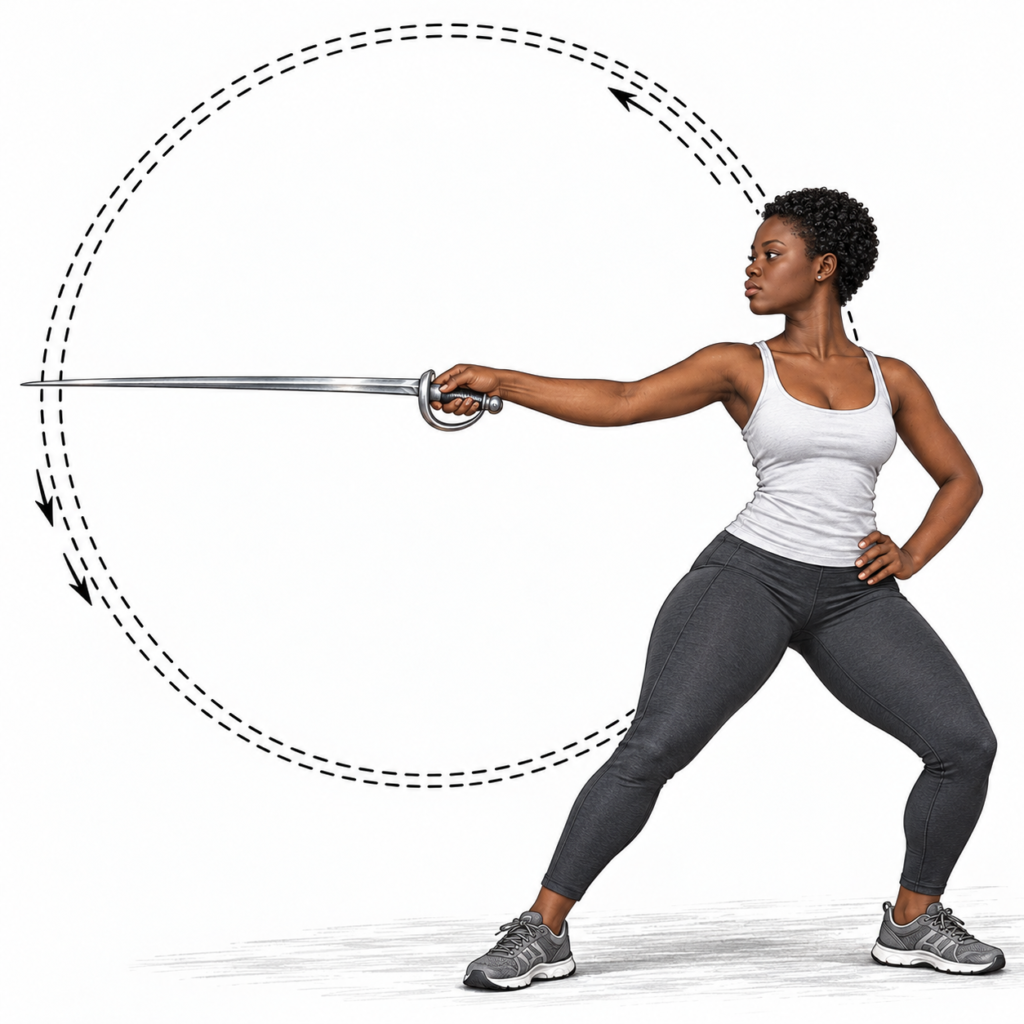
But there is a tactical disadvantage. Once a succession of moulinets settles into a recognizable rhythm, an opponent can anticipate the next cut and attack on the off-beat, while the sword is traveling through a portion of its circle that cannot immediately provide protection. Continuous movement does not necessarily mean continuous threat. What appears impressive as a demonstration may be considerably less useful when facing a single attentive opponent.
Of course, choreographers use moulinets not only with military sabres but also with rapiers, broadswords, and other theatrical swords. This has led to a minor controversy among fight directors. Some maintain that the technique is inappropriate for earlier weapons because its association with military sabre is much more clearly documented in later fencing literature. Others argue that similar circular cutting movements may have existed long before their appearance in surviving manuals.
Descriptions of warriors swinging their swords in circles are sometimes offered as evidence, although such descriptions seldom establish the precise mechanics of the movement. A sword swung horizontally above the head, for example, might describe what we would call a helicopter rather than a moulinet.
I, for one, would like both sides to remember that stage combat exists to serve the play and its audience, not to create a documentary on historical swordsmanship. A moulinet performed with a rapier may be historically questionable, but that does not automatically make it theatrically inappropriate.
Do what works for the play.