
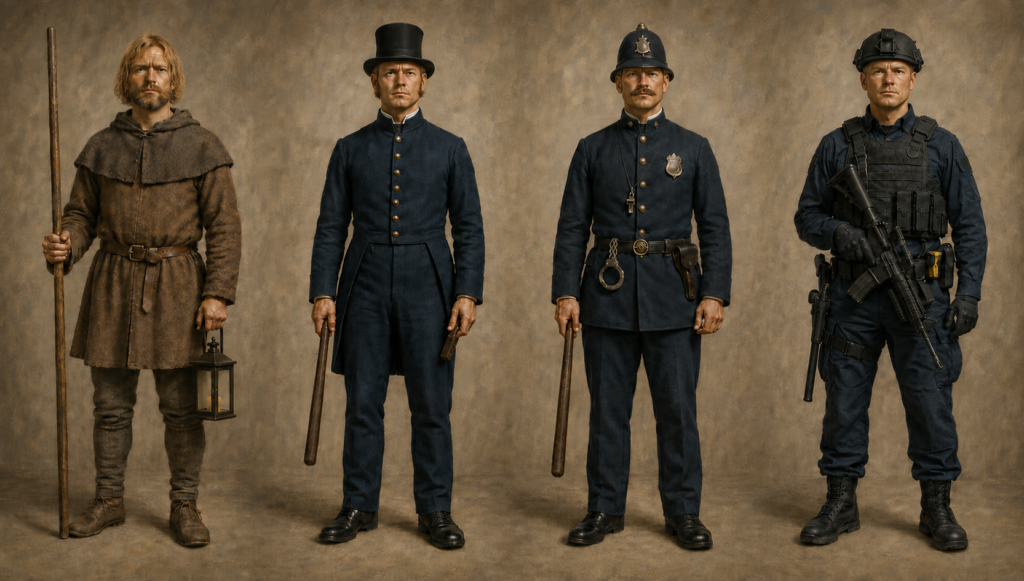
From Much Ado About Nothing to Arsenic & Old Lace to Lobby Hero, civilian police are a staple in theatre. But our common notion of a standing civilian police force is relatively recent, and the weapons and restraints available to officers have evolved along with their duties and position in society. Nor did policing develop uniformly: Great Britain and the United States created distinctly different traditions. Before equipping a police character for the stage, a production must therefore ask where and when the officer serves, what particular duty he is performing, and what—if anything—he would actually carry.
For the Performer
The historian can identify the uniform, badge, weapon, and legal authority. The performer must decide what those things mean to the people in the scene. No police officer is perceived in the same way by everyone. The same uniform may represent protection to the shopkeeper, oppression to the striking worker, interference to the adolescent, and nothing more than part of the scenery to someone who passes the officer every day.
What Does the Public See?
Fear places the officer in control of the space before anything has been said. The frightened character may become smaller, leave a wider distance, avoid eye contact, or watch the officer’s hands and equipment instead of his face. Hands may be kept conspicuously visible in an effort to appear harmless—or concealed because the character fears what may be discovered. Fear may produce obedience, paralysis, nervous friendliness, or a sudden attempt to escape.
Resentment creates a different physical relationship. The character may obey without yielding emotionally: holding the officer’s gaze, delaying a response, answering with exaggerated formality, or surrendering space only when directly compelled. This is particularly useful when the officer represents an outside authority imposing order upon a community that does not accept his presence as legitimate.
Familiarity reduces ceremony. A neighborhood officer known by sight may be greeted without anyone stopping work. People stand closer, make casual eye contact, turn their backs, complain, joke, or continue a conversation around him. His uniform and equipment remain visible to the audience but have ceased to dominate the characters’ attention. He has become part of the daily fabric of the neighborhood.
Intimidation increases as equipment creates physical and emotional distance. Armor, shields, rifles, helmets, and masks obscure the individual officer and present authority as a protected collective force. Civilians may step back, raise their hands, slow their movements, or address the formation rather than any particular person. The officers no longer appear to inhabit the same social space as the people facing them.
The officer may therefore be seen as protector, oppressor, nuisance, or background presence. Do not choose a general attitude toward “the police.” Decide what this particular character sees when this particular officer enters—and let that choice affect posture, eye contact, movement, and personal distance before the dialogue explains anything.
What Does the Officer See?
The officer is also making judgments. He may see neighbors to protect, in which case his posture can remain open, his eye contact personal, and his hands comfortably removed from his equipment. He can enter another person’s space without immediately turning the encounter into a confrontation because his authority is already understood.
He may see citizens to direct. The body then becomes more formal and purposeful: the officer takes a position from which he can be seen, uses clear gestures, expects space to open, and speaks as though compliance should follow the instruction. This need not be hostile. It is the physical assurance of someone accustomed to having ordinary directions obeyed.
When he sees a suspect to watch, his attention narrows. He maintains a useful distance, notices the hands, keeps the exits within his awareness, and places himself where he can observe without yet committing to an arrest. The change may be very small: casual eye contact becomes sustained, the body stops wandering, and one hand becomes available should the equipment be needed.
If the officer sees disorder to suppress, he begins to control territory rather than converse with individuals. He occupies doorways, divides people, directs movement, and uses his uniform, baton, firearm, or supporting officers to make resistance appear increasingly impractical. His focus is no longer upon understanding everyone present but upon ending the disturbance.
A person who requires assistance invites another physical life. The officer may reduce the distance carefully, soften the voice, lower his own height, or show empty hands. The equipment remains present, but the officer allows the person to attend to him rather than to the weapons he carries.
A perceived threat reverses that approach. Distance increases, the stance becomes stable, the hands remain ready, and the officer tries to keep the other person’s hands in view. Furniture, doorways, vehicles, or other officers may be used to preserve separation. A hand moving toward a baton or firearm is never a meaningless gesture on stage: the audience will read it as escalation even if the weapon is never drawn.
These choices can change within a scene. A familiar neighbor becomes a suspect; a person asking for help suddenly appears dangerous; an officer initially seen as a nuisance becomes a protector. Let the physical relationship change with the judgment. A shift in distance, the interruption of eye contact, or a hand becoming still beside a piece of equipment may reveal that change before either character says it aloud.
Production Checklist
Before staging a police character or arrest, establish the following:
- Country and jurisdiction. Is the authority municipal, county, provincial, state, federal, tribal, military, or private? Similar-looking officers may possess very different powers.
- Exact period. Equipment and procedure can change substantially within a few decades. “Victorian,” “Old West,” or “early twentieth century” may not be precise enough.
- Uniformed or plainclothes duty. This determines how authority is displayed and whether weapons, badge, and restraints are visible or concealed.
- Particular function. Is the character a local patrolman, detective, sheriff, town marshal, prison officer, military policeman, watchman, or soldier temporarily maintaining civil order?
- Whether the arrest was planned. A planned arrest permits officers to bring assistance, restraints, transport, and specialized equipment. A spontaneous arrest may leave them dependent upon whatever they ordinarily carry.
- Whether resistance or an armed threat was anticipated. Expected danger affects the number of officers present, their placement, the weapons available, and how closely they initially approach the suspect.
- Who carries the restraints. The person making the arrest need not be the person carrying the handcuffs or manacles. Restraints may belong to an assisting officer, the station, the jail, or the transport detail.
- Who applies them—and under whose authority. An accompanying constable may restrain a prisoner arrested by a detective or superior officer. Make clear who controls the arrest and who performs its physical tasks.
- Whether anyone carries a firearm. Determine whether the weapon is routinely worn, privately owned, specially issued, concealed, kept at the station, or secured in a vehicle. Do not give every police character a gun merely because a modern audience expects one.
- How the prisoner will be transported. Walking, horseback, wagon, railway, patrol wagon, and police car create different risks of resistance and escape. The method and distance of transport help determine whether restraints are used and whether the hands are secured in front or behind.
Only after these questions have been answered should the production decide what the officer wears, what equipment appears, how the arrest is made, and what happens if the prisoner submits—or resists.
With these questions in mind, we can now turn to the particular place and period of the production. The following guides examine how police authority, clothing, weapons, restraints, and arrest practices developed in: