
The Evolution of the Break-Open Shotgun: A Timeline and Transatlantic Perspective
The break-open shotgun is defined by its hinged action, which allows the barrel or barrels to swing away from the breech for loading. The action was a significant improvement over muzzleloading, but it could not become broadly practical until accompanied by a reliable self-contained cartridge.
Its adoption followed different courses in Europe and the United States. European gunmakers initially developed it as an expensive sporting arm, while Americans continued to rely on familiar and economical muzzleloaders. Improvements in cartridges, industrial production, and commercial distribution eventually transformed the break-open shotgun from a wealthy sportsman’s luxury into a common working firearm.
Before the Break-Open Shotgun: The Muzzleloading Fowling Piece
Before cartridge-firing breechloaders became common, the ordinary shotgun was a purpose-built muzzleloading smoothbore, often called a fowling piece. It was loaded from the muzzle with loose powder, wadding, and shot. Depending upon the intended use, it could also be loaded with buckshot or a single ball.
These guns were used for birds, small game, pest control, and personal or household protection. They were versatile, familiar, and economical, and could be useful even with little training or skill. Their owners could purchase powder, shot, wadding, and percussion caps separately, adjust the load to the immediate purpose, and obtain those basic supplies from many sources.
The early break-open shotgun therefore had to compete not merely with an older mechanism, but with an established and highly adaptable system whose ammunition was inexpensive and readily available.
The Pinfire Beginnings: The Wealthy Sportsman’s Shotgun (1850s–1860s)
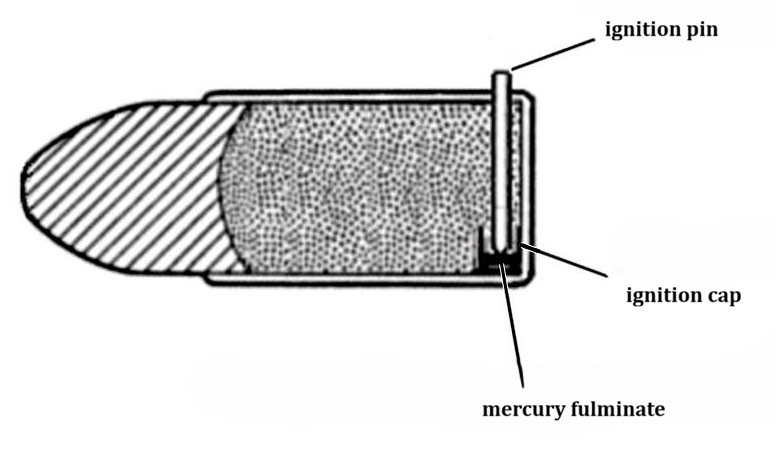
The first break-open shotguns to see limited use were based on the pinfire system, developed by Casimir Lefaucheux in the 1830s. In a pinfire cartridge, a small pin projected from the side of the cartridge case and rested against an internal primer. The cartridge was inserted with the pin at the top, fitting into a notch in the chamber. When the trigger was pulled, the gun’s external hammer struck the projecting pin and drove it against the primer.
This allowed the primer, powder, and shot to be incorporated into a single cartridge. Loading was much faster than loading a muzzleloader, and the primer was better protected from weather than a separate percussion cap. Benjamin Houllier’s development of an effectively gas-tight pinfire cartridge in 1846 further improved the system’s performance.
The projecting pin nevertheless required careful handling. It could be bent or displaced, and a sufficiently sharp accidental blow could ignite the cartridge outside the gun. Each cartridge also had to be rotated into the correct position when loaded.
Pinfire ammunition presented an additional economic disadvantage. Instead of purchasing inexpensive powder, shot, wadding, and caps separately, the shooter had to buy specialized manufactured cartridges. Where those cartridges had to be imported or were not regularly stocked, they were both more expensive and less dependable in supply.
During the 1850s and 1860s, break-open shotguns remained costly, handcrafted sporting arms, adopted principally in France and Belgium and increasingly by wealthy British sportsmen who could afford both the guns and a reliable supply of cartridges. In the United States, however, their expense and dependence upon comparatively scarce proprietary ammunition offered little practical advantage over familiar, less expensive muzzleloading fowling pieces, which used readily available components and could be maintained without reliance upon a specific cartridge.
The Centerfire Transition: Mass Production Begins (1860s–1870s)
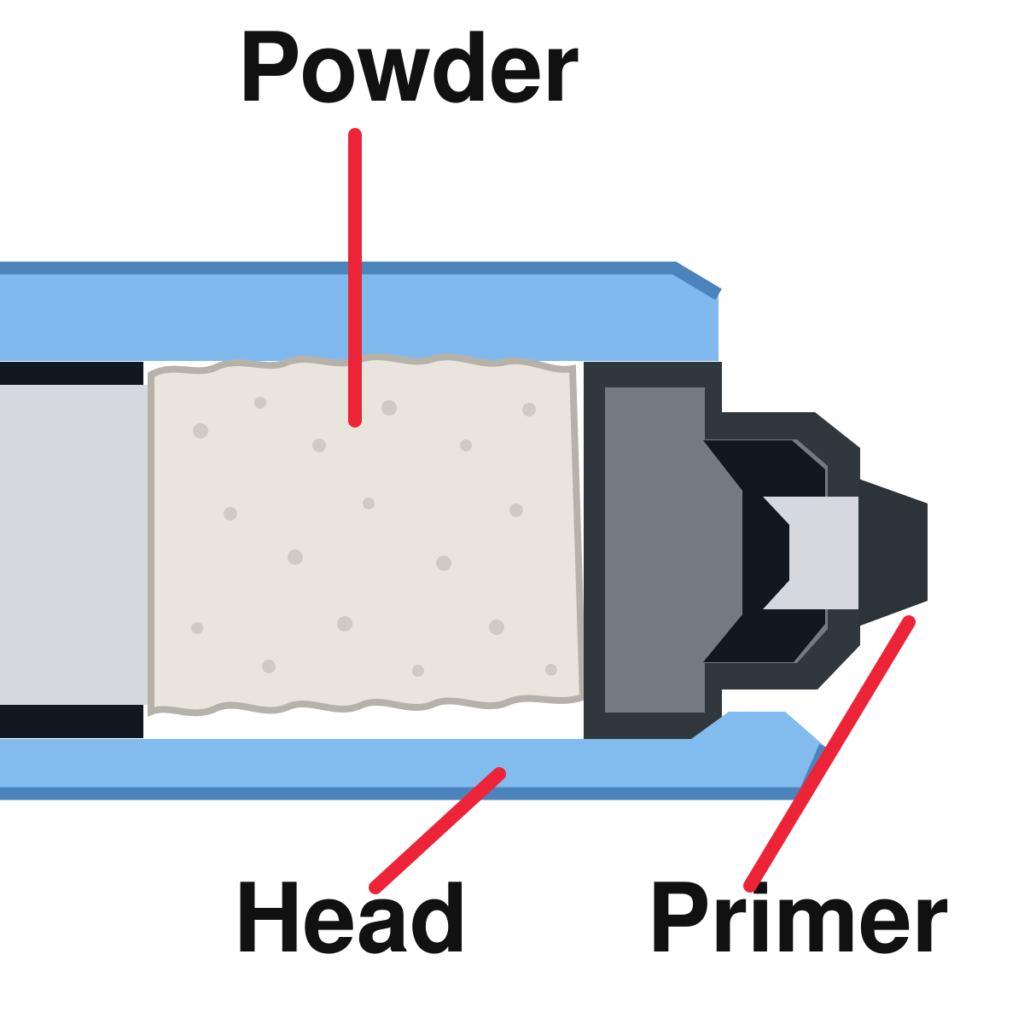
A major transition began during the 1860s with the development of practical centerfire cartridges. In the centerfire system, the primer was placed in the center of the cartridge base. The firing pin became a protected component of the gun rather than an exposed part of every cartridge.
The centerfire cartridge did not have to be rotated into a particular position when inserted. It was safer to carry, easier to load, and better suited to increasingly powerful charges. As centerfire ammunition became commercially available, it steadily displaced the pinfire system.
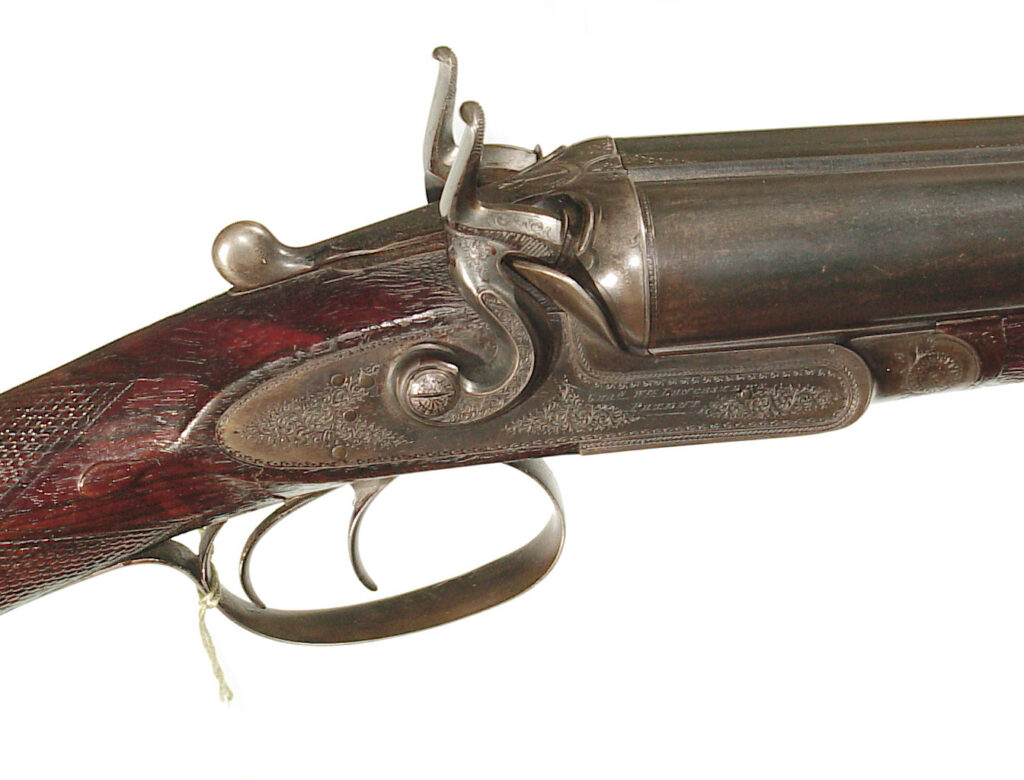
In Britain and Europe, manufacturers such as Holland & Holland, W.W. Greener, and Purdey refined the break-open action, producing exquisitely crafted side-by-side double-barreled shotguns for an upper-class clientele. The British gun trade remained largely bespoke, meaning that each firearm was custom-built for its owner. These shotguns, while highly effective, were economically still not within reach of the working class.
Meanwhile, in the United States, the spread of industrial mass production made the transition more accessible. American manufacturers such as Remington, Parker Bros., and Colt began to produce break-open shotguns, though they remained costly compared to muzzleloaders. Unlike in Europe, where shotguns were primarily used for sport, American shotguns were often purchased for utility—hunting, home defense, and pest control. The widespread availability of factory-made centerfire ammunition also played a crucial role in making break-open shotguns more appealing to rural farmers and frontiersmen.
The Working-Class Shotgun: Widespread Adoption (Mid-to-Late 1870s)
By the mid-1870s, break-open shotguns began to transition from an elite item to a firearm accessible to common farmers, trappers, and even criminals. This shift was facilitated by improvements in mass production and a growing domestic arms industry. In Britain, fine double-barrel shotguns remained the standard for gentlemen hunters, but in Belgium, mass-market gun manufacturers began producing cheap break-open shotguns for export, including large shipments to both the United Kingdom and the United States.
For Americans, many of whom lived far from a gunmaker, the ability to purchase firearms and obtain replacement parts over long distances was essential. Illustrated catalogs, hardware stores, and general supply depots allowed customers to order standardized guns without visiting the manufacturer. And standardization did not eliminate choice: buyers could select among gauges, barrel lengths, action types, stock styles, and grades of finish, much as later automobile buyers would choose not only among models but also from an array of factory options. Replacement parts could likewise be ordered without returning the gun to its original maker.
At the same time, the criminal and law enforcement markets began to embrace the break-open shotgun, particularly in sawed-off configurations for close-quarters combat. Stagecoach guards, highwaymen, and police officers began using cut-down break-action shotguns due to their ease of concealment and rapid reloading capability. By the late 1870s, these firearms were no longer a rarity but had become commonplace in both urban and rural settings.
The Everyman’s Shotgun: The Dominance of Break-Open (1880s–1890s)
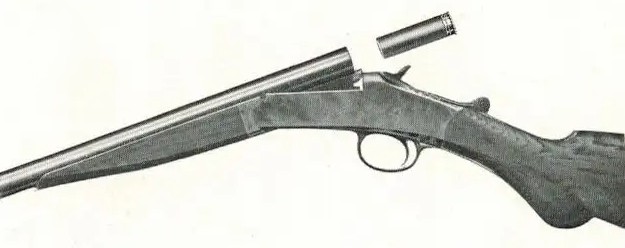
By the 1880s and 1890s, advances in steelmaking and machining had produced stronger and more consistent actions. Hammerless locks, improved safeties, extractors, and automatic ejectors made the guns easier to operate. American companies such as Harrington & Richardson and Ithaca offered practical guns for farmers, hunters, ranchers, and householders who had neither the need nor the means to purchase a bespoke sporting arm.
European production became varied. London gunmakers continued to produce costly handcrafted guns, while Birmingham and Liège supplied large numbers of more affordable models. The European market therefore included both luxury craftsmanship and mass production rather than following a single model.
American vs. European Approaches: The Role of Standardization
American firearms had long been understood as assemblies of three major units: lock, stock, and barrel. Those units could be made, purchased, or replaced separately. A gunsmith might obtain a lock and barrel from specialist suppliers, fit them to a stock, and complete the firearm locally.
This was modularity, but not yet full interchangeability. A replacement lock, stock, or barrel commonly required hand fitting before it would function properly with the remaining parts. Nevertheless, treating the gun as a collection of separable assemblies established an important conceptual foundation.
Industrial production gradually reduced the amount of fitting required. Greater uniformity in dimensions allowed manufacturers to produce guns in quantity and supply replacement components with a reasonable expectation that they could be fitted without reconstructing the entire firearm. Major locking surfaces and barrels might still require the attention of a gunsmith, but factory standardization made both manufacturing and repair more predictable.
This was particularly important in the United States, where customers might live far from the original manufacturer. A farmer, hunter, or law-enforcement officer could purchase a standardized firearm through a local merchant and obtain routine parts through the same expanding distribution network.
The Established Break-Open Shotgun
By the beginning of the twentieth century, the cartridge-firing break-open shotgun had largely displaced the muzzleloading fowling piece. The design could be produced as an inexpensive single-barrel farm gun, a sturdy mass-market double, or an elaborate bespoke sporting arm.
Its success resulted from the combination of several developments: the hinged breech, reliable centerfire ammunition, improved metals and machining, factory production, and widespread commercial distribution. Together, these transformed the break-open shotgun from an expensive European innovation into one of the most common and enduring firearm designs in Europe and the United States. While Europe remained the center of luxury gunmaking, American mass production and nationwide distribution helped democratize shotgun ownership, bringing practical break-open guns within reach of ordinary farmers, homesteaders, ranchers, and householders.