
The Phalanx, the Spear, and the concept of Unlimited War
Classical Greece
Time Frame – approx. 500 to 300 BC
Politics/Economics – Unique for this area of the world at this time, and for reasons still unclear, many Greek city-states (known as poleis) shifted away from tribal or king-led governance toward more collective political systems—most famously, the democracy of Athens. However, not all city-states were democratic; others, like Sparta, were oligarchies or had dual kings with strong military control. The shared victory over the Persian Empire in the early 5th century BC fostered a sense of unity and cultural pride, especially in Athens, which soon became the dominant naval power in the Aegean. Its control of trade routes and the formation of the Delian League brought economic prosperity and allowed for extraordinary growth in art, architecture, philosophy, science, and literature. For the first time in Western history, individuals pursued knowledge not solely to glorify gods or kings, but for its own sake—though religion still played a strong role in daily life, public rituals, and civic identity. While this flowering of culture was remarkable, it’s also important to remember that most of the population—women, slaves, and foreigners—were excluded from political participation.
The famous myths and legends of Greece—stories of the Trojan War, Odysseus’s long voyage home, heroes like Heracles, and the gods turned into constellations—come from a time long before Classical Greece. In fact, they predate even the so-called Greek Dark Ages, which began around 1200 BC. This was a catastrophic collapse during which writing disappeared entirely from the region for several centuries.
These stories survived not through written records, but through an extraordinarily resilient oral tradition. That tradition preserved the memory of the earlier Bronze Age civilizations of the Minoans and Mycenaeans, whose sophisticated societies were ultimately lost to time and upheaval. Of that earlier world, we know very little. Archaeology shows us that they were technically advanced—particularly in bronze weaponry and armor, which in some cases was more elaborate than what Classical Greece would later produce, and in ways we still don’t fully understand.
By the time Homer’s Iliad and Odyssey were written down—likely in the 8th century BC—the tales had already passed through hundreds of years of retelling. As a result, they were almost certainly shaped by the language, culture, and values of that later age, blending Bronze Age memory with Iron Age reinterpretation.
Fashion/Manners – Although Classical Greece did not develop a true “leisure class” in the modern sense, many citizens—particularly landowning males—had access to artistic and intellectual pursuits now associated with the liberal arts. Public life encouraged not only excellence in speech, music, and athletics, but also grace in posture and movement. There was a shared cultural aspiration to elevate daily life with a sense of balance, poise, and elegance—qualities reflected in sculpture and vase painting. From this artwork, we can infer that the ideal Greek carried himself with dignity and ease: proud but not boastful, physically expressive but never vulgar, like a dancer unaware of being watched.
Clothing mirrored this aesthetic. The tightly stitched garments of earlier centuries gave way to looser, draped clothing such as the chiton and himation, garments that emphasized the natural line of the body and allowed for freer movement. In contexts such as athletics or certain rituals, even these were dispensed with—nudity being seen not as shameful but as a celebration of form and function.
Civilian Conflict – Despite their martial myths, everyday Greeks were not armed citizens. Even in Sparta, there is no substantial evidence that men routinely carried weapons within city limits. A small knife might accompany a traveler beyond the city, but the average man likely had little need—or legal right—to carry arms during daily life.
Physical training in disciplines such as wrestling, boxing, and the pankration (similar to modern mixed martial arts) was widespread, but outside the formal games, these remained athletic rather than violent pursuits. While interpersonal conflict certainly existed (as it does in any society), altercations were more likely to involve fists or nearby objects than blades. There is every reason to believe that most civilian disputes—even heated ones—rarely escalated into weaponized violence.
This does not imply that the Greeks were inherently peaceful—only that their violence was typically situational and opportunistic, not routine or ritualized in personal life.
Warfare – It is no exaggeration to say that the Greeks redefined the nature of warfare in the ancient world. For them, battle was not about skirmishing or symbolic gestures—it was about decisive, full-commitment engagement. Most Greek city-states fielded armies composed of citizen-soldiers, primarily land-owning farmers, who formed dense blocks of heavy infantry known as the phalanx.
This formation was built for direct confrontation. Armed with long thrusting spears and protected by large round shields (aspis), men stood shoulder to shoulder in tight ranks, creating a bristling wall of spear points and interlocked shields. The overlapping shields shielded front-line troops from missiles, while the pressure from rear ranks made retreat both difficult and dishonorable. Since these soldiers were not professionals, but part-time warriors with limited formal training, the success of the phalanx relied on unity, discipline, and physical endurance rather than complex tactics.
The aim was simple and brutal: advance, break the enemy line, and inflict as many casualties as possible. Greek battles were often short and ferocious. Victory came through cohesion and shock—not maneuver.
While earlier empires (like Egypt or Assyria) had also used dense infantry formations, the Greeks elevated the phalanx to a central, do-or-die strategy. The Persian armies, with their reliance on archers, light cavalry, and flexible troop types, found this style of warfare terrifying in its raw physicality and relentless force. The Greeks did not just fight battles—they threw everything they had into winning them.
Greek heavy infantry—the hoplite phalanx—was often accompanied by smaller contingents of light infantry and missile troops. These included javelin-throwers (psiloi or peltasts), who could harass enemy formations before the main clash, as well as a handful of swordsmen who might engage in close combat if needed. Their role was to create disruption, exploit gaps, or protect the flanks—not to hold the line.
An even smaller number of archers, often recruited from specific regions like Crete, were used to weaken enemy ranks at a distance. However, in most city-states, archery was not held in high esteem and rarely played a decisive role in major land battles. Cavalry did exist but was extremely limited in both numbers and strategic impact. Greece’s rugged terrain and agricultural economy made large-scale horse breeding impractical. Where cavalry was present—such as in Thessaly or later in Macedon—it served primarily as a skirmishing or pursuit force rather than a battlefield-dominating arm. In the Classical period, cavalry rarely played a meaningful role in hoplite-centered warfare.
In most Greek city-states, military service was the duty of the landed citizenry. These men owned property, had a direct stake in the survival and success of their polis, and could afford the cost of arms and armor—especially the bronze panoply required of a hoplite. This personal investment in both equipment and outcome made them more reliable in battle than slaves or mercenaries, who were rarely used in front-line roles during this period.
The key exception was Sparta, which forged itself into a true warrior society. At birth, all male infants were inspected by city elders, and those judged physically weak or malformed were exposed and left to die—a practice rooted in the Spartan ideal of strength and endurance. At the age of seven, all boys were removed from their families and entered the agoge, a rigorous state-sponsored system of military and moral training. They were subjected to constant physical hardship, discipline, and combat conditioning.
By eighteen, Spartan youths began advanced military preparation, and at twenty they joined the ranks of the standing army—living in communal barracks and serving full-time as professional soldiers. They remained in active service until at least age thirty, and often beyond. This lifelong commitment, paired with superior training, discipline, and endurance, made the Spartan phalanx one of the most formidable fighting forces in Greece.
How Battles Were Fought – Though each city-state raised its own army, nearly all Greek forces fought in essentially the same way. The cornerstone of their strategy was the phalanx, a dense line of heavy infantry pressing forward in unison. Each soldier carried a large bronze or wooden shield (aspis), wore protective armor, and wielded a long spear or pike (usually around 7–9 feet), with a sword as a backup weapon. Altogether, a hoplite’s equipment could weigh up to 70 pounds.
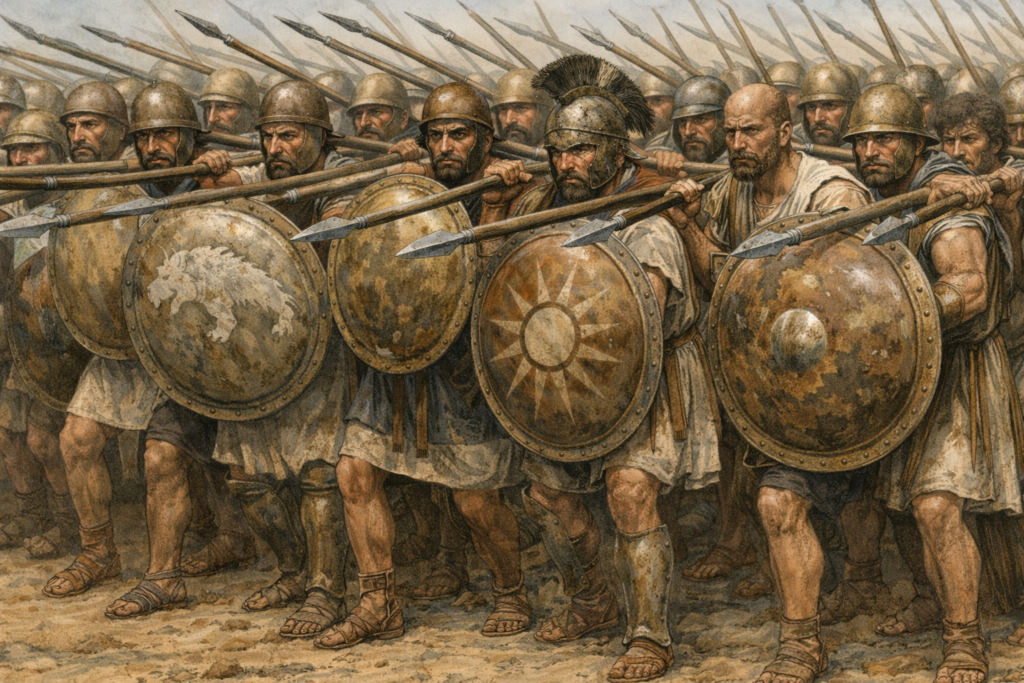
The phalanx did not charge swiftly. It moved forward as a slow, grinding wall—its power not in speed, but in mass and cohesion. On contact, if the initial clash didn’t break the enemy line, the pressure from rear ranks would rapidly build. Rows of soldiers behind the front would lean in, physically driving the formation forward, turning the front line into a battering ram of shield and spear. Pike heads could wedge between shields to wound or kill, but the breakthrough came when one section of the line managed to push through. That breach exposed the vulnerable sides and backs of the enemy’s formation—areas no longer protected by overlapping shields.
In the chaos that followed, a brutal killing zone would often form around the break. Those who held their ground were speared in place; those who fled were pursued and cut down, often by faster-moving light infantry or sword-wielding hoplites. Yet despite this violence, Greek warfare had its limits: when one side was clearly defeated, the victor usually did not press the attack further. Instead, both sides typically called a truce to recover the dead—an act of mutual respect tied to civic pride and religious observance.
Greek battles had to be fought on open ground, where the phalanx could maintain formation. Terrain like hills, forests, or narrow valleys made such tactics impossible. Moreover, since the soldiers were primarily farmers, large campaigns were only feasible when agricultural duties allowed—usually between planting and harvest. This made swift, decisive engagement the ideal. Generals discussed the battle plan ahead of time, but once the phalanx was in motion, there was little room for improvisation. Tactics were simple, and generals fought alongside their men—not from a distance, but in the front ranks, sharing the same risk.
Occasionally, armies were caught on the march—ambushed in narrow passes or bottlenecks—but these were the exception. Most Greek battles were pre-arranged, ritualized, and short—often decided within an hour.
Interestingly, the heroic warriors of Homeric legend did not emerge from the era of Greece’s organized battlefield success, but from a much earlier period—when warfare was more ritualized and personal. In that older, tribal world, battles were often resolved by champion combat: a few elite warriors from each side would step forward and fight in single or small-group contests, with the outcome determining the honor—or survival—of the tribe.
Unlike the massive hoplite battles of Classical city-states, which could involve thousands or even tens of thousands of soldiers, these earlier tribal conflicts might have fielded only a few dozen fighters in total. Warfare was intimate, heroic, and bound by custom as much as strategy.
By the time these oral traditions were eventually written down—centuries later during the rise of literate, urban Greek culture—the storytellers had recast those ancient duels into the language and scale of their own time. As a result, the champion-warriors of The Iliad are shown fighting within the structure of vast armies, often described in ways that reflect the phalanx model, even though they predate it by centuries.
This is much like how medieval knights of the Gothic era romanticized King Arthur: they imagined him wielding the weapons, speaking the language, and upholding the chivalric ideals of their own time, rather than those of the early Dark Ages in which he (supposedly) lived.
The Greek Warrior: Weapon, Myth and Reality
To portray a Greek warrior is to stand at the crossroads of two worlds: one rooted in myth and glory, the other in discipline and duty. The mythical warrior—Achilles, Hector, Theseus—is driven by personal honor, divine favor, and eternal fame. He is a figure of fierce individuality, emotional extremes, and impossible standards. His battles are personal trials, and his victories echo through time. He wields weapons imbued with near-mystical force: massive bronze swords, ash spears, and often elaborately decorated shields described as singular objects of craftsmanship and symbolism. Armor is ornate, frequently gifted by the gods or forged by legendary smiths, and is meant to declare identity as much as to protect. His weapon is an extension of his legend—no other man could lift it, let alone match it.
By contrast, the Classical soldier of the hoplite phalanx is something far more grounded. He is one shield among many, his value measured not by daring feats but by cohesion, stamina, and reliability. His weapons are practical and uniform in purpose, if not in design. He carries a thrusting spear (doru), typically 7 to 9 feet long, with an iron tip and a bronze counterweight (sauroter) at the base for balance and backup striking. On his left arm he bears a large, heavy circular shield (aspis), which interlocks with his neighbor’s and serves as both defense and anchor. At his side is a short leaf-bladed sword (xiphos)—or, less commonly, a forward-curving kopis used for slashing when close combat breaks formation. His armor may include a bronze helmet, breastplate, and greaves, but the exact configuration varies with personal wealth. His weapons are tools, not talismans. They protect the man beside him more than they define his soul.
These two types—the mythic and the civic—are shaped by fundamentally different worldviews. The mythical mind sees the universe as ruled by gods, fate, and supernatural forces. Lives are twisted by prophecy, curses, and divine rivalry. Emotion is righteous, and destiny is fixed. A character born from myth acts with passion, awe, and a constant awareness of their cosmic significance.
The Classical thinker, however, lives in a world that seeks order through reason. Though the gods remain, the human mind has taken center stage. Philosophers like Socrates, Plato, and Aristotle questioned what it means to live a good life, to govern justly, and to act with moral clarity. In the theater, playwrights like Sophocles, Euripides, and Aristophanes transformed old legends into sharp reflections of contemporary society—probing law, loyalty, hubris, and the limits of human choice.
Civic duty, ethical consequence, and rational debate now define the Greek moral landscape. A soldier from this era does not ask, “What do the gods demand of me?” but rather, “What is the just course of action—for me, and for the city?” One fights for eternal renown. The other fights because he must—and because the polis cannot stand without him.