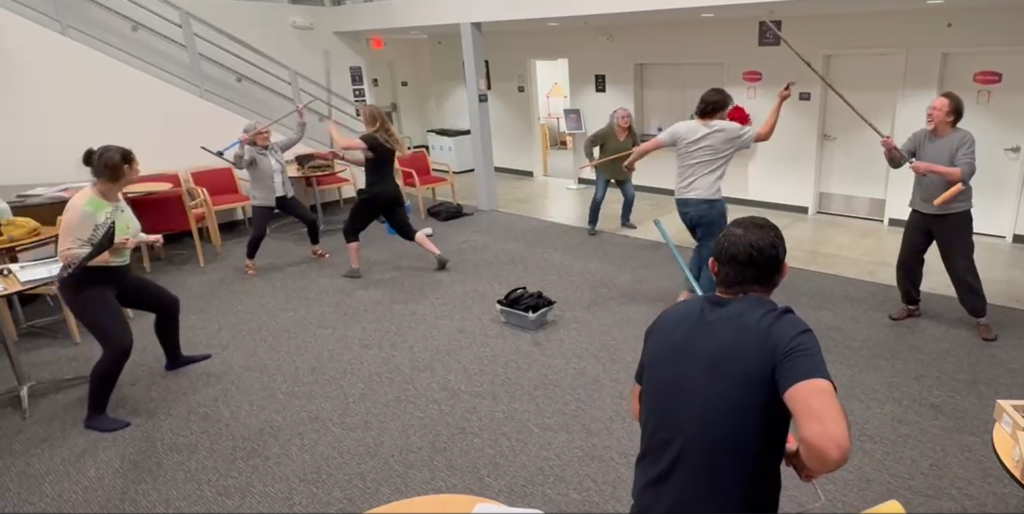
Choreography Basics and Acting the Fight

You might find it odd that choreography and acting the fight are combined into one section, but the more one thinks about it, the more inseparable they become. The actor will rarely be the choreographer, but cannot hope to act the fight without understanding how its story develops. Just as actors break down a script to understand and transmit the playwright’s intent, they must break down the fight to bring meaning to the movements.

Each move comes from an impulse, and each has a consequence. A fight is not a string of techniques — it is a dialogue of intention.


The Emotional Engine of the Fight

Human communication begins and ends with the face. Raw emotion plays there before the brain transforms thought into speech or gesture. Words can lie easily; faces hide little. In a fight, we must see thought.

Imagine anger growing in strength and weight — a ball of fire building inside one character. Words restrain it for a time, but eventually it must be released as physical action. That fire flies toward the opponent, who must dodge it, absorb it, block it, or send it back. However it manifests, the release of energy changes both aggressor and defender. Both are burned. Both must adjust to a new world.

The defender cannot escape the emotional reality of the attack. If he evades, he still confronts the anger. If he absorbs it, he changes. If he blocks and controls it, he must decide whether it has dissipated or must be returned — perhaps strengthened.

Two actors could spend hours breaking down the ramifications of just two moves:

  • Where does the impulse begin in the body?
  • How does it travel?
  • Exactly where is the intended point of contact?
  • Did it succeed?
  • How does the result change the next choice?

And that is only the beginning.


Intention Before Speed

Sometimes actors are told to slow down a fight. Often the problem is not speed — it is that the fight looks rushed. There is a difference.

A fight looks out of control when the storyline disappears. Instead of:

“I’m going to attack her!” — moves 1, 2, 3

We should see:

“I’m going to attack her here.” — move 1
“That didn’t work. I’ll strike here.” — move 2
“She’s left that side open! I can try to attack there.” — move 3

The fight moves only as fast as the thoughts can carry it. Each move must succeed or fail. Each phrase must be completed before the next begins.

If we don’t see the choices, we can’t believe the fight.


Breath, Sound, and Presence

All actions must be accompanied by sound. Grunts, groans, yells, breathing — the vocal cords must be engaged. Without sound, the fight becomes an aural black hole.

Talking during the fight forces breathing. Breathing relaxes the body. Relaxation gives control. Silence leads to stiffness and poor acting.


The Actor’s Homework

Go through every attack and defense.

  • Why does this move happen?
  • Does it succeed or fail?
  • Why does the next choice follow?

Do this work alone first. Then repeat it until the entire fight is driven by want → attempt → evaluation → adjustment. It is the same work done with spoken lines.

Understanding the inner monologue makes memorization easier. If a move is forgotten, the actor simply follows the next intention. The audience does not know the choreography — only the story.


Rehearsal: Being Changed by Your Partner

Bring that homework into rehearsal, but be ready to be changed by what appears in your partner’s face. Reactions may need to shift. Characters respond not only to movement but to perceived intention.

The same discovery that happens in scene work can happen in a fight.

When intention is clear, the fight looks more dangerous but is actually safer. It will not roll away out of control because both actors are communicating.


If You Are Creating the Fight

Start With Story, Not Stage Directions

If choreography falls to you, begin with essential story points:

  1. What must the audience understand overall?
  2. What must this scene communicate?
  3. What must this fight accomplish?

Black out the stage directions if necessary. They are often limiting and overly prescriptive. Read them once for orientation, then simplify.

In Man of La Mancha, for example, what truly must happen?

  • The muleteers must be defeated.
  • They sustain non-life-threatening injuries.
  • Quixote, Sancho, and Dulcinea each contribute.

Everything else is negotiable.


Block the Fight Without Weapons

Before adding swords, imagine the fighters with arms crossed and weapons removed.

Ask:

  • Who advances?
  • Who yields ground?
  • Who circles, avoids, presses, or retreats?
  • Why?

That negotiation of space is the fight. The sword merely articulates it in a historical vocabulary.

If it reads clearly without swords, adding blades will sharpen it. If it does not, clever blade work will not fix it.

Fights should travel, breathe, and evolve spatially.


Daydream the Fight

Imagine the fight in a real space with vague figures. Watch how they approach and retreat. Allow blocking to emerge before seeing arms or weapons.

Gradually sharpen the image. Write down the blocking outline first. Then layer in specific choreography.


Building Variation From Simple Material

Memorization is less interesting than motivation. Keep the number of memorized routines small.

One seven-move pattern per actor can become an extended fight through:

  • Rhythmic variation (pause after every third beat)
  • Looping patterns (A → B → A → B)
  • Repeating moves (1,2,3,4,4,4,5,6,7)
  • Sustained attack bursts (3,4,3,4)
  • Forward-only advance vs. retreat-only defense
    • In other words: Step forward on attack / step back on block
  • Then try the opposite
    • step forward on block / step back on attack
  • Controlled thrusts vs. full cuts
  • Yielding (ceding) parries with blade contact

The moves do not change. The meaning does.

Actors already know fourteen moves — their own and their partner’s. Recombine them. The audience will not see a pattern if emotional intention fills the pauses.


Actor Resistance and Character Justification

“But my character wouldn’t do that.”

In combat this objection becomes amplified, especially if a “weak” character must fight strongly.

Try extreme exercises:

  • Play the scene as an animal.
  • Exaggerate the animal qualities.
  • Explore Laban extremes: light/heavy, fast/slow, straight/circuitous, strong/weak.

Actors default to comfortable combinations. Challenge them to the polar opposite.

Every strong person has weakness. Every weak person has strength. Characters are not fully formed in week one. Saying “no” to a choice cuts off discovery.


Plot-Driven Fights Only

Fights must arise from plot consequence. When added merely to excite performers or attract audition turnout, they often drag pacing and create confusion.

Staged fights are not decoration. They are emotional consequence.

When disconnected from the production’s overall values, they disappoint.


Practical Safety and Discipline

A truism: the bad guy makes the good guy look good.

Each acting beat takes time. Feel the moment.

Energy must be controlled. There are no victims — only volunteers.

  • Protect against sliding (floor or shoes).
  • Maintain control of weapons during runs.
  • Break down complex actions and slow them down.

Put choreography in early. Memorize it when lines are due. If actors are still recalling sequences in tech, they cannot act the fight.

Anything unpolished by tech week should be cut.

Do less. Do it perfectly.


Final Principle

I place the highest priority on plot- and emotion-driven fights. That does not exclude occasional flourish or even cliché, if it suits the production’s tone.

But the foundation must always be:

  • Clear intention
  • Clear spatial storytelling
  • Clear emotional consequence

Once that is solid, parries, ripostes, thrusts, and cuts fall into place as timing mechanisms — not as the primary storytelling engine.

And then, the fight will not merely impress.

It will mean something.

Weapons of Choice