
There are at most only two things you can do with a sword in order to hurt someone: hack at him with the edge or stick him with the tip. [Yes, I know you can hit someone with the pommel or the guard, but those are really augmented unarmed techniques.] Whether cut or thrust, stage attacks are slower than real fighting. Stage attacks unfold; they do not strike, but rather develop.
All of swordplay is one person doing one of the above and another person preventing success. We can create swordfights on stage because, unlike real fighting, we can make sure that most of the attacks actually fail.
Audiences have no depth perception. You must trust in this for it is the one thing that makes all of stage combat possible. It’s also what can make a sword fight confusing to the audience. From their point of view, an attack to the left looks the same as an attack to the right, and a sword tip that has disappeared upstage of an actor has gone through the character. Remember that you are creating a two-dimensional picture, so what looks right to the actors may not look right from the house.
The Five Basic Attack Targets
Of course in a real sword fight, any contact anywhere on the body has the potential of causing damage, so attacks are only limited by opportunity and creativity. For stage, we reduce all of these possibilities to only five spots. Why? Specificity and safety. It’s hard for the audience to follow a sword fight as is it, and adding too many targets can confuse them. [There are choreographers who teach up to twelve attack points, but even they use the basic five for the majority of moves in the fights they choreograph and use the others sparingly.] Too many targets can also confuse the actors, making them miss their defenses and muddying up the fight.
The five attack points are
1) left hip
2) right hip
3) right shoulder
4) left shoulder
5) head
These are just nicknames that everyone uses for the five points in space where the two swords are going to meet, not really the part of the body that someone in a fight would actually try to attack.
For the first four positions, we want the audience to believe that the target for the attacker was always the same: dead center of the defender’s torso, the solar plexus. But of course the actor isn’t really going to aim for the solar plexus, because if the defender fails to make the block, you end up with a damaged actor. So the actor/aggressor aims his weapon tip for the point in space where the progression of the attack is going to be successfully thwarted.
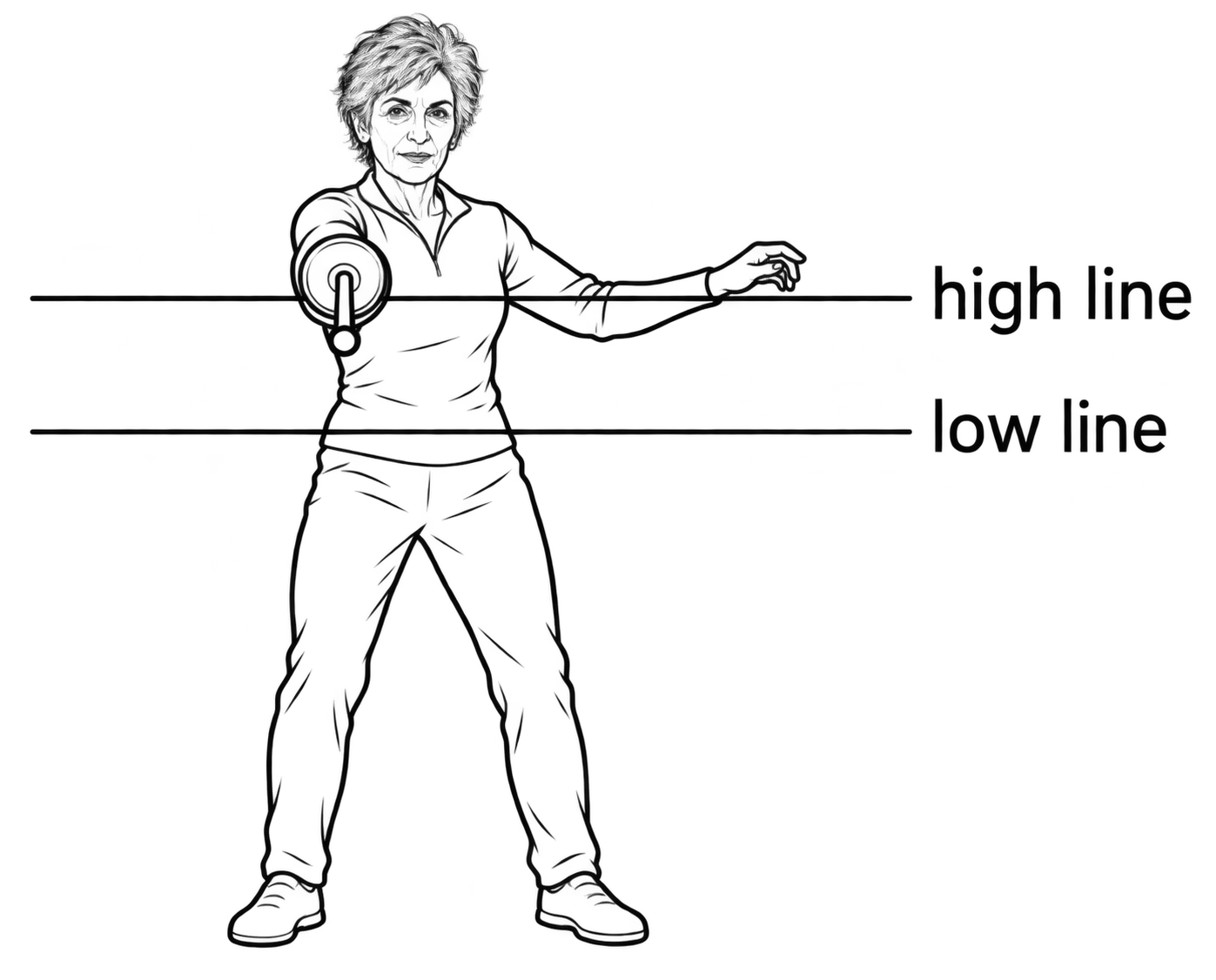
We have to be extremely specific as to what the attack points are, and not allow the sword tip to wander. The difference between a high line attack and a low line attack is only a matter of a few inches. As a matter of fact, I often find it beneficial not to have my actors think about attacking high or low but simply call all of the body attacks “flank”, either left or right. Students tend to allow their focus to drift anyway, so high becomes higher and low becomes lower with each fight rehearsal. By calling all of the attacks “flank” and having them drive the blade to the same spot, the point drift tends to be minimal. By performance time the tips usually will end up right where they need to be, as described below.
For the five attack points the aggressor’s sword tip will land exactly at the following: 1) left hip – the point in space at belly button height, natural waist level, the top of the hip bone, two inches to the left of the outside plane of the body and four inches in front of the body. 2) right hip – the point in space at belly button height, natural waist level, the top of the hip bone, two inches to the right of the outside plane of the body and four inches in front of the body. 3) left shoulder – the point in space at nipple level, armpit height, solar plexus level, two inches to the left of the outside plane of the body and four inches in front of the body. 4) left shoulder – the point in space at nipple level, armpit height, solar plexus level, two inches to the left of the outside plane of the body and four inches in front of the body. 5) head – the point in space no higher than seven inches above the head, aimed top dead center.
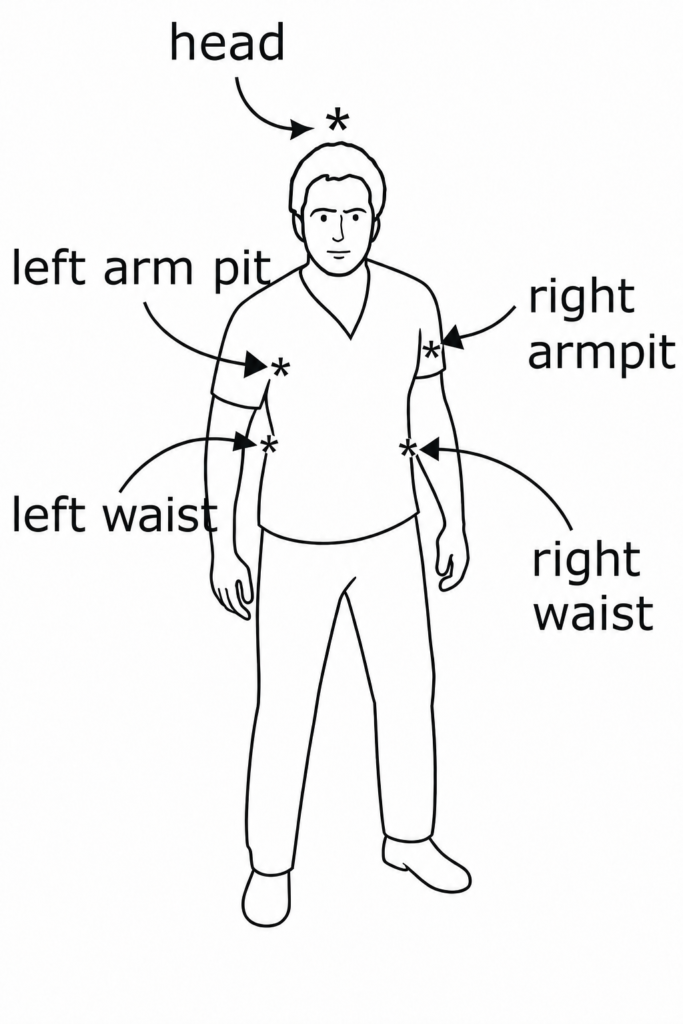
Try locating these points and you’ll see that the first four attacks, the ones to the body, all end up slightly in front of the defender. The audience must always see some daylight between the attacking tip and the defender’s body. This allows the tip to appear to be more dangerous and it also gives us somewhere to go when we need to do the kill shot. On the other hand, for the head cut we have to allow the tip to get past the frontal plane of the defender, for we what to have good solid contact between the two swords for safety’s sake, and in this case (and only this case) it means we have to close distance a bit.
To be honest with you, I really dislike the terms “hip” and “shoulder” for stage combat. As I mentioned earlier it makes the attacking sword tip drift far too high on the “shoulder” attacks and far too low on the “hip” attacks. But the terms are almost universally used by choreographers, so we’re stuck with them. What I want the audience to see is an attack always parallel to the ground, with only the tip pointing slightly up or down, just above or below the defender’s hand. So again, when I teach, I simply refer to all body attacks as flank. That way the tips land just above or below the defending hand.
We should also discuss the concept of inside and outside, which always refers to the defender’s blocking arm. In fencing it is considered best to keep the sword held at the center of the body. That way any attack to any quadrant is equally covered. But the reality is that the hand tends to drift a little bit in the direction of the shoulder to which it is connected. So if you are looking at a right handed fencer, the left side of the body is going to be a little bit more open to attack than the right. That left side is his inside (think of the inside of his forearm). His right side is his outside (think of the outside of his forearm). But if he switches hands and starts fighting with his left hand, his inside and outside are reversed.
Thrusting
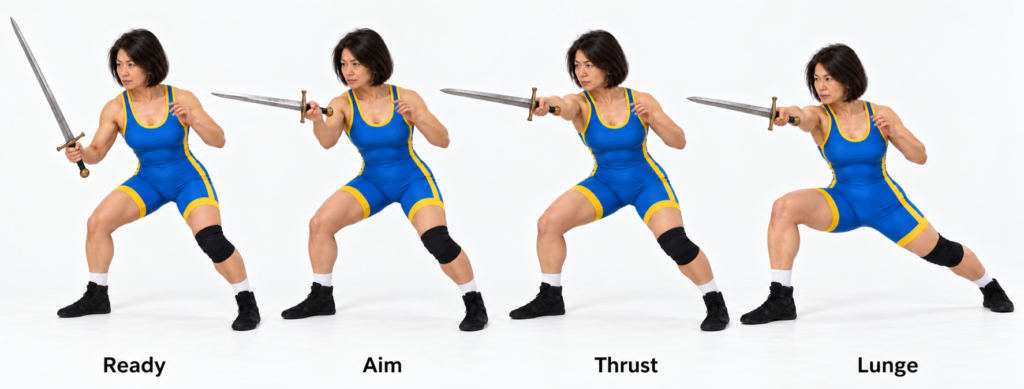
The thrust is an arm movement that attempts to stab someone with the point of a sword or knife. It is not a lunge, which is a lower body movement. The thrust refers only to the arm extension that makes the point of the sword more dangerous to the opponent. The thrust begins with the arm bent, with the tip of the sword aimed at a specific target on the opponent, and the hilt held close to the body. A line drawn from target to blade tip to attacking hand should form a perfectly straight line. The sword tip then moves in that straight line to the target as the arm is straightened. The thrust may be executed while lunging, or while stepping forward, or standing still, or even stepping backward. Again it only refers to the arm movement. There is no need to lean into the attack by bending at the waist. Keep the head up and the torso balanced on the hips.
There are such things as “diving” and “scooping” thrusts, which begin with the tip pointing up or down respectively, but these are advanced techniques best left to experienced combatants. On the other hand, there is no reason to assume that the hand must be returned to the center solar plexus position before beginning the thrust. If the hand happens to be, say, down by the left knee because of a previous move, the thrust can start directly from this position so long as hand, blade tip and target form a straight line when the thrust is complete.
On stage, since the audience has no depth perception, we don’t actually thrust at the other actor, but instead thrust very slightly away from the actor, to just outside of the plane of the body. This would be a point in space where the sword tip would end up if effectively blocked. So even though a real thrust would always be aimed at the center of the torso, directly at the solar plexus, the thrust targets for stage combat are four: Left high, right high, left low, and right low. Again, high is called “shoulder” by instructors for simplicity, and low is called “hip”, but these are misnomers, for the sword tip should never be higher than your partner’s arm pit [nipple level] nor lower than your partner’s natural waist [navel level]. Think about that for a minute and you’ll see that the difference between an attack to the high line and one to the low line is only about six or eight inches. Also, the tip should end up a couple of inches in front of the actor so that the audience can see that the attack failed. But remember that the actor’s job is to sell an illusion, the conceit that the middle of the body was the intended target and that the defender deflected it away at the last nanosecond.
Notice that for thrusts, we left out the fifth target, namely the head. We never, NEVER, thrust to the face. The margin for error is simply too great, and the possible injuries are too frightening to risk. So for the thrust, we have only four attack points.
So as not to confuse the actors, I prefer to use the terms left and right according only to the point of view of the person actually doing the particular action. So you thrust relative to your own left or right, or you block to your own left or right. Don’t worry about what your partner is supposed to do.
Lunge
As I said before, the lunge is what the legs do, not what the arm does. Real competitive swordplay involves a lot of attacks that may not all have the intent of actually striking, but are part of a constant probing and testing of the opponent. The bodies dance around and the swords are thrust and parried, but there will come one moment where a thrust is made and the opponent has left himself just a little too open. This fraction of a second is the opportunity that must be seized, so even as the thrust is beginning its extension, the body lunges forward to suddenly close the distance and hit the target. Touché!
Thrusts without the lunge are usually made just outside of striking distance. Adding the lunge is an act of great self-confidence, because if it fails the attacker is left hung out there vulnerable to counterattack.
The lunge provides the maximum extension of the sword to the target, so if the fighter is right-handed it is always performed with the right leg. The left foot is anchored to the floor, turned out to 90 degrees. The right leg steps forward into the deep lunge while the left leg straightens completely. Fencers will actually lock that knee joint for maximum stretch, describing the feeling as punching the ground with the left heel. That popping extension might even propel the fencer another half meter or so in the direction of the lunge. In order to avoid excess strain on the right knee, don’t allow the leg to lunge too deeply. At the full lunge, the right knee should be right above the heel. To protect the left leg, straighten it but don’t hyperextend it.
To get out of the lunge, fencers simply push off with the right leg, giving them really powerful right thighs. It’s also exhausting, so a much easier way is to bend the left knee first and then just evenly “squat-walk” out of the lunge. Of course, one can also recover by bringing the back foot up to meet the lunging foot and then standing up, but naturally that drives the actor forward rather than back, so is usually used if the defender has retreated a considerable distance.
Riposte
This is a fencing term that is used often in stage combat, although the actual technique itself has no use on stage unless the actors have been intensely trained by an excellent choreographer. The riposte in stage combat is an immediate attack following a successful parry. In true fencing it is the immediate attack during a successful parry, so immediate that it becomes one movement with the parry. This is known as single-time fencing, the basis of all modern sport fencing. When the riposte is done effectively it becomes a true counterattack, one that strikes even before the opponent has finished his intended initial attack. Fencers are trained to riposte automatically, even instinctively, but the blending of movements is impossible for the audience to discern, therefore they cannot see the character’s intention. All they can see are a series of what look like simultaneous attacks, and this takes them away from following the story of the fight. For stage combat it is preferable to have the actors use only double-time actions: completely finish one move (the parry) before attempting another (the thrust). There are enough choreographers out there who use the term riposte, so you should know that they simply mean an attack that immediately follows a successful parry.
Cutting
For stage combat purposes, a cut is not just an attack using the edge of the blade, but an attack that has been successfully blocked.
Just as with the thrust, the target to aim for is where the sword would stop in air when a cut is successfully blocked. This is a mere two inches away from your partner, and again the terms high and low are nipple and navel respectively. The tip should end up a couple of inches in front of the actor so that the audience can see that the attack failed. So when all is said and done the tip of the sword is going to end up at the same precise point in space whether the attack was a cut or thrust.
What changes is the look of the attack as it unfolds toward the defender. Just as with the thrust, we want to start by forming a straight line to the target. But this time, the order is elbow, hand, then blade tip. That’s right; the blade tip will be behind you before you start the attack. The movement of the hand will be the same – in a straight line to the target. The tip will make a gentle half circle, with the pivot point being the attacking hand, not the shoulder.
To the previously explained four body targets, we add one more – a vertical head cut. This one is scary at first but it can be made very safe so long as one key point is carefully practiced. As the sword blade drops down to make the cut, simply never allow your hand to drop below the level of your partner’s eyes. So long as you don’t lose sight of your partner’s eyes, your sword blade cannot possibly touch him, and you cannot possibly hurt him. For this cut we allow the sword tip to extend past the front plane of the defender, which is far closer than we do for any other attack. The sword tip will stop directly over the center of the defender’s head, not in front of the defender. This way the defender is certain to have enough incoming blade to make solid contact with the block, avoiding the straight-arm “reaching” block. The final image must have the defender keeping his arm bent when blade contact is made. If the defender has to reach forward to make the block, then there really wasn’t a threat that is going to be obvious to the audience.
Cutting motions with the sword should not be confused with tree chopping, which unfortunately is what you’ll usually see performed on stage. The problem is that the natural tendency of the actor is to execute the cut using a bent arm, like a baseball swing, and that’s fine if we don’t want the swing to stop. But if the cut stops in midair before reaching the victim (as it will in 99% of the choreographed fight) we have to believe that it was the block that did it, and that can’t happen with an attacking arm that is bent. Why?
When the arm is bent at the elbow, the elbow leads the motion of the swing followed by the hand and then the blade trailing behind. This is what happens when you slash with a sabre – by the time the blade actually makes contact with anything, all of the body momentum and even most of the weight of the sword has already passed by the target point. There is nothing that is going to stop the progress of the slash. If the defender holds up his sword for protection, the attacking sword will glance off of the defending blade, but the path from one side to the other will not be impeded.
But what we get onstage (and in most action movies) is a sword coming in with that full bent-arm swing, and then inexplicably freezing in midair just because the other blade touched it as though it were some sort of powerful electromagnet. With both actors keeping their elbows bent, it also becomes harder to figure out who is attacking whom. After a while it merely looks as though both are hacking away at an invisible cabbage floating halfway between them as they prepare coleslaw.
We need to get the same clear attack vs. defense that we get with the thrust, and we do that by allowing the cut to develop as it is performed, rather than simply hacking. How?
Ø Make sure that your arm, hand, and sword form a straight line at the very moment that your cut is blocked. If the elbow or wrist is bent, the impact point of the sword looks weak, the hilt has all of the momentum, and the blade cannot logically be stopped. It looks as though you just wanted to slice the opponent, not cleave into him. To the audience it looks as though the aggressor simply gave up. But if the arm and sword are straight (just like a thrust) then it gives the appearance of having tried to reach the opponent in order to cut into him with the far third of the blade, a point on the cutting blade known as the center of percussion. If the intention was to cut and not slash, then that far third, not the hilt, is going to be “loaded-up” with energy. If the blade is then blocked right at that center of percussion, the momentum to the sword is going to cause the blade to try to continue, not in front of the block, but by wrapping around behind the block, straightening the arm even more, even hyperextending it. This is a cut and block simulation that now obeys the laws of physics.
Ø Remember the three P’s of cutting motions: point, push, point. When you start your cut, the blade tip is going to be slightly behind you, so to begin you first point your elbow toward the target. This is important so that the audience and your partner can get a good visual cue as to what part of the body is being threatened. (If you’re right-handed, the cut coming from the left is going to be easier than from the right. You won’t actually be able to point with the elbow from that right side, but you should still try to get the feeling of leading with the elbow first.) Relax the shoulder – tension there isn’t necessary for a cut. If anything push your shoulder down; then push the pommel toward the target as you straighten the elbow. This makes the hilt of the weapons travel in a straight line from your body to the target point. Once your arm is straight, then and only then engage the point of the sword to the target using only your wrist. It is during this last motion that the blade of the sword will swing around in an arc, but notice that the hilt went only in a straight line. This will both look far more real than the traditional “hack”, but it also has the added benefit of completely dissipating the energy of the cut before it reaches your partner. As you get better, this three part break down will smooth out and look very convincing.
point with elbow push the pommel point with the tip point elbow push pommel point with the tip
Ø Lastly, you’ll need the slightest hint of a bounce-off after contact has been made. Keep the mental image of striking a crystal bell with your sword: if you come in chopping, you’ll shatter the bell; if you don’t flick your hand at the moment of impact, your strike will not resonate. (If it helps, imagine trying to reach behind your partner with your sword tip.)
The character’s intent is to cut.
The actor’s intent is to send the energy out next to his partner, not through his partner.
To recap: each cut is an attack that unfolds as it develops, with the hand (hilt) moving in a straight line while the blade tip swings in an arc. Contact is made with the first third of the blade, not the midpoint.
To get the stage cut to look clean, aggressive, and still be safe, here are a couple of great exercises:
- Get a plastic bottle of any size, fill it with water, and stand it on a tall stool. Try several full speed cuts to both sides of the bottle. How close can you get while not knocking it off of the stool? Make sure that from the blade tip to your shoulder is a straight line at the end of each cut. Until you can touch the bottle but not knock it over, you really don’t have control of the sword.
Is the above exercise easy? Great! Now try it with an empty bottle. - Play catch. No, really. Just stand about two or three yards apart and use a soft rubber ball or tennis ball or bean bag. Catch and toss with the same hand, and try to have the ball only go to the five attack points discussed earlier. No fake outs here, really indicate your intended target. Don’t make your partner reach for the ball – your job is make the ball land exactly where his target hand is waiting. If you swing your arm around in an arc as you throw, that ball will go everywhere. If your hand travels in a straight line, the ball will reach the exact target every time.
Short-Snap Cut
A slight variation to the full sabre cut is the short-snap cut, which is also the only kind of cutting seen in the Olympic sport of sabre fencing. The short-snap is performed with the arm already fully extended or nearly so, the sword is worked using only the wrist, allowing for a much faster series of attacks. As such attacks would not have any true cutting power behind them, they are usually added in fights as feints or set-ups for the real, more powerful attack. They are also often used for combination attacks, the first part of the attack being a regular full cut, and then the second part as a short-snap going immediately to a new target without having to waste time in pulling the sword back. It allows for more variation in timing, for the short-snap takes only a third of the time to perform than the full cut. Naturally, most combatants can only perform this action when the sword has a relatively light blade. In order to do a snap cut with a true military sabre blade, one would have to have Popeye forearms.
Long Sword Two-Handed Cut
Two-handed broadsword cuts are not dramatically different than cuts from any other weapon, except that we need to endow the prop with more weight. I say endow because military sabres actually feel heavier than broadswords, and so tend to move more slowly in air. But part of our job as actors is to not break the illusion of the broadsword being a weighty beast, so we generally pantomime a bit more prep and pretend to absorb a lot more crashing force.
The work of cutting with the longsword is divided into two distinct jobs – one for each hand. The dominant hand (for most people, the right hand) guides the tip, the non-dominant carries the weight and guides the hilt. In other words, the left hand does most of the heavy work, carrying the weight from side-to-side and forward-and-back, keeping the muscles of the right arm rested and fresh, ready to carefully guide the tip to exactly where the fighter wants it to go.