
Just as there are two ways of using a sword to hurt someone, there are two ways of using a sword to defend yourself. Blocking refers to stopping the incoming motion of a cut, while parrying is a deflection of a thrust. It gets a little confusing because most people end up using the terms interchangeably. I’m just as guilty as anyone else, but we should always try to keep a distinction between the two. For both types of defenses the incoming attack is kept as close to the body as possible. But although the sword movement may look the same, the body response must be different. Your job is to understand your intention so that the meaning behind the move can have clarity.
Parrying is a finesse move, one that diverts the incoming energy and allows it to skip harmlessly away. Parries require very little effort and have more of a look of guiding the offending sword tip away from its target. Because a mere deflection is needed, either the strong (true-edge) or the weak (back-edge) parry may be used. A strong parry leads with the knuckles; a weak parry leads with the thumb side. Don’t push the attacking sword away, for your partner is supposed to be thrusting just outside of the plane of your body already. All you have to do is gently meet the blade at a prearranged point in space.
Blocking, on the other hand, meets force with force, so we need to see that impact accepted by the blocking arm. Every movement has a specific consequence, so match the effect of your block on your own body to the amount of force your partner is pantomiming. Big cut, big reaction; light cut, light reaction. But it is, of course, a pantomime, for the blades will in reality only kiss on contact, not bash. The hand stays light – the effort is in the acting, not the sword. Blocks by definition need to be strong, so blocking with the weak or back-edge just isn’t done unless you are showing a desperation move. Again, don’t push the cutting sword away, merely meet it. The closer that the meeting point can be to the defender, the more exciting the fight will appear to the audience
Whether strong or weak, always block with the edge of the blade, never with the flat. Using the flat is slapping, not blocking. I know that there are several people who teach the opposite, but this is not a polite disagreement between differing stage combat philosophies. The others are WRONG. The only way to ever block is with the edge of the blade. Yes, the edge to edge contact will cause burrs and nicks along the edge, but those are easy to file off. You can’t glue a sword blade back together if it snaps in half. Blocking with the flat is a great way to break a sword. [To those who think that blocking with the flat is a good idea, try breaking a blade. You can only do it by forcing it along the flat, not along the edge.]
Whether block or parry, the broad mechanics are the same. Audiences don’t know from swordplay, so you have to help them understand what they are supposed to be seeing. They get the idea of attacking pretty quickly, but defense is harder to see. The more clues as we can give to them, the easier for us to tell the story. Since the attacking arm is straight, make sure that the defending arm is bent, especially at the elbow. Since the attacking blade is roughly parallel to the floor, the defending blade should have the tip pointing up or down, in other words, obviously not a threat during the moment of the block. The reaction of the defender must be proportionate to the amount of force coming in, so blocking a cut from a fencing sword will require very little arm strength, while absorbing the force of a broadsword cut will shake the entire body.
In order to sell the idea that the attack has come in on the low line, our defense will usually have the tip pointing toward the floor. If we are matching an attack to the high line, we generally show a defense with the tip pointing up. (There is something called a “hanging parry”, in which the tip is pointing down even though defending against a high line attack. Used sparingly, it makes a nice choreographic statement and benefits some combinations.)
Try as much as possible to have the swords form a good right-angled cross at each move. Real fencers don’t do this, of course. They try to keep the angle during the parry extremely shallow so that the tip is ready to thrust right back at the opponent even during the parry. This is excellent fighting technique, but very difficult for an audience to follow [one reason why competitive fencing is so hard to watch and requires that the combatants be rigged with wires connected to a panel of scoring lights].
We are trying to create the illusion that all of the thrusts and cuts are aimed for the center line of the opponent, but we can’t actually attack center, so it becomes the defender’s job to sell the illusion. The only way to do this is for the defending sword blade to cross in front of [protect] the center of the body before reaching the attacking sword. That sounds easy until you try it. As we will later see, many times the shortest distance when moving from one block to another doesn’t go past that center point, therefore we must take a long route to get there so that it can.
I mentioned earlier that actors often develop a bad habit of attacking too high and too low on attacks to the body. This tendency is often dramatically exacerbated by defenses that either reach down or up in order to make the block. It becomes a vicious cycle: the attack goes a little high, the defense reaches up for it, so the next attack goes a little higher, the next defense goes a little higher. And of course the same happen with the low attacks. Pretty soon you have all of the high line body attacks going to the forehead, and the low line body attacks aiming towards the knees. I wish I were exaggerating here but that is the literal truth.
As the hand moves across the body to make the parry, it is critical that the hand stay in one line parallel to the floor and reaches neither down nor up to meet the incoming attack. This must begin from the very first rehearsal or the habit becomes nearly impossible to break. When the attacks drift too far from the defending hand, don’t chase after it, but remind the attacker to cut or thrust back to the actual target.
While the attacker looks at the target, the defender’s eyes should stay glued to the incoming tip, as this helps the audience follow the flow of the action. When contact is made, it must always be with the forte (the area of the blade close to hilt) of the defender against the foible (the area near the tip) of the attacker.
The timing of the defense should be different from the attack so as to increase the dramatic tension of the fight. An all too common outcome of rehearsing the fight is that the attack and defense happen simultaneously, but this looks like “ESP” fighting. [“How did the defender know exactly where the attack was going to go?”]. Instead, let the attack be 90% developed before allowing the defense to even begin, then quickly bring the sword in for the block at the very last possible second. During rehearsals, this is also a great way for the partners to help with targeting, for as the attack is just about to finish, the defender should not begin his block if the tip has drifted too high or too low. Instead, he just grabs the tip, places it where it should be, and then begins his defense.
* * * * *
Here’s the part I hate: the French fencing numbering terminology of the parries. You may need to know it because it is so often used, but it doesn’t help you become a better combatant. These terms refer only to the defense, not the attack, and are hand specific, so if I attack you to your left shoulder and you block with your sword hand palm up it is called parry quarte, but if you use your dagger hand it is parry quinte. Unless, of course, you are left handed, in which case they are both reversed.
Way too much time is spent trying to teach the fighters the names of the moves when they should really be rehearsing the moves. After all, in an entire acting career a performer may be involved in only one or two sword fights. If an attack is coming to a certain target, you need to know how to respond to that attack, and learning the fancy French terms won’t help you memorize it any faster. And yet, we’re stuck with it, so for what it’s worth, here goes:
First, the concepts of inside, outside, high, and low. There are entire glossaries on the internet that get these terms wrong, which makes the subject unnecessarily confusing, so we need to be very clear.
Outside means a movement that brings the attacking tip toward the side of the defender’s body nearest the defender’s sword arm. Inside means a movement that brings the attacking tip toward the side of the defender’s body away from the sword arm. These terms are always described from the defender’s point of view.
When in doubt, simply extend your sword hand as though you were going to shake someone’s hand. Your palm faces inside; the back of your hand faces outside. Thus, for a right-handed defender, outside is generally the defender’s right side and inside is the defender’s left. [This is fencing terminology; martial-arts nomenclature is often reversed.]
High means a movement that brings the attacking tip to approximately solar-plexus or armpit height. The assumption is the that defender is always going to try to keep his hand moving across the center the torso. Therefor the he defending blade will point upward. Low means a movement that brings the attacking tip to approximately the level just above the hip bones, or around belly-button height. The defending blade therefore points downward.
“Low” means the waist-level line; it does not mean an attack below the waist. Calling the high and low lines “shoulder” and “hip” can be useful shorthand, but in practice it tends to make actors aim their attacks too high or too low.
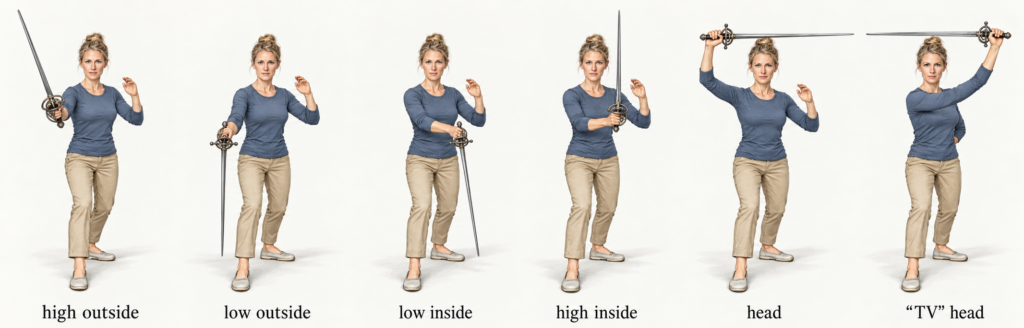
High Outside. With the hand palm up (supine, back-edge) it is called parry siste [6]. But it is sometimes called parry 5-A. With the hand palm down (prone, true-edge) it is called parry tierce [3].
Low Outside. With the hand in supination (back-edge) it is called parry octave [8]. With the hand in pronation (true-edge) it is called parry second [2].
Low Inside. With the hand palm down (prone, back-edge) it is called parry septime [7], but only for Olympic foil and epee fencing. With the hand palm up (supine, true-edge) it is called parry prime [1]. But in stage combat, those terms are reversed. A variation of parry [1] still leads with the knuckles but the wrist is turned around almost completely and the thumb pointing to the ground (true-edge). Meant for a very strong block, it is called the actor’s parry or better yet the “look-at-your watch” parry.
High Inside. With the hand palm up (true-edge) it is called parry quarte [4]. With the hand palm down (back-edge) it is considered parry quinte in epee and foil fencing, but stage combat tradition does not recognize this parry, so they do not name it.
Blocking a Head Cut – With the elbow rising normally, it is parry quinte [5]. But it’s also sometimes called parry 6. When the elbow swung across the body before lifting the sword, it is called 5-A, or the “TV” parry, because it frames the face so nicely. True-edge is used either way.
Why is the numbering so difficult? Because it comes from many sources, none of them specifically meant for stage combat. If you practice the first five numbered parries in order (especially starting with the actor’s parry of prime) you’ll see that they are all very strong block, all leading with the knuckles, meant for stopping strong cuts. That makes sense when swords were heavy bashing tools. The other three [6,7,8] can only be used as true parries since they use the weaker edge, the thumb side, to deflect a thrust. They developed as rapier play emphasized the easier to deflect thrust. As I mentioned before, the action called parry quinte [5] in competitive fencing is unnamed in stage combat. Interestingly, the action is actually used quite a bit, but there you are.
I should also mention something about the hand position. We call it prone or supine because, again, the terminology is a legacy of real fencing. When they do a parry, the blade is pointing only slightly up or down, so the hand really is either prone or supine, that is palm down or palm up. But in stage combat we try to pull the tip either straight up or straight down, so really the hand should be described as either palm towards the opponent or towards yourself. But there you are – another legacy that adds confusion rather than clarity.
There is real value in knowing when to use tierce instead of siste, or second instead of octave, but the benefit is in the movement, not the naming. A combination such as 2,6,2 is faster and easier on the wrist than 8,6,8, even though both sets of moves protect against the same combination attack. Choreographers will work out those details when designing the fight, so the value is huge for them, but I just hate seeing actors trying to rehearse a fight and calling out to each other the order of the parries. Inevitably it ends up confusing to both.
“8, 3, 5, 7, 6, 1, 3, 6, 4, 3…”
“Wait, I thought it was 7, 6, 5, 3 …”
“From the 1 or from the tierce?”
“Is tierce 3? Which one? The first 3 or the second 3?”
“The 3 after the 1”
“That’s an 8 before the 3…”
There is a better way, and we’ll get to that in another chapter – Choreographic Notation.