This page is still under construction, and lacks the necessary diagrams and images.
Until I can get them in, please look at this YouTube video. Starting at about 10:30, it fully describes the notation system I use.
As promised, I’m going to show you a much easier way of notating a fight than using the French parry numbers. I have seen that this is also the best way to memorize a fight. The following system isn’t mine, but I have made some modifications to it over the years. It uses numbers at their most efficient – showing the sequence of moves using regular counting numbers, because everyone knows how to count.
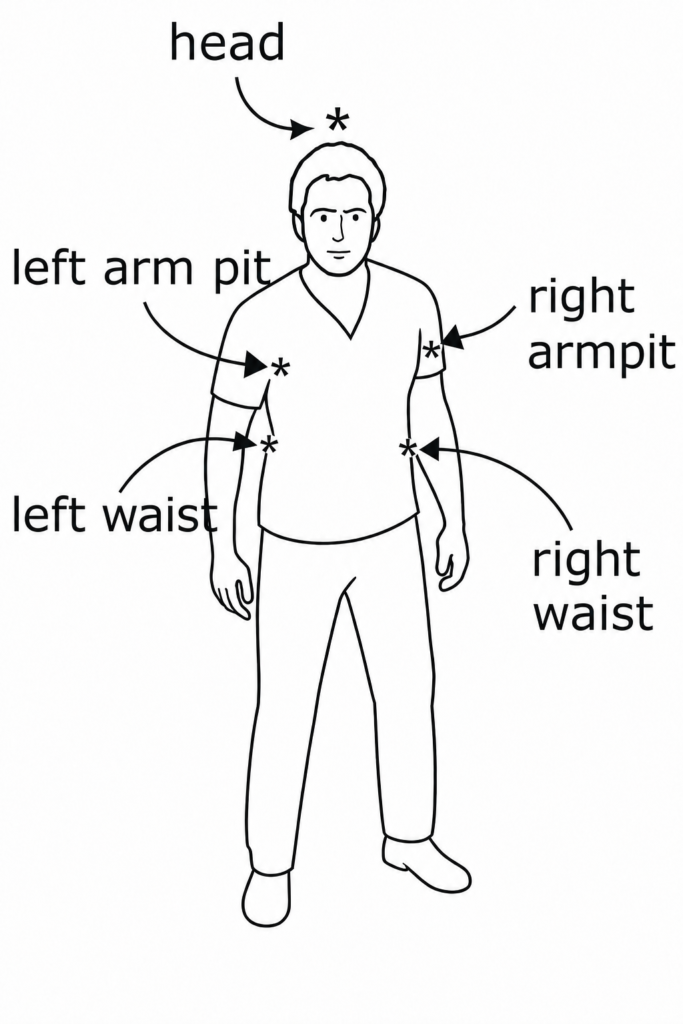
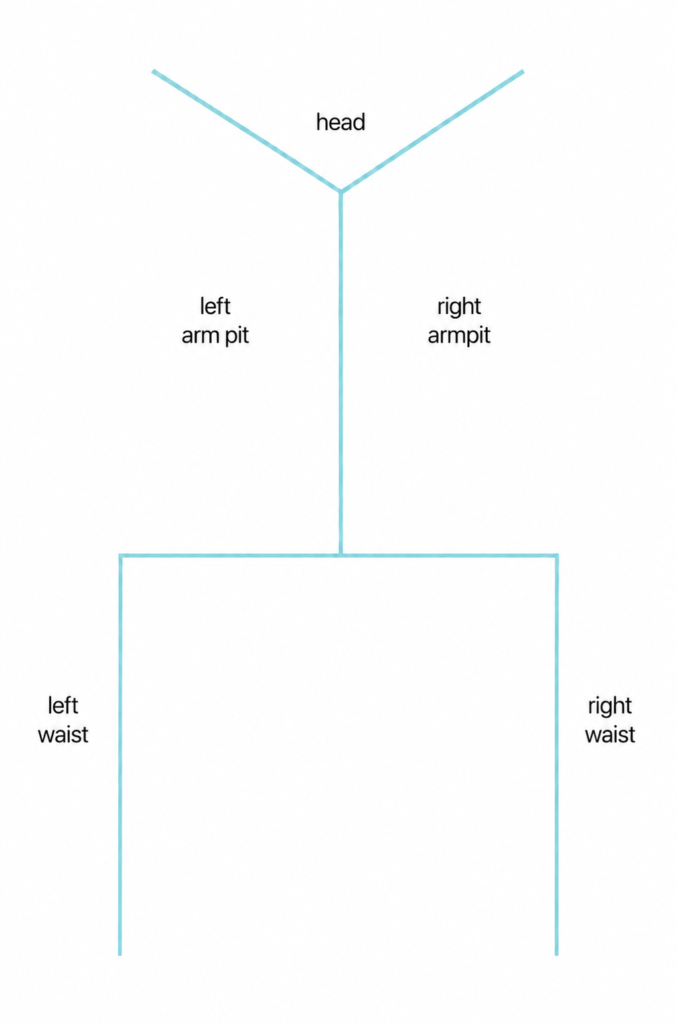
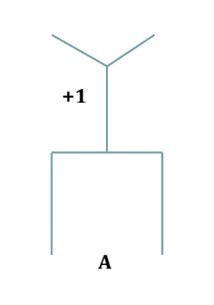
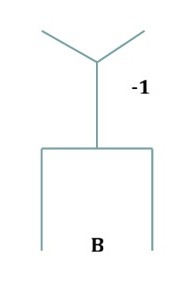
This little stick figure is not poor representation of the human form but instead a way to show the division of the five common target points for attacks and defenses. This is always going to be used to diagram your view of your partner. But the numbers are to indicate what you are going to do. Anything written in the upper V portion refers to an attack or defense for the head. Anything on either side of the center line is an attack or defense to the high line, and anything on either side of the lower box refers to moves on the low line. [Remember that high line means exactly armpit level; low line means belly button level, not an inch or two above]. The inside of the box is left for those things not part of regular swordplay, such as attack to the foot, throwing a punch, etc. When there is a “+”, you are attacking; when there is a “-”, you are defending.
The following is a completely arbitrary sequence of attacks and defenses:
The numbers in this case refer only to the order of the moves. It doesn’t matter that the “3” is higher than the “1”; they both go to the same target, namely, to the left (your partner’s right shoulder). If there is a “+” in front of the number, it means that it is an attack. If there is a “-” in front of the number, it means it is a defense. Slowly go through the motions shown in the above filled-in figure. If you still aren’t sure about the mechanics of sword work, don’t worry. If the number has a “+” just stick your arm straight out and point at the target. If it has a “-”, bend your elbow and bring your hand all the way to your own body.
So looking at the above figure, we would describe your seven moves like this:
1) attack to the left high line (your partner’s right)
2) parry an attack to your right low line
3) attack to the left high line (your partner’s right)
4) block a vertical cut to your head
5) parry an attack to your right high line
6) attack to the right low line (your partner’s left)
7) attack to the left low line (your partner’s right)
Now let’s see your opponent’s view of the same fight sequence:
As you can see, your partner’s choreography is the mirror image of yours, which makes sense because each attack will have a matching defense and one person’s left is the other person’s right. And while your parter is doing the above choreography, he sees you doing this:
See: that’s you doing the first set of moves, but from your partner’s vantage point.
What’s really great about this is that two actors can practice the hand movements without their partner being present, even without swords in their hands, and still memorize what is the hardest part of the fight – the sequence of attacks. I usually provide my actors with the written transcription of the fight on the first rehearsal, and even with complete novices they are able to read, understand, and replicate the entire fight within 30 minutes of instruction.
But what about the foot movement? What about the palm being prone or supine? What about cuts vs thrusts? There are some fight directors who need to have every body movement transcribed, but the actors don’t need that. They’ll pick-up the foot movement and the fine tuning of the sword movements very quickly in the course of teaching them the choreography, just as they pick up intention and emotional response in the course of rehearsing their acting. If the actor needs a reminder here and there that a certain move must be a thrust rather than a cut, then he will make his own notation of a “t” rather than a “c” next to the number.
When I hand out the printed choreography to the actors, I’ll usually add a written description of each move next to the diagram as a record of what the moves are supposed to be. That way if there is a question and I’m not there they can simply go to the master instruction list. But I try to keep the diagram itself as clear and simple as possible. The actors need to memorize the fight first before they can feel comfortable enough to add anything approaching finesse. From what I’ve seen, using this diagrammatic notation is the easiest way to do so.
Getting from Move to Move
Let’s try an even simpler pattern and see how to link some of these attacks and defenses. There is very little absolute right and wrong in this except that we must never violate the two cardinal rules of sword play: 1) protect the center and 2) stay away from the face. Protecting the center is all about maintaining the illusion that your opponent is actually trying to kill you, so the defenses must always radiate out from the center of what is being protected. And staying away from the face is about the very real danger that these even blunted weapons can cause. The tip of the sword must never point at or cross in front of anyone’s face at any time for any reason.
Side A Side B
As you can see, we have side A doing a series of four consecutive attacks. But right now, we’re going to focus on side B, the defenses. Let’s assume that B starts with the hand at center in a standard en guarde. The first parry is therefore going to be a very simple drift of the hand to the right and lifting the tip up. Moving to the second parry is really just a wrist movement. The hand can stay where it is as the blade makes a counterclockwise half circle in front of the body until the tip is pointing down. That half circle has to be big enough to go around the level of A’s head.
The third parry is as simple as the first, simply moving the hand from right to left and leaving the tip pointing down. The fourth attack continues the circle, and here is where some actors get into trouble. They will often try to follow the attack in a clockwise half circle. What they don’t anticipate is that once that chase catches up with the attack, their own blade will push the attacking tip right into their own body. What went wrong? They forgot the first commandment of blocking – clear the center. To get from the third to the fourth parry, the hand stays where it is as the wrist makes the blade do a counterclockwise half circle. Again, it has to be pretty big to both cover the center and stay away from your partner’s face.
Let’s go back to the arbitrary choreography that I laid out before.
There is a standard back-and-forth on the first three moves, and then if you are right handed the head block on move four leaves your elbow pointing to the right. If from there you go to number 5 by just dropping your elbow, there is a good chance that the incoming thrust is going to get inside your block, putting you in real danger. Instead, from 4 your hand should drop down to the center of your torso while lifting the tip, and then move the sword to the right.
Now, for fun, try making move number five a hanging parry, that is the hand held high but the tip pointing down. From the head block on four, you can almost leave the elbow where it is and let the blade swing down to protect the high line, and then continue nonstop to the attack on six. Which way is right? Whichever serves the storyline better.
Looking at the complementary moves, again the first three moves are simple back-and-forth, and the attacks of four and five are likewise fairly intuitive. But the natural reaction of continuing straight down on the left side for the parry (#6) can get you into trouble if you don’t clear the center. From five you’ll need to pull the tip back and to the left, parallel to the floor, and then make the blade travel in a 270 degree clockwise circle between the two of you until it make the block on the lower left.
To get to the last move, one of course would normally slide the hand from left to right. But what if instead, you make a full counterclockwise circle? Added to the previous move it makes for quite a flashy combination. What does it suggest to you, compared to the simpler version? Arrogance? Panic? Think of variations whenever you work through choreography and see how a slight change can affect the emotional tone of the pattern. Don’t change the moves, just the way they are presented.
Adding the Dagger
“what is his weapon?”
“Rapier and dagger.”
“Well, that’s two of his weapons, but no matter.”
A little joke from Hamlet.
Fighting with the dagger uses the same techniques as those for the rapier. All of the cuts, thrusts, and blocks for one can be used for the other, and with two weapons we have a few other options as well. Simultaneous attacks are possible, as well as using both weapons to block a single powerful cut, either as a parallel block [both weapons pointing either up or down] or a cross block [the weapons forming an “X” in the air and catching the incoming cut in the formed “v” shape of the crossed blades]. The sword is the historically the primary attacking weapon and the dagger is the primary blocking tool, but in a staged fight both weapons are used in both capacities for added visual excitement. For example, the sword might be used to parry an attack, but then the dagger is brought up to replace the sword, “holding” that attacking blade in place (called a transfer parry), which frees the defending sword to initiate its own attack.
When two weapons are used, the stances of the fighters usually change. You’ll recall that in single rapier fighting the lead foot and the sword hand are on the same side, usually the right. In rapier and dagger, with the rapier held in the right hand, by standing with the left foot and left shoulder forward both weapon tips are equally distant to the opponent, and therefore equally dangerous. Which hand is held high and which is held low is up to the fighter, and would change constantly during a fight anyway in order to confuse the opponent.
Let’s go beck to the previous fight phrase that we worked out to see a little rapier and dagger fighting. In notating the moves, we’ll add “R” and “L” to each number so as to designate which hand is to be used, right or left.
And, of course, the opponent’s moves:
Side A Side B
If we try to extrapolate a little story from side A, we might say that he starts off by confidently using only his dominant weapon for the first three moves (the sword), then has to use a cross block with both weapons on move 4 in order to protect his head, immediately uses the sword to protect his right flank, and then aggressively uses the dagger to push his opponent back in move 6.
For side B, he is playing it conservatively, rather predictably using his right hand on the right side, left hand on the left. However, he does take advantage of an apparent opening when, after the vertical head shot on 4, he goes right to a high line attack on move 5 with the same weapon, probably as a compound attack.
Just for fun, let’s try different hands doing the same sequence.
And, for the partner:
Side A Side B
So the pattern of attacks and defenses hasn’t changed, but the phrase now has a very different feel. For side A, there is a strong feeling that he’s holding his sword in reserve, waiting for the right moment to strike, which he finally does in the last two moves.
Side B has what at first seem to be ungainly combinations, but this can be used to the actor’s advantage. Taken one way, the character could be in dire straights, desperately attempting to survive the fight without being able to construct a viable strategy. On the other hand, get creative with all of these moves that make the arms cross in front of the body. They open up great opportunities for elaborate circular arm moves or even spinning the body from move to move.