
© 2009 Richard Pallaziol, Weapons of Choice ™- all rights reserved
The birthplace of humanity is found in the plains of the great continent, and with the earliest human fossilized remains we find the first tools – and the first weapons. A full survey of all of the cultures, empires, and battles of Africa is beyond the scope of this (or any single) book, so I’ll just point out a couple of examples.
Raiding parties. Before the conquest of the continent during European colonization, most coastal kingdoms and tribes conducted trade with neighboring tribes, and with a certain frequency would conduct raids on their neighbors as well. Though many achieved great wealth and ofttimes the subjugation of tribes within a large area, the action of raiding warfare followed the broad basic strategy as the same raids seen in pre-iron cultures the world over. The specific intent was usually to steal cattle, food, or even land, and a side benefit was the taking of captives both male and female for use as slaves. A number of the most physically fit members of the tribe would attack either isolated members of the opposing tribe or attack at a time when the population would not be able to mount a counter attack. Should they find themselves confronted with serious resistance, the raid would be abandoned. If the tribes were of relatively equal strength or size, each raid would in time lead to a reprisal raid. Deaths were not planned, but were hardly unknown. The most isolated tribes still retain some aspects of this raiding warfare style to this day, especially where grazing land is scarce due to the thickness of flora or paucity of arable land.
Weapons were universally spears, knives, axes, and clubs. It is interesting to note that Sub-Saharan Africa never went through a bronze age, their first metal for tools being iron, usually of exceptional quality. Iron (and then steel) full length swords were introduced very early on in those areas in the north and east that had trade contact with the Middle East and the Mediterranean (Sudan being the best example), but the trend didn’t extend into the south, center, or west of the continent. An exception is the Masai, who have beautiful elongated leaf-shaped blades on simple handles with no guards. But then again these nomads of Kenya originated in Sudan, and brought their technology with them.
Much of Northern Africa maintained extensive trade with the Middle East, India, and China, so a variety of weapons are found amoung these post-Carthage, post-Pharaohic kingdoms. As several had access to and bred exceptional stocks of horses, many also adapted fighting with lance and archery from horseback.
Attempts to include regional differences in weaponry when mounting a show is laudable, but can be very difficult, for the vast majority of weapons that are in museums have turned out to be purely ceremonial or were constructed for trade between tribes, so either way were never intended for battle. For example, the vast collection of “throwing” knives that intrigued the European explorers of the 19th century have turned out to have been either used as currency or were hacking tools, never thrown. The exception is among certain tribes in the Congo, especially around Zaire (most strikingly the Zande tribe) and southern Sudan, where knives were thrown, and it seems only for two distinct purposes:
1] As the Saharan warriors often had horses and lances, the large throwing knives, thrown Frisbee-like rather than overhand, would have been an extremely effective weapon against a mounted combatant, better than a thrown spear. It is certainly possible that the throwing knives were developed near the Saharan border and then the practice migrated south.
2] Be that as it may, for the tribes of the Kongo kingdom (modern Zaire) these weapons were part of their ritual warfare. When fighting against other non-horsed tribes, the throwing knifes and spears were used on behalf of the chief for their set-piece battles, never for raiding. The defense against the missiles consisted of using a very large wicker shield to deflect the higher missiles and very athletic leaps if the knives were thrown low. Many of these moves survive in their traditional battle dances.
The great generalization can be made that the areas of savanna and desert tend to have nomadic herders, while the tribes dwelling in jungle and woodland tended towards agriculture. The herders tended toward more practical weapons, while the farmers/gatherers tended to the more ceremonial and ornate. But throughout, there are few weapons that can be described as swords. Shorter edged weapons were definitely daggers, and the longer pieces were more like impaling or puncturing weapons and are akin to short pikes. These are also seen with greater frequency among the cattle herding tribes of central Africa.
The countries with direct access to the Mediterranean and to the Red Sea had the edged sword very early on, often purchasing full length blades from Middle Eastern manufacturers and then fitting their own hilts, but based on existing European and Arabian layouts. What we would consider single hand medieval broadswords were in common use throughout Northern Africa, and indeed were more common than curved blades. Curved weapons, however, were usually much more exaggerated than Arab designs, with many interesting shapes and more severe curvatures in the blades.
Of special interest to fight choreographers is that Sudanese nomads often wore an arm dagger, strapped to the left forearm with the blade tip at the elbow. From that placement we can assume that the knife was pulled and used by the right hand in a standard overhand grip. From this we must also deduce that it was a defensive tool, a weapon of last resort.
In areas where cattle were raised in larger numbers, raiding existed along with “primitive” warfare. From time immemorial, the essential pattern of warfare in the South African region was a ritualized affair, either as an escalation of several raids or as a result of insults, perceived or otherwise. For these larger set-piece battles, warriors consisted of virtually the entire tribal population, meeting at opposite ends of a prearranged field. The bravest male contingencies from both sides would stand in the front lines, hurling occasional spears and a constant shower of verbal invective. Bravery was proven by standing in the middle of the spear and arrow landing zone and evading the projectiles at the last moment. If anyone’s arrow or spear actually killed someone, the fighter who threw the spear would immediately withdraw from the battlefield and perform a purification ritual. Most of the spears could be safely evaded, and after a time one side would seem to have demonstrated more martial spirit, intimidating the other side into submission. For the most part these were civilized and quite bloodless affairs. Thus it might have remained were it not for one brilliant and ruthless ruler.
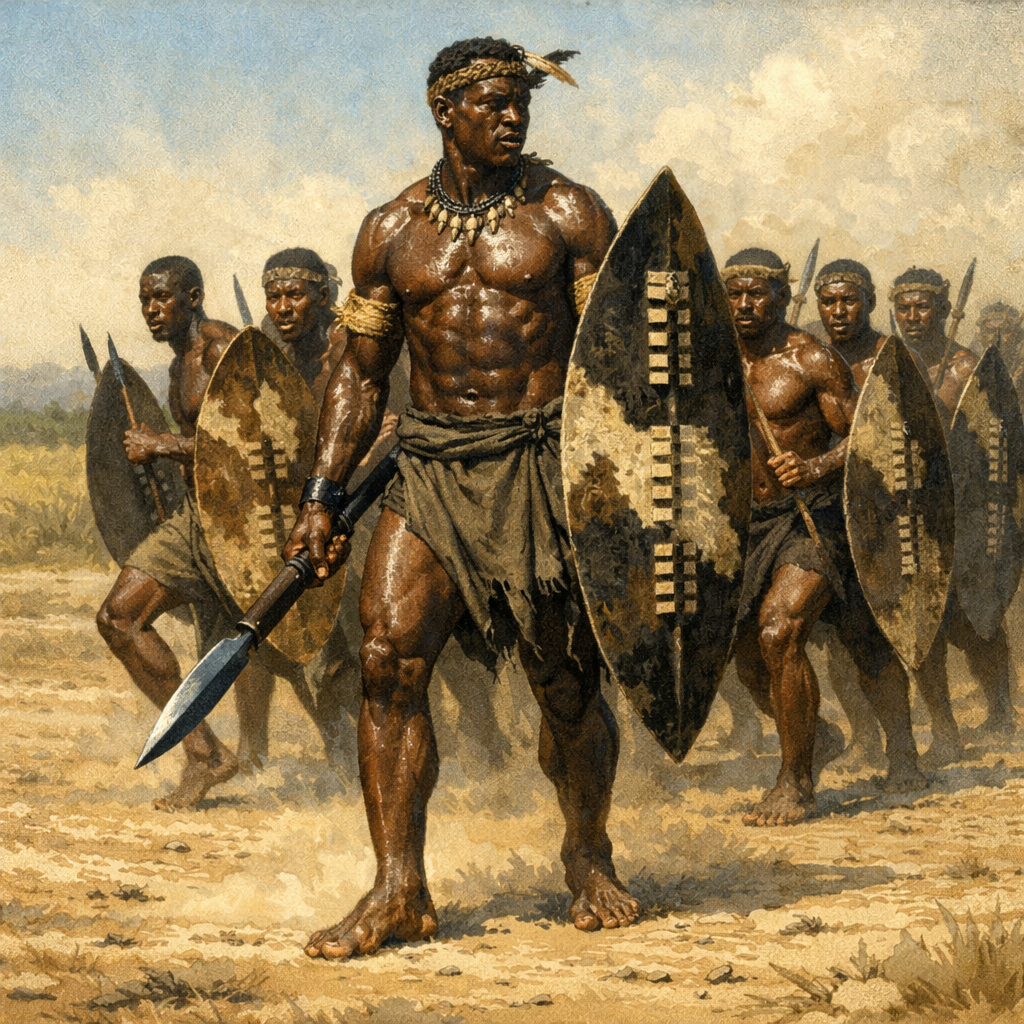
Shaka Zulu was born an illegitimate and early on was cast out with his mother to a neighboring tribe. Once he began military training he convinced his new chief to allow him to lead one small band of warriors in a training program of his own devising. Every aspect of tactics, strategy and materials was overhauled. The thin sandals, which he felt gave poor footing, were discarded and his warriors went barefoot. The spear was reduced to four feet long, but now fitted with a heavy foot-long cutting head. The shield was given a new pointed elliptical shape. His warriors were also specifically drilled in conditioning exercises as well as detailed martial arts training.
The first battle with his new army was a terrifying spectacle. Shaka’s troops charged the opposing force, ignoring the few spears which were thrown at them and holding onto [not throwing] their own. As soon as they reached the front line, they used the points of their shields to scoop up the round shields of their opponents, exposing the lower torso, into which was thrust the heavy tip of the new spear, instantly disemboweling the enemy. (The new spears were named “iklwa” – an approximation of the sound made when thrusting and pulling it out of the enemy’s body) The destruction of the enemy was total, as was the terror of the survivors who fled the field.
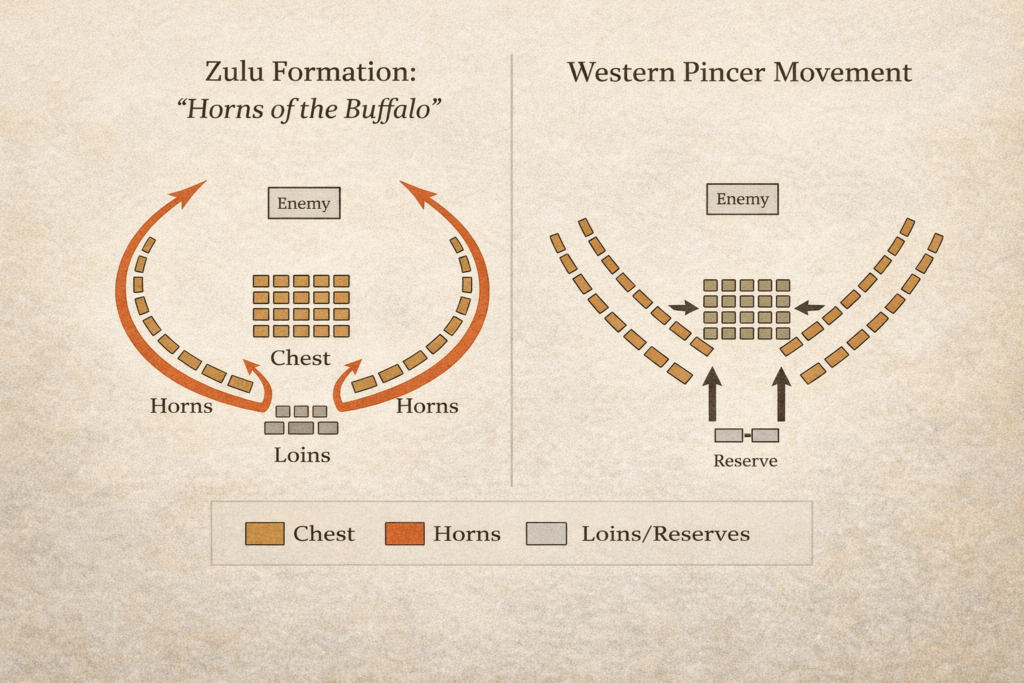
Shaka went on to become a general of his adoptive tribe, then conqueror and chief of his birth tribe, and finally emperor of the vast area known as Zululand. During his reign from 1816 to 1828, his enemies tried to adapt to the new battle style, but he adapted faster. Turning his attention from tactics to strategy, he developed a battle formation of a central powerful line supported by two faster moving wings, which he referred to as the “horns of the bull”. The horns were used to control the movement of the enemy, and then finally crush the opposing army in what was known in Europe as a pincer movement.
As Shaka increased in power so did his ruthlessness and his insistence on absolute discipline. To make sure that his warriors had toughened the soles of their feet sufficiently, he tested them by having them dance barefoot in a kraal covered with nettles. Any soldier who so much as flinched was instantly killed with a spear.
One can only guess as to what might have been the future of the region had not the English arrived in force in the late 1800’s. Perhaps the creation of another Rome or China. But the rapid fire machine guns and accurate rifles of the Europeans soon led to the destruction of Zulu control of their empire, though not before giving the English their worst fear of their sub-Saharan campaign.
The training required for Zulu warriors was far more expansive than that of other African nations, but it was not particularly intricate or complicated. The training centered on toughening up the warriors to enured to pain. A “sport” amoung the younger warriors involved a form of stick fighting, with poles the length of the shield and spear that they would later use as full-fledged warriors. Some of these training moves still survive today, although the schools of “Zulu martial arts” that have sprung up in the United States are a poor blending of Asian techniques modified for African weapons. These schools and the techniques that they teach have no real correlation to any historical practices.
By the time Europeans began carving up the continent to secure slaves, diamonds and gold, native resistance throughout Africa followed a familiar pattern. Most insurgents, although large in number, fought with spear and sword. Although possessing a fair number of trade rifles, the quality of the firearms sold to natives was usually at least one generation behind whatever the invading Europeans were using. Spare parts were nonexistent as were quality gunpowder and bullets. Many native contingents never mastered firing from the shoulder, preferring to fire from the hip or from outstretched arms to avoid painful recoil, but this also meant that shots rarely found their mark. Their most successful tactic was usually the massed infantry charge, but even when fully armed with modern repeating rifles and capable of implementing sophisticated tactics, they were no match against cannon, artillery and machine guns.