
© 2009 Richard Pallaziol, Weapons of Choice ™- all rights reserved
Mayans, Aztecs, and Incas
It is grossly unfair to lump these three empires together, separated as they were by time and geography. But they are distinct from other native North American cultures, in that these all had centralized governments led by emperors (considered to be divine) with assistance from a well developed hereditary bureaucracy. Wealth to maintain power came both from agricultural production and tribute from both allied and conquered lesser kingdoms. Dominion was periodically reestablished by use of large scale raiding wars.
In studying them as warriors they show remarkable similarities as well. All three great empires used no metal weapons nor ever developed the wheel into a method of transportation. This is especially surprising for the Incas, as they were expert in all aspects of metal working, save that of iron.
Raiding wars within these cultures were driven by ritual. Only worthy warriors would engage in battle, and the object was to take live prisoners of as high rank as possible. The captives were not returned after payment of ransom; as a matter of fact they were not returned at all. We know from Aztec documentation that the captives were feted and honored by their captors for several days, even referred to as “son”, and the village would make a public show of mourning their soon-to-be deaths. The majority of the captives were sacrificed outright in a ceremony that theatrically created an idealized version of the submission and destruction of the enemy. Captive warriors of high rank would be subjected to a ritual of gladiatorial combat, tied to a central disk platform and given blunted clubs, fighting against heavily armored warriors using sharpened weapons. To die in such a manner was considered by both victor and victim to be highly honorable.
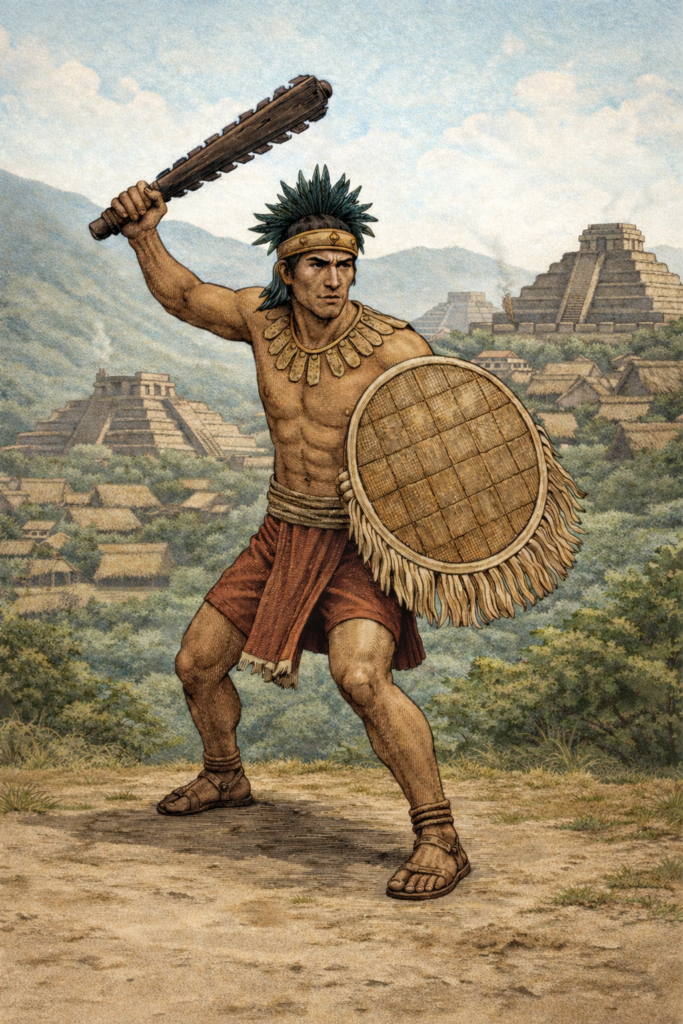
On the battlefield, set-piece battles would start with archers and slingers showering missiles into the enemy, containing the movement of the enemy to prevent encirclement. The elite warriors would fight in the center with spears or clubs meant to break a man’s leg or knock him unconscious so he could be taken away as a captive. The most feared weapon, used by both the Mayans and the Aztecs, was the macuahuitl, a wooden club lined on both edges with obsidian. Such a weapon combined the attributes of both battle ax and broadsword, and accounts from the Conquistadors describe warriors cleaving horses in two with a single stroke of this formidable sword/club. Unfortunately, no macuahuitl survives.
Use of a wooden shield strapped to the forearm was common. Only the victors would be allowed to keep the captives after the fight. Any captives taken by the losing side were immediately released. Once a battle was won, the vanquished would return to their village or city, and the specifics of tribute payment would be worked out by emissaries. None of this prevented many battles from being bloody affairs. The destruction of an opposing tribe was never the intention of battle, although a great many warriors might die.
It is very easy to ascribe the downfall of the Aztecs and Inca to the Spanish superiority of weapons, armor, and horses. In truth, the Spanish were even more assisted by the virulence of European bacteria, the treachery of local client kingdoms against their overlords, and the unwillingness of the warriors to simply overwhelm the Spanish with shear numbers or fight with the intent of killing. In the one battle in which the Aztecs did change their tactics and fought to kill, the Spaniards quickly lost and were nearly wiped out. If the Aztecs had fought for only one more day using the same methods, the later history of Mesoamerica might be completely different.
Weapons Available
Aztec and Mayan – Obsidian-tipped spears. Obsidian-edged wooden weapons. Macuahuitl, single or double-hand. Round shields (chimalli). Slings, bows, and arrows. Metal known but rarely used for warfare.
Incas – No true spear in the European sense, but commonly employed long darts—essentially light javelins approximately five to seven feet long—launched with the aid of a spear-thrower (atlatl), greatly increasing their range and striking power. Slings were among their most effective battlefield weapons, capable of hurling stones with remarkable force and accuracy at considerable distances. Warriors also threw stones by hand when fighting at close quarters. Melee weapons included wooden and composite maces fitted with stone, bronze, or star-shaped heads; clubs reinforced with hard materials; and T-shaped stone axe-heads lashed onto wooden shafts, wielded much like a battle-axe or halberd. Some regions of the empire also employed short stabbing spears and pole weapons, though these were generally less prominent than missile weapons and maces.
Among the tropical forest tribes outside of the influence of empires, simple spears, usually thrown, and sharpened stone club/daggers. Also what the Spanish would term the macana, a double-edged, single handed hardwood club found from the Caribbean to the Amazon headwaters. The blowgun, common among Amazon River basin tribes, could shoot out a poison-tipped dart with accuracy to about 30 to 60 feet, but these were hunting instruments, not used in warfare. The amount of poison on the dart would be enough to kill a bird or small monkey, but poorly suited to be an effective weapon against a human.