Knife Props and Safety

Knives vs. Daggers

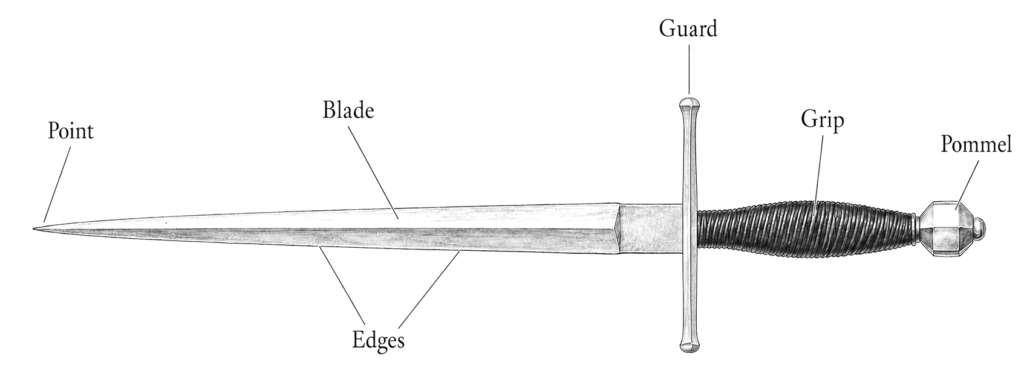
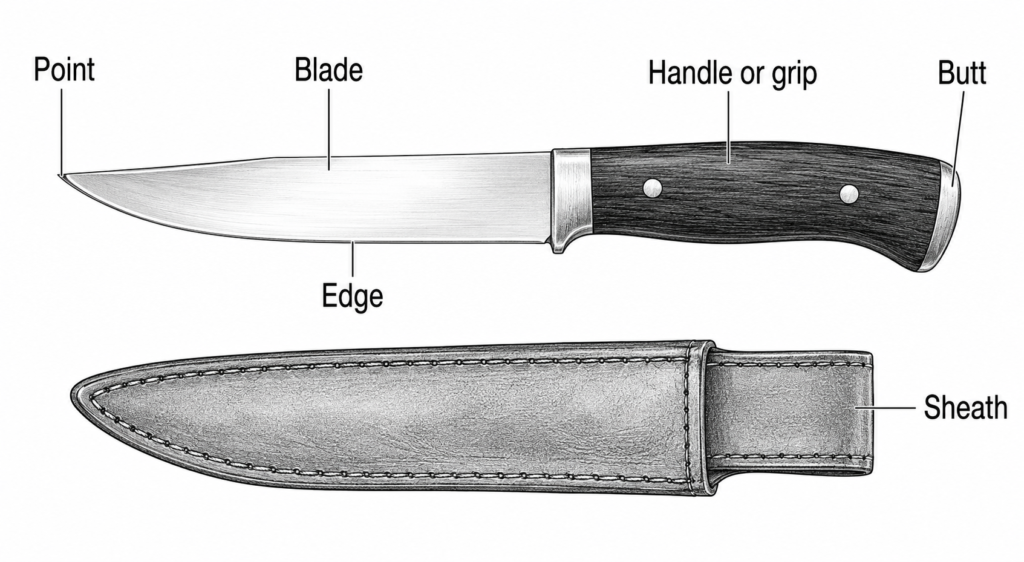
Although knives are sometimes used as weapons, they are fundamentally utilitarian tools; this distinguishes them from daggers, which are purpose-built for thrusting and killing a human being.

Selecting Real Knives for Stage Use

Since most real knives, even inexpensive ones, are quite strong, you rarely need to worry about fight-worthiness. If you are purchasing a knife for stage use, you can’t do much better than finding what you need at a garage sale or thrift store for a few dollars, then grinding down the edge and tip until they are no longer sharp. Done properly, this makes the knife as safe as any other solid prop.

But please note that this approach assumes a solid, one-piece construction with a sound tang; decorative or novelty knives should be avoided entirely. And, as with swords, always check for proper temper. Some blades will not bend when tested and will instead snap suddenly. If a blade resists bending during a flex test and gives no sense of elastic “give,” stop immediately—blades that behave this way tend to snap rather than deform.

When in doubt, trust your instincts and pass it up.

Blade lengths come large and small, thick and thin, but there are a few specialty styles that you might be asked to find:

Retractable (Collapsible) Knives

Retractable knives – Also called collapsible knives. Here is a prop that can never be made safe. A retractable knife has a floating blade rather than a fixed blade. Inside the hollow grip, the shortened blade tang is surrounded by a compression spring. When the tip of the blade is pressed against something, the blade retracts into the handle, and then is pushed back out by the spring when the “stab” is over. Well, most of the time.

There are other times when the blade presses ever so slightly along the edge of the handle opening. When that happens, the blade does not retract and the actor gets impaled with a blunt “fake” blade. That is exactly what happened rather famously during a performance at an opera in New York. The singer was not only impaled, but she suffered a collapsed lung which could easily have proved fatal. When examined, the knife was found to be in perfect working order. Insurance companies began reviewing the injury rates related to these items and concluded that they are too dangerous to use. Most insurance carriers will not cover injury claims for a show in which a retractable is used, even if the injury had nothing to do with the knife, because they consider the use of retractables to be proof of an unsafe work environment. I consider them so dangerous that when I go to theatres to evaluate their weapons stock, I advise immediately destroying any retractables I find, metal or plastic. A retractable knife cannot be constructed, designed or retrofitted to be safe.

In case anyone is missing my point here, let me simplify. All retractables must be destroyed.

Gravity, Flick, and Out-the-Front Knives

The following knives are sometimes suggested as “safe alternatives” to retractables. They are not.

Gravity Knife – Also called a flick knife, the blade has no tang and again floats in the handle. Unlike the retractable, there is no spring inside to push the blade out. Instead, a small spring presses against the side of the blade, holding it in place. When an exterior button is pressed, the spring is lifted, allowing the blade to drop into any new position until the button is released. The blade can drop in or out according to gravity (hence the name), or with a little practice it can pop up with a flick of the wrist (hence the other name). Never use a flick knife as a retractable. It is just as deadly, possibly more so. Since there is no spring to push on the blade, the mechanism to hold the blade in place has to be even stronger than on a switchblade.

Paratrooper’s Knife – Also called an OTF [out-the-front] switchblade. Just as in the gravity knife, the blade lives in the hollow handle until it pops out of one end, but this knife is double spring activated. A simple slide switch on the side of the handle can both open and close the knife with one hand. Pretty rare nowadays, but since you might run across one and someone suggests using it as a retractable, let me just say: extremely dangerous.

Switchblades: Legal and Practical Considerations

Switchblade – This type of knife has a pivoting blade like a folding knife, but with a spring-loaded mechanism that opens the blade automatically when a button is pressed. The blade swings out sideways and locks in the open position until a release tab is pressed, allowing it to be folded closed. Switchblades open with one hand and close with two.

In California, civilian possession and use of switchblades is tightly restricted. A switchblade with a blade two inches or longer may not be carried in public, transported in a vehicle in a public place, sold, or transferred, and violations are typically charged as misdemeanors. However, this does not prohibit the construction or possession of such knives entirely: a switchblade may be built, modified, or held for a production within a film studio or theatre, provided it does not leave the premises or enter public space. In practice, this means that a switchblade can exist as a controlled prop inside a closed production environment, but it cannot legally travel to or from that environment.

Separately from state law, federal regulations restrict the interstate commercial sale and mailing of switchblades, including shipment through the U.S. Postal Service. These federal transport restrictions apply regardless of state legality and are especially relevant when props are shipped, rented, or transferred between productions in different states. You can’t.

Stage-Safe Switchblade Alternative

For productions, the simplest and safest solution is the switchblade comb or other inert automatic prop. These contain no sharpen-able blade, are legal to own, carry, and ship, and deliver the correct look without legal or safety risk. If a visible “blade” is needed, remove the comb insert and replace it with a thin, lightweight, inert metal or plastic piece for wardrobe effect only—never a cutting edge. The goal is purely cosmetic: a visible object that reads as a knife without introducing cutting mass or momentum.

Here’s how:

Converting a Switchblade Comb for Stage Use

  • Open the comb several times and check the strength of the spring; there is no need to waste time if the comb starts out defective.
  • Notice that the “safety” tends to slide on its own, so you will need to put a drop of glue or a small piece of tape on it to ensure that you can always open the knife.
  • Spread open the spine of the comb by sliding a strong knife blade in between the spine and the plastic comb, gently wiggling the blade to pry the spine open and continuing along its length.
  • Separate the plastic comb from the spine, then cut off the plastic comb just where the teeth begin, taking care not to remove the bottom piece of plastic.
  • With a pair of tin-snips, cut out a length of very thin aluminum for your blade; an aluminum soft drink can works out fine. (Use the piece of comb that you cut out as a template for the width, but give the length an extra inch or two to make your life easier. Some people try to use thin steel for the blade, but the spring mechanism of the comb simply can’t take the extra weight, and the comb starts to fail in just a few rehearsals.)
  • Slip the “blade” into the spine, making sure that you are not covering the small hole on one side of the spine base.
  • Close down the spine to secure the blade in place; a couple of turns on a table vise work best, because you want a nice, even flattened finish in order for the blade to operate easily. Finally, using the tin-snips again, trim the blade so that it has the shape you want.

That should be it. If the assembly went well, the knife should be working fine. If not, or if the knife starts to fail in the future, try the following fixes. Naturally, these things don’t last forever, but before you throw it away, one of them just might prolong the life of your prop.

Troubleshooting and Maintenance

First, keep in mind that the handle is where the blade lives, so is of necessity hollow. It is also made of very thin soft aluminum, so each time that you press the release button, or even stick it in your pocket, or even when we wrap them up to ship to you, it compresses slightly. Not enough so that you would notice, but every time it’s used the handle gets just a little bit squished.

The first clue that something is going wrong is that the blade won’t pop out, or if it does, it seems that the spring seems weak. It’s never the spring. Each time that the blade pops open, it should do with a satisfying smack. If it doesn’t, you’ll need to open up the handle.

In order to do that, you need to have the knife open, so you may need to hold the release button down and give the blade a good strong pull to release it. It might need a stronger tug than you think, so be a little assertive with it. Then stick a wide bladed tool into the handle just above where the release button is (as shown). Twist it back and forth a couple of times until the handle opens a bit. You don’t need to open the entire handle – just the area above the release button. That should do the trick. Nine times out of ten, this is the fix that fixes. This is also good periodic maintenance, and should be done about once a week or any time the blade feels slightly sluggish. [Sometimes the handle doesn’t get squished, but the release button itself will sink down and not rise up again. It’s actually a variation of the same problem, and the fix is the same as well.]

It didn’t work? It could be that the blade itself is slightly twisted or bent and is rubbing against some part of the inside of the handle. The blade is made of soft aluminum too, so if you can spot the bend, you should be able to twist it back using a pair of pliers or even just your hands.

On rare occasion there is a little bit of resistance at the pivot point. One drop of a light penetrating lubricant (such as WD-40) can reduce friction at the pivot. It certainly can’t hurt and might be all you need to bring it back to life.

Lastly, there is that silly safety button that slides up and down. What a nuisance. Just bring it down to the open position and either tape it in place or put in one drop of glue to keep it from moving.

After that, you’re on your own. But seriously, most times these will get the prop working again in only a few minutes.

Butterfly Knife

Something like a folding knife, but the blade pivots on two pieces that combine to make a handle. By holding the closed knife by one part of the handle, the other part can be swung around in a full circle. Swing one way, the blade is exposed; swing the other way, the blade is back inside the handle.

There are a couple of drawbacks on using this knife. All three parts are free moving, so the blade never locks into place, making it inherently weak and giving it a perpetually loose feel. Also, the opening of the knife requires some dexterity, for you have to catch the spinning part of the handle as the knife is opening in order to get the blade to stay open. More than a few knuckles have been soundly rapped during the learning process. In addition, its sale is being restricted in many states. Lastly, it has only limited theatrical use. The knife hasn’t been around for too long, was never terribly popular, and only seen on the street from the late 1970’s to the mid-1990’s. Even then it was more of a novelty than a serious knife fighter’s weapon.

Boot Knives and Concealed Fixed Blades

Boot knives and other small concealed fixed-blade knives are frequently requested for stage use, usually because the script calls for a weapon that is “hidden” and then revealed as a threat. In practice, they are almost always a problem.

From a physical standpoint alone, they work against the actor. A knife strapped inside or alongside a boot rubs constantly against the ankle and lower leg, quickly becoming distracting or painful over the course of a rehearsal. Retrieving it cleanly is also far more difficult than imagined. Fishing a knife out of a boot requires fine motor control, balance, and time—none of which read well on stage, and all of which introduce unnecessary risk.

More importantly, boot knives expose a common misunderstanding about how weapons read to an audience. A knife is not just a blade; it is blade and handle. The entire object must be concealed on the actor’s body, but when the knife is finally revealed, only the blade length is visible to the audience. If the blade is too short to be clearly visible from the house, the moment fails theatrically, regardless of how convincing it may feel onstage.

For that reason, any proposed boot knife should be tested early. Make up simple prototypes in different blade-and-handle combinations and have the director view them from the house. If the audience cannot clearly see the blade when it is presented as a threat, the knife is not doing its job. In most cases, this experiment leads to the same conclusion: the blade must be longer than can reasonably be concealed in a boot.

At this point, I want to stop speaking abstractly and speak directly to the fight director, the props master, and the costumer.
I have watched this problem unfold more times than I can count. A boot knife sounds clever on paper. It feels economical. It promises a hidden threat and a dramatic reveal. And then it quietly metastasizes into a technical failure that no one wants to own—until tech week, when there is no time left to solve it cleanly.

If you are any one of these three people, you must anticipate this problem early and head it off at the pass. Do not wait for rehearsals to reveal that the knife rubs the actor raw, that it takes too long or too much dexterity to retrieve, or that the blade simply does not read from the house. By then, everyone is already committed to the idea, and the production starts making compromises instead of decisions.

The reality is simple: for a knife to read as a threat, the blade must be clearly visible to the audience. That requirement almost always conflicts with what can be safely and comfortably concealed in a boot (or under a dress against a thigh, or in a bustier. When that conflict appears—and it almost always does—the correct solution is not to engineer harder, but to cut the business.

And in my experience, boot knife business is usually cut. The important thing is to discover that early on—before the first rehearsal—rather than scrambling during tech week to solve a problem that was structural from the start.


This guidance is written for prop masters, directors, and stage managers responsible for selecting and maintaining knife props. No knife prop is safe in isolation; safety depends on construction, choreography, distance, and repetition under controlled conditions.


Weapons of Choice