
Politics, Economy, Worldview
Early Celtic societies of Western Europe—particularly in the British Isles—were organized around warrior aristocracies, kin groups, and ritual authority rather than centralized states. Their power structures were personal, performative, and deeply symbolic. Political authority was inseparable from martial reputation, and social standing was earned visibly, not administered.
Political Structure
Celtic political organization centered on tribal kingship, but kingship of a distinctly non-bureaucratic kind. Kings ruled not through law codes, taxation, or standing officials, but through personal authority, lineage, and demonstrated martial excellence. A king was expected to lead in battle, arbitrate disputes, and embody the honor of the tribe.
Authority was reinforced by warrior elites rather than administrators. Loyalty was owed to the king as a person, not to an abstract office. Leadership could be challenged, replaced, or abandoned if it failed to deliver success, protection, or prestige.
Alongside kings existed a powerful priest-scholar class—the Druids—who functioned as judges, historians, ritual authorities, and custodians of memory. Their influence was cultural and moral rather than coercive, but it shaped legitimacy and continuity. Political power without ritual sanction was unstable.
There was no unified Celtic state. Tribes varied widely in size, strength, and cohesion, and alliances were temporary. This fragmentation made the Celts formidable in localized conflict but vulnerable to disciplined external powers.
Economy and Land
The Celtic economy was primarily agrarian and pastoral, supported by farming, herding, and seasonal movement. Unlike Slavic communal landholding, land was tied to kin groups and status. Wealth was measured in cattle, land, slaves, and war spoils rather than coin.
Trade existed, especially in prestige goods, but it served social display more than systemic growth. Imported items—metalwork, weapons, ornament—were used to reinforce status and identity rather than to transform economic structure.
Surplus supported a warrior class and a ritual elite, but not large populations or sustained campaigns. Warfare was episodic and intense rather than continuous.
Worldview and Values
Celtic worldview emphasized personal honor, visible courage, and reputation. Identity was performative: who you were depended on what you dared, endured, and displayed. Shame was a powerful social force; public failure carried lasting consequence.
Violence was not merely instrumental—it was expressive. Battle was a proving ground where individual valor mattered more than cohesion or restraint. Heroic death was culturally meaningful, and exposure to danger was a mark of excellence rather than recklessness.
Religion reinforced this orientation. Celtic belief systems emphasized cycles, transformation, and the permeability between worlds. Ritual sites, sacred groves, and seasonal observances anchored spiritual life. There was little emphasis on moral absolutism; instead, meaning emerged through participation in ritual, conflict, and memory.
Women could hold significant power within this framework. Historical and literary sources attest to female leaders, warriors, and figures of authority—less constrained by formal hierarchy than in later feudal systems.
Violence and Authority
Violence was central to legitimacy. A leader who could not fight—or who avoided risk—was diminished. Yet this did not produce chaos. Violence was ritualized, anticipated, and socially meaningful, governed by expectation rather than codified law.
Authority was therefore fragile but vivid. It depended on continued performance, not institutional continuity. This made Celtic societies brilliant in moments of crisis and display, but less suited to prolonged political consolidation.
Theatrical Implications
Onstage, Celtic characters should feel intense, expressive, and unrestrained, but not disordered. Status is asserted through presence, speech, and willingness to risk exposure. Leadership is charismatic and volatile. Violence is direct, emotional, and personal.
This is a culture where courage is currency, memory is law, and the body itself is a site of meaning. The Celts do not defend systems or exploit them—they embody them.
Fashion / Manners
Celtic dress and manners were expressive, symbolic, and deliberately conspicuous. Appearance was not merely functional; it was a means of asserting identity, courage, and social position. Where Slavic dress minimizes distinction and Viking clothing supports mobility, Celtic presentation embraces visibility and display.
Dress and Appearance
Celtic clothing varied widely by region and status, but certain patterns recur. Wool was the primary fabric, supplemented by linen where available. Tunics were common, often belted, with trousers worn by many groups in the British Isles—an item Romans famously associated with “barbarism,” but which was practical and well established.
Color mattered greatly. Celtic clothing was frequently dyed, sometimes vividly. Reds, blues, yellows, and greens appear in both archaeological evidence and classical accounts. Color signaled vitality and standing, not excess. Patterned fabrics, checks, and stripes were valued and recognizable.
Cloaks were worn for warmth and drama alike, fastened with prominent brooches. These brooches were often finely made and highly visible, functioning as markers of status and identity. Jewelry—torcs, arm rings, bracelets—was worn openly and proudly, especially by elites. These were not subtle adornments; they were declarations.
In some contexts, deliberate exposure was meaningful. Classical sources describe warriors fighting lightly clothed or even naked. While such accounts are often exaggerated, there is strong evidence that minimal armor and exposed skin were culturally legible choices, signaling fearlessness and contempt for danger rather than poverty.
Grooming and Body Presentation
Hair and body presentation were central to Celtic self-expression. Hair was often worn long, sometimes styled upward or stiffened with lime to create dramatic silhouettes. Beards varied by region and individual preference, but grooming was intentional rather than neglected.
The body itself was a canvas. Tattoos or body markings, whether permanent or ritual, reinforced identity and mythic association. Physical presence mattered: height, stance, volume of voice, and willingness to occupy space all contributed to perceived status.
Cleanliness was not absent, but polish was not the goal. The aim was impression, not refinement.
Manners and Social Conduct
Celtic manners were direct, expressive, and confrontational by later standards. Speech was bold, public, and often performative. Boasting was an accepted and expected practice, functioning as a verbal claim to reputation that others were free to test.
Hospitality was highly valued and ritually significant. A host’s generosity enhanced honor; a guest’s behavior reflected on both parties. Violations of hospitality carried severe social consequences.
Deference existed, but it was personal rather than formal. Respect was shown to those who had proven themselves, not to offices or abstract authority. Challenges—verbal or physical—were not automatically insults; they could be invitations to demonstrate worth.
Gender and Conduct
Women in Celtic societies occupied a broader social space than in many neighboring cultures. They could own property, lead, arbitrate disputes, and in some cases fight. Their manner and dress reflected status and role rather than prescribed modesty.
This visibility reinforced the Celtic emphasis on personal presence as the foundation of authority.
Theatrical Implications
Onstage, Celtic characters should feel larger than life without being stylized into caricature. Clothing should be bold, textured, and intentional. Jewelry should read as weighty and meaningful. Movement should be expansive; speech should be confident and emotionally charged.
This is a culture where manners do not suppress feeling—they display it. Where danger is not hidden, but invited. The Celts announce themselves to the world, daring it to look away.
Civilian Conflict
In Celtic societies, civilian conflict was public, performative, and inseparable from honor. Violence was not merely a last resort; it was a socially intelligible means of establishing status, resolving disputes, and demonstrating worth. Conflict did not undermine order—it created it.
Honor, Reputation, and Provocation
Disputes commonly arose from insult, competition over status, land claims, cattle theft, or perceived slights. Honor was personal and visible; to be challenged publicly without response was to accept diminution.
Provocation was therefore culturally legible. Verbal insults, boasting, and challenges were not necessarily breaches of decorum but part of an accepted grammar of social testing. To refuse engagement—whether verbal or physical—was often more damaging than to lose a fight.
Reputation accumulated through remembered encounters. A person known to answer challenges, even imperfectly, retained standing. A person known to avoid them did not.
Forms of Civilian Violence
Civilian violence took many forms, from spontaneous brawls to ritualized confrontations. Fights were often one-on-one or small-group, highly visible, and emotionally charged. They were not typically aimed at extermination but at demonstration: of courage, endurance, or dominance.
Duels and single combats appear repeatedly in both classical accounts and later Celtic literature. These contests could precede battles or stand alone as means of settling disputes. While not governed by formalized legal structures like Norse hólmganga, they were constrained by expectation and witness. Rules were cultural rather than codified.
Feud existed, but it was tempered by the same performative logic. Escalation was possible, but excessive or hidden violence risked social backlash. Killing without witness or ritual framing could provoke broader retaliation.
Civilian Weapons
Weapons ownership among Celtic civilians reflected martial readiness and personal identity, not occupational distinction.
The spear was common and socially neutral. Easy to produce and effective, it served hunting, defense, and conflict alike.
The sword held special status. Unlike among Slavs or even early Franks, swords were culturally central to Celtic identity. They were long, often slender, and treated as personal extensions of the warrior. Even so, they offered little hand protection, reinforcing the cultural acceptance of risk and injury.
The shield, when used, was a personal choice rather than universal equipment. Many Celtic fighters chose to fight without one, embracing exposure as proof of courage.
Knives and small blades were present, but they lacked the symbolic weight seen in Norse or later medieval contexts. The defining civilian weapon was the sword, not as a mark of rank, but as a declaration of readiness.
Armor was rare. Helmets and protective gear appear sporadically, but the dominant aesthetic was deliberate vulnerability.
Social Meaning of Violence
Violence among the Celts was a form of communication. It announced boundaries, tested claims, and reaffirmed hierarchy through visible risk. Victory mattered, but so did participation. To fight bravely and lose could preserve honor; to refuse to fight could destroy it.
This produced a society comfortable with intensity, noise, and confrontation. Conflict was not hidden or sanitized. It was expected to be seen, remembered, and retold.
Theatrical Implications
Onstage, Celtic civilian conflict should feel immediate and emotionally charged. Confrontations escalate quickly, driven by insult or challenge. Weapons appear early and openly. The audience should sense that restraint is a choice, not a norm.
This is a world where the body is proof, courage is currency, and violence—when it comes—is meant to be witnessed.
Warfare
Celtic warfare was collective, explosive, and centered on personal valor rather than sustained control. It was not designed to conquer territory in the administrative sense, nor to maintain long campaigns. Instead, war functioned as a ritualized proving ground where reputation, courage, and tribal identity were asserted through overwhelming, immediate action.
Organization and Leadership
Celtic warbands were assembled by tribe, kin group, or alliance, led by warrior-kings whose authority rested on charisma and proven courage. Leadership was participatory rather than managerial. A leader was expected to fight at the front, not direct from a distance. His legitimacy depended on visibility and risk.
There was little in the way of permanent military hierarchy. Warriors followed leaders they respected and abandoned those who failed them. Command existed in the moment, not as an institution. This made Celtic forces highly motivated but strategically brittle.
Druids and ritual specialists often played a role in sanctioning warfare, determining auspicious timing, or framing conflict within religious meaning. War was not only political or economic—it was cosmological.
Strategic Logic
Celtic warfare favored shock over endurance. Battles were intended to be decided quickly through ferocity, noise, and momentum. Psychological dominance mattered as much as physical force. Displays of courage—charging, shouting, exposing oneself—were integral to strategy.
There was little emphasis on maneuver warfare, supply chains, or prolonged sieges. When confronted by enemies who could absorb the initial assault and maintain discipline, Celtic forces were at a disadvantage. Victory depended on breaking the enemy’s resolve early.
Raiding occurred, but unlike Viking raids, these were often extensions of inter-tribal rivalry or prestige acquisition rather than systematic economic strategy.
Nature of Combat
Combat typically began with a massed tribal charge. Warriors advanced rapidly, often shouting, displaying weapons, and attempting to overwhelm the enemy’s cohesion through intensity. Individual combat emerged quickly as formations dissolved.
Once engaged, fighting was chaotic and personal. Warriors sought notable opponents, testing themselves against equals or superiors. Withdrawal was dangerous and often dishonorable; courage lay in pressing forward even at great risk.
This style of combat produced spectacular victories—and devastating defeats. Discipline was emotional rather than structural.
Weapons and Arms in War
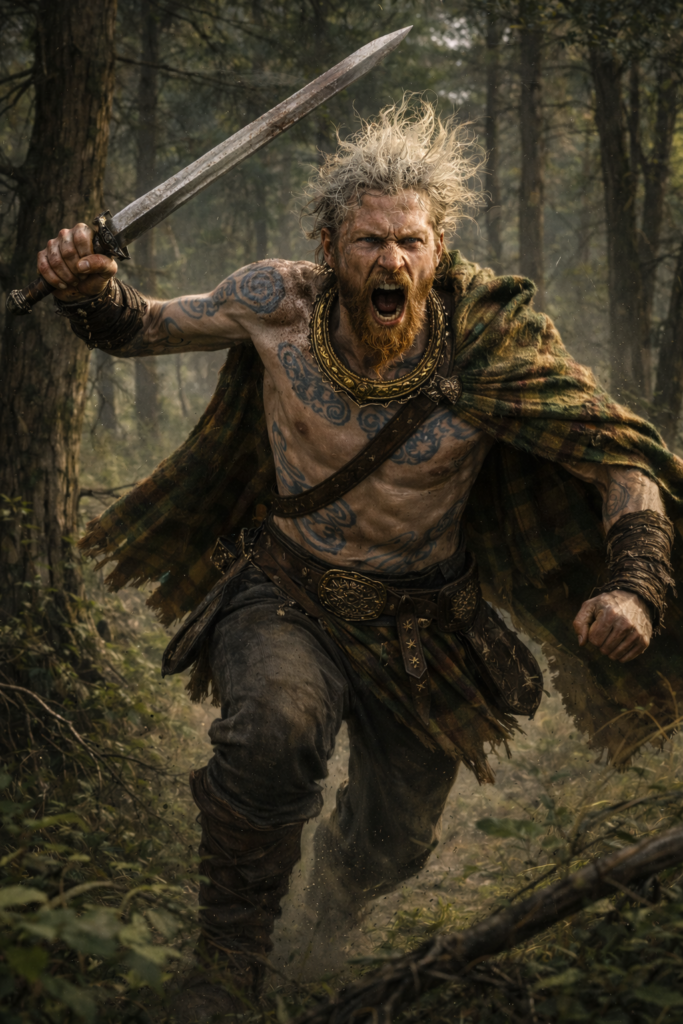
The long, single-handed sword was the defining Celtic weapon. Often narrow and flexible, it favored slashing attacks and reach over durability. Classical accounts describe blades bending under heavy use, sometimes requiring straightening—an inconvenience accepted as the cost of reach and speed.
The spear was widely used, especially at the outset of combat, but it lacked the symbolic centrality of the sword.
War chariots were employed by some Celtic groups, particularly in Britain. Unlike Near Eastern chariot warfare, these were not missile platforms. Instead, they served as mobile stages for elite warriors—delivering them into battle, allowing dramatic entrances and withdrawals, and amplifying personal presence.
Shields were available but optional. Many warriors chose to fight without them. Armor was rare. Helmets appear occasionally, often ornate, but protection was secondary to display.
Warfare and Society
Celtic warfare reinforced a social order built on memory and reputation. Deeds in battle were remembered, recited, and woven into communal identity. Failure was equally memorable.
This produced intense warrior cultures capable of astonishing bravery but limited political consolidation. Against enemies who relied on discipline, reserves, and logistics—such as the Romans—the Celtic model proved unsustainable over time.
Position in the Wider Transition
Celtic warfare represents the culmination of heroic combat traditions in Western Europe. What follows—under Roman pressure, Christian moral frameworks, and later Germanic consolidation—is a gradual shift away from individual display toward structural violence.
For theatrical purposes, Celtic warfare should feel loud, immediate, and dangerous. It is not tactical chess; it is ritualized collision. Courage is not measured by survival alone, but by willingness to step fully into risk.