
Among the many Germanic peoples who emerged from the collapse of Roman authority in Western Europe, the Franks occupy a singular position. They were neither purely tribal raiders nor simple inheritors of Roman systems, but a transitional culture that fused Germanic warrior traditions with selectively preserved Roman administration and an increasingly central Christian ideology. It is within Frankish territories that the political grammar recognizable as medieval Europe first coheres.
Politics, Economy, and Worldview
Political Structure
Frankish society was organized around kingship, but kingship of a distinctly early medieval type. Authority rested not on abstract law or permanent bureaucracy, but on personal leadership, military success, and the ability to reward followers. The king was first among warriors, expected to fight, to judge, and to distribute land, treasure, and offices. His legitimacy depended as much on continued success as on lineage.
Unlike many purely tribal societies, Frankish kings exercised authority over defined territories rather than over kin groups alone. This territorial sense—however imperfectly enforced—marks a decisive shift. Roman administrative habits survived in fragmentary form: written law codes, limited taxation, and the continued use of former Roman cities as centers of power. Yet these tools were always subordinate to Germanic expectations of personal loyalty. Governance functioned through a network of counts, local strongmen, and warrior elites, each bound to the king by oath and reward.
Succession proved a chronic weakness. Frankish custom treated the realm as divisible property, frequently splitting territories among heirs. The result was a recurring cycle of consolidation and fragmentation, warfare between rival kings, and shifting borders. Political stability was therefore episodic rather than continuous, achieved under particularly forceful rulers and lost again upon their deaths.
Economy and Land
The Frankish economy was overwhelmingly agrarian, grounded in subsistence farming supported by local estates. Long-distance trade never vanished entirely—especially along major rivers—but it was limited and irregular. Wealth was measured less in coin than in land, livestock, weapons, and portable treasure.
Land was the central economic and political resource. Control of land meant control of food production, labor, and military manpower. Frankish rulers rewarded loyalty by granting estates to followers, not as abstract salaries but as sources of sustenance and authority. This practice laid the groundwork for feudal relationships, though these remained fluid and personal rather than legally fixed.
The rural population lived under the protection—and domination—of local elites. In exchange for labor, produce, and military service when required, peasants received security against raids and internal disorder. This arrangement was not yet a fully articulated feudal system, but it established its essential logic: protection in exchange for obligation, mediated through land.
Worldview and Authority
The Frankish worldview blended three powerful elements: Germanic warrior values, Roman conceptions of order, and Christian moral authority. None fully displaced the others; instead, they coexisted in uneasy but productive tension.
From their Germanic inheritance, the Franks retained an emphasis on honor, loyalty, and martial prowess. Violence was not aberrant but expected—a legitimate means of resolving disputes and asserting dominance. At the same time, Roman ideas of law and hierarchy persisted, encouraging the notion that authority could be structured, inherited, and symbolically reinforced rather than constantly re-won through force.
Christianity provided a crucial ideological stabilizer. Frankish kings aligned themselves with the Church not merely out of piety, but because it offered moral legitimacy, literacy, and continuity. Bishops and monasteries became allies of royal authority, reinforcing hierarchy and obedience while benefiting from royal protection and patronage. Unlike earlier pagan systems, Christianity reframed kingship as a divinely sanctioned office, even when its exercise remained brutally pragmatic.
The result was a culture increasingly oriented toward order over impulse, hierarchy over equality, and institutional continuity over heroic individualism. While still violent and unstable by later standards, Frankish society marks a decisive turn away from purely tribal logic and toward the medieval structures that would dominate Western Europe for centuries.
Fashion / Manners
Frankish dress and manners reflect a society in transition: neither the stripped-down practicality of purely tribal cultures nor the refined civility of late Roman elites, but a visible negotiation between the two. Clothing, grooming, and conduct served as markers of rank, loyalty, and legitimacy, especially among the warrior elite.
Dress and Appearance
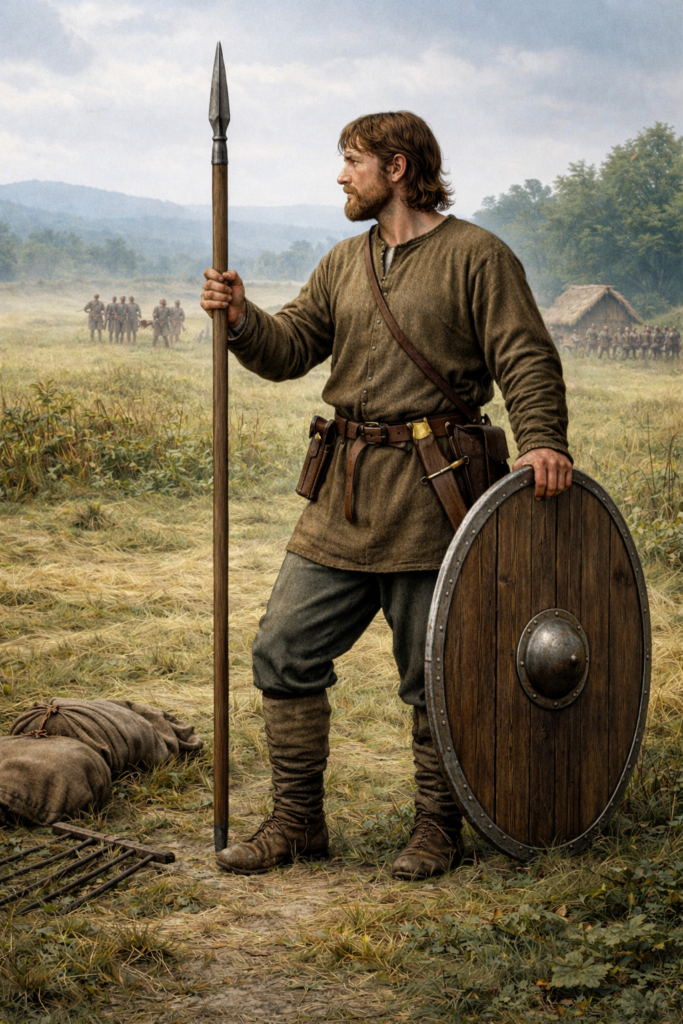
Clothing was practical but not austere. Wool and linen dominated, tailored for warmth and durability, yet garments increasingly displayed status through cut, color, and ornament. The warrior elite wore tunics of finer weave, cloaks fastened with brooches, belts with metal fittings, and boots rather than simple wrappings. Trousers were universal, though their quality and decoration varied sharply by rank.
Hair and grooming carried cultural weight. Frankish nobles often wore long hair as a sign of status and legitimacy; to cut a man’s hair was to strip him of authority. Beards were common, and care in grooming signaled standing rather than vanity. Cleanliness was uneven but not absent—elite households retained some Roman habits of bathing and laundering, particularly in urban centers and monastic settings.
Jewelry functioned less as decoration than as portable wealth and visible allegiance. Rings, brooches, and belt fittings announced affiliation and favor. Such items were frequently given by lords to followers, reinforcing bonds of loyalty through public display.
Manners and Social Conduct
Frankish manners were hierarchical and performative. Deference was expressed through posture, seating, and silence rather than elaborate gestures. One did not speak freely in the presence of a superior without invitation. Authority was reinforced through ritualized acts: oaths sworn publicly, gifts exchanged before witnesses, judgments delivered ceremonially.
Meals were taken in halls that combined Germanic communal tradition with Roman spatial inheritance. Seating arrangements mattered; proximity to the lord signaled favor. Food was shared, but not equally, and drinking was social yet controlled. Boisterousness existed, but unchecked disorder was increasingly discouraged, particularly under Christian influence.
Hospitality was expected but conditional. A guest entered a web of obligation, owing respect and restraint in exchange for protection and sustenance. Failure to observe these norms could provoke swift reprisal, legal or violent.
Christian Influence on Conduct
Christianity reshaped manners without erasing older customs. Public piety—attendance at church, patronage of monasteries, observance of feast days—became part of elite self-presentation. Clergy introduced expectations of restraint, humility, and moral order, particularly in formal settings. Yet these ideals coexisted with warrior values; mercy and brutality often sat uncomfortably side by side.
Over time, Christian ritual added predictability and discipline to social life. Confession, penance, and ecclesiastical judgment offered alternatives to endless feud, even if they were not always embraced. The result was a gradual shift toward regulated behavior, especially among elites who saw advantage in stability.
Theatrical Implications
Onstage, Frankish characters should occupy space with confidence but restraint. Rank is expressed through who sits, who stands, who speaks first, and who remains silent. Violence is never far beneath the surface, but it is not casual. Clothing should communicate hierarchy clearly, avoiding both Roman elegance and tribal roughness. The Frankish world is one in which order is being learned, rehearsed, and sometimes imposed by force.
Civilian Conflict
In Frankish society, violence was neither rare nor anarchic. It was expected, regulated, and increasingly constrained by custom, law, and Christian authority. Civilian conflict existed in the space between feud and law, where personal honor, kin obligation, and royal authority competed to determine outcomes.
Feud, Law, and Containment
Disputes commonly arose from injury, insult, land boundaries, inheritance, and broken obligations. The traditional response was feud—retaliatory violence carried out by kin groups—but among the Franks, feud was increasingly contained rather than encouraged. Royal law codes introduced systems of compensation (wergild), assigning monetary values to injuries and deaths according to the victim’s rank. These payments were not expressions of mercy; they were mechanisms designed to prevent cycles of revenge that destabilized territory and weakened royal control.
Acceptance of compensation did not imply forgiveness, only resolution. Refusal to accept lawful settlement marked a person as dangerous and outside the king’s protection. In this way, violence remained personal but was channeled into predictable forms, reinforcing hierarchy rather than undermining it.
Local courts, overseen by counts or royal representatives, heard disputes and enforced judgments. While these institutions lacked modern impartiality, they offered an alternative to constant bloodshed and allowed authority to present itself as an arbiter rather than merely a participant.
Everyday Readiness for Violence
Despite these constraints, daily life required readiness for physical confrontation. Frankish civilians—especially free men—were expected to defend themselves, their households, and their honor. Fights were typically swift and decisive, often ending once dominance was established rather than pursued to annihilation. Displays of restraint could be as meaningful as acts of aggression, signaling confidence and social standing.
Christian influence encouraged moderation, but it did not eliminate violence. Instead, it re-framed it as a last resort, ideally sanctioned by law or authority rather than impulse. The tension between restraint and readiness is central to Frankish civilian behavior.
Civilian Weapons
Most civilians carried or owned weapons suited to both utility and defense.
The knife was universal. Worn openly, it functioned as a tool, eating implement, and last-ditch weapon; its presence was unremarkable and socially neutral.
Many free men owned a seax, or short blade—longer than a knife, shorter than a sword—well suited to close combat. These were practical weapons requiring little space and minimal training, making them ideal for civilian defense.
The spear remained common as a household weapon. Easy to produce and effective with limited instruction, it could be used to defend property or augment local levies when called upon. In civilian contexts, spears were typically kept rather than carried.
The axe, often indistinguishable from a working tool, doubled as a formidable weapon. Its ambiguous status made it socially acceptable and legally unobjectionable.
Swords, by contrast, were not civilian wear. They were expensive, symbolically charged, and associated with warriors and elites. A civilian openly carrying a sword outside military or ceremonial contexts signaled status, threat, or exceptional circumstance. As with Charlemagne, habitual sword-wearing was notable precisely because it was rare.
Social Meaning of Armed Civilians
Weapons carried by civilians were not declarations of aggression but signals of autonomy and standing. To be armed was to be free; to be unarmed marked dependency. Yet the type of weapon mattered. Modest arms signaled participation in the social order, while overtly martial weapons implied ambition or challenge.
The Frankish approach to civilian conflict thus balances on a narrow ridge: violence is permitted but bounded, weapons are common but coded, and law seeks not to abolish conflict but to contain it. For theatrical purposes, this produces a world in which tension is constant, escalation is deliberate, and even restraint carries weight.
Warfare
Frankish warfare occupies a pivotal position between the decentralized raiding cultures of the early Dark Ages and the more systematized feudal warfare of the High Middle Ages. It is organized but personal, hierarchical but fluid, and grounded in obligation rather than standing institutions. War among the Franks is neither a seasonal raid nor a fully professional enterprise; it is an extension of kingship itself.
Organization and Leadership
Frankish armies were assembled through personal obligation. Kings called upon counts, local lords, and warrior elites, who in turn gathered their own followings. Participation was tied to landholding and favor rather than citizenship or pay. This produced forces of uneven size and reliability, but with a strong core of experienced warriors bound by loyalty to their leader.
Command was centralized in theory but dispersed in practice. The king or leading noble directed the campaign, yet tactical control on the battlefield remained largely in the hands of individual leaders and warbands. Discipline existed, but it was enforced socially rather than institutionally. Cohesion depended on reputation, honor, and the presence of trusted companions.
The king’s place in battle mattered. He was expected to be visible, active, and personally brave. Victory reinforced legitimacy; failure invited challenge. Warfare was therefore inseparable from political survival.
Nature of Combat
Frankish warfare favored direct engagement. Battles were decided by closing with the enemy and breaking their cohesion rather than through maneuver or prolonged skirmishing. Shielded infantry formed the backbone of most forces, with elite warriors occupying the front ranks. Mounted warriors increasingly played a role, particularly for mobility and shock, though decisive fighting still occurred on foot during much of this period.
Formations were pragmatic rather than rigid. Shield walls or dense fighting lines were common, but flexibility mattered more than precision. Individual prowess remained important, yet success depended on mutual support within a leader’s retinue. Retreats were dangerous and routs catastrophic; morale and cohesion mattered as much as numbers.
Campaigns were limited in scope. Armies could not remain in the field indefinitely, constrained by agricultural calendars and supply realities. Warfare was seasonal, episodic, and aimed at control rather than annihilation: securing territory, enforcing obedience, punishing rivals, or asserting claims.
Weapons and Arms in War
The spear remained the most common battlefield weapon. Effective, economical, and versatile, it suited both trained warriors and levied fighters. Shields were widespread and essential, enabling formation fighting and mutual protection.
The axe was common among warriors of varying status. Robust and deadly, it required less refinement than a sword and could be wielded with force in close quarters.
The sword was the weapon of elites. Costly to produce and maintain, it functioned as both a practical arm and a symbol of rank. On the battlefield, swords were sidearms rather than primary weapons, used once formations collapsed into individual fighting.
Armor was limited. Helmets and mail existed but were not universal, restricted to wealthier warriors. Most protection came from shields, positioning, and mutual support.
Warfare and Society
Frankish warfare reinforced hierarchy. Those who fought well gained land, gifts, and reputation; those who failed lost standing or protection. Military success translated directly into political authority. Defeat weakened not only armies but the social fabric binding lords and followers.
Christianity increasingly shaped the framing of war without diminishing its brutality. Campaigns could be justified as punishment, defense, or divine mandate, lending moral weight to violence. Clergy accompanied armies, blessing banners and reinforcing the idea that war, when sanctioned, was an extension of order rather than chaos.
Toward Norman Europe
By the late ninth and tenth centuries, Frankish warfare had laid the groundwork for what followed. The combination of land-based obligation, mounted elites, hierarchical command, and Christian legitimacy formed the template inherited by the Normans. When Norse settlers adopted Frankish language, law, and military practice, they did not discard their martial identity; they refocused it within a Frankish framework.
Frankish warfare thus marks the moment when violence becomes structural rather than episodic—a defining step toward the medieval world that follows.