
Time Frame c. 1775 – 1820
At first glance, this appears to be an unusually brief period to isolate, especially given how inelegantly it overlaps with the final decades of the Rococo. But it is precisely in the tension between these two eras, acting like millstones grinding in opposite directions, that the foundations of modern Western society are formed. For many living through it, this was not a clean transition but a lived contradiction: individuals often spoke the language of rational equality while still moving, dressing, and thinking in habits inherited from the old aristocratic order.
The effects of this short span reverberate through politics, economics, military organization, fashion, and social conduct to this day.
Politics / Economics
The great intellectual ideas born in the previous century—republicanism, free-market capitalism, individual rights, and inherent equality without regard to ancestry—are no longer confined to philosophical discourse. They are now forcefully promoted, argued, and enacted throughout Europe and the European colonies in the Americas.
In some regions, such as England, these struggles remain largely intellectual and parliamentary. In others—most notably France and the United States—they erupt into violent revolution. In every case, it is widely understood that what is at stake is nothing less than the future structure of Western civilization.
Because the possibility of an entirely new social order seems palpably within reach, the pressure to act is immense. The conflict between rational examination of classical ideals and the passionate call to violent overthrow often plays out not only between nations, but within cities, families, and individual minds.
From the perspective of those living through it, this is not chaos but transformation. Many believe they are restoring human society to its natural condition: one governed by rational compassion rather than inherited privilege. The emotional intensity underlying this belief is difficult to overstate.
As an illustration of the fusion of idealism and violence, consider this excerpt from the Argentine national anthem (1813), written three years before independence was achieved:
Listen, mortals, to the sacred cry – liberty, liberty, liberty!
Listen to the sound of broken chains, see noble equality now enthroned.
A new and glorious nation rises to the heights of the earth,
Its head crowned with laurels, and at her feet a Lion destroyed…
Crowned with glory we shall live, or we swear to die gloriously.
The language moves rapidly between moral elevation and bloodshed. Neither quality can sustain itself for long without reshaping the other.
Fashion / Manners
During this period, manners and style—previously markers of class—become markers of political allegiance.
A bow from the waist might signal republican sympathies; bending at the leg could identify a monarchist. Excessive lace might provoke hostility in a republican coffeehouse, while insufficient turnout of the feet in an aristocratic salon could suggest anarchic leanings. Dress and comportment become a minefield in mixed company.
As tensions rise, factions increasingly segregate themselves socially.
With the collapse of aristocratic dominance, middle- and lower-class values assert themselves in appearance and behavior. Men adopt working-class trousers, shorten their hair in imitation of Roman republican styles, and favor simpler garments made of less expensive fabrics. Greeting rituals simplify: the bow becomes a modest bend from the waist, and the handshake becomes fully acceptable.
The overall movement is away from ornament and toward clarity, restraint, and civic seriousness—a visible rejection of Rococo artificiality.
Civilian Conflict
The smallsword does not by itself increase the number of duels, but it dramatically increases their lethality.
Unlike the rapier, which could wound through cutting as well as thrusting, the smallsword is exclusively a thrusting weapon. Its thin blade penetrates deeply, causing internal bleeding that surgeons of the period are often unable to control. Even when bleeding can be slowed, systemic infection is likely in the pre-antibiotic world. Poison is unnecessary; the wound itself is sufficient.
As a result, fatalities among young noblemen rise sharply.
At the same time, pistols come into vogue as an alternative dueling weapon. Ironically, this increases the number of duels. Individuals who might hesitate to face sharpened steel are far more willing to appear on the field of honor with a firearm.
Thus, while public violence is increasingly claimed by the state, private violence briefly becomes more deadly before finally being suppressed later in the century.
Warfare
In terms of weapons and battlefield tactics, there is little fundamental change from the late-18th-century model—except in scale.
Armies grow steadily larger, placing increasing strain on the populations required to feed, clothe, and equip them. By this time, all armies use cloth or paper preloaded cartridges, replacing the wooden cartridges of matchlock bandoleers. Soldiers can now carry thirty to fifty rounds—enough for one or two days of sustained combat.
One important note for those depicting the American Revolution: American forces are chronically underfunded and poorly supplied throughout the war, not merely during the winter at Valley Forge. Food is scarce and often poor in quality, and the provision of adequate clothing and blankets is a constant struggle.
Weapon Carry (Military Sabre)
The sabre is worn from a waist belt and moves with the body. Its weight anchors the hips and reinforces grounded posture. Contact with the hilt signals familiarity and readiness, not status. The weapon extends function; it does not define identity.
The Origin of the Military Salute
The modern military salute is often said to descend from medieval tournaments, where knights supposedly lifted their visors to identify themselves as fellow nobles. The story is appealing—and entirely incorrect.
There is no evidence of any saluting practice during the roughly three hundred years between the end of the medieval period and the rise of professional standing armies. More importantly, the medieval gesture, had it existed, would have been one of mutual recognition between equals, whereas the military salute is explicitly a gesture of submission from inferior to superior. Finally, knights did not walk about wearing armor or helmets; they arrived with retinues, were already well known, and only donned helmets moments before combat.
The true ancestor of the salute is the civilian bow.
In medieval and early modern Europe, the bow was the most basic sign of obedience. One bowed first to a superior, bowed lower, and held the bow until acknowledged. By the seventeenth century this had evolved into a more elaborate gesture involving a step back and the sweeping removal of the hat. This practice carried naturally into military life, where officers were drawn from the upper classes and soldiers from the lower.
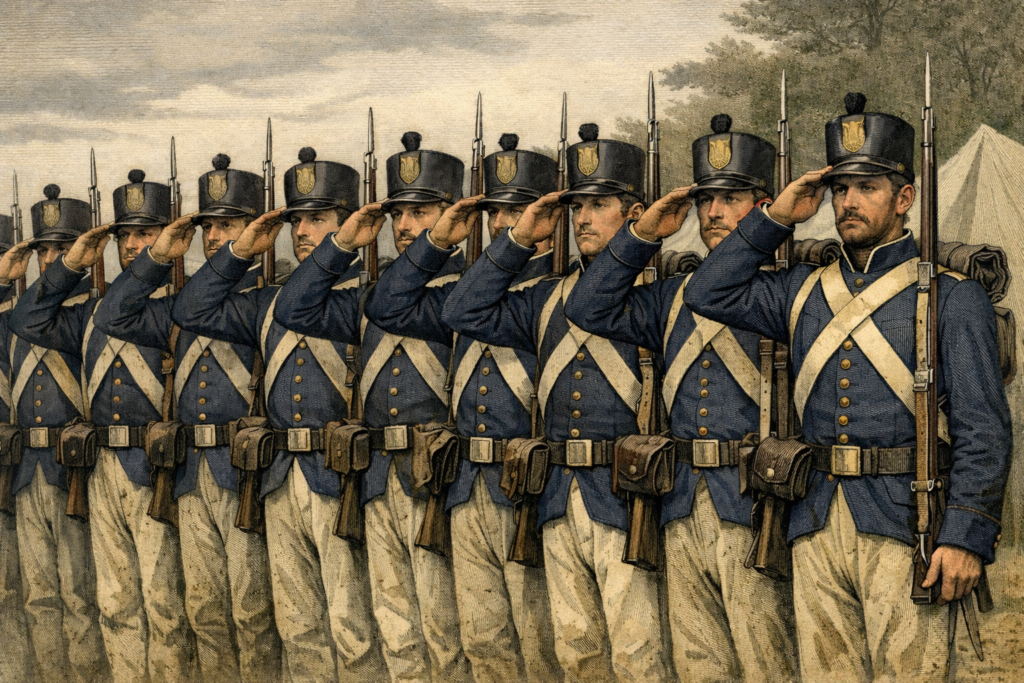
As armies grew larger and formations tightened, the traditional bow became impractical. Soldiers stood shoulder to shoulder, often carrying muskets and wearing swords, and later packs. Removing and replacing a hat with one hand was increasingly difficult, especially as headgear evolved into tall forms such as the mitre cap and later the shako.
The solution was a compression of the gesture. Rather than fully doffing the hat, the soldier touched the brim with the fingers, signaling intent rather than action. This abbreviated movement preserved the meaning of submission while allowing discipline and formation integrity to be maintained.
The modern salute thus emerges not from chivalric romance, but from logistical necessity—a refined bow adapted to mass armies, standardized equipment, and tightly packed formations. It remains a visible reminder that obedience and hierarchy must function even when bodies can no longer move freely.
Actor Physicality
The Empire body is disciplined, purposeful, and answerable to the state. Where the Rococo body existed to be observed, the Empire body exists to act. Even in stillness, it conveys readiness rather than display.
Authority is no longer performed through refinement and lineage, but asserted through function, competence, and restraint. The body becomes a tool—trained, regulated, and ultimately replaceable.
Posture
Posture is vertical and structural. The spine is upright without theatrical extension; the chest is open but grounded. Weight settles clearly into the feet and hips. Stillness feels contained, as though energy is stored rather than dissipated. Posture is standardized rather than personal.
Gait
Walking is direct and destination-driven. Steps are longer, firmer, and minimally turned out. Direction changes are economical. Movement privileges purpose over appearance.
Arms, Hands, and Gesture
Arms may hang naturally. Gestures are limited, deliberate, and aligned closely with speech or command. Straight lines replace curves; brevity replaces flourish. Excessive gesture reads as weakness or affectation.
Seated Posture
Sitting is efficient and temporary. The back is supported, the torso upright, the feet planted or crossed functionally. The body retains readiness to rise without adjustment.
Weapon Carry (Military Sabre)
The sabre is worn from a waist belt and moves with the body. Its weight anchors the hips and reinforces grounded posture. Contact with the hilt signals familiarity and readiness, not status. The weapon extends function; it does not define identity.
Greeting and Submission: The Salute
The salute replaces the bow. It is compact, precise, and hierarchical. The hand moves directly to brim or brow and returns without flourish. The gesture signals obedience to role and structure rather than personal deference.
Idle Behavior
Idle behavior is characterized by contained readiness. Former aristocrats display disciplined restraint—hands clasped, stillness held deliberately, old habits suppressed. Bourgeois bodies store energy forward, awaiting instruction or opportunity. Wasted motion disappears. The body does not perform itself.
Emotional Containment
Emotion is controlled but not concealed. Anger, resolve, or grief may surface directly, without ornament. Loss of control is not embarrassing; it is dangerous.
Actor Anchor
An Empire body asks one question only: “What must be done?” If a body is preoccupied with how it appears, it has not yet entered the Empire—regardless of costume or text.