
The use of defensive shields in real sword combat often devolved into literal trading of blows. One fighter struck, the other blocked; then the roles reversed—back and forth until a block failed. That failure usually meant a severe injury, quickly followed by the winner battering the loser into submission or death. Height, reach, and arm strength mattered enormously. Bigger, stronger men had a clear advantage. Always.
That style of combat is historically plausible—and theatrically dull. For the stage, we allow combination attacks that are not strictly historical but are far more engaging to watch. Linking two or three attacks together, and blocking not only with the shield but also with the sword, opens the visual language of the fight. Done well, shield combat can approach the rhythmic complexity and storytelling potential of a theatrical rapier bout. This flexibility allows the fight to reveal strategy, temperament, and character, rather than simply endurance.
The Wards (en garde positions);
A ward (or guard) is a pre-engagement position—a place the weapon and body occupy before the opponent has committed to a specific attack. It expresses readiness, intention, and tactical preference, not reaction.
A ward:
- exists in potential, not response,
- shapes what attacks are invited or discouraged,
- determines the most efficient and safest responses once an attack does commit.
Only after the antagonist commits does a parry or block occur—and that action is selected because of the ward already in place.
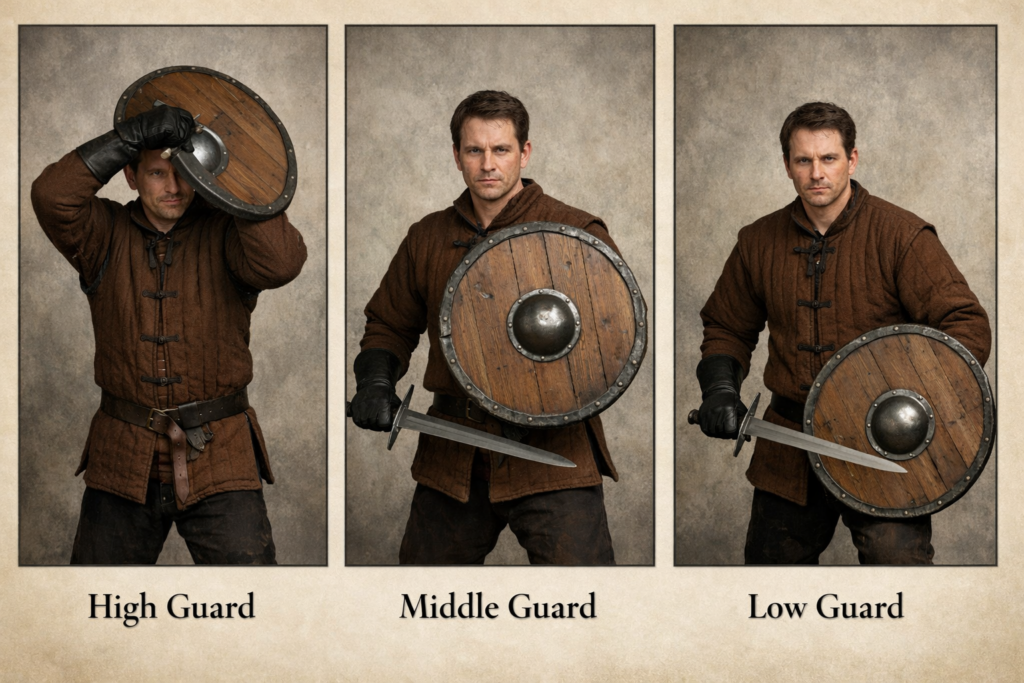
High Ward — when provoking low-line commitment and forward pressure
High Ward is chosen when the defender wishes to invite an attack beneath the shield—most commonly to the stomach, hips, or legs—and to draw the antagonist forward into a committed, downward action.
By clearly closing the head and upper line, High Ward removes hesitation. The antagonist is presented with an obvious solution: attack where the shield is not. To do so, they must lower the weapon, extend the arms, and often step in. That extension lengthens the attack and commits the body weight forward, making timing legible and recovery slower.
The defender answers this commitment by dropping the shield into Middle or Low at the moment of attack, perhaps reinforcing the block with the sword. The counter follows immediately, exploiting the antagonist’s lowered weapon and forward balance.
High Ward is especially effective against shorter or more aggressive opponents who favor body-level strikes, and it reads on stage as confidence under pressure—an actor willing to concede space in order to control the exchange.
In sword logic, High Ward says: “You will have to come through me to reach that opening.”
Middle Ward — when the goal is assessment and delay
Middle Ward is used when no attack has yet committed and information is still being gathered.
It neither strongly invites nor strongly denies any single line. Because it covers the center line, it forces the antagonist to declare intent before a clean opening appears. This makes Middle Ward the natural choice at the opening of an exchange, during resets, or when space is uncertain.
In sword terms, Middle Ward says: “Show me what you intend.”
On stage, it reads as readiness without aggression.
Low Ward — when provoking reach, extension, or imbalance
Low Ward deliberately exposes the head and upper torso. It invites a high-line strike, which requires lift, reach, and visible commitment.
This ward is chosen when the defender wants the antagonist to:
- overextend upward,
- raise their hands or weapon,
- or commit to a large, readable action.
Low Ward is especially effective against taller opponents, whose high-line attacks naturally take longer to arrive and open the body underneath. The response is usually a rising block reinforced by the sword, followed immediately by a counter into the now-open midline.
In sword logic, Low Ward says: “Come down on me if you dare.”
The best way to learn how to use a shield is, paradoxically, to begin without one. Imagine blocking an incoming cut using only your forearm. You will quickly discover that the safest and most effective block meets the sword perpendicular to its path. If the blade travels horizontally, your hand naturally turns vertical—up or down. If a vertical cut descends toward your head, your arm crosses its path, forming a barrier. The instinct is sound.
This may seem absurdly obvious. Who would try to block a sword by aligning their arm parallel to the blade? The chances of success are nearly nil. Yet this basic understanding is frequently abandoned once the shield is strapped on.
Most shields are secured with a forearm strap near the elbow and a hand grip at the center. The shield’s size and solidity create the illusion that arm orientation no longer matters. In practice, it matters a great deal. If the forearm runs parallel to the incoming blade and the sword does not strike dead center, the impact will torque the shield around the arm. At best, the shield slams into your leg or chest. At worst, the blade skips off the rim and into your face. Arm position is not optional—it is fundamental.
Shields can also be used offensively, striking with either the flat or the edge. Although these techniques are mechanically simple, they should be taught only under the direct supervision of a competent instructor. Unlike the sword, the shield is a close-range weapon. Its mass and momentum can easily knock an actor unconscious, fracture a limb, or crack a rib. As always, the closer the actors are to one another, the higher the risk.
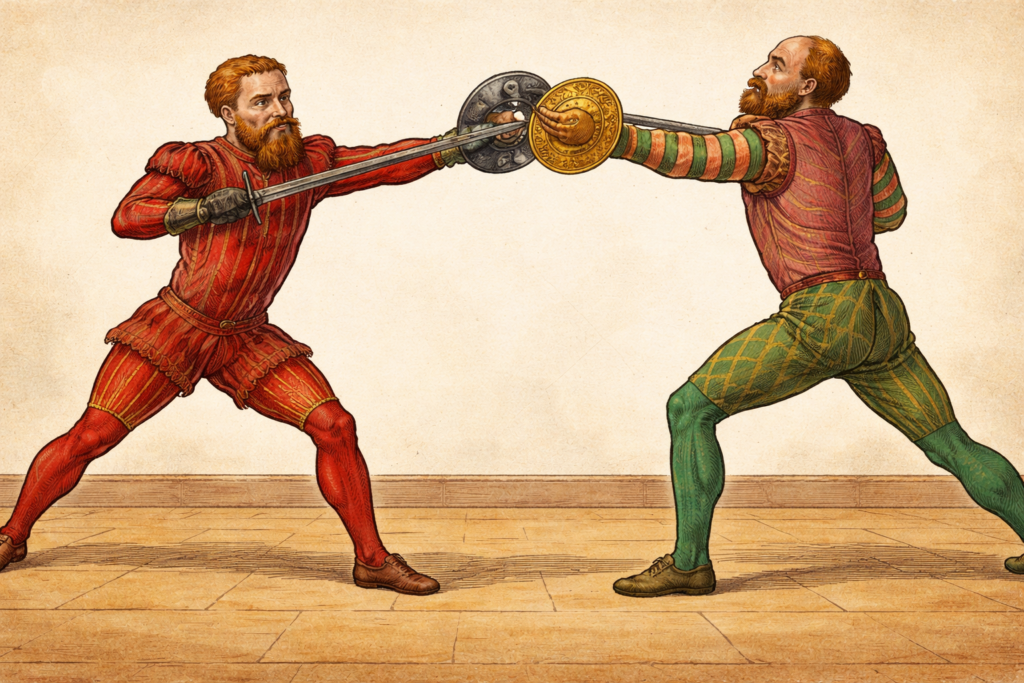
Bucklers are an entirely different creature. A buckler is a small shield—typically about a foot in diameter—gripped at the center by a single handle. It is not a passive defensive tool but an aggressive one. Rather than absorbing blows, the buckler attacks the opponent’s weapon, creating openings for strikes with the sword or dagger. One punches with a buckler; one does not hide behind it. Given its size, a conventional block is unlikely and often ineffective.
In sword-and-buckler fighting, defense is usually shared between the sword and the buckler. The sword helps intercept the attack; the buckler then strikes or presses the opponent’s blade out of line, clearing the way for an immediate counterattack. The result is fast, assertive, and visually dynamic—a fighting style that reads clearly on stage while remaining grounded in historical logic.