
Time Frame: 1850–1890
Politics / Economics
With all the major elements of the Industrial Revolution firmly in place, only one final component was required to bring it to full fruition: the widespread laying of railway lines throughout Europe and the United States. Once completed, goods could be transported to any part of a country—or across an entire continent—within days of manufacture. In the span of a single generation, a journey that had once taken six months could now be completed in five days. With the invention of the telegraph, news from any major city could reach even the most remote hamlet within minutes.
Photography fundamentally altered how humans assimilated information about the world at large. Once exposed to photographic evidence, people increasingly accepted reality only as that which could be visually confirmed, even if only by proxy. War could no longer be convincingly portrayed as heroic. The photographs from Gettysburg stand as stark testimony to the ugliness of battle, giving the lie to innumerable patriotic paintings and idealized narratives.
Beneath these changes ran a deeper transformation. As societies shifted from rural, self-regulating communities to dense urban and industrial systems, individuals were increasingly asked to surrender a degree of bodily sovereignty that earlier generations had taken for granted. Where a person had once been expected to govern his own conduct, risk, and honor directly, he now lived within structures—factories, railways, armies, and cities—whose dangers were collective, impersonal, and largely unavoidable. Even in times of peace, the body became subject to forces beyond individual judgment or control.
Industrialization made this surrender explicit through a new and unsettling moral calculation: injury and death not as deliberate acts, but as acceptable byproducts of large undertakings. Railways, mines, factories, and mechanized transport maimed and killed civilians in numbers previously associated only with war, enslavement, or overt tyranny. What was novel was not the existence of suffering, but its normalization—loss of life justified as commensurate with the scale, speed, and presumed necessity of the project itself. Though rarely framed as violence, this acceptance marked a profound shift in how societies weighed human cost against progress.
With the publication of Darwin’s On the Origin of Species, doubts again flared concerning the legitimacy of religious authority. At the same time, the heady optimism of living at the dawn of a new political and social utopia faded as the realities of the new republics revealed themselves to be just as susceptible to corruption and oppression as the monarchies they had replaced. Exuberant Romanticism became muted. Art and science alike began to focus less on human greatness and more on human limitation, contradiction, and failure.
The cultural response was Victorian morality. Today this is often reduced to a caricature of repressive prudishness, but it was far more comprehensive than that. The prevailing belief was that unrestrained passions encouraged vices which multiplied and ultimately degraded both the individual and society. Indulgence in sensual pleasure was thought to lead directly to crime, misery, and moral decay. Conversely, by cultivating pastimes that were both pleasing and elevating, one might attain true happiness while simultaneously improving the social order. While this idea was hardly unique to the period, it had never before been embraced as an overarching societal norm.
As a result, nearly all aspects of daily life were redefined through this moral lens. Clothing became darker, more somber, and more conservative. Dances and popular entertainments grew more restrained. Forms of address became more formal—even within the privacy of the home.
When applied in practice, many of these conventions bordered on the absurd. Men were excluded from the birthing room not merely to avoid the impropriety of seeing their wives unclothed, but because their presence among the doctor and midwife constituted public proof that they had seen their wives unclothed. (That a child was visibly emerging from the womb—evidence of the same fact—was discreetly ignored.) Referring to chicken breasts and legs as “white” and “dark” meat was not only to spare delicate sensibilities at the table, but to demonstrate that the speaker did not dwell on prurient subjects.
Yet Victorian morality also brought several crucial social concerns into public view. Movements against slavery, against child labor, and in favor of women’s rights all made significant gains. Public works expanded literacy, sanitation, and the overall livability of rapidly growing cities. These efforts were understood to be not merely the responsibility of government, but also the moral obligation of those who benefited privately from the accumulation of wealth.
Running counter to this moral seriousness was a persistent fascination with death, the paranormal, and the grotesque. Monsters, demons, and ghosts had always existed in literature, but now they inhabited the everyday world. One no longer needed to bargain with the devil to be in mortal danger. The idea that evil could afflict good people who had committed no moral lapse became a dominant theme. Melodramas flourished—not because of exaggerated gesture or vocal projection (though those were necessary for large houses), but because they allowed for the unrestrained depiction of villains whose near-inhuman delight in cruelty gave form to anxieties that polite society refused to name.
Fashion / Manners
By mid-century, almost all objects in daily use were manufactured at least in part by machine. By the end of the nineteenth century, only about ten percent of clothing was custom made. Pre-made garments, by necessity, could not achieve the tailored fit of earlier bespoke attire, and male fashion shifted toward boxier silhouettes with little opportunity for individual embellishment. Instead of personal distinction, men dressed largely alike—conservatively and soberly—with different outfits prescribed for specific times of day rather than for self-expression.
At the same time, consumption increasingly divorced itself from strict utility. Homes were filled with bric-a-brac, ornaments, and whatever degree of opulence the household could afford. Eclecticism was a virtue: mismatched styles signaled “worldliness.” Entire walls covered in family photographs created a faux-aristocratic lineage. Objets d’art were mass-produced to satisfy middle-class aspirations toward cultural refinement, including vast numbers of landscape and still-life paintings depicting simple domestic themes that would not challenge the average viewer.
Manners themselves did not fundamentally change, but they became far more restrictive. Hats and gloves were always removed indoors. One sat back in the chair; legs might be crossed at the knee, but never ankle-to-knee. Individual flair was discouraged. The ideal man cultivated an air of reserve—aloof, sober, conservative—the exact opposite of the flamboyant aristocracy that had preceded the French Revolution.
Social interaction was tightly regulated. Lifting the hat in passing greeting was expected, but engaging in conversation without formal introduction was unthinkable. This rule reflected a genuine concern: outward appearance no longer reliably signaled status. Anyone could purchase the clothing of the well-to-do, and modern transportation made strangers ubiquitous. At minimum, a calling card might establish credentials; better still was a letter of introduction. Ultimately, however, a trusted associate had to vouch for the newcomer—an act that carried real social risk, as one’s own honor was placed in the balance.
Civilian Conflict
By this period, the sword had become largely a sporting implement and only rarely a weapon of honor. It was widely regarded as an anachronism. Civilian swords survived primarily within fencing clubs, and it was there that the modern fencing salute developed: lifting the blade to the face and then lowering it in acknowledgment before a bout. With both combatants fully masked, this gesture simply indicated readiness to engage. Its later adoption by stage and film as a “historical” dueling salute is a pure invention.
More broadly, this period marks a decisive shift in how violence itself was understood and administered. Personal violence governed by honor, reputation, and individual accountability steadily gave way to violence exercised by professionals—soldiers, police, and sanctioned competitors—operating within formal rules and institutions. Conflict was no longer something a gentleman resolved personally; it was increasingly delegated, regulated, or mechanized.
The invention of the percussion revolver—capable of firing six shots in quick succession—led to a sharp decline in dueling. Bare-knuckle fighting gave way to gloved boxing under the Marquis of Queensberry Rules of 1867, but this shift largely expanded the ranks of middle- and lower-class prizefighters rather than preserving the tradition among gentlemen.
Early revolvers, being percussion muzzle-loaders, had significant limitations. Damp weather could cause misfires; lead balls might loosen if carried too long; and gas leakage at the junction of chamber and barrel reduced power and velocity. These weapons were relatively low-powered and imprecise by later standards.
Beginning in the mid-1870s, rifles, revolvers, and shotguns became available as true breech-loaders firing commercially manufactured brass cartridges. Firearms could now be used by anyone with minimal training or strength. Powder no longer needed to be measured, caps no longer set, and brass cartridges sealed out moisture. Revolvers could be left loaded indefinitely and fired with far higher velocity due to the elimination of gas leakage.
Advances in metallurgy also reduced overall weapon size and improved balance. Where percussion pistols typically topped out around .36 caliber for practical handling, cartridge revolvers of .45 caliber were lighter, shorter, and better balanced, with the center of mass resting in the hand rather than the barrel. The result was a weapon that was easier to carry, easier to aim, and significantly more powerful.
Increased power brought increased recoil. Shooters adapted by abandoning the fully upright stance of the dueling era in favor of bent knees, wider footing, and softened joints, allowing the body to absorb recoil. Even so, controlling the weapon required strength and concentration.
Despite popular mythology, the wearing of firearms was uncommon in eastern cities and rare even in most frontier towns. Fewer than five percent of adult men routinely carried sidearms, largely due to cost. A revolver and a box of cartridges could represent up to seven months’ wages for an average worker. In genuinely dangerous territory, however, firearms were indispensable tools. Six-shot revolvers were common, lever-action rifles nearly as much so, capable of firing up to twenty rounds before reloading. Large fighting knives were common in the West and South, while folding pocket knives were ubiquitous nationwide.
Throughout the period, responsibility for organized violence steadily shifted away from civilians and toward centralized institutions. Local militias, once understood as a necessary extension of citizenship, were gradually displaced by standing national armies trained, equipped, and commanded by the state. In parallel, maintaining public order in cities became the province of uniformed police rather than armed householders or ad hoc groups. Together, these changes narrowed the circumstances under which private individuals were expected—or permitted—to employ force, reinforcing the idea that violence was no longer a personal obligation but a regulated function of government.
Warfare
It is striking that at a time when civilian menswear was turning increasingly dark and somber, military uniforms remained brightly colored. Part of this was controlled ostentation, allowing units to display identity and pride, but there was also a practical necessity. Generals often had to observe battles from distances of half a mile or more, overseeing lines that might stretch a mile in either direction. As warfare remained centered on the careful movement of ordered blocks of soldiers, the ability to recognize different units at a distance was critical. Brightly colored uniforms aided this visibility, and even details such as wide stripes down a trouser leg could indicate whether a unit was advancing in good order or had lost discipline and was responding to a threat invisible from the commander’s vantage point.
While the fundamental structure of warfare did not change during this period, its armaments did—and in ways that caught commanders unprepared. Beginning in the 1820s, muskets transitioned from flintlock to percussion lock. The reduced number of steps required to fire increased the rate of fire, a development that generals readily understood and incorporated into existing tactics. Far more consequential, however, was the shift from smoothbore barrels to rifled barrels.
Rifled barrels had long been known to be superior in accuracy, but they presented practical difficulties. A lead ball had to be slightly larger than the barrel so it could be forced into the grooves as it was rammed down the muzzle, forming a tight seal. This process was slow and required care. If the ball was too loose, expanding gases would escape past the grooves and the projectile would lose power and stability. For this reason, smoothbore muskets—easier and faster to load—remained the standard issue for the great mass of infantry.
That limitation was overcome with the invention of the Minie ball. Slightly smaller than the barrel diameter, it could be rammed quickly down the barrel, but when fired its hollow base expanded outward, pressing into the lands and grooves of the rifling and sealing the gases. Fired from a rifled barrel, the conical Minie bullet spun like a thrown football, gaining tremendous stability, range, and striking power.
The transition to rifled muskets was not immediate. At the outset of the American Civil War, both sides scrambled to arm rapidly expanding armies. Most armories were stocked with older flintlock smoothbores. Although these were quickly converted to percussion locks, their barrels remained smooth. As a result, while soldiers could reload more quickly, effective range and accuracy remained largely unchanged.
By the second year of the war, however, weapons production became more standardized, and smoothbores ceased to be manufactured. Rifled-barreled muskets became the norm. Soldiers could now fire faster, with greater accuracy, and—most importantly—at far greater distances. Where smoothbore muskets had an effective range of roughly 150 yards, the new rifled muskets were effective out to 400 yards or more.
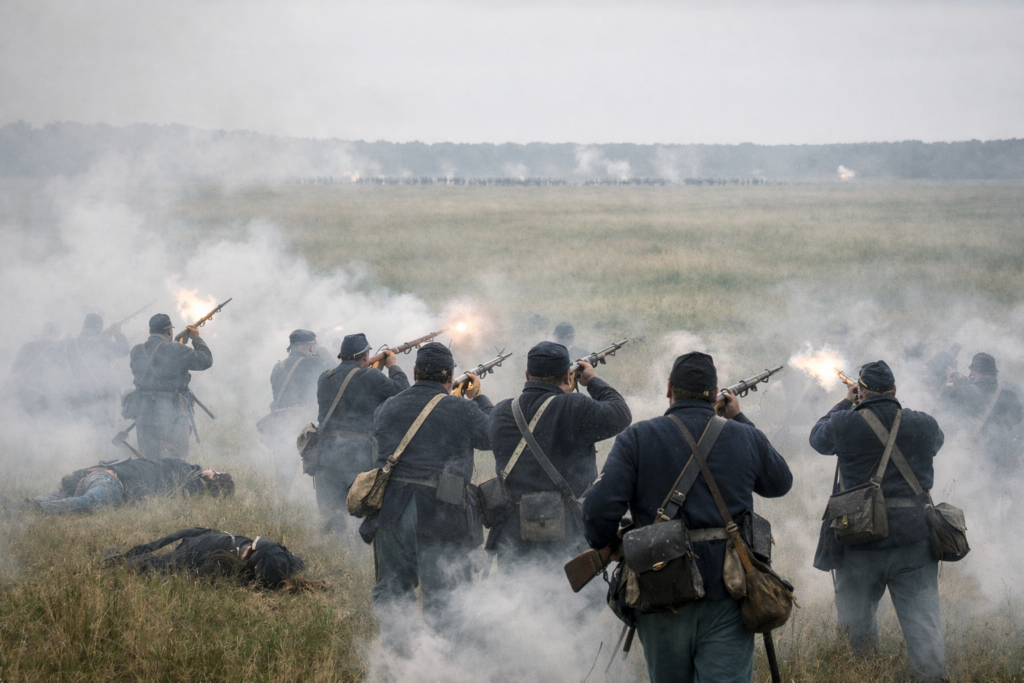
This was the change that commanders failed to fully account for. West Point–trained officers continued to employ tactics inherited from the Napoleonic wars, positioning troops at distances that had once placed them near the outer limits of enemy fire. With rifled muskets, those same formations were now well within lethal range for extended periods. Charges calculated using assumptions from the previous era became catastrophes, turning battles into prolonged slaughters rather than decisive engagements.
For the soldiers themselves, the effect was overwhelming. Fire was so dense that entire stands of saplings were cut down to a height of three feet. The noise and percussive force of continuous firing were so extreme that many soldiers could not distinguish the sound of their own weapons amid the din. One post-battle inspection by a contemporary reporter recounted:
“On the field of Gettysburg there were 27,574 guns picked up, and of those 24,000 were found to be loaded, and half of them were double loaded. One fourth had from three to ten loads in, and many had five or six balls to one charge of powder. In some cases the powder was above the ball, in others the cartridges were not broken at the end, while in one musket twenty-three balls, sixty-two buckshot, and a quantity of powder were all mixed up together.”
Two significant observations arise from this account. First, the fear and confusion of battle led many soldiers to remain unaware that their weapon was disabled; they continued to reload and attempt to fire, sometimes repeatedly, until they were killed, wounded, or abandoned the gun to take another from a fallen comrade. Second, it reveals the uneven training and discipline of many infantry units, as well as a general lack of practical firearms knowledge among line officers. Soldiers were sometimes permitted to load their weapons with arbitrary quantities of shot and ball on the assumption that more projectiles would be more effective. This is all the more remarkable given that soldiers were issued pre-measured, pre-wrapped paper cartridges containing exactly the powder, ball, and wadding required for each shot.
Toward the end of the war, some practical breech-loading rifles became available, but these were still single-shot weapons using stiff paper cartridges. It was not until the mid-1870s that well-engineered multishot rifles firing brass cartridges were mass-produced. In the United States, lever-action rifles were adopted by the army, particularly in the western territories, where much of the fighting involved cavalry actions against Native American tribes. Though limited in range by their relatively short barrels, lever-action rifles were well suited to engagements between light cavalry forces, where rapid fire was more valuable than long-distance accuracy.
European armies, by contrast, did not face the demands of patrolling vast frontiers. They never widely adopted the lever-action rifle, instead moving more quickly toward bolt-action designs as soon as they became available in the 1880s. With superior range and more powerful ammunition, bolt-action rifles better served the needs of Europe’s predominantly infantry-based armies.