
time frame: 1650–1730
Please note: What is commonly called the Golden Age of Piracy spans roughly eighty years, from the mid-seventeenth century to the early eighteenth. It is not a single, continuous phenomenon, but a sequence of overlapping phases shaped by European wars, trade routes, and the availability of skilled seamen.
c. 1650–1680 — The Buccaneer Phase
This period is dominated by Caribbean buccaneers and privateers, many operating with tacit or explicit state support during imperial conflicts. These men function as irregular naval forces, blurring the line between sanctioned privateering and outright piracy. Their targets are primarily Spanish shipping and coastal settlements, and their methods are closely tied to European military objectives of the time.
c. 1680–1700 — The Pirate Round
As Caribbean opportunities diminish and enforcement increases, some crews undertake long-distance voyages around Africa into the Indian Ocean and Red Sea. This so-called Pirate Round targets rich Mughal and East India Company shipping. The scale of these voyages, and the wealth they promise, accelerates the development of piracy as a fully independent enterprise rather than a byproduct of European war.
c. 1715–1730 — The Post-War Explosion
The most iconic phase follows the end of the War of the Spanish Succession. Large numbers of trained sailors and privateers suddenly find themselves unemployed, while global trade continues at wartime levels. Piracy spikes briefly but intensely in the Caribbean and Atlantic before being rapidly and systematically suppressed by expanding naval patrols and coordinated imperial policy.
European monarchies were able to defeat other powers and establish colonies throughout the world primarily through technological advantage, especially in the production and use of firearms. But guns and soldiers must be transported, and then local materials and goods sent back to the mother country. Without the West’s superior sailing vessels, each conquest could never have been exploited. A case can be made that if steam propulsion had been developed earlier than it was, the Age of Exploration might never have occurred at all, since steamships require deep harbors and reliable fuel supplies at their destinations. Only light sailing ships, powered entirely by wind, allowed Europeans to explore and then dominate nearly every corner of the globe.
Piracy is inseparable from this system. It arises not from ideology or rebellion, but from trade in motion. Ships carrying concentrated wealth across long distances, often thinly defended and far from immediate support, create ideal conditions for predation. Pirates are therefore not a separate civilization so much as a parasitic one, shaped by the same technologies and economic pressures that created global empires in the first place.
Worldview
The conditions described above produce a consistent way of thinking about violence, authority, and survival. Pirates do not operate with long time horizons. They do not seek to hold territory, build institutions, or maintain continuity. The sea is not a homeland but a corridor; ships are not places to inhabit but opportunities to be intercepted, stripped of value, and abandoned. What matters is speed, surprise, and the ability to move on before consequences can accumulate.
Authority within this worldview is pragmatic rather than hierarchical. Leadership exists only so long as it produces results—loot, survival, and momentum. Loyalty is conditional, hierarchy temporary, and obedience transactional. Reputation replaces law as the primary regulating force. A crew known for sudden, overwhelming violence is more likely to induce surrender without resistance, and surrender is always preferable to prolonged fighting. Terror, in this sense, is not excess; it is economy.
Violence itself is not ritualized or moralized. It is not a contest to be won, nor a demonstration of skill or honor. It is an interruption, applied to collapse resistance as quickly as possible. Fairness is irrelevant. Advantage is everything. A shove over a rail, a disabling wound, or a single brutal killing that causes others to freeze or flee is a successful outcome. Prolonged combat represents failure, not bravery.
This worldview shapes physical behavior as well. Balance is assumed to be provisional and recovery uncertain. The environment is hostile and unstable; falling may be fatal, and injury compounds rapidly. Movement is therefore compact, guarded, and opportunistic. Actions are abandoned the moment they cease to offer advantage. Technique matters only insofar as it serves immediate survival.
Boarding
Military battles at sea are usually attempts to sink or decisively cripple an opposing vessel. Pirates, by contrast, aim to leave ships intact. A captured vessel can be looted, sold, reused, or—if of little value—scuttled. Pirate cannon fire is therefore typically directed at masts, rigging, and sails rather than hulls. The goal is to slow and isolate a merchantman, then close alongside.
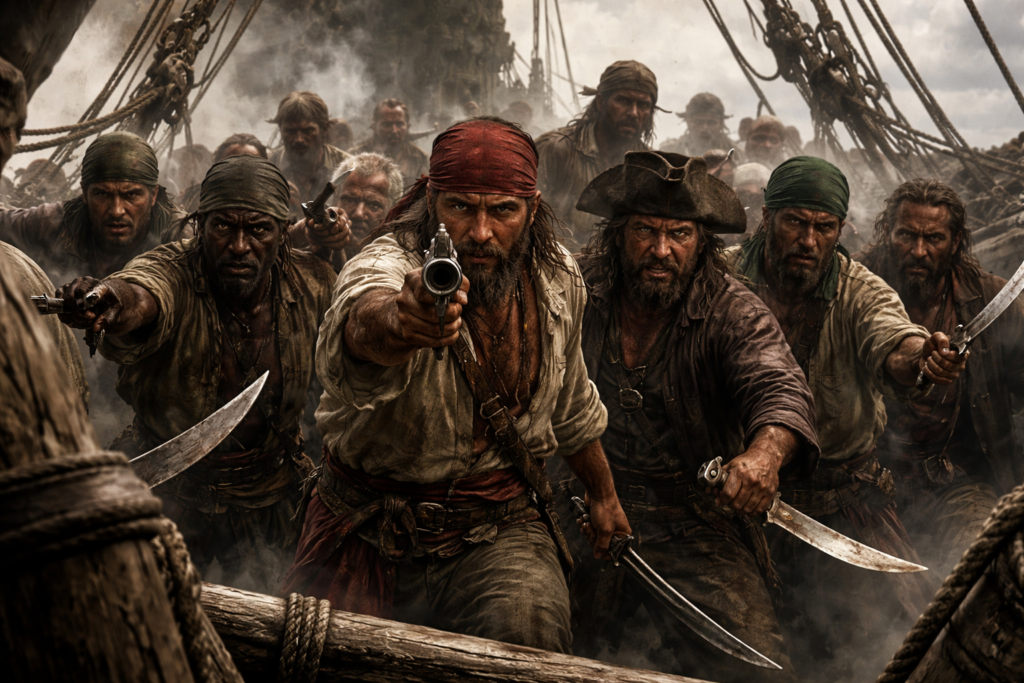
Once close, grappling lines are thrown and the ships drawn together. Boarding follows quickly. Resistance is met with lethal force, not as a matter of cruelty but of efficiency. Witnesses are a liability. The faster resistance collapses, the sooner the pirates can take what they want and leave. None of this requires specialized “pirate” equipment. In fact, most weapons we associate with pirates were developed by naval forces to combat piracy itself, and were simply adopted—often stolen—by pirates when opportunity allowed.
Boarding actions are not duels. They are crowded, asymmetrical, and chaotic. Attacks overlap. People are struck while engaged with someone else, shoved while distracted, stabbed from the side or rear. The environment is as dangerous as any weapon: open hatches, ladders, railings, coils of rope, cannon tackles, and sudden changes in footing. Once balance is lost, recovery is often impossible. Falling into the sea, being crushed against a rail, or disappearing down a hatch are common and final outcomes.
Firearms at Sea
If outrunning pirates failed and defensive cannon fire proved ineffective, the next line of defense was preventing boarding. At close range, pistols and muskets could kill individual attackers, but each firearm requires time to reload, and accurate fire from a pitching deck is unreliable. Firearms aboard ship are therefore best understood as single, decisive actions rather than sustained tools.
The most effective shipboard firearm was the blunderbuss. Not a hunting weapon, the blunderbuss—sometimes called a “thunder gun”—is a short musket with a wide, flared muzzle. Designed primarily as an officer’s weapon to suppress shipboard insurrections, it fires multiple small projectiles rather than a single ball. The flared barrel allows the shot to spread rapidly, cutting down several attackers with a single discharge. Ammunition could be improvised from whatever was at hand: gravel, ballast, glass shards, nails, or tacks. A group of men attempting to cast grappling hooks could be disabled with one shot, even with poor aim.
The effect of such weapons is as much psychological as physical. Smoke, noise, and sudden violence create shock and hesitation. After firing, the weapon is either discarded or repurposed as a club. Reloading in the midst of a boarding action is rarely practical.
Bladed Weapons and the Cutlass
When grappling hooks connect, the ropes must be cut before the ships are drawn fully together. A full-length military sabre can do this, but its length makes it prone to fouling in rigging and confined spaces. A shorter variant was therefore favored: the cutlass. Quite literally, the name implies “cut the rope,” though the weapon is also a powerful killing tool. Most cutlasses consist of a simple sabre hilt fitted with a heavy, curved blade roughly two feet in length.
The cutlass is not a fencing weapon. It is designed for chopping, short cuts, back-edge strikes, and brutal efficiency in tight quarters. It can sever rope, disable hands and faces, and strike effectively even when there is no room to extend the arm fully. Blade contact with the environment—rails, masts, ladders—is expected and unavoidable.
The form of the cutlass reflects long maritime experience. From the Middle Ages onward, some of the most capable seafaring commanders were Moors—hence Shakespeare’s choice of Othello as a Venetian general. European powers frequently hired Muslim commanders to lead fleets, and even the word admiral derives from the Italian almirante, itself a corruption of the Arabic al amīr, meaning commander or prince. While Europeans favored rapiers and broadswords on land, Muslim cultures developed the curved sabre, a form well suited to both mounted and maritime combat. Shortened and thickened, that curved blade becomes ideal for shipboard fighting. The cutlass guard is simply a variant of established sabre guards. Full-length sabres were, and still are, presented to naval officers as symbols of rank, but they had little practical utility on a crowded deck.
Improvised Weapons
In the final moments of hand-to-hand fighting, more improvised weapons often come into play: knives, belaying pins, clubs, tools, and occasionally light fishing harpoons. Anything that can crush, hook, or shove is useful. The goal is not elegance, but interruption—ending resistance by whatever means are immediately available.
Wearing and Drawing Weapons
Wearing a cutlass was straightforward. Most pirates simply thrust it into a belt or sash, though some used scabbards. Modern audiences sometimes assume that swords were universally worn in a standardized fashion, but historical practice was more flexible. Conventionally, single-edged swords are worn on the left side with the edge and knucklebow facing forward, as are rapiers and smallswords. Yet this convention is not always the most practical.
Both buccaneers and samurai understood that drawing a sword may require using it before it is fully clear of the body. Grasping the hilt with the knucklebow and edge forward creates a weak bend in the wrist until the blade is completely withdrawn. Wearing the sword the “wrong” way allows an immediate hammer grip, with a strong, locked wrist from the outset. The most common initial attack is a high strike from the attacker’s right down toward the defender’s left. Even if the defender’s blade is only partially drawn, it can still intercept that blow and, in the same motion, descend onto the attacker’s head. Japanese katana are worn this way for precisely this reason, and for close-quarters fighting aboard ship, many pirates appear to have adopted the same logic.
Duration, Injury, and Aftermath
Shipboard fights are short. Fatigue is already present from sailing, climbing, hauling, and stress. Minor injuries rapidly become disabling. Once resistance collapses, interest in violence evaporates. Bodies are ignored. Loot is taken. The ship, like everything else in the pirate worldview, is left behind as soon as it has yielded what it can.
Pirate combat, then, is neither romantic nor chaotic in the theatrical sense. It is unsentimental, opportunistic, and efficient—violence applied, then abandoned, in service of movement and survival.