
Steel allowed a strong sword of over four feet long to be built, and the stirrup provides a solid platform from which to swing it. The nations of Europe and all of its royal houses were built on these two tools. With them came feudalism, and when it took hold it left a legacy we still feel in our cultural norms, social hierarchies, legal systems, the concept of private land ownership and property rights, dispersed political authority, even in our popular entertainment. The echoes of feudal values and themes persist, underscoring the enduring impact of this medieval system to this day.
Early Medieval (Romanesque)
Time Frame – 880 AD to 1144 AD
Politics/Economics
– By the turn of the millennium the feudal system was fairly well codified, although there still existed great regional variation. For the most part it was a contract between vassal and lord, the vassal providing material and the promise of military service to the lord, the lord providing security to the vassal. In time it formed the main structure of society throughout Europe, one that served well in a time of barter rather than monetary transactions for goods and services. In theory, the scale of feudalism extended to the highest level, with regional lords owing subservience to the king. In reality, most European kings had very little recourse in trying to control a recalcitrant lord, short of calling other lords to join in a military attack. Such an action carried the risk of civil war, so most monarchs were loath to disturb the status quo. The practical result was that most lords were pretty much free to run their own counties with little interference from the monarch.
Their domination over others came from their weapons and their ability to use them on horseback. Forms of feudal society based on military service had been seen in many steppe cultures in Eastern Europe. Several were warrior societies based on fighting from horseback while well armoured, but significantly using a light lance and without the benefit of stirrups. The stirrup and the sword were costly, but allowed one armed man to control dozens of others (see Warfare, below). While this form of government is often called a plutocracy (rule by the wealthy) it should more accurately be called an oplocracy (rule by the weapon) for merely having wealth was not enough to secure power. And since the son of a lord had a natural advantage in having access to these costly implements and many opportunities to train in their use, the feudal system quickly became a hereditary one. While there were a few variations in different pockets of Europe, the transfer of power was overwhelmingly that of agnatic primogeniture – everything goes to the eldest male child.
This form of inheritance may strike us moderns as unfair, but was based on some very practical considerations. The wealth of a lord was based on a central and easily defensible physical position, usually a castle, and enough surrounding agricultural land to be self-sustaining and even profitable. Dividing such an entity would have been difficult, if not instantly ruinous. The eldest son would also have been the physically strongest heir, so more likely to be able to fight off any attempts at raiding. Other sons were left to their own devices, either joining the church or by offering their services as retainer/warriors to other lords.
Because so much was at stake during this transfer of power from one generation to the next, the legitimacy of the first born son was critical. Having an uncontested heir would do much to ensure that rivals to power would be less likely to attempt a takeover. Hence, for the nobles, the question of a woman’s fidelity to her husband before the birth of the first son could mean the difference between peace and war. The father’s dalliances could have ramifications as well, for many an illegitimate son, especially if older than the “true heir”, would often attempt to battle his way to his inheritance. And if the true heir was too young to be an effective warrior, such an overthrow was very easily accomplished.
Interestingly, being an illegitimate did not necessarily remove one from the ranks of the nobles, although it certainly precluded one from having a direct line to power. They were even allowed to show the family crest on their coat of arms, but by convention couldn’t put it in either the main field nor in the right upper quadrant. That area was reserved for members of the “true” line. No, an illegitimate had to show that crest “with a difference”, most commonly by placing the crest on the left quadrant. As the descriptions in heraldry were always in Latin, and the word sinister means on the left side, the word became shorthand for explaining someone’s bastardy. Of course, with time it also became associated with the dubious motives of someone perhaps always plotting to take what was not rightfully his.
Fashion/Manners
– Feudalism created extremely conservative societies, with little room for individual expression. What art and learning there was largely served the church. In fashion, the choice of style and fabric was unofficially but tightly regulated by custom and the weight of local pressure.
Manners at first still did not differ much from upper to lower class. Eating by all was done with spoon and hand, a knife being used to cut bread or the occasional serving of meat. Despite this broad similarity, everyone showed respect and submission to those above them, because a superior had very real power: he or she could punish, injure, or even execute someone with little oversight. However—and this is the key point—the required respect was not yet wrapped in complicated etiquette systems. There were no elaborate ceremonial gestures, no specialized protocols for each social level. Deference existed, but not a developed hierarchy of ritual behavior.
With time, this changed. The Normans, having settled first in France, adopted that language as their own, and shed most of their Scandinavian traditions and religion as well. Once feudal, their further expansion through most of Europe spread Norman French as the language of the ruling class. Learning continued to be the dominion of the Church, so Latin was the language of scholars. Whatever local language survived did so at the village and worker level. These separations in society slowly created separations in expected conduct. As those of lower class might not be able to speak directly in a common language with the nobles, some non-verbal standards of greeting and general conduct were required to prove that the stranger knew his place and posed no threat. It is here that we find the beginning of the practice of bowing to a superior and doffing the hat.
Warfare –
The advent of the stirrup was so startling a development that it is difficult to appreciate how profound was the effect that it had on western Europe, indeed how it still affects us to this day.
Horses had been used in combat before this time, and often in a heavy cavalry capacity. Indeed the Parthians had bred full-sized chargers, fought with a couched lance, and wore full lamellar armour and complete helmets – and all before the third century B.C. But without the stirrup there was no steady platform from which to fight while on horseback. A horseman might carry a spear, but the attack with it had to be made with an overhand throw or underhand thrust. Hold on too tightly at the moment of impact and the horseman could risk getting knocked off of his mount. Similarly, swinging the sword while on horseback gives a height advantage to be sure, but with only a rope loop for the feet there is no solid foundation from which to strike.
With the stirrup, not only is the rider more secure in the saddle, but the weight and power of the horse can be transferred through the rider and into the weapon, be it lance or sword. Each strike delivers a tremendous amount of power, far more than can be generated by a foot soldier. A single horseman could easily subdue a score of even well-armed men standing on the ground. This came at the same time that improvements in steel-making allowed for longer and better tempered weapons, better suited for use on horseback. The stirrup, lance, and sword, and the armor that soon followed, couldn’t be carried by a regular horse. The much larger warhorse, known as the charger, was carefully bred. But charger, sword, lance, armor, and rigging for stirrup, saddle, bridle and reins – these were all extremely expensive. Such a dynamic separation between impregnable warrior and everyone else in society further intensified the breakdown in what had been stable and more egalitarian tribal/chieftain societies.
So instead of warfare being a contest between the massed eligible fit males, it moves to battles between mounted knights, closing in at full charge and then continuing the fight with sword or ax, but still on horseback as long as possible. The larger number of peasant levies were mostly poorly armed and usually unarmoured as well. Their function was to take control of the battlefield after the initial clash of knights.
Anglo-Saxons
Although Angles, Saxons, and Jutes had settled in the British Isles since at least the time of the Roman evacuation, most shows that feature this culture do so by setting it in the period of their zenith, that is, just before the Norman Conquest.
These pre-Norman English had a governing system which followed Germanic traditions. The warriors below the level of high lords or king held the title of thegn, and these held their property and status directly as grants from their warlord, mostly in direct recompense for their actions as warriors. As such, the positions were not strictly hereditary. This actually improved the discipline of the fighters during battle, for title and land could be revoked at any time.
Most of the hard fighting was done by the thegns, and most war bands were limited in number to about 20 to 60 warriors. If larger numbers were needed, all able-bodied men from fifteen to sixty years of age could be called to arms, but these were usually unskilled and ill-armed farmers. Even so, they considered themselves warriors: every boy would receive a shield and spear upon coming of age (about thirteen years old). At minimum, a fighter was expected to arrive when called with shield and spear, and all would have the long knife known as the saex. Better built shields had a metal boss, a central hollow hemisphere which was used as a powerful punching weapon for close-in fighting. Thegns might also have a two-handed ax and some limited armour pieces, as well as several throwing spears. Due to the lack of a domestic steel industry, swords were relatively uncommon. Depending on access to trade with Germany, only one third to one tenth of thegns and huscarls (retinue “bodyguards” to a high noble) might have one.
The difference in fighting styles would be directly related to the weapon that each soldier had. Using a spear can keep one just out of distance to an opposing warrior, but also limits the use of the shield as a defensive weapon. Even short spears are too long to be able to pull back behind the shield, the way one can with a sword or knife, so the shield ends up protecting the left side and the center of the body, but not the right.
No matter how armed, Anglo-Saxons preferred to fight on foot, believing it to be more courageous and honorable than fighting from horseback. Discipline was high, and they differed from the neighboring Celts and Vikings in their ability to maintain a “shield wall” during their attacks. Instead of a rash charge at the enemy, Anglo-Saxons would form a tight line, often three warriors deep, and interlock the shields in the Roman manner. With spears sticking out between the shields, they would march slowly and directly into the enemy formations.
Late Medieval (Gothic)
Time Frame– 1145 AD to 1350 AD
Politics/Economics
– The time designation is rather arbitrary, and the starting point could have been set fifty years in either direction, but what is acknowledged is that roughly during this period Europe began to civilize itself once more, laying the groundwork for the Renaissance to come. It is also when the inhabitants began to identify themselves collectively as Europeans.
The effects of the crusades, which took place before and during this period, awakened Europeans to the larger world around them. Although material benefits were centuries away, large numbers of books were slowly making their way through the religious orders, the lost literature and study of Greece and Rome being copied page by page by monastic clerics. Roads and canals were refurbished and so travel became easier for goods and people. As suppliers could finally reach buyers further and further from their homes, surplus production could be converted to profit instead of merely being hoarded in storage. Daily trade could extend beyond the limits of daily travel. Slowly a market economy based on cash began to supplant the barter system. A distinct middle class began to develop outside of the castle centers, and the townships became the foci of a new urban culture, the larger ones even supporting the first universities.
With larger economic concerns came larger political concerns, and a recognition that trade and commerce could only be effectively conducted on a national level. By the end of the 13th century the counts and lords were more willing to cede direct power to the King’s court (the Magna Carta notwithstanding), knowing that strengthening the King’s hand would ultimately strengthen their wealth.
The court of the king was also the central government; his personal aides were the defacto ministers of the bureaucracy that managed the affairs of state. The national and monarchical concerns were the same. Therefore wherever the king’s person was located was by definition the court, and by necessity the government moved along with the king. A specific city such as London or Paris might house the king for most of the year, but in and of themselves were not the seat of power.
Fashion/Manners
– With increased prosperity came a further separation between the lives of the nobles vs. commoners. Fine fabrics, exotic foods, and elaborate social entertainments dominated courtly life. Also here we see the first stirrings of rules of etiquette. Making the sign of the cross when presented with a dish of food was considered to be not only an indication of piety, but also of good social decorum. One always dried the mouth before drinking from a shared bowl, and using two hands to hold it rather than one was further evidence of courtesy. Weapons were never worn indoors, and gloves and hoods were removed when entering the great hall. This is the setting of “fairy-tale” stories, not only in our imagination, but also in theirs. Tales of fighting dragons, rescuing damsels, magic swords, sleeping beauties awakened with a kiss – they all come from this time. The literature, dance, clothing, music, and art began to serve the ideals of the aristocracy, helping to provide the illusion of fairy-tale other-worldliness.
Some specific body postures and movement make sense when one remembers the clothing of the upper class in this period. But one must keep in mind that although the clothing became more exaggerated, the movements remained simple and direct. Fussiness must be avoided in favor of simple, long elegant movement. For example, as the shoes tended to be of extreme length and pointed, crossing the legs while seated simply looks comical. Instead, the feet should be turned out at every opportunity, and the legs apart. When out of doors, hats were not doffed, and indeed hats were removed indoors only in the presence of social equals, not as a sign of submission to authority. If the hat was off, it would usually be held in the left hand at the hip while bowing. Otherwise, both arms could freely swing down and to the side in an open gesture, palms forward, while bowing. The bow itself was simple: a slight bend at the waist while the left foot stepped back and both knees would bend, lowering the body. Seventy percent of the body weight should be on the right leg, the left being used for support only.
We have seen so many variations of a king conferring knighthood in movies that we forget how simple was the actual ceremony. The knight-to-be while standing drew his sword with his right hand, grasped the center of the blade with the left, and then knelt on both knees. Resting the hilt on his right forearm, the sword was offered to the king. The king would take the sword and touch the blade to the knight’s left shoulder, and then return the sword. The knight would then rise and sheath the weapon. Movie directors like to have both shoulders touched, or even three touches, so as to draw out the moment. But Gothic ceremonies tended to be solemn but simple, with little embellishment. And although the same film directors want the knights to be on one knee because it looks better, the ceremony was a semi-religious one. As an oath before God, both knees must be on the ground.
There has also been much said of the custom of greeting by grasping the other at the forearms or at the elbows. Many posit that this precursor to the modern handshake was a way to keep someone from attacking you with a dagger in this very dangerous time. But, as lawyers would say, this assumes facts not in evidence. First, such a greeting was only done among social equals, never to mere strangers on a country road, and there is simply nothing in any historical documentation that suggests that attacks during greetings ever occurred or that anyone was ever worried about it. Second, greeting in general was very effusive compared to our modern Western timidity. Family members embraced and kissed openly during casual greetings, and knights usually embraced and kissed each other on the cheek, as is done in most of the non-Anglo/Saxon world today. Thirdly, and most tellingly, grasping another by his elbows does nothing but limit the use of your own hands. It leaves the other person’s hands completely free to attack you with whatever weapon he wishes. Rather than an indication of wariness, I see it as a sign of great openness and trust.
Civilian Conflict
– Tournaments and jousts exhibited all of the techniques of war, but to local villagers they were treated as the nearest equivalent of a grand sporting event. To the reigning monarchs, they were something of a conundrum. Although wildly popular and an excellent way of training the uninitiated into the techniques of actual battle, they could also unleash dangerous passions that could prove difficult to control. There was also the fear that the massing of so many armed men could hide an insurrection, so most kings tried to keep the tournaments under the direct control of the crown. This proved difficult, as the popularity of these events and the sudden influx of cash to the hosting city or parish meant that tournaments, legal and otherwise, were bound to pop up anywhere at almost any time.
The earliest tournaments were melees, in which two teams were formed and attacked each other using the regular weapons of war, on horseback at first but then on foot should circumstances warrant. The attendees were told to use the flats rather than the edges of their sword. As years passed, the tournament became more ceremonial and somewhat less bloody, the use of special blunted weapons doing much to reduce injuries.
Dueling as we understand it did not exist. The nearest equivalent was the right to judicial combat. This could be invoked either to establish innocence or to redress wrongs, but was considered a legal, rather than personal, action.
Warfare
– Warfare was still largely based on direct confrontations between mounted knights (and their men-at-arms); in other words, heavy cavalry vs. heavy cavalry. As economic conditions improved, more and better armed horsemen were available for battle. The arms and armor they used were not uniform, and limited only by the wealth of the fighter. Most aspired to sword, axe, lance, shield, full body armor and chain mail, and a fully armored war horse. While dismounting and fighting on ground was performed as situations required, the knight’s greatest strength on the battlefield came from his position on horseback.
Whether or not the fully armored knight was excessively hindered by his armor has been a subject of great debate among historians. Some have suggested that once knocked from his saddle, the knight was as helpless as a turtle on its back. Others note that accounts exist of at least one knight astonishing crowds by scaling ropes and leaping over fences while wearing a full suit of armor weighing sixty pounds. We should assume that these represent the two extremes of human capability, and that the mobility of the fighter depended more on the individual’s strength and ability than any inherent limitations in a suit of steel. And I can relate from experience that falling from a horse is quite a shock to the body even in the best of circumstances, let alone being battered about within a tin can. One should assume that in those several seconds of hitting the ground, gathering one’s wits, and turning over to come to one’s feet, the knight would be at his most vulnerable and completely defenseless. One good hit with an axe and he’d be done for.
While most of the movies we have seen show every knight in battle wearing a complete suit of armor, that was almost certainly not the case. For most humans the wearing of steel, chain mail, and the cloth padding underneath it all is stifling and dehydrating. Although some battles might have lasted for several hours, knights needed frequent rests between every few minutes of actual combat. To increase mobility and endurance, many would remove much of their armor as temperatures rose. Chain mail and helmet were considered essential, but each additional piece was up to the wearer trying to strike a balance between protection and practicality. It seems that being completely armored was more often than not taken as a sign of being untested and fearful. This is a common situation throughout history, with the greenhorns packing every possible item they can get hold of, while the veterans go into battle light and mobile.
As important now as the mounted knights were large numbers of heavily armoured men-at-arms. These infantry soldiers used pikes to break cavalry charges and also take the field in direct fighting. Usually men of proven combat experience, they were often well paid mercenary units rather than a part of the conscripted levy.
Also on the battlefield were increasing numbers of bowmen and crossbowmen. These were generally kept behind the knights or on the flanks. Their primary function was to weaken the enemy cavalry during their charge, although they could also devastate a standing infantry. Once both sides engaged, they also needed to fire into any breakaway group of riders attempting a flanking manoeuver or encirclement. These archers served as very effective light infantry so long as they could stay just out of range of the battle line. In order to move quickly so as to respond to changing battlefield conditions, bowmen were lightly armoured. In case the fight came to them, they could attempt to defend themselves with short swords and bucklers, but for them these were weapons of last resort only.
Held in especially high regard was the English longbowman. His bow was six feet long, carved from a single piece of yew trunk wood or large branch, and typically had a draw weight between 100 and 120 pounds (by comparison, most modern hunting bows draw around 45 pounds, while the most powerful commonly available peak at roughly 75). While the longbow was a personal weapon, the arrows were not. In wartime, arrows were mass-produced, issued, recovered, and reissued by the crown or by a captain’s supply train, treated as expendable military stores rather than private property.
The archer kept his shoulders relatively square to the enemy, with the left (leading) foot pointed forward, unlike the sideways stance favored by modern competitive archers. It also appears that the draw was brought only to the front of the face rather than back to the ear; this is supported by the fact that the few surviving complete arrows measure only about thirty inches in length. Although these techniques might seem to reduce the bow’s available power, the longbowman was nonetheless capable of loosing six to eight arrows per minute in sustained combat, with higher rates achievable in short bursts. Some archers could harass the enemy at distances approaching 400 yards, though effective battlefield fire was typically delivered at much shorter ranges. A cavalry charge would take roughly seventeen seconds to cross 200 yards; within that brief window, longbowmen could deliver an opening volley followed by two to three additional arrows per man before contact, making them an extremely effective countermeasure. Crossbowmen, by comparison, generally loosed a single bolt during the same interval, as their rate of fire was rarely better than two shots per minute, despite the weapon’s greater penetrating power at closer ranges. As in modern archery, the arrow was usually placed on the left side of the bow for firing, though this may not have been an absolute rule. There were no formal schools for archery; skills were passed from father to son and absorbed informally within the village. It was commonly believed that a young man at full growth required three years of regular practice to handle the longbow effectively.
If archers could not take a position behind the protection of a line of pikemen, they were expected to create a quick defense behind wooden spikes driven into the ground, with the sharpened points directed towards the enemy. For this purpose, they carried a metal headed mallet, and some carried small hatchets. Doubtless, in an extreme emergency these might be used for hand-to-hand fighting as well. More well-equipped archers might also have a single-hand sword and buckler, but this was relatively rare. Archers provided all of their own equipment, and few had the wherewithal to afford anything beyond his bow. This was not as scary as it seems. The best use of longbowmen is to have them fire from a distance where they are not subject to attack, out of range even from the crossbowmen. Although the threat of being overrun was real, it was uncommon, and archers could normally see if the battle was moving their way and could beat a hasty retreat.
Three bits of folklore that are untrue. First, the arrow quiver was never worn on the back. That was a Victorian era conceit, made even more popular by book illustrations and film depictions of Robin Hood. Longbowmen usually carried their arrows in a cloth wrap. Once they took position on the field they would either stick the arrows in a bunch on the ground or tuck them all behind the back through the belt, points sticking out low and to the right. The cloth or leather wrapping ranged in complexity from a single square to a true container with protective rain flaps and straps from which to hang the quiver onto the waist belt. The benefit of sticking them in the ground was of course having easy access to them for quickly firing. The benefit of sticking them in in the belt is that you could move around and not lose your arrows. Why not draw them directly from the quiver? If arrows are pulled out by the feathered end, it rips the feathers and destroys the accuracy of the arrow flight. When drawn from the belt, you can pull the arrow out from the arrowhead, from underneath the belt. This actually smooths out the fletching as it passes through the belt.
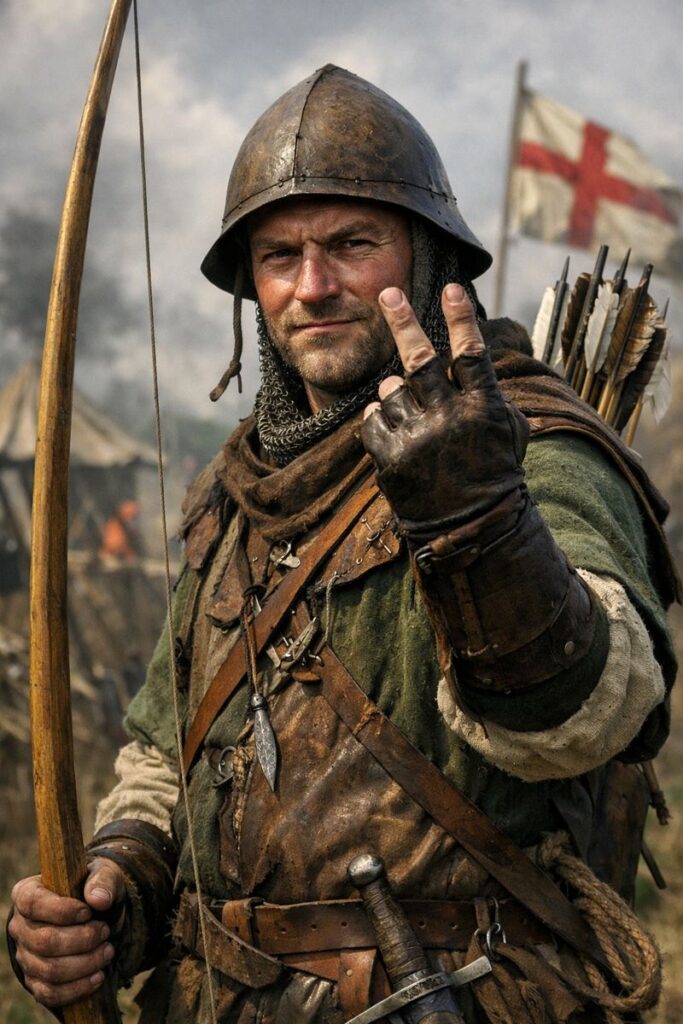
Secondly, there is an old story that the modern English insult of the “backward peace sign” (two fingers thrust up, palm turned in) comes from 14th century English archers. The idea is that the French would cut off the two draw fingers of any English bowman captured in battle, so shoving the fist upward with the two fingers pointing is something like a taunt, “I’ve still got mine, what are you going to do about it”. The problem is that
1) that doesn’t really convey the real meaning of the gesture,
2) the gesture doesn’t exist until the early 20th century, and
3) the French didn’t cut off any archers’ fingers. Archers were commoners, never taken prisoner. The only reason to take a prisoner is if he had some ransom value. If cornered or caught on the battlefield, archers were simply killed outright.
Finally, there is the oft-repeated claim that the modern insult phrase “fuck you” derives from English longbowmen taunting the French with the phrase “pluck yew,” a supposed reference to yew bows and unmaimed draw fingers. This explanation collapses immediately under scrutiny. There is no plausible linguistic mechanism by which pluck yew could evolve into fuck you within the known phonology of Middle or Early Modern English, nor is there any historical record of such a phrase being used, idiomatically or otherwise. Medieval English profanity was already blunt, explicit, and well documented; it did not rely on coy wordplay or battlefield riddles to convey insult. Like the finger-amputation story, the “pluck yew” derivation is a modern folk etymology—tidy, performative, and entirely fictitious.
At the bottom of the ranking of warfare participants were the true foot soldiers, usually untrained peasant levies. Held in utter contempt by mounted nobility, they were often used as a follow-up force. Once a break in the battle line had been formed by the knights or by the archers, the ill-armed peasants would rush in to capitalize on the break, hold the field and kill as many of the enemy as possible. Their weapons were non-standard, usually using variations of simple farming implements. Alternatively, the peasants could be used in an all-out charge into a well defended enemy position. With luck, the enemy would break their formation in order to slaughter the expendable foot soldiers. The attacking cavalry could then take advantage of the disarray in the enemy line.
When a true heavy infantry was needed, no one depended on the peasant levy. Instead, the men-at-arms themselves would dismount and form a sturdy line, with the peasants filling in the line as necessary.
Throughout this period, the feudal system proved to be insufficient to provide fighters in sufficient quantity or skill for all of the conflicts across the continent. The ancient call to arms was increasingly ignored, with many preferring to pay a (substantial) fine rather than present themselves for war. While at first this was distressing to military commanders, it soon was found to be quite a benefit. The money raised by this “scutage” was used to pay for mercenary units, who proved to be superior warriors with well-maintained weapons and battle-honed skills and discipline. While they could prove ready to jump sides if offered better pay by the enemy, once in battle they outperformed any other units.
Weapons available
– The feudal system allowed money to accumulate and centralize, allowing for more soldiers in battle and more weapons to be built. Arrows, crossbows and spears return in large numbers for the ground troops. Mounted knights and men-at-arms are generally armed with singlehand swords with cruciform style large guards. As armour plate and steel helmets become more common, impact weapons such as maces and heavy headed axes are used. Quarterstaffs, heavy walking sticks, and the ubiquitous dagger are standard weapons for a civilian walking outside of the protection of the village or township.
Byzantium
It is woefully unfair to discuss this Greek empire in so few lines, but there are so few productions in the United States that take place in a Byzantine setting that we’d be wasting everyone’s time pretending otherwise. Still, for a civilization that managed to glitter for a thousand years, it deserves at least a moment of attention—if only for the remarkable pageantry by which it defined itself.
The Byzantine Empire, roughly from 360 AD to its fall to the Ottomans around 1460, was the long echo of Rome. It carried forward Roman law and administration, Greek intellect, and Christian faith, blending them into a culture that thought of itself not as a successor, but as Rome reborn and purified. The emperor was not merely ruler but divine representative, and every public appearance was shaped by ritual. Even the simplest act of governance was a ceremony.
The imperial audiences in the Chrysotriklinos (Golden Hall) could have been designed by a theatre technician. The emperor sat motionless upon a gem-studded throne beneath a golden dome. When envoys were brought in, hidden hydraulics lifted the throne as gilded lions beside it rose and roared, while mechanical birds in golden trees burst into song. Petitioners advanced to a marked point and performed the triple proskynesis—three deep bows, each ending with one knee on the floor and the right hand touching the marble before rising again. Only then did they remain kneeling while the emperor extended his hand, palm down, to be kissed. No gesture of the emperor was accidental; the turn of a head or the lift of a finger was a cue to attendants and musicians.
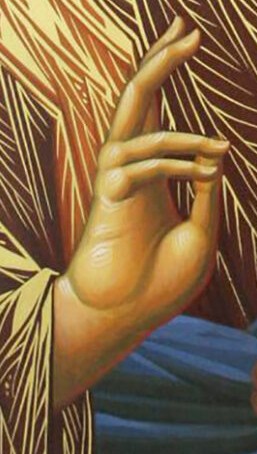
The same choreography ruled the coronation in Hagia Sophia. The emperor stood alone before the altar while the people chanted Axios!—“He is worthy!”—three times. The Patriarch crowned him, and he processed through the nave blessing the congregation with both hands in the Orthodox “IC XC” sign. The new king bowed not to the Patriarch but to the icons of Christ and the Virgin, acknowledging that his power flowed from them.
Public life was saturated with such spectacle. In the Hippodrome, where chariot races were held, the crowd acclaimed the emperor in rhythmic unison—“Many years to the Emperor!”—three times. He responded not with a wave (far too common) but with a slow bow and the sign of the cross. Every gesture was calibrated, every movement a reminder that hierarchy was sacred.
That sense of formality extended beyond the palace. Upon entering a home or church, one crossed oneself right-to-left, then bowed and kissed the icon—forehead, lips, and hand touching the frame in order. In more formal devotions, worshippers performed three bows, each time touching the floor with the right hand while murmuring Kyrie eleison (“Lord, have mercy”). Streets often filled with processions: priests swinging censers in steady arcs so the smoke preceded them like a herald, choirs chanting in slow antiphony, laypeople bowing as relics passed. Movement was deliberately slow, mirroring what was believed to be the rhythm of heaven.
Even private courtesies were ritualized. Guests were seated strictly by rank—an honor seat always at the host’s right hand. Before eating, diners made the sign of the cross over the bread; after eating, they wiped their hands on embroidered linen, never on their clothing. To greet clergy, one bowed from the waist, right hand to the heart, while the priest blessed with two fingers extended in the “IC” sign.
Byzantine clothing enforced this restraint. Layered silks, brocades, and gold-threaded mantles held the body erect; one simply could not slouch in them. Movement was minimal: turns were deliberate, gestures confined to the forearm, the head kept upright. Even silence was expressive—a form of assent or dissent depending on its duration.
In warfare the Byzantines were less inspired but no less ritualized. Their standing army of mercenaries was well equipped but seldom innovative. Their only real marvel, Greek Fire, a petroleum-based incendiary sprayed from bronze tubes, terrified enemies and the recipe of which remained a closely guarded secret. Their cataphracts—armored cavalry sheathed in overlapping plates—were magnificent to watch but slow to maneuver. Before battle, troops received the Eucharist, then knelt in collective prostration before an icon of Christ or the Virgin. Commanders invoked both emperor and Theotokos (the Virgin Mary), soldiers kissed their sword hilts, and all shouted the battle cry Nobiscum Deus!—“God is with us!”
Triumphs followed an equally exact pattern. Victorious generals processed through the Golden Gate of Constantinople on foot, never horseback, to show humility. They carried the victory crown to the waiting emperor, knelt, and kissed the ground before being lifted and kissed on both cheeks—a ritualized grant of favor that transformed military success into divine approval.
For our purposes, Byzantium is best understood not through its battles but through its rituals of bearing. A Byzantine—whether emperor, priest, or common citizen—lived within a choreography of reverence. Power was expressed through stillness; obedience through measured motion. Even the act of standing upright was a declaration of faith.
Yet beneath the gold and incense, the empire ran on self-discipline and communal order. Most disputes never reached the emperor’s court. Neighbors settled quarrels before local notaries; guild masters arbitrated among their tradesmen. The Eparch’s Book of the tenth century describes behavior codes for bakers, merchants, innkeepers—even prostitutes—revealing a society maintained less by policing than by supervision, custom, and the fear of public shame.
If a fight broke out in the marketplace, bystanders were expected to step in. Failing to intervene could itself be punished. Justice was a shared moral duty, not a service of the state. The streets were self-governing theaters, each citizen playing his part.
For the actor, this is a world of containment rather than impulse. Every gesture is bounded by hierarchy; even silence carries weight. A Byzantine character moves as though within invisible walls—aware that each step, glance, and pause might testify to faith, loyalty, or defiance. The empire glittered for a thousand years not because it changed, but because it rehearsed itself to perfection—an eternal performance under rules it never ceased to observe.