
I. POLITICS / ECONOMICS / WORLD VIEW
There is no single historical moment that can accurately stand in for “ancient Japan.” The culture developed in layers across many centuries, and any theatrical use of the setting necessarily selects one of those layers. For the purposes of this text, the default assumption is a late sixteenth– to early seventeenth–century Japan: the period spanning the final Sengoku wars and the early Tokugawa peace. This is the era most Western productions implicitly invoke when imagining samurai, feudal hierarchy, and pre-modern Japanese society.
In this world, the individual does not stand at the center of meaning. Identity is understood as relational and role-bound: one is a retainer, a lord, a farmer, a merchant, a spouse, a child. Duty flows downward and obligation upward, not as a moral abstraction, but as the natural order of things. Personal desire exists, but it is subordinate to role, lineage, and service. The self is not something to be expressed, but something to be correctly inhabited.
Authority is layered rather than singular. The emperor exists as a sacred and cultural figure, while practical power rests with military governance and regional lords. Loyalty is not owed to an abstract nation, but to a house, a lord, and a network of obligations that bind land, labor, and protection together. Order is maintained less by universal law than by mutual surveillance, reputation, and the visible enforcement of hierarchy.
The prevailing worldview accepts impermanence as fundamental. Life is understood as fragile, contingent, and subject to forces beyond individual control. Death is not an aberration but an expected companion to duty, particularly for those who serve in violent roles. This does not produce nihilism, but clarity: one does not rage against the transience of life so much as act decisively within it.
Religious life reflects this same pragmatism. Shinto, with its emphasis on place, ancestry, and continuity, coexists comfortably with Buddhist traditions that stress impermanence, discipline, and the acceptance of suffering. These systems are not mutually exclusive, nor are they experienced as philosophical debates. They provide frameworks for behavior, restraint, and endurance rather than doctrines to be argued.
Within this worldview, calm is not the opposite of violence. Emotional control is prized precisely because it allows for decisive action without hesitation or distortion. The ideal warrior is not gentle, but unclouded—capable of killing, enduring pain, or facing death without theatrical display. Stoicism is not emotional absence; it is emotional discipline made visible.
The ethical language later gathered under the term bushidō did not function as a battlefield manual during this period. Rather, it emerged as a retrospective cultural ideal, shaped most fully after decades of civil war gave way to an enforced national peace, when warriors increasingly served as administrators and officials rather than full-time soldiers. What persisted was not constant combat, but a shared expectation of loyalty, restraint, service, and readiness for sacrifice.
As open warfare receded, the warrior class did not disappear. It transformed. Samurai became bureaucrats, magistrates, and stewards of order, carrying forward a martial identity in symbolic, legal, and cultural form. The sword remained a mark of status and dignity even as its battlefield necessity diminished. Some warriors became masterless (Ronin), but most adapted to the new order rather than falling into criminality.
For an actor approaching this world, the essential re-calibration is this: meaning does not arise from self-expression or personal fulfillment, but from correct conduct within a role that already exists. Identity is performed through action, posture, obligation, and ritual, not declared through psychology or confession. The sword, the bow, the gait, the exchange of courtesies, and even silence itself are all legible signs of rank, training, and allegiance. The universe is not conquered here—it is interpreted, served, and obeyed.
II. FASHION / STYLE / MANNERS
For our purposes, fashion must be understood in its broadest sense. It does not refer only to clothing, but to the full range of visible behaviors that signal belonging: posture, movement, gesture, etiquette, restraint, and the disciplined control of the body in public space. Fashion, at its core, is social armor. It protects the individual by signaling correct placement within the hierarchy and by avoiding unnecessary attention.
In this world, behavior is not casual. How one stands, walks, sits, bows, or remains still communicates rank, discipline, and reliability. Excessive gesture, emotional display, or physical looseness reads as immaturity, instability, or disrespect. Control is not coldness; it is competence made visible.
Warriors are expected to demonstrate stoicism in the face of discomfort, danger, or insult. Pain is not denied, but it is not advertised. Fear may exist, but it is not allowed to disrupt bearing. Loyalty and obedience are expressed not through declarations, but through correct action and restraint, especially in the presence of peers or superiors.
By this period, warriors are also expected to move fluently within cultivated social spaces. Familiarity with formal etiquette—especially in ritualized settings such as the service of tea—is not decorative refinement, but proof of discipline and self-command. A mistake in ceremony is not merely clumsiness; it can read as insult, incompetence, or deliberate provocation.
The kneeling and sitting position known as seiza exemplifies this discipline. From standing, the left knee lowers first, followed by the right, a sequence that prevents the scabbard from driving forward or striking the floor. The tops of the feet lie flat, the buttocks rest on the heels, and the torso remains erect. The posture is formal, stable, and deliberately limiting. It is difficult for many Western adults, but there are no shortcuts that preserve its meaning.
Bowing from seiza follows strict order. The right hand touches the floor first, then the left, forming a shallow triangle. The head lowers as far as possible without lifting the hips from the heels. It is preferable to bow shallowly with control than deeply with loss of balance. When rising from the bow, the left hand leaves the floor first, followed by the right.
In formal settings, kneeling serves not only as etiquette but as regulation. A person seated in seiza cannot easily strike or launch an attack, and is therefore rendered publicly safe. When required to advance while kneeling, one moves without rising, using a controlled sliding gait that preserves balance, dignity, and readiness without appearing aggressive.
Standing and walking follow the same principle of continuity. Period fencing and martial guides stress that movement in combat should not differ radically from everyday movement. The body should not adopt one stance for daily life and another for danger. The implication is constant readiness without overt threat.
Over time, intensive training reshapes the body. Warriors often carry their weight low, with a broader base and a grounded presence. Legs may track slightly wider than the shoulders, producing a sense of solidity rather than elegance. For performance, actors should not distort their bodies to imitate this literally, but should aim to capture the weight, stability, and economy of motion seen in period art rather than modern athletic lightness.
To blend into this society is to appear deliberate, contained, and reliable. Stillness is active, not passive. Movement is purposeful, not expressive. Manners are not decorative—they are evidence that the individual understands their place in the world and can be trusted to hold it.
III. CIVILIAN CONFLICT
Civilian violence in this world is governed by different pressures than warfare. It takes place in streets, homes, inns, shrines, and private compounds rather than open fields. Reputation, legality, witnesses, and status shape how conflict unfolds. Violence is not absent from daily life, but it is constrained by environment and consequence.
Disputes between members of the warrior class are sometimes formalized as duels, but these are neither common nor governed by rigid protocol. A challenge typically names a time and place, often a day in advance. Either party may choose not to appear, preserving life at the cost of honor. In practice, many personal conflicts are resolved not through formal encounters but through ambush, hired killers, or sudden attacks carried out with little ceremony.
Western readers are often intrigued by the concept of hara kiri, a mispronunciation of hara-kiri, meaning “belly cutting.” This is only one expression of seppuku, the act of ritual self-killing undertaken by a warrior facing disgrace, defeat, or mortal injury. Seppuku does not guarantee death, but the person performing it is expected to proceed without hope of survival. The act is understood as an assertion of responsibility and courage, allowing the warrior to die with reputation preserved or even enhanced.
The abdominal cut known as hara-kiri represents the most extreme form of seppuku, believed to release the spirit in the most direct and dramatic fashion. It is agonizing and prolonged, and for this reason a trusted attendant may be asked to sever the head at the height of suffering. It is understood—though rarely stated—that this attendant must also be prepared to act should the warrior falter, in order to prevent disgrace from extending to the family.
This practice should not be confused with the suicide missions of the kamikaze pilots during the Second World War. Those acts were framed as contributions to victory in a modern total war, not as personal atonement for failure or loss of honor.
Outside ritualized contexts, violence between civilians of any class may erupt suddenly and be fought with whatever is at hand: edged tools, household implements, farming equipment, or bare hands. Members of the warrior class are expected to be competent with all forms of combat, and thus would bring trained efficiency to such encounters. Lower-status individuals may have less formal training, but necessity still produces effectiveness.
It is worth noting that unarmed fighting traditions were fairly common among rural populations in some regions, particularly Okinawa, and would later be recognized as the roots of what we now call karate. In earlier periods, these methods did not separate striking, kicking, throwing, or grappling into distinct disciplines. What was taught depended on lineage, circumstance, and the interests of the instructor. Weapons, if available, were not excluded; they were considered natural extensions of the body.
The idea that unarmed arts were cultivated to make violence gentler or more humane belongs largely to modern Western storytelling. In their historical context, these disciplines were forged for survival in a world that assumed lethal stakes. Their purpose was to incapacitate or kill efficiently, not to express restraint or moral superiority.
The frequent claim that karate or related arts are gentle because Zen is gentle confuses inner discipline with outward action. Zen training cultivates clarity, steadiness, and freedom from distraction, but it does not soften technique. In historical martial culture, a calm practitioner is not one who avoids violence, but one who applies it without hesitation, distortion, or excess emotion. Serenity and brutality are not opposites here; they coexist.
The following is perhaps the favorite story concerning Japan’s most famous swordmaster, Miyamoto Musashi, author of the Book of Five Rings. He declared that he was undefeated in over fifty combats. Musashi did not tell this tale – but it later became part of his legend.
Musashi was challenged by a very boastful local expert. An agreement was made to meet in the morning on a sandy shoal at a beach nearby. The expert arrived on time, but Musashi was nowhere to be found. Hours passed by until finally a very disheveled Musashi approached without his sword and obviously hung-over. Some mention was made by observers that perhaps the fight should be postponed to another day, but Musashi insisted that he was able to fight and the only reason to postpone would be the cowardice of his challenger. His challenger immediately drew his katana and threw the scabbard into the ocean, yelling out, “From this spot I shall not leave without his blood on my sword!” Musashi turned to the crowd and, just loud enough for his opponent to hear, muttered, ”He must not think much of his chances today if he throws away a perfectly good scabbard.”
But Musashi had no sword. He staggered to a small fishing boat anchored on the beach, pulled out a short oar made of pine, and with his knife rough-shaped it until he had a reasonable approximation of a katana-length club. The crowd became silent as the two men approached each other. When they were less than two sword lengths away, both men stood as still as statues.
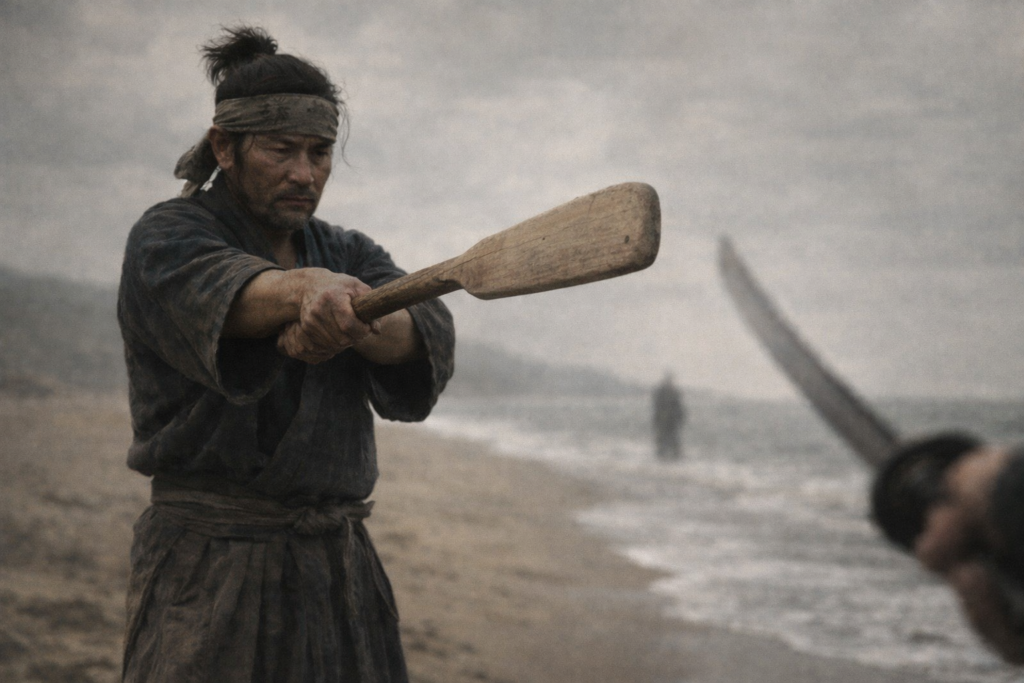
For what seemed an eternity the two men stood with their weapons pointing at each others’ faces, the only sound being the steady fall of each gentle wave collapsing on the sand. Both men seemed to be utterly relaxed, and yet intensely focused. Suddenly, with a fury that shook the air, both men leaped at each other as they swung their weapons down, Musashi slightly slower than his opponent, and in almost the same instant both men jumped back to their ready stance.
The onlookers at first could not understand what they saw, if indeed that they actually saw anything at all, so suddenly had the moment exploded and then gone back to stillness. Then a slight wind revealed that Musashi’s headband had been neatly sliced by the downstroke of his opponent, and as the headband fell to the ground a single cut on his forehead began to bleed. Then is when his opponent fell to the ground, fatally wounded from a blow to the head. Musashi had expertly timed his leap so that his opponent’s sword would be a hair’s width away from killing him, and in that moment that the sword passed his face he would be close enough to deliver a death blow to his challenger’s head.
Again, Musashi never told this story himself, but did admit to having used an oar in a fight at least once. Many versions of the tale abound, and the details seem to cover every imaginative conceit. But if the story is apocryphal, it does illustrate some important truths about the nature of single combat in this period, namely winning with whatever weapon was at hand, not allowing emotion to rule the movements of the fight, waiting for the single perfect moment for a decisive all-or-nothing attack, and the fact that most fights were over in the space of one or two moves.
For actors and choreographers, the lesson is clear. Civilian violence is not stylized sport. It is abrupt, personal, and final. It rewards preparation, awareness, and timing rather than endurance or flourish. Calm is not kindness—it is control.
[I never quite understood how much energy could be delivered from a standing start until I had the opportunity to attend a seminar in traditional Japanese swordplay conducted by Masayuki Shimabukuro Hanshi, 8th dan (level) iaido master. Iaido is taught and practiced using only sharpened blades, and we dutifully practiced for two days the various draws and attacks at a slow and deliberate pace. Finally, he demonstrated what a simple attack would look like at regular speed. He squared off against a 3rd dan guest instructor, and both were completely relaxed. When the guest instructor began to inhale, Shimabukuro leapt forward, his entire body moving in like a freight train, the sword crashing down to a centimeter above the other’s forehead. The room reverberated from the sound of his shout, which was closer to the compressed roar of a lion than a human sound. So sudden and powerful was the attack that the guest instructor had no time to even raise his weapon, and the color drained from his face when he realized how easily this grand master could take someone’s life at will.]
To coolly face death without fear or concern over defeat required an incredible self-discipline and control over emotions, and the Japanese form of Buddhism known as Zen perfectly fit those requirements. While Shinto, the native religion based on deity and ancestor worship and respect, remained popular, Zen gave its practitioners a practical tool in preparing the mental toughness and self control necessary to not be overwhelmed by external events. Both religions [and a few others] coexisted in Japan. Even though several governments tried to separate and regulate the different sects, it is interesting that the vast majority of Japanese today consider themselves Buddhist but also believe in and practice at least some level of Shinto.
When not a duel, a fight of anger between two civilians of any status might of course be fought with any found object, edged weapon, or even unarmed. As all of the samurai class were expected to be expert in the use of all weapons, we would expect that they would have fought with a high degree of skill. If the lower classes had any martial arts training, they still would not have had the luxury of being able to devote several hours to daily practice. Having said that, it is worthy of note that unarmed fight training among the peasant class was fairly common in at least the area of Okinawa, said training that we would later recognize as karate.
Modern karate was developed during the twentieth century and the word translates as “open hand”. But before then the term, although pronounced the same, was originally written with different ideograms, and meant “Chinese hands”, reflecting the origin of the art. The original unarmed fighting style made no distinction between punching and kicking (karate) throwing and grappling (judo) or traps and releases (aikido). What was taught depended on the lineage and, more often, on the competence and interests of the individual instructor. A weapon, if conveniently at hand, was not an unwelcome addition but an expected extension of skill. The notion that unarmed arts were cultivated to make violence gentler or less lethal belongs largely to Western cultural storytelling. In Japan, these disciplines were forged for survival in a world that presumed lethal stakes. They were taught so that a practitioner could kill swiftly, defend effectively, and reduce the opponent’s capacity to do the same.
IV. WARFARE
By this period, warfare is no longer defined by individual challenge or mounted display. It is organized, collective, and increasingly impersonal. Battles are decided by coordination, formation, and discipline rather than by personal heroics. The image of the lone warrior cutting a path through the field belongs more to legend than to lived battlefield experience.
The primary weapons of war are long arms. Spears dominate the frontline, used in dense formations to control space, break charges, and kill efficiently at reach. Firearms, introduced earlier in the century and rapidly adopted, reshape the logic of battle entirely. Drilled volleys, rotating ranks, fortifications, and siege tactics become central. Warfare now favors preparation, logistics, and command over individual prowess.
The sword is present, but it is not the architecture of battle. It functions as a secondary weapon, drawn when formations collapse, distance closes, or fighting turns chaotic. In close press—at armor seams, throats, joints, or during grappling—the sword is decisive, but it is not the weapon that determines the outcome of the engagement as a whole.
Infantry forces expand dramatically during this period. Foot soldiers are organized, trained, and deployed in large numbers, forming the backbone of armies rather than auxiliary support. Their role is collective rather than individual. They fight to hold ground, maintain formation, and exhaust or break the enemy through pressure rather than personal distinction.
Victory on the battlefield is verified rather than assumed. The taking of enemy heads serves as formal proof that a specific opponent has been defeated. This practice is bureaucratic as much as brutal, providing tangible evidence of success that can be counted, identified, and rewarded. It is not indiscriminate savagery, but a grim accounting system tied to rank, obligation, and recognition.
As open warfare gives way to enforced national peace, the battlefield recedes from daily life, but its habits do not vanish. Military discipline, hierarchical command, and readiness for violence remain embedded in the culture of the warrior class, even as their duties shift toward administration and governance. The symbols of war persist after its constant practice has ended.
For theatrical purposes, the essential correction is this: Japanese warfare in this period is not a sequence of individual duels strung together on a field. It is collective, fast-moving, and lethal, shaped by formation, timing, and overwhelming force. When violence breaks into individual encounters, it does so suddenly and ends quickly.
Onstage, this means resisting prolonged sword exchanges, heroic endurance, or stylized back-and-forth combat as representations of battlefield fighting. The reality to convey is pressure, collapse, and decisive action within a larger, impersonal machine of war.
© 2009 Richard Pallaziol, Weapons of Choice ™- all rights reserved