
The cultures of the South Pacific islands were diverse in language, custom, and political complexity, but most were organized around tribal or chieftain-based systems, with some—most notably Hawai‘i—developing highly stratified forms of hereditary kingship. Across Polynesia, warfare was rarely territorial in the modern sense. It was instead rooted in cycles of raiding, retaliation, prestige, and ritual obligation. Violence reinforced status. It did not resolve conflict so much as maintain balance, reputation, and hierarchy.
One defining feature shared across much of Polynesia was the near absence of metal prior to sustained outside contact. Bone, stone, shell, and dense hardwoods were the primary hard materials available. As a result, weapons were overwhelmingly spears, clubs, daggers, and cutting implements, often carefully shaped and sometimes edged with shark’s teeth. These weapons were not crude substitutes for metal arms; they were refined within the material logic of the culture and fully capable of inflicting lethal injury at close range.
Fashion, Style, and Manners
Dress throughout Polynesia was minimal by European standards, but this should not be mistaken for informality. Clothing—or its absence—functioned as a clear marker of status, role, and occasion. Chiefs and nobles were often distinguished by featherwork, cloaks, tattoos, or the quality and rarity of materials rather than by coverage. The body itself was the primary social display.
In the Hawaiian archipelago, this general pattern existed within a particularly complex social and political structure. At the top stood the mo‘i (king), supported by high-ranking ali‘i (lords). Beneath them were the kahuna, specialists and priests, followed by the maka‘ainana, the common workers who made up the majority of the population. At the bottom were the kauwa, a small group of outcasts. All positions were hereditary, and the obligations of rank were absolute.
Hierarchy was enforced physically. Posture, eye line, and spatial awareness were matters of survival as well as etiquette. In some cultures, those of lower rank were required to bow, kneel, or prostrate themselves in the presence of elites, and even to avoid allowing their shadow to touch a person of higher status. Movement through space was therefore cautious and deliberate. Stillness, lowered gaze, and controlled breath were not signs of passivity but of social intelligence.
Weapons were commonly worn openly—tucked into a sash, carried in hand, or kept within immediate reach. The presence of arms shaped everyday interaction. Encounters between men were charged with physical potential, even when no violence occurred. An actor portraying a Polynesian character should assume a heightened bodily awareness: of distance, balance, footing, and readiness.
Civilian Conflict
Violence outside formal warfare was neither rare nor highly regulated. Disputes over honor, status, insult, or perceived disrespect could escalate quickly, and restraint was not a cultural expectation in the modern sense. Civilian conflict might take the form of ritualized encounters governed by custom, or sudden ambushes intended to kill decisively. Reputation mattered, but survival mattered more.
Because weapons were simple, durable, and ubiquitous, there was little distinction between “armed” and “unarmed” confrontation. A club, dagger, or stone could be seized in moments. Civilian violence was therefore immediate, personal, and often public, reinforcing communal norms through physical consequence rather than legal abstraction.
Warfare
Polynesian warfare was typically conducted at close range and involved relatively small numbers of combatants. Dense vegetation and broken terrain limited long-distance visibility and massed formations. Unlike regions such as parts of sub-Saharan Africa, where large spear-throwing engagements could involve much of the male population, Polynesian battles more often consisted of individual or small-group combat using held spears and heavy striking weapons. The intent was to kill, not to capture.
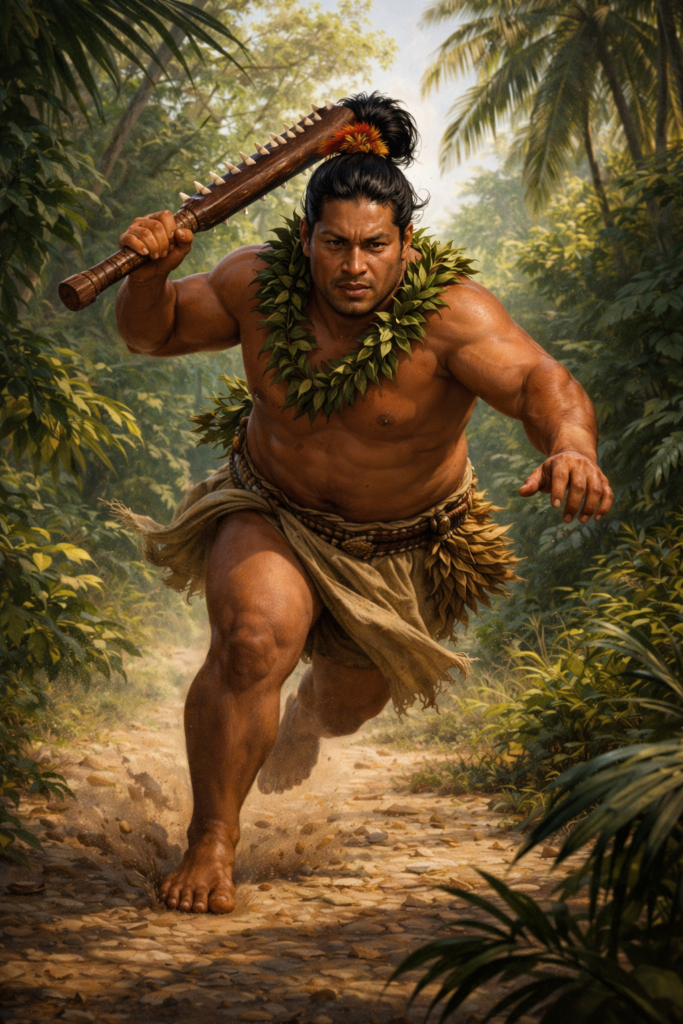
Thrown projectiles—stones, javelins, or slings—were sometimes used to disrupt or injure before closing, but combat quickly resolved into brutal hand-to-hand fighting. Skill, strength, balance, and aggression were decisive. Battles were short, violent, and conclusive.
The leiomano is a close-combat weapon constructed of hardwood and edged with embedded shark’s teeth, found in several forms across Polynesian cultures. It is neither a sword nor a knife in function, but a striking weapon designed to slash, tear, and crush through committed, full-body motion. Its effectiveness depends on momentum and proximity rather than finesse; it assumes that the combatant has already closed distance and intends to end the encounter decisively. The shark’s teeth create ragged, traumatic wounds, reinforcing a mode of violence in which restraint or capture is not the goal. For the actor, the leiomano implies a fighting style driven from the hips and legs, with minimal feinting, little withdrawal, and a cultural relationship to violence that treats it as practical, familiar, and socially embedded rather than emotionally heightened.
Another weapon found in parts of Polynesia, particularly Hawai‘i, was a weighted cord or rope used to entangle an opponent’s legs. Unlike striking weapons, this device was not intended to wound directly but to destabilize—tripping or binding the lower limbs long enough to close distance and deliver a killing blow with a club, dagger, or spear. Its use presumes excellent timing, accuracy, and an understanding of human balance, as well as a tactical mindset that values control of movement over prolonged exchange. For the actor, this weapon suggests a combatant who reads footwork and momentum keenly, attacks the base rather than the guard, and treats unbalancing an opponent as an immediate prelude to decisive violence rather than an end in itself.
Taxes were paid regularly, and both the ali‘i and the mo‘i could call the population to war. Hawaiian weapons included stone clubs, axes, spears, and daggers, many edged with shark’s teeth, as elsewhere in Polynesia. Hawaiians also made use of slings for stone throwing and developed at least one distinctive weapon: a weighted cord thrown at an opponent’s legs to entangle or trip them before closing in for the kill.
To maintain physical readiness, Hawaiians participated widely in athletic contests—wrestling, boxing, sprinting, javelin throwing—activities that closely resemble events found in both ancient and modern Olympic games. Select warriors were also trained in lua, an indigenous martial system taught privately and focused on joint breaking, throws, and lethal targeting.
From these practices and from oral tradition, we can infer that Polynesian—and particularly Hawaiian—warfare relied on a brief initial use of projectiles followed by sustained, ferocious close-quarters combat. For the actor, this implies characters who move with grounded stability, conserve motion, and understand violence as an extension of social order rather than a rupture from it.