
Politics, Economy, Worldview
Anglo-Saxon society in early medieval Britain occupied a middle ground between heroic warrior culture and emerging institutional order. It retained Germanic kin-based values and honor codes, while developing more durable forms of kingship, law, and territorial identity than most neighboring cultures. This was not yet feudal Europe—but it was no longer purely tribal.
Political Structure
Anglo-Saxon political life centered on kingship, but kingship of a negotiated and conditional kind. Kings ruled defined territories—early kingdoms rather than tribes—but their authority depended on consent, success, and generosity, not abstract sovereignty.
A king was expected to:
- lead in war,
- preside over law,
- reward followers,
- and maintain peace within his realm.
His power rested on the loyalty of thane-warriors and household retainers, bound by personal oath rather than land tenure. Failure—especially military failure—could lead to abandonment or replacement. Kingship was durable only when continuously performed.
Assemblies (witan or councils) advised the king, consented to major decisions, and provided a forum for elite consensus. Authority was therefore shared but hierarchical, a key distinction from both Celtic charisma and Frankish centralization.
Economy and Land
The Anglo-Saxon economy was agrarian and localized, but increasingly stable. Permanent settlements, managed fields, and inherited land holdings created continuity across generations. Unlike Slavic semi-mobility, Anglo-Saxon villages tended to remain fixed.
Landholding was individual or familial rather than communal, though obligation tied land to service. Wealth was measured in land, livestock, weapons, and gift-goods. Coinage existed intermittently and unevenly, used primarily for royal or ecclesiastical purposes rather than daily exchange.
Surplus supported:
- warrior households,
- religious institutions,
- and limited regional trade.
This surplus allowed for more sustained warfare and governance than in purely subsistence cultures, without yet enabling standing armies or bureaucracy.
Worldview and Social Values
Anglo-Saxon worldview blended Germanic honor culture with Christian moral framing. Courage, loyalty, and reputation remained central virtues, but they increasingly existed alongside ideas of lawful order, divine judgment, and communal responsibility.
Reputation mattered—but so did memory beyond the individual. Deeds were recorded, not just remembered. Law codes, genealogies, and chronicles began to shape identity across time.
Christianity played a stabilizing role earlier and more deeply here than among the Vikings or Slavs. It did not erase older values, but it redirected them. Kingship gained sacred dimension; violence acquired moral framing; restraint became a virtue rather than a weakness.
Fate (wyrd) remained a powerful concept, but it now coexisted with providence. Action still mattered—but order mattered too.
Violence and Authority
Violence was accepted but increasingly regulated. Feud persisted, yet kings sought to contain it through law, compensation, and royal judgment. Authority aimed not to abolish conflict, but to monopolize its resolution.
This produced a society comfortable with arms and battle, yet increasingly uneasy with uncontrolled disorder. Stability became aspirational.
Theatrical Implications
Onstage, Anglo-Saxon characters should feel grounded, deliberate, and restrained, without the theatrical flamboyance of the Celts or the explosive aggression of the Vikings. Authority is quieter, built on trust and continuity rather than display.
This is a culture learning how to remember itself, preparing—unknowingly—for the shock of Norman conquest.
Fashion / Manners
Anglo-Saxon fashion and manners reflect a society in the process of disciplining itself. Where Celtic display celebrates exposure and Viking dress supports movement and intimidation, Anglo-Saxon presentation emphasizes respectability, continuity, and controlled presence. Clothing and conduct mark belonging within an ordered community rather than individual bravado.
Dress and Appearance
Anglo-Saxon clothing was practical, layered, and sober in appearance. Wool was the dominant fabric, with linen used for undergarments and warmer weather. Tunics, belted at the waist, were standard for both men and women, with trousers or leggings worn beneath. Cloaks fastened with brooches provided warmth and signaled status through material quality rather than size or ornament.
Colors were present but restrained. Earth tones—browns, greys, muted blues, and greens—dominated everyday wear. Brighter dyes existed but were used sparingly and often reserved for higher-status individuals or ceremonial occasions. Patterning was subtle, favoring woven texture over bold contrast.
Clothing was well maintained. Garments were repaired, cleaned, and reused across generations. Neatness mattered. Disorder suggested poverty or moral laxity rather than courage.
Grooming and Self-Presentation
Hair and grooming were culturally regulated. Men typically wore their hair trimmed or tied, beards kept but not exaggerated. Excessively long or wild hair—common in earlier Germanic or Celtic contexts—was increasingly viewed as undisciplined.
Cleanliness carried moral weight. Christian influence reinforced habits of washing, orderly dress, and bodily restraint. Appearance was not decorative but testimonial: it reflected a person’s reliability, self-control, and adherence to communal norms.
Adornment existed but was limited. Rings, small brooches, and belt fittings marked status and allegiance but avoided ostentation. Display without purpose was suspect.
Manners and Social Conduct
Anglo-Saxon manners were formalized but not theatrical. Respect was shown through silence, posture, and attentiveness rather than dramatic gesture. Speech followed hierarchy: one waited to be addressed, spoke plainly, and avoided excess emotion in public settings.
Public life revolved around halls and assemblies. Seating arrangements, order of speech, and ritualized hospitality reinforced social rank. Generosity remained a key virtue, but it was expected to be measured, not flamboyant.
Hospitality was obligatory and structured. A guest entered under protection and was expected to behave with restraint. Breaches of decorum—boasting, uncontrolled anger, or insult—were socially damaging and remembered.
Christian Influence on Manners
Christianity exerted a profound influence on conduct. Humility, patience, and obedience became aspirational virtues, especially among elites. While older honor codes persisted, they were increasingly tempered by moral expectation.
Violence did not disappear, but its public expression narrowed. Outbursts became signs of instability rather than strength. Control—of speech, body, and emotion—was increasingly associated with authority.
Theatrical Implications
Onstage, Anglo-Saxon characters should appear contained, deliberate, and watchful. Movement is economical. Emotion is present but restrained. Clothing should read as orderly and functional, with clear hierarchy expressed through material quality rather than silhouette or ornament.
This is a culture rehearsing the behaviors that will later define medieval courtliness. Authority no longer needs to shout. It expects to be obeyed.
Civilian Conflict
In Anglo-Saxon society, civilian conflict was expected, structured, and increasingly regulated. Violence had not vanished, but it was no longer culturally celebrated as spectacle. Instead, conflict existed within a framework that sought to contain escalation, preserve order, and reinforce royal authority.
Feud and Law
Feud remained a recognized response to injury, insult, or killing, rooted in Germanic kin obligation. However, among the Anglo-Saxons, feud was no longer the preferred outcome. Kings and assemblies actively worked to redirect violence into compensatory systems, most notably through wergild—the assignment of specific values to lives and injuries according to rank.
Acceptance of compensation ended disputes without requiring forgiveness. Refusal to accept lawful settlement marked a person as dangerous and unstable, placing them at odds with both community and king. Over time, this transformed feud from a default response into a social liability.
Royal courts and local assemblies provided venues for arbitration. Justice was public, remembered, and enforced through communal pressure rather than centralized force. The goal was not abstract fairness, but stability.
Everyday Conflict and Restraint
Daily life required readiness for confrontation, but restraint carried increasing social value. Public outbursts, brawls, or uncontrolled aggression were viewed with suspicion. Strength was measured by the ability to contain violence, not merely to unleash it.
Disputes were expected to be voiced openly and resolved visibly, but with limits. Silence, withdrawal, or appeal to authority were acceptable strategies. Honor was preserved through lawful behavior as much as through physical courage.
Women played active roles in conflict resolution within households and kin groups, particularly in matters of inheritance and compensation. Their influence was social rather than martial, but it was significant.
Civilian Weapons
Weapons ownership among Anglo-Saxon civilians reflected graduated readiness, not constant aggression.
The knife was universal. It served domestic, occupational, and defensive purposes. Its presence was unremarkable and socially neutral.
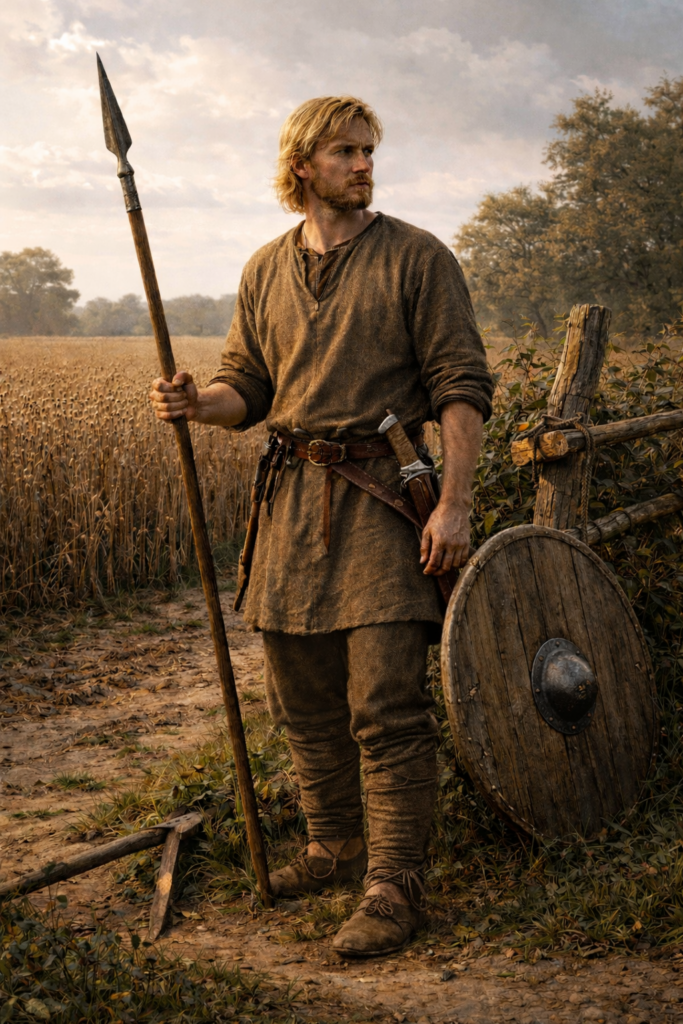
The spear was the most common weapon associated with free men. Often kept rather than carried, it could be used for defense, hunting, or levy service. Ownership signaled freedom and responsibility.
The axe, primarily a tool, doubled as a weapon when needed. Like the spear, it was practical rather than symbolic.
The seax—a large single-edged blade—held particular cultural significance. Larger than a knife but shorter than a sword, it bridged tool and weapon. Its presence was common among free men and emblematic of Anglo-Saxon identity.
The sword remained rare and prestigious. Expensive to produce and maintain, it was associated with warrior elites and royal retainers. Civilian sword-wearing outside specific contexts was notable and often deliberate.
Shields were uncommon in civilian settings but widely available for collective defense.
Social Meaning of Arms
To be armed signaled status and autonomy, but the type of weapon mattered. Modest arms indicated participation in lawful society; overtly martial display suggested ambition or threat.
The Anglo-Saxon ideal was the armed but restrained free person—capable of violence, yet committed to order.
Theatrical Implications
Onstage, Anglo-Saxon civilian conflict should feel controlled but tense. Disputes unfold through speech, appeal, and measured escalation. Weapons appear deliberately, not impulsively. Violence, when it occurs, feels like a failure of order rather than its fulfillment.
This is a society learning to govern itself, one settlement at a time.
Warfare
Anglo-Saxon warfare reflects a society moving steadily away from heroic display and toward collective discipline and territorial defense. War was neither purely ritual nor purely predatory; it was a civic obligation tied to land, law, and kingship. Violence served order, not spectacle.
Organization and Leadership
Anglo-Saxon armies were assembled through obligation rather than profession. Kings called upon local leaders, who in turn summoned free men owing service through landholding or allegiance. This produced forces that were temporary but reliable, grounded in shared interest rather than mercenary pay.
Leadership was hierarchical but personal. Kings and ealdormen led from the front, expected to fight alongside their men. Authority rested on trust, reputation, and continuity rather than fear. Failure in war weakened legitimacy; success reinforced it.
Councils advised on campaigns, and warfare was increasingly framed as a collective undertaking rather than a personal venture. This marked a significant shift from earlier tribal models.
Strategic Logic
Anglo-Saxon warfare emphasized defense of territory and enforcement of authority. Campaigns were local and purposeful: repelling raids, punishing lawbreakers, asserting claims, or suppressing rebellion. There was little interest in distant conquest for its own sake.
Armies were constrained by agricultural cycles and supply limits. Warfare was seasonal and episodic, but increasingly planned. The goal was stability—restoring order quickly rather than pursuing annihilation.
Nature of Combat
The defining feature of Anglo-Saxon warfare was the shield wall. Infantry fought in dense formations, shields overlapping, relying on cohesion, discipline, and mutual protection. Individual heroics mattered less than holding position.
Battles were contests of endurance and morale. Breaking the enemy’s line mattered more than inflicting casualties. Once a shield wall collapsed, defeat followed quickly.
Mounted warriors existed but played limited roles. Decisive fighting remained on foot. Coordination mattered more than speed or ferocity.
Weapons and Arms in War
The spear was the primary battlefield weapon, effective in formation fighting and economical to equip. Spears could thrust over shields and maintain pressure without breaking formation.
The seax served as a secondary weapon once lines collapsed, suitable for close, brutal fighting.
The sword was carried by elites and royal retainers. It functioned as a sidearm and symbol of status rather than a primary tool of battle.
Shields were essential. Large, round shields provided both protection and offensive leverage within the shield wall.
Armor was limited but increasing. Helmets and mail existed among wealthier warriors, signaling the gradual movement toward professionalization that would accelerate after the Norman Conquest.
Warfare and Authority
Anglo-Saxon warfare reinforced royal authority. Successful kings maintained peace by demonstrating the capacity to mobilize and defend. Failure invited rebellion or replacement.
Christian framing increasingly shaped war’s justification. Campaigns were presented as defense of order, punishment of wrongdoing, or fulfillment of divine obligation. Violence was morally contextualized, not celebrated for its own sake.
Position in the Transition to Norman England
Anglo-Saxon warfare provided the structural foundation the Normans would later exploit and formalize. The shield wall, obligation-based service, territorial kingship, and Christian legitimacy all predate the Conquest.
What the Normans introduced was not order, but scale and permanence.
For theatrical purposes, Anglo-Saxon warfare should feel disciplined, heavy, and resolute. Movement is forward but measured. Courage is collective. Victory belongs not to the loudest warrior, but to the line that holds.