
Politics, Economy, Worldview
Among the major cultures of early medieval Europe, the Slavs represent a deliberately decentralized world. Neither raider-oriented like the Norse nor rapidly institutionalizing like the Franks, early Slavic societies emphasized local autonomy, communal decision-making, and agricultural continuity. Their political invisibility in written sources is not evidence of disorder, but of a social system that resisted durable hierarchy.
Political Structure
In times of external pressure—Frankish expansion, Avar domination, Byzantine influence—some Slavic groups developed stronger leadership structures. These early princes and war leaders were exceptions rather than norms, and their authority depended on continued success rather than institutional permanence.
Economy and Land
The Slavic economy was overwhelmingly agrarian, rooted in subsistence farming, herding, fishing, and seasonal gathering. Villages were often semi-mobile, relocating fields or settlements as soil was exhausted. This adaptability reduced dependence on fixed infrastructure and made long-term occupation by outside powers difficult.
Land was held communally rather than as individualized property. Families worked plots assigned by custom, not law. Wealth was measured in livestock, stored grain, tools, and labor capacity rather than coin. Trade existed, especially along river systems, but it supplemented rather than defined daily life.
Because surplus was limited, Slavic societies did not support large warrior classes or standing elites. When fighting was required, farmers became fighters, then returned to the fields. This rhythm shaped every aspect of Slavic life.
Worldview and Social Values
Slavic worldview emphasized continuity over conquest. Survival depended on cooperation, memory, and seasonal rhythm rather than heroic dominance. Reputation mattered, but it was rooted in reliability and contribution rather than individual martial achievement.
Religion reinforced this outlook. Slavic spiritual life was animistic and local, centered on land, water, forests, and ancestral presence. Sacred sites were tied to place rather than institution. Authority came from age, experience, and perceived wisdom, not divine sanction of rulers.
Christianization, when it came, arrived unevenly and late. Even then, it often layered over existing beliefs rather than replacing them. This further delayed the emergence of centralized authority and formal hierarchy.
Violence and Authority
Violence existed, but it was defensive and episodic, not expansionist. Raiding occurred, but it was not culturally glorified. Warfare was a disruption of normal life, not a path to status.
Authority was therefore limited by expectation. A leader who demanded too much labor, tribute, or risk could simply lose the community’s support. Slavic societies lacked the mechanisms—and the desire—to sustain coercive rule over long periods.
Theatrical Implications
Onstage, Slavic characters should read as grounded, communal, and situationally decisive rather than hierarchical or flamboyant. Leadership shifts depending on circumstance. Speech is practical, consensus-oriented, and rooted in shared memory rather than command.
This is a world where power is temporary, violence is reluctant, and survival depends on cohesion. The Slavs are not passive—but they are not performative. Their resistance lies in endurance rather than spectacle.
Fashion / Manners — Slavs
Slavic dress and manners in the early medieval period reflect a culture oriented toward agricultural continuity, communal labor, and environmental adaptation, rather than display or rank signaling. Appearance communicated belonging and practicality more than status. Manners emphasized cooperation, familiarity, and restraint over ceremony.
Dress and Appearance
Slavic clothing was simple, durable, and locally produced. Linen and wool dominated, woven within the household or village. Garments were cut for labor and seasonal change: long tunics or shirts belted at the waist, trousers or leggings, and layered outer garments for colder months. Clothing tended toward light colors—off-whites, browns, and muted earth tones—though simple dyes were used when available.
Decoration was minimal and functional. Embroidery, when present, appeared at cuffs, hems, or collars and often carried symbolic or protective meaning rather than aesthetic flourish. Metal fittings were scarce and reserved for tools rather than ornament.
Footwear was practical and often improvised: leather shoes, wrapped cloth, or barefoot labor depending on terrain and season. Cloaks or mantles were worn in cold or wet conditions, easily shed when working.
There was little visual distinction between the clothing of leaders and non-leaders. Age, experience, and demeanor carried more weight than costume. Any difference in dress tended to reflect life stage or role—elder, farmer, herder—rather than hierarchy.
Grooming and Self-Presentation
Grooming was functional rather than expressive. Hair was kept long enough to be managed easily, often tied or covered during work. Beards were common among men, trimmed for practicality rather than style. Cleanliness was dictated by environment and labor; bathing occurred when conditions allowed, especially near rivers or during communal activities.
Adornment was rare and meaningful when present. Amulets, simple pendants, or woven charms might be worn for protection or spiritual significance rather than decoration. These objects signaled belief and belonging, not wealth.
Neglect was not celebrated, but neither was polish. A Slavic individual was judged by reliability and contribution, not by refinement.
Manners and Social Conduct
Slavic manners were informal, communal, and context-driven. There was little emphasis on ritualized deference. Respect was earned through age, experience, and demonstrated competence, not asserted through posture or silence.
Speech tended to be direct and practical. Decisions were discussed rather than announced, especially in communal settings. Interruptions were acceptable if relevant; silence could signal agreement or withdrawal rather than submission.
Hospitality was expected within the bounds of capacity. Guests were fed and sheltered, but excess was impractical. Hospitality created obligation on both sides: the host offered protection, the guest respected limits and contributed when able.
Public life revolved around shared labor and seasonal rhythm. Manners were shaped by proximity and familiarity rather than formality. Social correction occurred quietly, through comment or withdrawal of cooperation, rather than public reprimand.
Spiritual Influence on Conduct
Animistic belief reinforced attentiveness to place and behavior. Actions were understood to affect not only people but land, water, and unseen forces. Excess, arrogance, or disruption of balance was viewed with suspicion.
Later Christian influence introduced new moral frameworks, but early on these were layered atop existing expectations of moderation and mutual obligation rather than replacing them.
Theatrical Implications
Onstage, Slavic characters should appear unadorned, grounded, and collectively oriented. Clothing should look worn, repaired, and reused. Rank is expressed through who speaks first or is listened to longest, not through costume or posture.
Movement is efficient and purposeful. Manners are familiar rather than deferential. This is a society that values belonging over distinction, and whose quiet cohesion stands in contrast to the performative identities of both Viking raiders and Frankish elites.
Civilian Conflict
In early Slavic societies, civilian conflict was managed communally and conservatively. Violence existed, but it was treated as a disruption to collective survival rather than as a path to honor or advancement. The overriding goal was restoration of balance, not assertion of dominance.
Conflict, Custom, and Community
Disputes most often arose from land use, resource access, family obligations, injury, or breach of trust. The preferred response was mediation by elders or household heads, not immediate retaliation. Because land and labor were shared resources, prolonged internal conflict endangered everyone.
Feud existed but was limited in scope and duration. Retaliatory violence was discouraged not through formal law codes, but through social pressure and practical necessity. A family that escalated conflict risked isolation, withdrawal of labor support, and loss of standing within the village—penalties often more damaging than physical injury.
There was no centralized legal apparatus. Resolution depended on memory, consensus, and reputation. Outcomes were binding only insofar as the community accepted them. This made justice flexible but also deeply personal.
Readiness and Restraint
Slavic civilians lived with the understanding that violence was possible, but not inevitable. Readiness was defensive rather than aggressive. Individuals were expected to protect themselves and their households, yet also to exercise restraint.
Fights, when they occurred, were typically brief and functional. The aim was to stop a threat, not to annihilate an opponent. Excessive violence invited communal response and lasting distrust. Courage was respected, but so was moderation.
Women participated actively in conflict resolution and household defense. While battlefield roles were limited, civilian authority and influence were not restricted by gender in the same way as in more hierarchical societies.
Civilian Weapons
Weapons ownership among Slavic civilians reflected utility first, violence second. The knife was universal. It served as tool, eating implement, and emergency weapon. Its presence was ordinary and unremarkable.
The axe was common, primarily as a working tool. Like the Norse axe, it could function as a weapon when necessary, but it was not culturally glorified. Its use in conflict was pragmatic rather than symbolic.
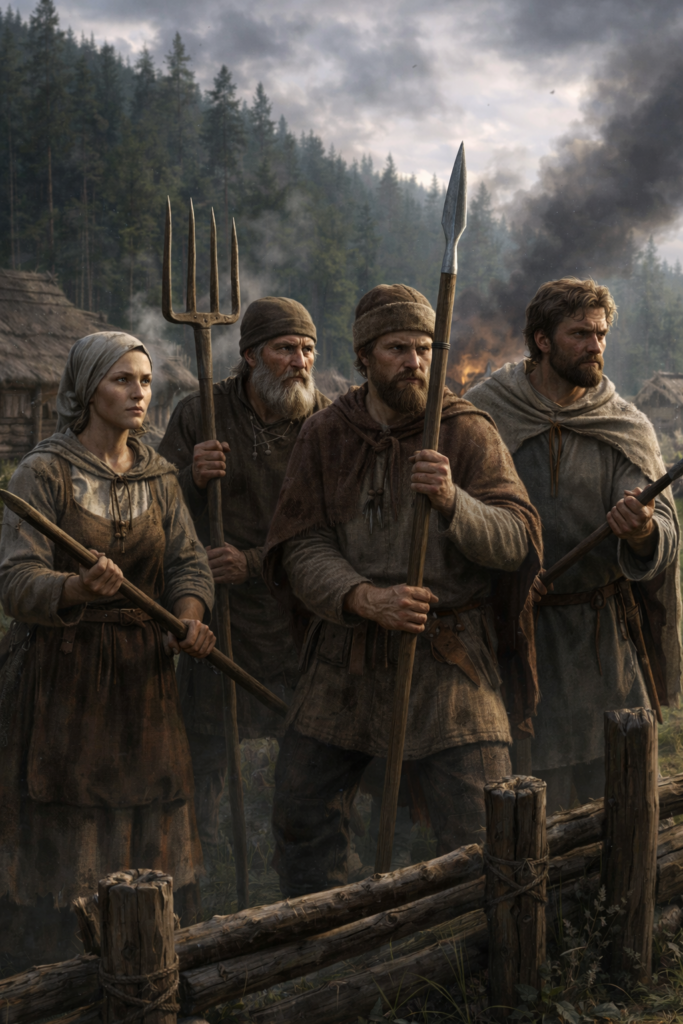
The spear was the primary defensive weapon available to the community. Easy to make and effective with minimal training, it could be used to defend settlements or repel raids. Spears were typically kept rather than carried daily.
Shields were uncommon outside moments of collective defense. Armor was virtually nonexistent among civilians.
Swords were rare to the point of novelty. Their cost, maintenance demands, and limited practical advantage in daily life placed them beyond the reach—and interest—of most Slavic communities.
Social Meaning of Armed Civilians
To be armed in Slavic society signaled preparedness, not status. Weapons were tools for necessity, not markers of identity. Open display of arms outside moments of threat could be read as antisocial or destabilizing.
A person’s standing rested far more on reliability, cooperation, and contribution than on martial display. Persistent aggressors risked exclusion rather than admiration.
The Slavic approach to civilian conflict thus prioritizes containment over expression, defense over assertion, and continuity over spectacle. For theatrical purposes, this creates a world where tension simmers quietly, decisions are collective, and violence—when it erupts—feels consequential precisely because it is restrained.
Warfare
Slavic warfare in the early medieval period was reactive, defensive, and episodic, shaped by agricultural life, limited surplus, and the absence of standing elites. War was not a profession, nor a source of prestige in itself. It was a disruption to be endured, managed, and concluded as quickly as possible.
Organization and Leadership
Slavic communities did not maintain permanent warrior classes. When conflict arose, farmers became fighters, assembled through kinship, proximity, and necessity. Leadership was situational: a respected elder, experienced fighter, or charismatic individual might take command for the duration of a threat, but that authority rarely extended beyond the immediate crisis.
There was no expectation of obedience outside the moment. Leaders led by persuasion and example rather than command. Once danger passed, authority dissolved and individuals returned to their ordinary roles.
This structure limited the scale and duration of Slavic warfare. Large, sustained campaigns were impractical. What Slavic groups lacked in professionalization, they compensated for with cohesion and familiarity.
Strategic Logic
Slavic warfare prioritized defense, delay, and survival, not conquest. Communities avoided open battle whenever possible, especially against more heavily armed or organized enemies. Instead, they relied on terrain, concealment, and endurance.
Forests, marshes, rivers, and poor roads were not obstacles but assets. Slavic fighters were accustomed to their environments and used them to restrict enemy movement, isolate small groups, and wear down invaders through attrition and uncertainty.
Villages could be abandoned temporarily, supplies hidden, and populations dispersed, denying attackers decisive victories. Time was often on the defender’s side.
Nature of Combat
When fighting occurred, it was close, chaotic, and collective. There was little emphasis on formation fighting or individual display. Engagements were short and decisive, aimed at repelling attackers or breaking contact rather than achieving total victory.
Ambush, harassment, and sudden counterattacks were preferred to head-on confrontation. Slavic fighters avoided prolonged exposure, withdrawing once objectives were met.
Morale was tied to the defense of home and kin rather than loyalty to a leader or banner. Once that purpose was fulfilled, there was little incentive to pursue further violence.
Weapons and Arms in War
Slavic warfare relied on simple, accessible weapons. The spear was the primary weapon of war. Easy to produce and effective in both defense and ambush, it required minimal training and worked well in dense terrain.
The axe, often a working tool, served as a secondary weapon. Durable and effective at close range, it required little specialization.
The bow was used for hunting and could be adapted for warfare, particularly in harassment and ambush, though it was not central to pitched combat.
Shields were used when available, especially in collective defense, but were not universal. Armor was extremely rare. Protection came from terrain, numbers, and timing rather than equipment.
Swords were virtually absent from Slavic warfare in this period, appearing only through trade, capture, or exceptional circumstance.
Warfare and Society
Because warfare drew directly from the agricultural population, its cost was immediately felt. Loss of life meant loss of labor, food production, and continuity. This reinforced the Slavic preference for avoidance, restraint, and rapid resolution.
There was no cultural glorification of war as a path to honor. Success was measured by survival and preservation of the community, not by trophies or expansion.
Position in the Wider World
This defensive orientation made Slavic territories difficult to dominate permanently, even when they were vulnerable to raids or incursions. Over time, sustained pressure from neighboring powers would lead some Slavic groups to adopt stronger leadership and military structures—but this represents a later evolution, not the baseline condition.
In the early medieval period, Slavic warfare stands apart as collective, reluctant, and terrain-bound—a model of resistance rather than assertion. For theatrical purposes, it offers a world where violence is purposeful but never indulgent, and where survival depends on cohesion rather than spectacle.