
Time Frame: 1710–1789
Worldview
The Rococo period sits at a moment of profound contradiction. The absolute monarchy is in visible decline, yet the aristocracy appears at its most insulated, ornamental, and detached from the realities of governance and labor. Parliaments and representative bodies increasingly hold real power—sometimes through slow reform, sometimes through sudden violence—while the day-to-day operation of states, markets, and bureaucracies falls to an expanding middle class of administrators and managers. The complexity of a modern market economy requires expertise, literacy, and constant attention, and it is the bourgeoisie, not the nobility, who increasingly provide it.
This redistribution of practical responsibility allows the upper class to withdraw from productive engagement altogether. Politics, commerce, the military, and even household management are delegated downward. From this withdrawal emerges something historically new: a true leisure class, defined not merely by wealth, but by the absence of necessity.
Religion during the Rococo period does not disappear, but it undergoes a quiet reconfiguration. Formal observance remains socially mandatory, and public piety continues to function as a marker of respectability, yet religious doctrine increasingly recedes from everyday moral enforcement among the upper classes. In its place emerges a system of regulation based less on sin and conscience and more on propriety and embarrassment. Moral failure is no longer framed primarily as offense against God, but as a failure of refinement—something to be exposed, whispered about, and remembered. Confession is replaced socially by gossip; absolution by social recovery. One does not fear damnation so much as being seen.
At the same time, Europe is in the midst of the Enlightenment. Philosophy, science, and political theory undergo radical transformation as inherited ideas are subjected to systematic skepticism. Observation alone is no longer sufficient; hypotheses must be tested, retested, and proven under controlled conditions. The modern scientific method is born. No belief—religious, political, or social—is immune from examination. Ancient Greek ideas about democracy, individual rights, and rational inquiry are revived and made operational. For some, this intellectual upheaval is liberating; for others, terrifying; for still others, revolutionary.
This tension—between intellectual radicalism and social withdrawal—defines the Rococo worldview. While ideas of equality and reason circulate widely, the aristocracy doubles down on separation, refinement, and visible distinction from the world those ideas are beginning to reshape.
Manners, Fashion, and the Body
The aristocracy’s retreat from public responsibility expresses itself most clearly in manners and appearance. As middle-class wealth grows, nobles feel compelled to prove that their status is not earned but innate. Refinement becomes evidence of biological and moral superiority. Social life is reorganized around this belief, producing a system of etiquette so intricate that failure at any moment can result in humiliation.
At its core, Rococo refinement rests on two principles: separateness of the body and elevated inclination.
The separateness of the body is not merely metaphorical. Nobles are believed to exist on a higher physical plane, removed from the profane world of labor, dirt, and bodily necessity. Commoners are tied to the earth; nobles must be protected from it. This belief persists despite its obvious contradictions.
Fairy tales such as The Princess and the Pea reflect the assumption that noble bodies are uniquely sensitive, unable to tolerate even the smallest intrusion of physical irregularity.This shift produces a profound internal tension. Because virtue is now judged externally, the aristocratic individual must constantly monitor not belief or intent, but appearance and conduct. The self becomes a performance under continuous evaluation. A single lapse—an unguarded gesture, a poorly chosen word, an excess of emotion—can fracture social standing. The resulting anxiety is not merely social but existential: identity itself is unstable, dependent on the uninterrupted success of one’s presentation. This pressure helps explain the Rococo obsession with rehearsal, instruction, and correction, and the terror of public exposure that lurks beneath the era’s surface frivolity.
In practice, this ideology creates constant anxiety. Every social interaction is a minefield. Nobles must perform refinement flawlessly at all times, for any lapse suggests a hidden vulgarity. Embarrassment at crudity becomes a virtue. Bodily functions are denied altogether. Touch is restricted; proximity becomes a privilege. To be allowed near someone—or to touch them—is a significant mark of favor.
Food, travel, entertainment, and even conversation are ritualized. Implements multiply. Procedures harden. Delicacy is preferred over robustness in all things. Servants are no longer simply helpers; they become buffers, shielding the nobility from contact with common people and the messiness of ordinary life. The old mixed-class tavern and inn culture disappears from aristocratic experience entirely.
Fashion reinforces this separation visually. Over the course of the century, line, texture, and color move steadily toward the ethereal and feminine for both men and women. Pastels, lace, frills, powdered wigs, and delicate patterns dominate by the 1780s. This is a conscious strategy: as the middle class gains access to quality goods, the upper class escalates extravagance to maintain visible distance. New social customs emerge—formal tea and coffee service, ever-changing dance fashions such as the minuet, and the construction of opera houses and concert halls designed as much to exclude the lower classes as to elevate art.
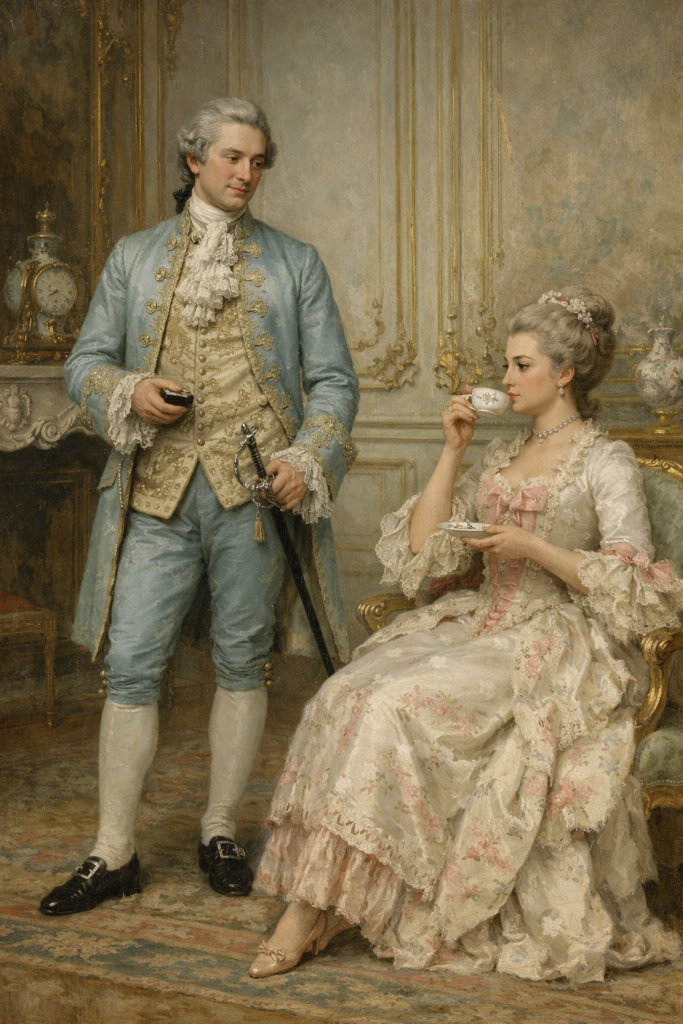
Physical comportment follows suit. Strength and authority give way to cultivated frivolity. The body is no longer presented as a seat of power but as an ornamental element within a room. Sitting becomes lounging; standing becomes posing. The aristocratic body appears to float rather than rest. Every movement is contrived to look effortless, even as enormous resources are spent on instruction. Dancing masters, posture coaches, and etiquette tutors shape every gesture. One must move at all times as though observed by one’s peers—even when alone.
Men are trained to move lightly and gracefully, though certain structural elements remain: turned-out feet, expanded chest, lifted chin, straight back. Walking is finally permitted to be heel-to-toe. Arms are bent or occupied, never left to hang. Asymmetry is preferred. Bows become more relaxed: the hat is removed and swept only to waist height, the arm nearly straight, the right foot extended forward with a gentle bend at the waist. Indoors, hats are removed and remain off.
Ironically, the aristocracy fills its days with activities that resemble middle-class pastimes—card games, serving coffee, staged picnics in artificial “rustic” settings—yet insists on performing them through rigid ritual and meticulously affected casualness. These are not idle diversions but controlled environments, designed to regulate behavior and display refinement. The salon, in particular, functions not merely as a room but as a social mechanism: a space for discovery, instruction, performance, and dissemination. Conversation becomes a cultivated art in which ideas are tested aloud, reputations are formed in real time, and wit functions as currency. What is said within the salon travels outward through letters, gossip, and imitation, long before mass media exists. Admission itself confers legitimacy; exclusion erases social presence. While most aristocrats remain consumers rather than creators, the life of leisure does provide one genuine benefit—time. A small number of nobles devote that time seriously to art, philosophy, science, and literature. These figures are exceptions rather than representatives, but their work, often produced in or circulated through these same controlled social spaces, materially advances Enlightenment thought.
Alongside this stands the rapidly growing bourgeoisie. This class runs industries, administers governments, and reshapes cities. Shops, restaurants, pre-manufactured clothing, and furniture become common. Bourgeois fashion follows military trends rather than aristocratic excess. Their physical comportment reflects practicality: arms may hang naturally, feet remain parallel, and chairs are used as furniture rather than theatrical props. The middle class does not attempt to imitate aristocratic mannerisms; the social gulf is now mutual.
Actor Physicality — Rococo
Since the Rococo body exists to be seen, assessed, and judged, it is neither tool nor a private possession; it is a social instrument, continuously on display. Even when alone, the body behaves as though observation is possible. Physical ease is not permitted unless it can be framed as refinement. Where later bodies will be disciplined for function, the Rococo body is disciplined for appearance. Movement is curated. Stillness is posed. Effort is hidden at all costs.
Posture
Rococo posture is elongated, elevated, and carefully moderated. The spine lengthens without rigidity; the chest is lifted, but softly. Weight never settles fully into the feet. The body appears suspended rather than grounded, as though lightly removed from the earth.
This posture suggests not strength, but exemption—exemption from labor, from urgency, from necessity. Collapse is unthinkable. Even fatigue must be stylized.
Posture is personal and competitive. Each individual cultivates a slightly distinct version of refinement.
Gait
Walking is one of the primary arenas of social signaling. Steps are small, precise, and often turned out. Heel-to-toe walking is permitted, but muted and controlled. Direction changes are smooth and ornamental, not abrupt. Speed is regulated; haste implies vulgar necessity. Walking does not privilege destination. It privileges how the body is read while in motion.
Arms, Hands, and Gesture
Arms rarely hang freely. Elbows are bent, hands are occupied, posed, or in gentle motion. Even at rest, the limbs maintain awareness.
Gestures are curved, layered, and often indirect. They may begin late or finish after the spoken thought, allowing gesture to decorate language rather than reinforce it. Asymmetry is favored, as it suggests ease and natural grace.
Gesture exists partly for the watcher. Even conversation is a mild performance.
Seated Posture
Sitting in the Rococo period is not rest; it is presentation. The body perches rather than settles. The back may touch the chair lightly, but full support is avoided. Feet are arranged rather than planted. The torso angles slightly, avoiding square alignment with the furniture. Arms are draped or arranged with care. Stillness is maintained through constant micro-adjustment. The seated body remains alert to interruption, judgment, or opportunity.
Weapon Carry (Smallsword)
The smallsword is worn from a shoulder sash, not a waist belt. As a result, the scabbard moves independently of the body, requiring constant awareness while walking or turning. The sword is not a tool of readiness. It is a marker of identity. Touching the hilt signals status, favor, or social alignment, not imminent violence. Many wear the sword with visible anxiety, acutely aware that improper handling invites ridicule. The body adapts to the sword rather than the sword serving the body.
Greeting and Deference: The Bow
The bow is central to Rococo physical life. It is layered, expansive, and negotiated. Status determines who bows first, how deeply, and for how long. The movement often includes a step back, removal and sweeping of the hat, and a controlled inclination of the torso.
The bow is held until acknowledged. It establishes hierarchy while affirming mutual participation in the same social code. The bow says: I recognize you—and I recognize myself in relation to you.
Idle Behavior
Idle behavior in the Rococo period is best described as performative vigilance.
The body is never truly idle. Small adjustments, fabric touches, posture resets, and fingertip contact with furniture occur constantly. Even alone, the body behaves as though gossip or judgment might intrude at any moment.
Complete stillness is rare and uncomfortable. Collapse, slouching, or slackness would betray a failure of refinement.
Emotional Filtering
Emotion is not suppressed, but filtered. Feelings are shaped before release, softened by etiquette, or redirected into wit, irony, or gesture. Direct emotional exposure risks appearing crude or uncontrolled.
The goal is not honesty, but elegance.
Actor Anchor
A Rococo body asks one overriding question: “How am I being read?” If the body settles, simplifies, or acts without regard for observation, it has left the Rococo world—regardless of costume or text.
Civilian Violence and Personal Arms
The transformation from rapier to smallsword mirrors the broader cultural shift. As aristocratic life becomes increasingly stylized, so too does its weaponry. The rapier—once a brutal, versatile tool suited to brawling street violence—is replaced by the smallsword, a weapon designed for elegance rather than practicality.
For the only time in European history, a weapon is created primarily as an accessory of fashion. The smallsword cannot cut, is useless in battle, and is ineffective against other weapons unless wielded by someone specifically trained in its narrow system. Its hilt offers minimal protection and exists largely as ornament. Worn from a shoulder sash rather than a waist belt, the scabbard moves independently of the body, requiring instruction merely to walk without ridicule.
Training in smallsword fencing is intensive, expensive, and time-consuming, effectively limiting its use to the leisure class. Fear of public embarrassment—of wearing or handling the sword incorrectly—leads many nobles to abandon carrying a weapon altogether. With the disappearance of the waist belt comes the disappearance of the dagger. For the first time in European history, men no longer routinely wear a secondary blade. Daggers survive only as concealed tools of thieves and ruffians.
Use of the left hand in fencing is increasingly viewed as gauche and gradually disappears. Dueling becomes an almost exclusively aristocratic activity. While less widespread than in the early seventeenth century, it remains alarmingly common among young nobles, often over imagined slights. The duel is more formalized but still lacks the theatrical salutes of later fiction. Seconds handle all arrangements, enforce agreed-upon terms, prevent escalation, and maintain secrecy, as dueling is illegal in most jurisdictions.
Monarchs continue to be portrayed with swords of war rather than civilian weapons, though these are often reduced broadswords or early sabres that function more as symbols than practical arms.
Warfare and the Military World
A fundamental transformation in warfare occurs at the start of the eighteenth century, driven by a seemingly modest innovation: the bayonet. Originally improvised by jamming a blade into the barrel of a musket, the bayonet converts a firearm into a spear. Early plug bayonets disable the musket entirely, but the later socket bayonet—mounted beneath the barrel—allows continuous firing while providing defense against cavalry.
This single change eliminates the need for separate pikemen. Musketeers become both shooters and defenders. Infantry firepower and resilience double without increasing troop numbers. Soldiers are trained to fire in unison and hold formation against bayonet charges. Hand-to-hand bayonet training exists largely for morale; once a line is breached, defeat is almost certain.
At the same time, firearms improve dramatically. Flintlocks replace matchlocks. Barrels become thinner and lighter. Misfire rates drop to roughly 20 percent among trained troops. Reload times fall below thirty seconds. Soldiers can fire shoulder to shoulder, creating devastating walls of bullets effective out to 150–200 yards, though volleys are typically delivered at closer range.
These developments render cavalry increasingly obsolete. Infantry can now hold—and even advance against—mounted troops. Artillery becomes the primary means of softening enemy positions. Warfare returns, in many ways, to Roman principles: disciplined infantry maneuvering in coordinated formations. This requires standing armies trained daily by professional officers promoted for competence rather than birth. Kings increasingly favor effective commanders over landed nobles, reshaping military hierarchies.
Uniforms evolve to support tight formations. Clothing becomes close-fitting. Plumes vanish. Hats shrink. High-contrast vertical stripes appear on trousers to aid drill alignment—a detail that survives today in formal wear. Everything bulky or flamboyant is removed to allow soldiers to stand shoulder to shoulder.
The myth of hyper-formalized “gentlemanly” warfare—armies politely arranging battles by correspondence—is just that: a myth. Challenges to battle occur only when one side believes it holds a decisive advantage or when logistics force engagement. Supply limitations, disease, desertion, and poor intelligence make prolonged campaigns impractical.
It is during this period that the modern military salute emerges. Contrary to popular belief, it does not descend from medieval knights lifting visors. That practice did not exist, and even if it had, the salute is a gesture of submission, not equality. Instead, the salute evolves from the civilian bow. Over centuries, the bow incorporates hat removal, steps, and acknowledgment protocols. As military headgear becomes impractical to remove—especially with mitres and shakos—the gesture is abbreviated into a symbolic touch of the brim. This compromise becomes standardized across infantry and cavalry.
Specialized units proliferate—grenadiers, fusiliers, dragoons, hussars, rangers—but the battlefield ultimately resolves into heavy infantry versus heavy infantry. Sabres become standard sidearms, enabled by advances in metallurgy that allow long, light curved blades. Heavy cavalry favors straight blades for thrusting; light cavalry favors curved blades for cutting. Infantry sabres are generally curved, with straight blades reserved for dress swords.
The military does not issue knives, but irregular troops and riflemen often carry simple butcher-style blades for practical tasks. These “rifle knives” prefigure later American fighting knives. Pistols exist but remain tactically insignificant.
Summary for Performers
Rococo is a world of contradiction: radical ideas and extreme artifice, intellectual freedom and physical repression, refined gesture and profound social anxiety. Violence becomes stylized, weaponry ornamental, and warfare mechanized. The body is both obsessively controlled and aggressively denied. For actors, this period demands precision, restraint, and constant awareness of social surveillance—every movement is a performance, and every failure is visible.