
Daggers are constructed in many of the same ways as small swords. Their blades are generally straight, symmetrical, and double-edged, although there are many historical and theatrical exceptions.
The terminology surrounding daggers is not consistent. Historical sources, dictionaries, manufacturers, and theatrical suppliers may apply the same name to quite different weapons—or different names to nearly identical ones. The terms used here reflect their practical use within stage combat rather than any attempt at strict historical classification.
All measurements given for a dagger refer to the exposed blade, not the overall length of the completed weapon.
Selecting a Dagger Blade
The appropriate blade depends first upon the weapon against which the dagger will be used. A very light dagger may work well against an épée- or schlager-bladed sword but be overwhelmed by a heavier blade. The dagger must have enough strength and stiffness for the intended contact without becoming unnecessarily heavy or slow.
Length is also important. Although a short dagger may look convincing, it may provide too little blade for effective parries. This becomes particularly troublesome when the dagger must defend against a much longer weapon.
The blade must also be visible to the audience. A narrow dagger that looks perfectly satisfactory at close range may disappear in the actor’s hand or become indistinct beneath stage lighting. The size and shape must therefore suit the performance space as well as the historical period and visual style of the production.
The measurements below are not absolutes, but they can give you an idea as to rough dimensions to look for when deciding on a blade.
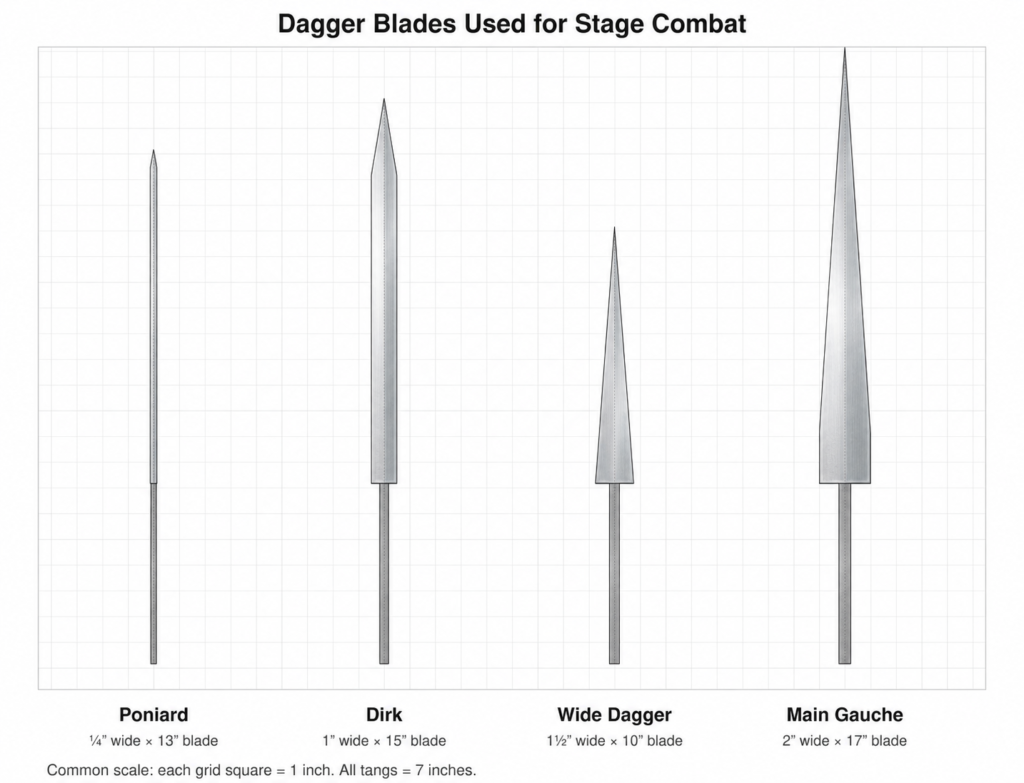
Poniard
The poniard is usually made from a shortened épée blade. It is the lightest and narrowest of the common stage-combat dagger blades.
Because it is so light, the poniard is particularly well suited to quick, precise choreography. It is best matched with swords fitted with épée or schlager blades. Against a broader or heavier sword blade, it may appear visually inadequate and provide too little resistance during contact.
Dirk
The dirk blade is broader and stouter than the poniard. Its increased width gives it greater visual presence, making it more convincingly threatening in a larger theatre.
For stage-combat purposes, the dirk provides a useful intermediate choice between the narrow poniard and the much broader wide dagger. It retains enough agility for relatively quick work while providing greater substance in both appearance and contact.
Wide Dagger
The wide dagger is also sometimes called a pie or wedge blade. It is broad at the base and tapers in straight lines toward the point, producing the familiar general-purpose appearance most audiences associate with a fighting dagger.
Its width makes it highly visible and allows it to pair convincingly with a broad range of sword blades. Very short versions, however, may leave too little usable blade for dependable parries. A dagger must provide enough length for the actor to intercept the opposing weapon without bringing the hands dangerously close together.
Main Gauche
Main gauche literally means “left hand.” The name is applied to a long parrying dagger intended to accompany a rapier, normally carried in the fighter’s other hand.
A main-gauche blade is longer than most dagger blades because it must provide an effective defence against a sword of much greater reach. Its length also makes it particularly useful in rapier-and-dagger choreography, allowing the dagger to perform substantial parries, opposition, and control rather than serving merely as a short secondary weapon. Remember that in Shakespeare’s time rapier blades were often over 40 ” long, so the parrying dagger needed more length than that found on a Medieval dagger.
The Practical Consideration
No blade category alone determines whether a dagger is suitable for stage combat. The blade must be matched to the opposing weapon, the speed and force of the choreography, the abilities of the performers, and the visual needs of the production.
The blade is also only one part of the completed dagger. Its tang, handle, guard, edges, point, and overall construction must all be appropriate to its intended use. Selection, preparation, and inspection of the completed prop are covered on the accompanying pages.