
Knives and daggers are among the most familiar weapon props. Their apparent simplicity can be deceptive. Even a blunt, purpose-made prop can cause injury, and their small size sometimes encourages a casualness that would never be tolerated with a sword.
This section concerns the selection, construction, preparation, inspection, and care of knives and daggers intended for theatrical use.
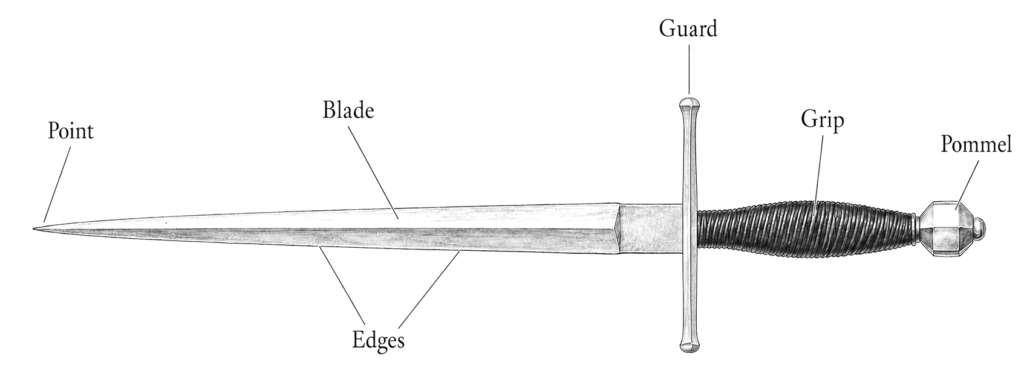
Knives and Daggers Defined

For practical purposes, a knife is generally derived from a working tool and commonly has a single-edged, asymmetrical blade. A dagger is generally designed as a weapon, with a straight, symmetrical, double-edged blade.
Principal Parts
Blade
The principal metal component of the knife or dagger. Part of the blade may be inside the handle, hidden from view.
Point
The tip of the blade. On a theatrical weapon, the point must be fully rounded and free of any sharp projection.
Edge or edges
The long sides of the blade that would be sharpened on a functional weapon. The edges of a theatrical weapon must be properly dulled and prepared for their intended use.
Tang
The portion of the blade that extends into or through the handle, securing the two together.
Handle or grip
The portion held in the hand.
Guard
A barrier between the blade and the hand. It may help prevent the hand from sliding forward onto the blade and, on some daggers, protect the hand from an opposing weapon.
Pommel or butt
The terminal end of the handle. It may help secure the grip, improve retention, or contribute to the balance of the weapon.
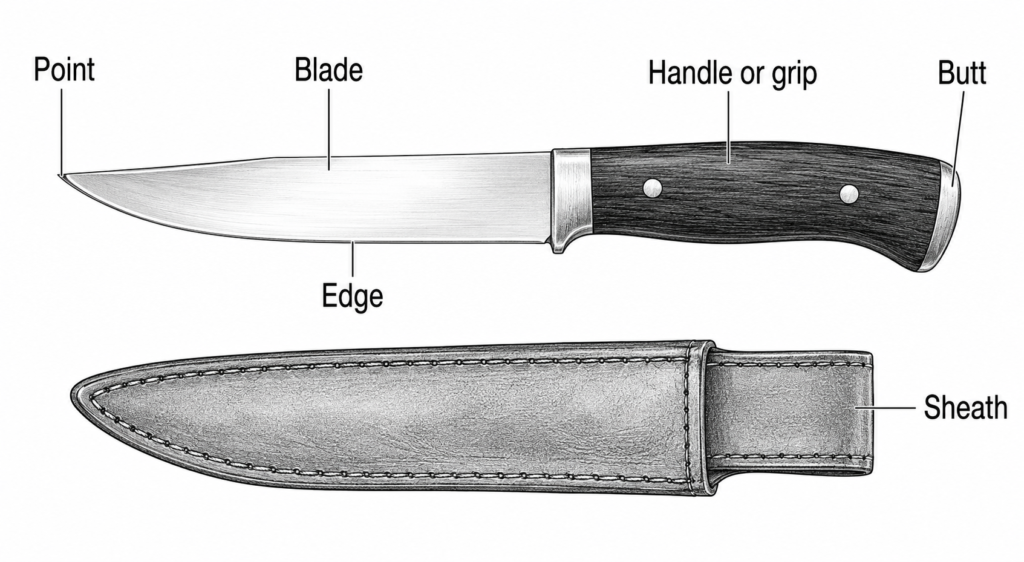
Sheath
A fitted covering made of semi-flexible material used to protect and carry the blade when the weapon is not in use.
Note that a fixed-blade knife is usually built around two principal elements: the blade and the handle. A dagger is often constructed more like a small sword, with a separate guard, grip, and pommel. As with the distinction between knives and daggers themselves, there are many exceptions.

In This Section
- Selecting and Preparing Knife Props for Stage Use
- How to select an appropriate knife prop and prepare its edges, point, handle, and overall construction for theatrical use.
- Dagger Blades Used for Stage Combat
- The principal types of blades used in theatrical daggers and the practical differences among them.
- Checking and Maintaining Knives and Daggers
- How to inspect weapon props for looseness, damage, sharp edges, burrs, and other developing hazards.
- Retractable Knives: Why They Can Never Be Safe
- Why the familiar retracting-blade specialty prop cannot make contact safe.
- Folding, Automatic, and Specialty Knife Props
- The particular limitations and hazards presented by folding knives, simulated switchblades, gravity knives, and other specialty mechanisms.