
No one ever wants a blade to break, but it happens. A sword receives considerable local stress at the point where it is struck, and a thicker blade is less likely to be seriously damaged there. That does not mean, however, that the blade will necessarily break at the point of impact. The load is carried throughout the blade, and failure begins wherever the combination of stress, reduced cross-section, existing damage, or defective steel makes the blade weakest.
Every sword also contains an inherent point of vulnerability: the shoulder, where the visible blade narrows to become the tang inside the handle. Because the entire load on the blade must pass through this narrower section, the shoulder is a natural stress concentrator. The more abrupt the transition—and particularly the sharper its interior corners—the greater the concentration of stress.
The heavier the blade the more stress it must endure. Stress from missed cuts – stress from successful cuts – and stress simply from carrying a heavy pommels
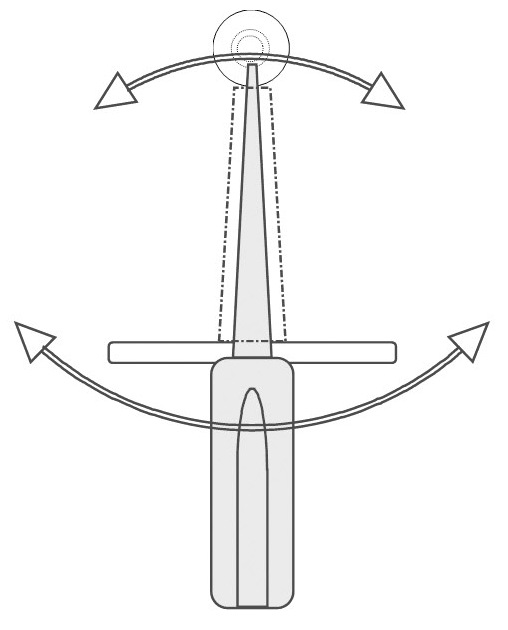
Each time you swing a sword and stop it suddenly without hitting anything, the blade’s momentum tries to carry it forward. Because your hand has stopped the hilt, the blade bends under the resulting load, with much of that load carried back toward the guard.
When the sword strikes something, the impact deflects the blade at the point of contact while your hand controls the hilt. Once again, the blade is placed under bending stress, and that stress must be transferred through the tang. The most vulnerable area is usually the shoulder, where the tang suddenly narrows. Because this abrupt reduction leaves less steel to carry the load, stress tends to concentrate there.
In short: with each forceful swing, hit or miss, the shoulder must hold the broader blade to the narrower tang.
A heavy pommel is also in motion when a sword is swung. When the sword comes to a sudden stop, the pommel’s inertia makes it want to continue moving. This places additional stress on the tang, particularly near the narrow upper end where the pommel is attached. With repeated use, cracks may develop either there or at the shoulder. The farther a heavy pommel extends behind the hand, the greater the load it places on the tang when the sword is started or stopped.
The length of the hilt and the weight of the pommel also affect the sword’s handling. A sword intended primarily for cutting generally carries more of its weight toward the blade. A sword intended primarily for thrusting is generally balanced closer to the hand, making the point easier to direct. A longer hilt may also bump against the forearm. Every design involves trade-offs; there is no standard length or proportion suitable for every sword.
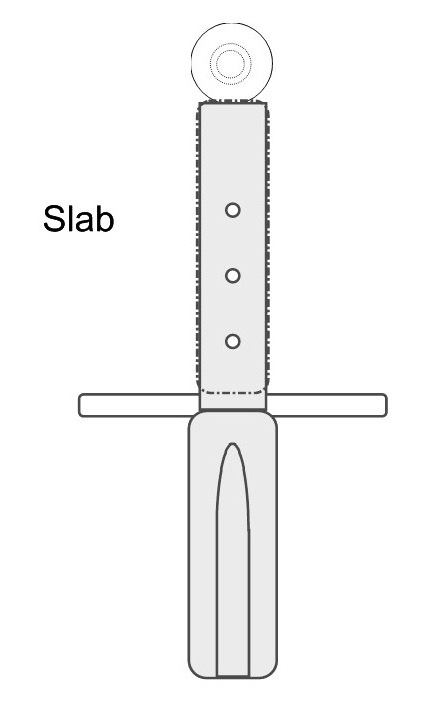
The strongest tang possible is one that remains nearly as wide as the blade proper. This general principle is found in katana and in many knives and machetes. Although their handles are constructed differently, all retain a broad tang with only a slight shoulder, leaving far more steel to carry the stress.
This type of tang is less easily adapted to Western broadswords and rapiers, which generally use a narrower tang extending through the handle so that a substantial pommel can be attached.
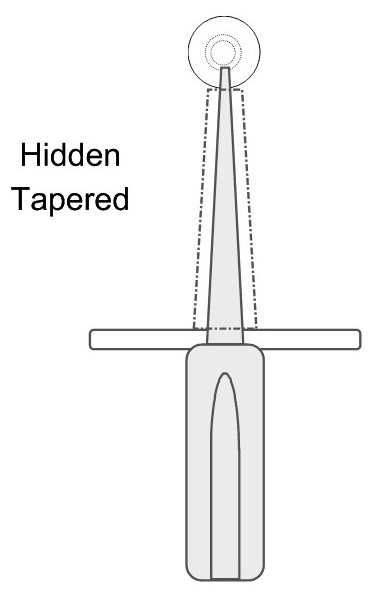
A tang that starts wide and gradually becomes narrower is an excellent design for a wide-bladed sword. The gradual taper spreads stress along the tang rather than concentrating it at an abrupt shoulder, while leaving the end narrow enough to hold the pommel.
In this example, it is called a hidden tang because no part of it can be seen from the outside. The end of the tang is threaded, as is the inside of the pommel, so the pommel simply screws on like the lid of a jar.
A threaded pommel may gradually loosen under the repeated stress of fighting. It should therefore be checked periodically and tightened whenever necessary.
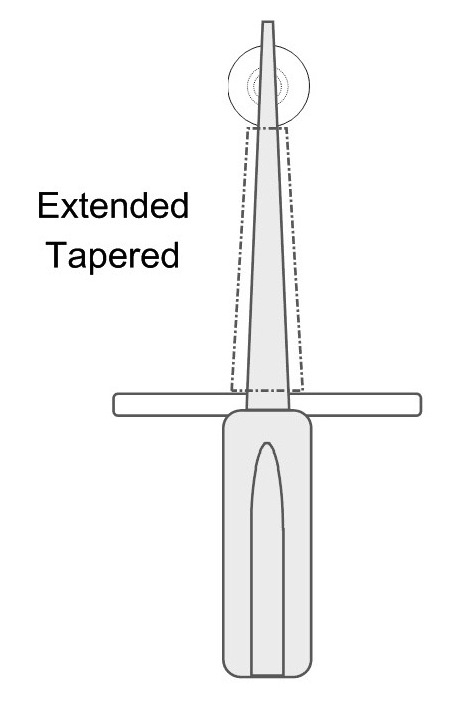
In this example, the tang extends completely through the pommel and emerges from its end. This is an especially strong arrangement for heavy broadswords with substantial pommels. Instead of depending upon a threaded connection inside the pommel, the extended tang supports and secures the pommel throughout its length.
The end of the tang may be hammered down over the pommel, making the blade essentially a giant rivet. Alternatively, it may be threaded to accept a cap nut, making the blade essentially a giant bolt.
In either construction, tightening or peening the end of the tang draws the pommel firmly against the handle, guard, and other hilt components. That compression is what holds the sword together.
Which is better: hammering the extended tang down over the pommel, or securing the pommel with a threaded connection?
A threaded pommel or cap nut can loosen with use, but it can also be tightened whenever necessary. A peened tang makes the blade into a giant rivet and is far less likely to allow the pommel to vibrate loose. A peened hilt can still loosen as the handle materials compress with use or change with age and humidity. Repairing it may require grinding away the existing peen, dismantling the hilt, and refitting the components around what is now a shorter tang. By comparison, a threaded pommel or cap nut can simply be tightened.
The short answer is that there is no perfect answer. Peening provides greater security; threading allows easier adjustment and repair. Everything is a carefully considered compromise.
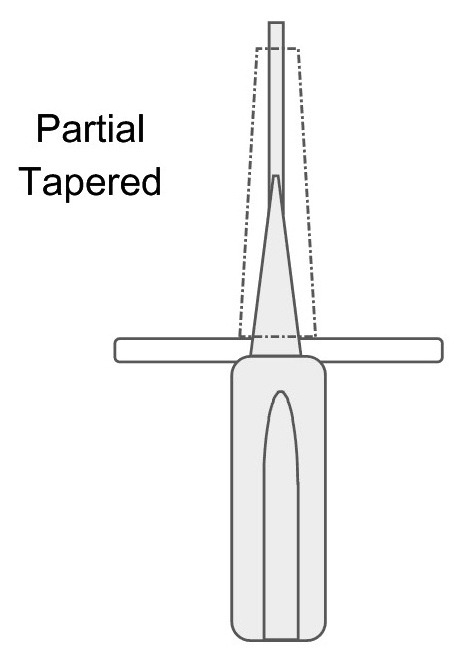
In an effort to reduce construction costs, many sword makers use a tang that tapers to about the middle of the handle, then weld a simple steel rod onto it for the remaining length. Any weld creates another potential point of failure, but the middle of the tang is generally under less stress than either the shoulder or the pommel attachment. If a tang must be welded, this is therefore the least objectionable place to do it.
This construction also makes the wooden handle much easier to hollow out. The rod can be made from softer steel than the blade, making it easier to thread for a nut or hammer down to form a peen.
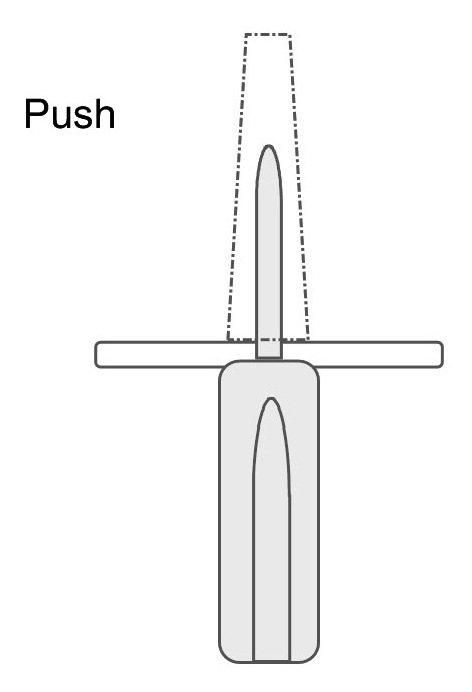
On purely decorative, or “tourist,” swords, the tang may extend only partway into the handle. This is called a push tang and may be held in place with nothing more than glue, although it can also be secured with rivets. If the sword is swung about, the short tang acts as a lever and may soon split or break through the handle. Any pommel must be hollow and attached to the handle, or made as part of the handle itself. A sword with a push tang is suitable for wall-hanging only.
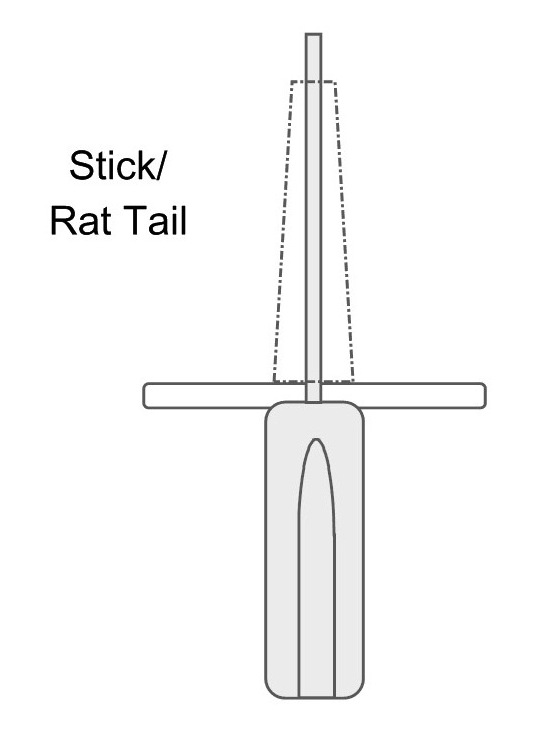
Just one step above the push tang—but still horribly unsuitable for stage combat—is the rat-tail tang. Found on most swords from India and Spain, the tang is usually a narrow rod of soft steel, about ¼ inch thick, welded directly onto the blade at the shoulder.
The rod may be strong enough to support the blade while the sword hangs on a wall, but it cannot safely withstand the repeated stresses of fighting. Because the weld is located at the shoulder—the very point where stress is already concentrated—the tang is almost certain to bend or break there after only a few forceful swings. That construction alone makes the sword useless for stage combat.
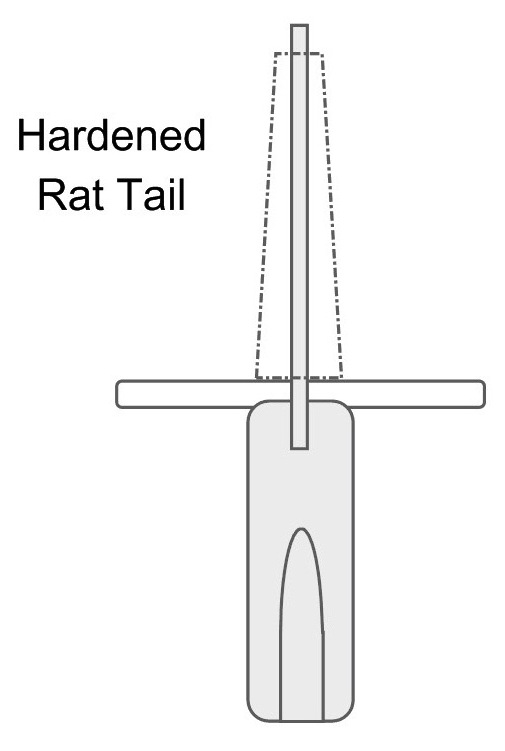
And yet, at Weapons of Choice we made some excellent, fully fight-worthy swords using what was essentially a rat-tail tang—but with several critical modifications.
- First, instead of using a soft, easily worked steel rod, we used tool-grade hardened steel, threaded only at the pommel end. I dare you to break that.
- Second, the rod was not simply welded onto the blade at the shoulder. It extended deep into the body of the blade proper and was welded well away from the area of greatest stress.
- Third, we used this construction only with exceptionally thin blades, such as machete blades.
It is not the mere presence of a rod tang, therefore, that makes the ordinary rat-tail construction unsafe. It is the combination of a thin rod of soft steel, a weld placed directly at the shoulder, and a blade heavy enough to place substantial stress upon the rod and its weld.
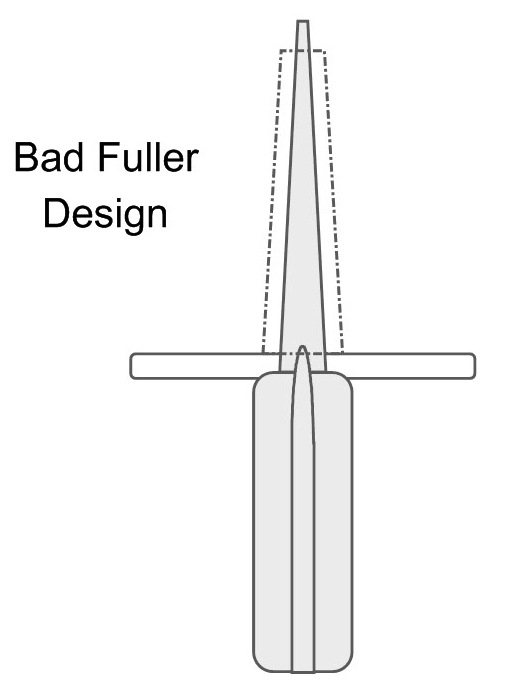
Here is an example of an otherwise good sword ruined by a critical design flaw.
Notice that I have drawn the blades with a groove running down the center. This is known as a “fuller.” A fuller is a concave channel that removes weight from the blade while retaining much of its stiffness and strength. It allows the swordmaker to produce a lighter blade without simply making the entire blade thinner.
But now notice what is wrong with this particular example. That’s right: the fuller continues across the blade shoulder and slightly into the tang. At the very place where the tang suddenly narrows—and where stress is already concentrated—the fuller removes still more steel. Far from strengthening the sword, it makes the blade considerably weaker at the shoulder.
Blade breakage at the shoulder is a common problem with blades of this design sold by a particular Chinese company very popular in the Ren Faire world. Those blades also tend to have edges that are too thin, leading to deep gouges of ¼ inch or more along the striking and blocking edges. Each of those gouges becomes another possible starting point for a crack.