
Politics, Economy, and Worldview
The Norse peoples of Scandinavia occupied one of the most marginal environments in early medieval Europe. Poor soils, short growing seasons, and limited agricultural surplus shaped a culture that could not rely on land alone for stability or wealth. As a result, Norse society developed along lines fundamentally different from those of the Frankish world: politically decentralized, economically outward-facing, and ideologically oriented toward action, reputation, and fate rather than order or continuity.
Political Structure
Viking political organization remained local, personal, and non-territorial. Power rested with chieftains rather than kings, and even kingship—where it existed—was weak, negotiated, and contingent. A leader’s authority depended on persuasion, generosity, and demonstrated success rather than inherited right or administrative control.
Assemblies (things) provided communal decision-making, dispute resolution, and law, but enforcement was collective and situational. There was no standing bureaucracy, no permanent administrative class, and little interest in governing land beyond one’s immediate sphere. Leadership could be withdrawn as easily as it was granted. A man followed a leader because it benefited him to do so; loyalty was conditional, not absolute.
This political fluidity made Viking society highly adaptable but inherently unstable. Confederations formed quickly for expeditions and dissolved just as rapidly. Long-term consolidation was rare until Norse leaders entered foreign systems—most notably Frankish ones.
Economy and Movement
The Viking economy was hybrid and mobile. Subsistence farming supported daily life, but surplus and prestige came from beyond the village. Trade, raiding, mercenary service, and settlement abroad were not aberrations; they were integral economic strategies. It is worth noting that “Viking” was not the name of a people. Norse men and women did not identify themselves as Vikings; the term described an activity. One went a-viking—to raid, trade, or seek fortune abroad—and then returned home. The same individual might farm one season, trade another, and raid in a third.
Longships made Norse society uniquely mobile. Rivers, coastlines, and open seas functioned as highways rather than barriers. Viking activity stretched from the British Isles to the Mediterranean, from the Frankish heartlands to the rivers of Eastern Europe. This mobility allowed small groups to exert disproportionate influence.
Raiding was not random savagery but a calculated response to economic constraint. Wealth was extracted in portable forms: silver, slaves, livestock, weapons, and prestige goods. Successful leaders redistributed this wealth to retain followers, reinforcing the cycle of outward expansion.
Trade and violence existed side by side. The same ship might carry merchants one season and raiders the next. The distinction mattered less than success.
Worldview and Meaning
The Norse worldview differed sharply from the Christianized cultures to the south. It was not oriented toward moral order, salvation, or institutional continuity, but toward reputation, action, and acceptance of fate.
Honor was earned through visible deeds. Reputation mattered more than longevity; memory more than legacy. Death was inevitable and not inherently tragic—what mattered was how one met it. This produced a culture of decisiveness and risk-taking that outsiders often perceived as recklessness.
Law existed, but it did not replace personal responsibility. A man was expected to defend himself, his kin, and his standing. Wrongdoing demanded response; passivity invited loss of honor. Fate (wyrd, ørlög) was not a justification for inaction but a condition within which action gained meaning.
Religion reinforced this worldview. The gods were powerful but fallible, heroic rather than moral. They rewarded courage, cleverness, and loyalty, not obedience. There was no promise of universal order, only the certainty of struggle.
Contrast with the Frankish Model
Where Frankish society moved toward hierarchy, land-based obligation, and institutional stability, Viking society remained kin-based, opportunistic, and outward-facing. Authority was earned repeatedly, not inherited securely. Wealth was taken, not administered. Violence was not constrained by emerging structures of law so much as channeled by custom and expectation.
For theatrical purposes, this produces a radically different behavioral logic: Viking characters are not stabilizers of order but agents of motion. They do not defend systems; they test them.
Fashion / Manners
Viking dress and manners reflect a society organized around mobility, visibility, and readiness, rather than hierarchy or institutional display. Clothing was functional, but not crude; manners were direct, but not lawless. Appearance communicated competence, reputation, and preparedness, not submission to rank.
Dress and Appearance
Viking clothing was built for movement. Wool and linen dominated, layered for warmth and durability, with cuts that allowed rowing, walking, and fighting without restriction. Tunics were knee-length, belted at the waist, worn over trousers or leggings secured with wraps. Cloaks were common, fastened with simple brooches, and designed to be shed quickly when necessary.
Color mattered. Contrary to later imagination, Viking clothing was often dyed—reds, blues, yellows, and greens—derived from natural sources. Color signaled prosperity and care, not flamboyance. Ornamentation existed, but it was restrained and practical: simple patterns, functional metalwork, and durable fastenings rather than decorative excess.
Footwear was sturdy and flexible, suited to wet decks and uneven ground. Armor, where present, was minimal. Helmets and mail were rare and costly, owned by wealthier warriors and leaders. Most protection came from shields and awareness rather than encumbrance.
Weapons were integrated into dress rather than displayed ceremonially. Knives were universal. Spears and shields were carried when trouble was expected, not worn as constant badges of status. Swords, when owned, were prized and carefully maintained, but not brandished unnecessarily.
Grooming and Self-Presentation
Personal grooming carried real social weight. Archaeological evidence and contemporary accounts indicate that Norse men paid close attention to hair and beard care. Combs, tweezers, and razors were common finds. Cleanliness was not a luxury; it was a marker of self-respect and readiness.
Hair was typically kept long enough to manage but not impede work. Beards varied, trimmed rather than wild. Neglect signaled poverty, illness, or loss of standing. A well-kept appearance suggested a person capable of discipline, planning, and self-command.
This attention to grooming often surprised outside observers, who expected savagery and instead encountered deliberate self-presentation.
Manners and Social Conduct
Viking manners were direct and situational rather than deferential. There was little emphasis on submission through posture or silence. Instead, respect was negotiated through confidence, restraint, and reciprocity.
Speech was plain. Boasting existed, but it was expected to be grounded in truth and reputation. Empty claims invited challenge. Silence was not submission; it could signal calculation. A person was judged by how they handled pressure, insult, or opportunity.
Hospitality was deeply valued, but conditional. A guest was protected while under a roof, but that protection carried obligations of restraint and respect. Violating hospitality was not merely rude; it was socially catastrophic.
Conflict was not avoided, but it was governed by expectation. Sudden violence was acceptable under certain conditions, but ambush without cause or betrayal of trust carried lasting stigma. Reputation mattered because memory was long.
Law, Custom, and Public Behavior
Despite their reputation, Norse societies were not anarchic. Law existed as a communal practice, enforced through assemblies and shared memory rather than bureaucracy. Public behavior was shaped by the knowledge that disputes would be remembered, judged, and discussed.
Manners in public spaces—assemblies, halls, markets—were governed by custom. Interrupting, dishonoring, or refusing lawful settlement had consequences that extended beyond the immediate moment. Violence was permitted, but it was rarely meaningless.
Theatrical Implications
Onstage, Viking characters should move with ease and alertness, not stiffness or ritual formality. Rank is expressed subtly—through confidence, possession of good tools, and how others respond—rather than through seating or silence. Clothing should look lived-in, functional, and capable of being removed or adapted quickly.
There is no courtly polish here, but neither is there chaos. The Viking world values competence over obedience, readiness over display, and reputation over hierarchy. Manners are not absent; they are simply situational rather than ceremonial.
Civilian Conflict
In Norse society, violence was neither exceptional nor continuously suppressed. It was anticipated, negotiated, and remembered. Civilian conflict existed within a framework of honor, kin obligation, and communal judgment, where the goal was not peace but balance—the restoration of standing after injury, insult, or loss.
Honor, Feud, and Obligation
Disputes arose from insults, property claims, broken agreements, injury, and killing. The expectation was not avoidance but response. To fail to answer a wrong was to lose honor, not merely reputation but social viability.
Feud functioned as a recognized mechanism, not a breakdown. Kin groups were expected to support their members, escalating disputes when necessary. However, unchecked feud threatened communal stability, and Norse societies developed methods to contain it without abolishing it.
Assemblies (things) provided spaces where grievances could be aired and settlements negotiated. Compensation payments were common, calculated according to injury and status. Acceptance of compensation did not erase shame, but it allowed conflict to conclude without further bloodshed. Refusal to settle carried consequences: loss of allies, legal sanction, or escalation toward outlawry.
Formal Duels (Hólmganga)
When disputes resisted settlement through compensation or arbitration, Norse societies recognized a formal mechanism for resolution: hólmganga, literally “island-going.” This was not spontaneous violence, but a ritualized civilian duel, governed by custom and witnessed by the community. It provided a sanctioned alternative to endless feud by transforming private grievance into public trial by courage.
In common variants, each combatant was permitted three wooden shields. Blows were exchanged in turn; when a shield broke, it was discarded. Once the final shield failed, the next clean strike determined the outcome. In some cases, first blood was sufficient; in others, surrender or incapacitation ended the contest. The precise rules varied, but the structure was consistent: the duel was finite, visible, and socially binding.
Refusal to meet a lawful challenge could damage reputation, while victory conferred legitimacy rather than mere dominance. Over time, as Christianity spread and centralized authority increased, hólmganga was increasingly restricted and eventually outlawed—not because it was chaotic, but because it competed with emerging legal institutions.
Law Without Enforcement
Norse law operated without standing police or permanent courts. Enforcement depended on public consensus and memory. Judgments were effective only if the community recognized and supported them.
Outlawry represented the ultimate sanction. A person declared outside the law could be harmed or killed without consequence. This penalty did not require constant surveillance; it relied on the certainty that no one was obliged to protect the outlaw. In this way, Norse law constrained violence not through prevention but through social consequences.
Everyday Readiness for Violence
Norse civilians lived with an assumption of potential violence. Free men—and in some contexts free women—were expected to defend themselves and their households. Readiness was not paranoia; it was competence.
Fights were often sudden and decisive. Prolonged brawls were less common than swift, targeted acts meant to assert dominance or settle a grievance. Cowardice, not brutality, carried the greatest stigma. Excessive or treacherous violence, especially against guests or kin, could permanently damage standing.
Restraint mattered, but it took a different form than in Frankish society. A Norse individual demonstrated restraint not by avoiding conflict, but by choosing when and how to engage.
Civilian Weapons
Weapons were ubiquitous, but their meanings were contextual rather than hierarchical.
The knife was universal. It functioned as tool, eating implement, and immediate weapon. Its presence was assumed and unremarkable.
The axe was both tool and weapon, often indistinguishable from one another. Its dual purpose made it socially acceptable and widely owned. Axes required little specialized training and were devastating at close range.
The spear was common in households and travel. Easy to make and effective with limited instruction, it served as both defensive arm and hunting tool. Like shields, spears were carried when needed rather than worn continuously.
Swords were prestigious but not exclusive to a warrior caste. While expensive and valued, swords could be owned by successful farmers, traders, or raiders. They were named, inherited, and remembered, functioning as extensions of personal identity rather than symbols of office.
Shields were practical objects, often carried during travel or public assembly when tension was expected. They signaled readiness rather than aggression.
Social Meaning of Armed Civilians
In Norse society, being armed signaled competence and independence, not defiance of authority. To be visibly unarmed suggested vulnerability rather than obedience.
Weapons did not automatically escalate a situation; misuse did. Reputation governed interpretation. A known troublemaker armed was dangerous; a respected individual armed was prudent.
The Norse approach to civilian conflict accepts violence as a fact of life, but subjects it to memory, narrative, and consequence. Every act is remembered, judged, and carried forward in story. For theatrical purposes, this produces a world where conflict is immediate, personal, and consequential, and where even silence may be read as a choice rather than a lack of power.
Warfare
Viking warfare was shaped by mobility, timing, and selective violence, not by territorial defense or standing armies. It was not designed to hold ground, administer populations, or impose long-term order. Instead, it aimed to strike, extract, and depart, exploiting speed, surprise, and local imbalance.
Organization and Leadership
Viking warbands were assembled through voluntary association rather than obligation. Leaders attracted followers by reputation, success, and the promise of shared profit. Authority was personal and contingent; a leader who failed repeatedly would simply lose his following.
There was no permanent military hierarchy. Warbands formed for specific expeditions and dissolved afterward. Size varied widely, from a few dozen to several hundred, depending on the leader’s standing and the perceived opportunity. Loyalty was strong within the group but not abstract or institutional.
Command in battle was direct and immediate. Leaders fought alongside their men, not behind them. Orders were few, understood in advance, and adapted on the spot. Discipline arose from shared purpose and mutual dependence rather than drill.
Strategic Logic
Viking strategy emphasized choice of moment and place. Raids targeted undefended or lightly defended sites: coastal villages, monasteries, river towns, isolated estates. Intelligence mattered. Surprise mattered more.
Longships allowed rapid movement, shallow-water access, and sudden appearance far inland via rivers. Just as important, they allowed rapid withdrawal. Vikings avoided prolonged engagements unless confident of advantage. Retreat was not shameful if it preserved lives and profit.
When Vikings did fight pitched battles, it was usually because escape was impossible or because the prize justified the risk. Even then, they preferred decisive action over attrition.
Nature of Combat
Viking combat favored aggressive shock and individual initiative. Fighting formations existed—most notably shield walls—but they were pragmatic rather than rigid. Cohesion mattered, but flexibility mattered more.
Battles opened with missile exchange where possible, then closed rapidly into hand-to-hand fighting. Once lines broke, combat became intensely personal. Individual skill, nerve, and endurance determined outcomes.
There was little interest in pursuit beyond immediate advantage. Victory meant breaking resistance, seizing goods, and surviving intact, not exterminating the enemy.
Weapons and Arms in War
The spear was the most common battlefield weapon, used both for thrusting and throwing. Its reach and versatility made it ideal for both formation fighting and skirmish.
The axe was iconic for good reason. Durable, powerful, and effective against shields, it required less refinement than a sword and excelled in close combat. The sword, while prestigious, was not universal. When present, it was carefully maintained and often named. In combat, swords were used once formations collapsed and space allowed freer movement.
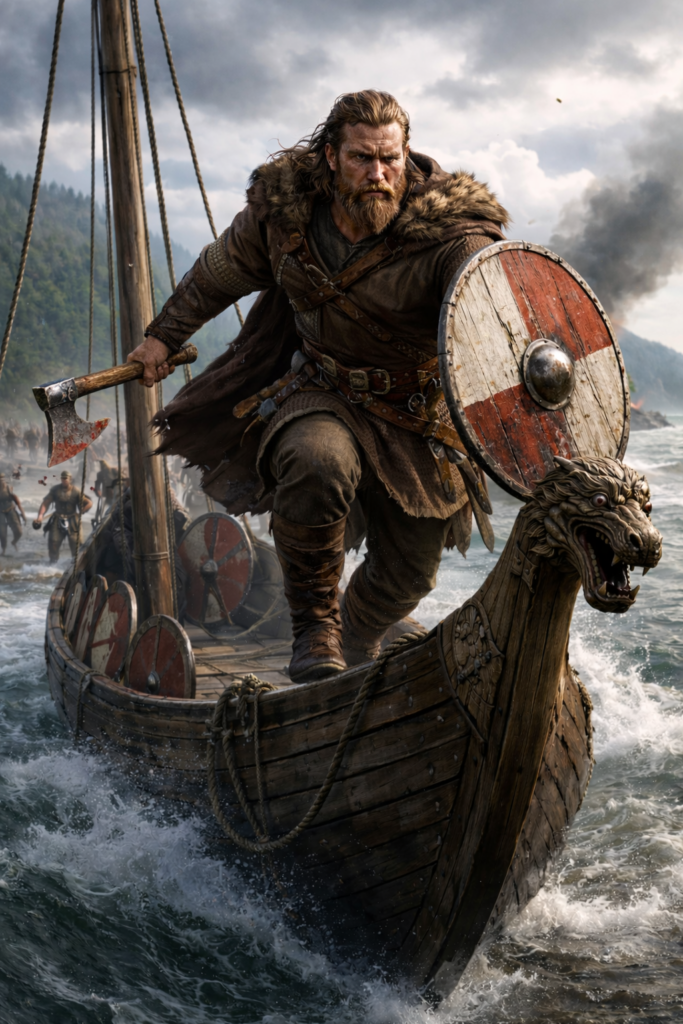
Shields were essential: round, wooden, and actively used for both defense and offense. Shield work—pushing, striking, binding—was central to Viking fighting technique. Armor was limited. Helmets and mail existed but were rare, owned by wealthier warriors. Protection relied primarily on shields, awareness, and speed.
Warfare and Society
Viking warfare was inseparable from economy and identity. Successful expeditions brought wealth, slaves, weapons, and reputation. These, in turn, enabled marriage, leadership, and further expeditions. Failure carried social cost but not permanent disgrace if followed by later success.
Religion framed warfare not as moral struggle but as test and proof. Courage, resolve, and cleverness mattered more than righteousness. Death in battle was neither sought nor avoided—it was accepted as possibility rather than tragedy.
From Raiders to Rulers
When Vikings settled abroad—most notably in Frankish territories—they adapted. The same skills that made them effective raiders made them effective enforcers once land and authority replaced mobility and extraction. In adopting Frankish law, language, and military structure, Norse leaders did not abandon their martial culture; they redirected it.
Viking warfare thus represents the opposite pole from Frankish order: not the consolidation of power, but its disruption. Yet it is precisely this disruption that reshaped medieval Europe and made the next phase—Norman rule—possible.