
The cultures of the South Pacific islands were diverse in language, custom, and political complexity, but most were organized around tribal or chieftain-based systems, with some—most notably Hawai‘i—developing highly stratified forms of hereditary kingship. Across Polynesia, warfare was rarely territorial in the modern sense. It was instead rooted in cycles of raiding, retaliation, prestige, and ritual obligation. Violence reinforced status. It did not resolve conflict so much as maintain balance, reputation, and hierarchy.
One defining feature shared across much of Polynesia was the near absence of metal prior to sustained outside contact. Bone, stone, shell, and dense hardwoods were the primary hard materials available. As a result, weapons were overwhelmingly spears, clubs, daggers, and cutting implements, often carefully shaped and sometimes edged with shark’s teeth. These weapons were not crude substitutes for metal arms; they were refined within the material logic of the culture and fully capable of inflicting lethal injury at close range.
Fashion, Style, and Manners
Dress throughout much of tropical Polynesia was minimal by European standards, but this should not be mistaken for informality. Clothing—or its absence—could function as a marker of status, role, and occasion. In the Hawaiian Islands, high-ranking chiefs wore magnificent feather cloaks (ʻahu ʻula) and helmets (mahiole), while in Tahiti and the neighboring Society Islands, sacred girdles of red feathers (maro ʻura) distinguished the highest chiefly authority. Among the Māori of New Zealand, where the cooler climate encouraged more substantial clothing, finely woven flax cloaks, dog-skin garments, and elaborate ornamentation similarly proclaimed rank. In the Marquesas Islands, extensive tattooing and ornaments worn on the head made the body itself a powerful expression of identity and prestige. Throughout these societies, the significance of appearance lay not merely in how much of the body was covered, but in what its presentation communicated.
In the Hawaiian archipelago, this attention to rank existed within a particularly complex social and political structure. At the top stood the aliʻi, the chiefly class, whose highest rulers were known as aliʻi nui, or paramount chiefs. The mōʻī, or sovereign, became the highest authority in the later Hawaiian kingdom. The kahuna were respected priests, healers, craftsmen, and other specialists, some of whom belonged to chiefly families. The makaʻāinana, the common people who farmed, fished, and practiced essential trades, formed the overwhelming majority of the population. At the bottom were the kauwā, a hereditary outcast class. Birth and genealogy strongly influenced social position, although political authority could also be acquired or lost through warfare and alliances. The obligations of rank were reinforced by the kapu system, which governed sacred relationships, conduct, and access to particular people and places.
Hierarchy could also be expressed physically. In Hawaiʻi, approaching a chief of particularly sacred rank might require an individual to lower themselves or prostrate themselves completely. Certain prohibitions extended even to the relationship between a person’s body and the chief’s sacred presence, including restrictions involving shadows. Such rules were not universal even within Hawaiʻi; their severity depended upon the rank and sacred status of the individuals involved. In Tonga, deference to chiefly authority could likewise govern whether an individual stood or sat, how closely one might approach, and the relative positions occupied during formal gatherings. These customs made posture, height, eye line, and spatial awareness important expressions of social knowledge. Lowering the body was not necessarily submission born of fear; it might equally be an acknowledgment of established authority and proper conduct.
Weapons also carried social meaning, although their presence varied considerably with location and circumstance. Among the Māori, a short club (patu), sometimes fashioned from prized greenstone (pounamu), might be carried in the belt or suspended from the wrist. Such weapons were practical instruments of combat but could also represent chiefly authority, inherited prestige, and personal achievement. In Hawaiʻi, warriors employed spears, clubs, daggers, and specialized weapons incorporating shark teeth. The warrior’s relationship with his weapons could be deeply personal, and certain weapons were believed to possess mana, or spiritual power. Nevertheless, the possession or display of weapons should not be taken as evidence that all ordinary encounters were implicitly hostile.
For an actor portraying a character from one of these societies, the essential consideration is the relationship between the body, social position, and surrounding space. A high-ranking chief might occupy space with considerable assurance, while someone of lower status might regulate their approach, posture, or movement according to established custom. A warrior carrying a weapon would understand its balance, its position on the body, and the distance necessary to employ it. These behaviors should arise from the character’s particular culture, circumstances, and experience rather than from a generalized notion of a Polynesian warrior. The result is not constant tension or theatrical menace, but a physical life governed by learned conventions of respect, authority, and readiness.
Civilian Conflict
Outside formal warfare, disputes could arise over personal insults, theft, property, sexual relationships, status, or violations of established custom. Their consequences varied considerably across Polynesia, where communities possessed their own systems of authority, obligation, and justice. Violence was one possible response, but it was neither inevitable nor necessarily the preferred means of settling a dispute. An injury to one individual might involve an entire family or community, making the restoration of social relationships as important as the punishment of an offender.
Among the Māori of New Zealand, the concept of utu governed the restoration of balance following an injury, insult, or other disturbance of social relationships. Although frequently translated as revenge, utu could involve compensation, reciprocal obligations, or reconciliation rather than bloodshed. One customary practice, muru, permitted the taking of property as compensation for an offense, generally according to recognized procedures. Nevertheless, serious disputes could develop into retaliatory violence involving families or neighboring communities. Personal conflict was therefore seldom entirely personal; an individual’s conduct could affect the reputation and security of others.
In Hawaiʻi, conduct was regulated by the kapu system, which established sacred prohibitions governing social rank, religious observance, and everyday activities. Violations of certain restrictions could incur severe punishment, including death. Authority was exercised through chiefs and established social obligations rather than through an independent system of civilian law as Europeans would understand it. An offense against a person of high rank might consequently carry implications far beyond the immediate encounter. The possibility of violence existed within a society that placed considerable importance upon knowing one’s position and observing the boundaries established by custom.
Elsewhere, reconciliation could assume an explicitly ceremonial form. In Samoa, the traditional practice of ifoga provided a means by which an offending party, often represented by a chief, could publicly acknowledge wrongdoing and seek forgiveness from the injured family. The ceremony emphasized humility, restitution, and the restoration of relationships. Such practices remind us that the avoidance of further violence could itself require courage, discipline, and considerable public ceremony.
Civilian confrontations might involve clubs, stones, knives, or other weapons readily available in the surrounding environment, but it would be misleading to assume that everyone routinely went armed or that every quarrel threatened immediate bloodshed. The presence of weapons, the authority of those involved, and the expectations of the community all influenced how a confrontation developed.
For the actor, the essential consideration is that physical conflict carried consequences beyond the immediate participants. A character might respond to an insult with anger, but also with an awareness of rank, obligation, family reputation, and the possibility of retaliation. Another might deliberately restrain himself, not from weakness or fear, but because the circumstances demanded it. The resulting physical behavior could range from controlled stillness and formal confrontation to sudden violence. What matters is that the character understands the rules of his society, even when he chooses to break them.
Warfare
Warfare throughout Polynesia varied considerably according to geography, political organization, and the resources available. On smaller islands, conflict might involve raiding parties or relatively small groups of warriors, while the powerful chiefdoms of Hawaiʻi could assemble substantial armies for territorial conquest. Terrain also influenced tactics. Dense vegetation, steep valleys, and broken ground could favor ambush and close combat, while open coastal plains permitted larger formations. In New Zealand, the Māori developed elaborate fortified settlements known as pā, whose defensive earthworks, palisades, and elevated positions demanded methods of warfare quite different from those employed in open battle.
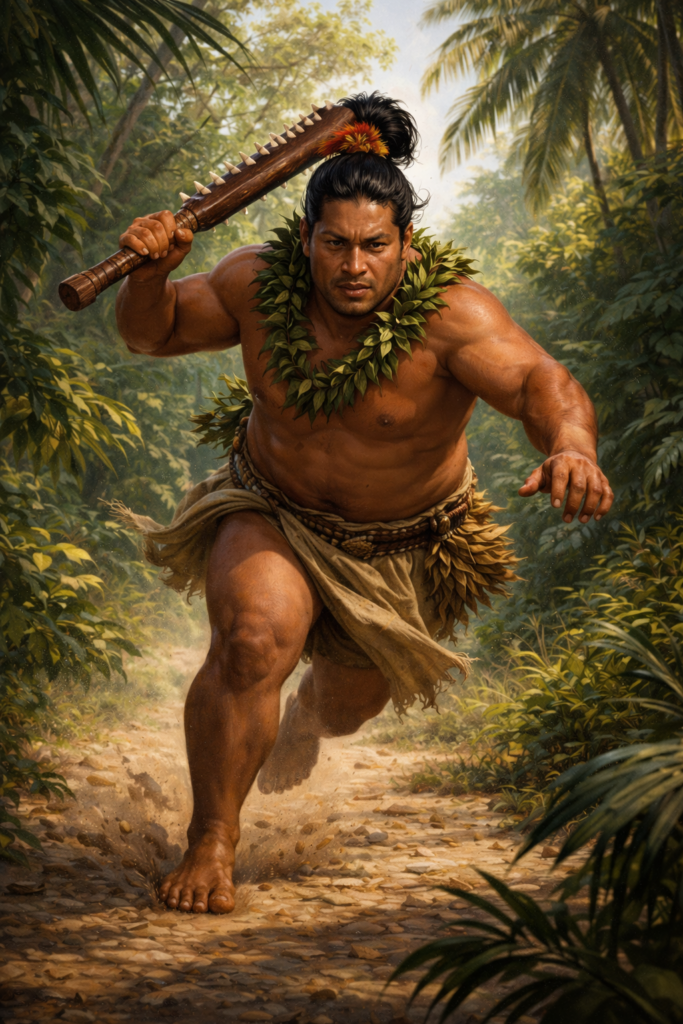
Throughout much of Polynesia, combat relied heavily on spears, clubs, and other hand-held weapons. Missile weapons, including stones hurled by slings and thrown spears, could be employed before opposing forces closed. In Hawaiʻi, armies sometimes advanced in organized formations, using projectiles to weaken or disrupt their opponents before engaging at close quarters. Once the formations met, strength, balance, coordination, and individual fighting skill became critical. Combat could be exceptionally violent, but its objectives extended beyond killing. Warfare might secure territory, avenge injuries, establish political dominance, or compel submission. Prisoners were sometimes taken, and their subsequent treatment depended upon the society and circumstances.
The Hawaiian leiomano was a close-combat weapon constructed of hardwood and edged with embedded shark’s teeth. Although shark-tooth weapons appeared elsewhere in the Pacific, the leiomano is particularly associated with Hawaiʻi. It was neither a conventional sword nor a simple club, but a weapon capable of inflicting severe cutting and tearing injuries through forceful contact. Its effectiveness depended upon the placement of its cutting edges, the movement of the weapon, and the distance from which a blow was delivered. For the actor, it suggests a fighting vocabulary quite different from that of a European sword: a compact weapon whose threatening surfaces must be understood, whose reach is relatively short, and whose use requires careful attention to the relationship between the weapon hand, the torso, and the opponent. Its construction should inform the choreography without dictating a single historical fighting style.
Another Hawaiian weapon was the pīkoi, a weighted cord designed to entangle an opponent’s legs and bring him to the ground. Unlike a club or dagger, its immediate purpose was to disrupt balance rather than inflict a wound. Once the opponent was disabled, a warrior might close with a striking or cutting weapon. The pīkoi demonstrates that Hawaiian combat was not simply an exchange of powerful blows, but could employ timing, distance, deception, and attacks directed against an opponent’s mobility. For the actor, it offers a particularly useful distinction between striking an adversary and controlling the position of his body.
Among the Māori of New Zealand, weapons included the taiaha, a five- to six-foot wooden fighting staff wooden fighting staff with a pointed end, and the patu, a 12″ to 20″ striking weapon fashioned from wood, stone, or bone. The taiaha could be used to thrust, strike, and manipulate an opponent’s guard, while the shorter patu was suited to fighting at close quarters. Warriors might carry both, allowing them to change weapons as distance and circumstances required. Māori warfare also placed considerable emphasis on deception, surprise, and the defense or capture of fortified pā. The result was a military tradition combining individual martial skill with organized preparation and tactical ingenuity.
In Hawaiʻi, warfare was closely connected to chiefly authority. The aliʻi could mobilize warriors and demand provisions, labor, and military service through established systems of obligation. Large campaigns required considerable organization, particularly when armies crossed difficult terrain or traveled between islands in war canoes. Hawaiian men also participated in athletic activities including wrestling, boxing, running, and spear throwing, which developed strength, endurance, coordination, and competitive skill. Selected warriors received specialized training in lua, a Hawaiian martial tradition incorporating grappling, throws, joint manipulation, and methods of disabling an opponent. Such training was not necessarily universal, but its existence demonstrates a sophisticated understanding of unarmed combat alongside the use of weapons.
For the actor, these traditions suggest neither indiscriminate savagery nor a single recognizable Polynesian fighting style. The Hawaiian warrior advancing with a spear, the specialist employing a pīkoi, and the Māori fighter defending a fortified position confront different physical problems. Each must understand distance, balance, footing, and the possibilities of the weapons at hand. More importantly, each participates in a social and political order in which warfare has recognizable purposes, obligations, and consequences. Violence is not merely an eruption of anger, but an activity shaped by training, authority, custom, and circumstance.