
Kicks are not mere variations of punches and slaps, and the potential force behind them is much greater. Add to that the fact that most people have no idea how far their foot can really travel on a kick, and you’ll see how we’ve moved a step up on the danger ladder. To reduce that risk, we have to be even more attentive to relative body positioning at every point in the kicking simulations.
Global principles that apply to every kick on this page:
- Kicks carry significantly more force than punches or slaps.
- Most actors underestimate how far their foot actually travels.
- The audience has no depth perception; do not aim “close.”
- Illusions work best when the energy of the kick resolves away from the partner, not toward them.
- If a kick looks athletic but feels unsafe, it is unsafe.
Each kick below is presented using the same four-part structure:
Set-up – relative positions and spacing
Picture – what the audience sees immediately before the action
Action – the illusion itself
Reaction – how the victim sells the effect
Fan Kick
In reality, this is a big looping slap to the face using a foot instead of a hand.
Set-up
The victim stands full back, and the aggressor is upstage and full front, facing the victim. The distance between the two needs to be generous—at least twice the length of the aggressor’s arm. To make sure, have one actor touch the other lightly on the shoulder, then take a large step back with the non-kicking foot.
Picture
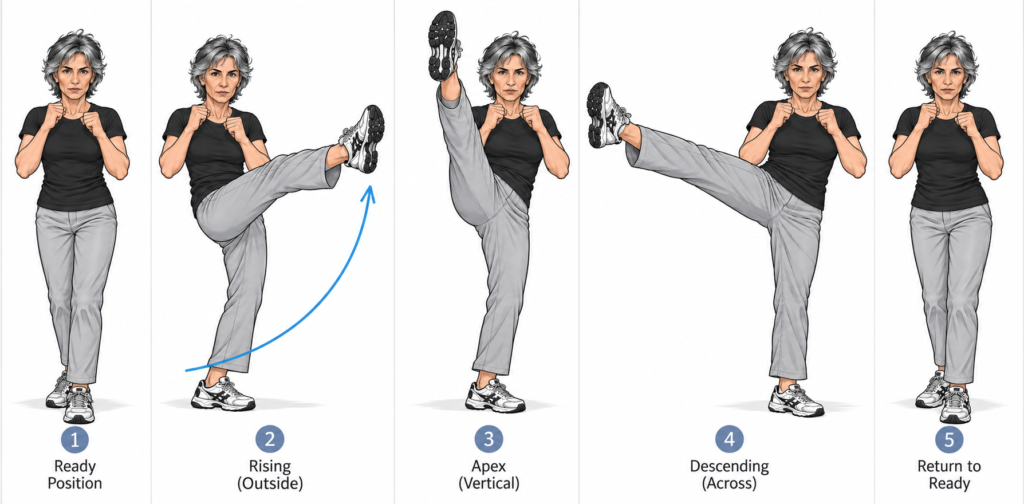
The aggressor keeps the non-kicking foot planted, then takes another step back with the kicking foot. Be sure to keep the body weight over the planted foot.
Action
For a right-footed actor, an inside fan kick travels right to left; an outside fan kick travels left to right. Either way, the leg remains straight as it swings in as large a circle as is comfortably possible, landing in the same spot from which it began. Throughout, your weight should be balanced on the supporting leg.
Try this very gently at first and you’ll quickly discover that it requires considerable hip flexibility and strong thigh control. Most actors will not be able to perform this kick safely unless the victim is already low, often on hands and knees.
As the victim’s back is to the audience, the victim can provide the knap by simply clapping the hands.
Reaction
The aggressor’s reaction is static, ready for the next move. The victim moves the head and body in the direction of the kick. In broad comedy—for example, The Three Musketeers—the reaction might even turn into a cartwheel.
Groin Kick
Non-contact illusion only.
Critical Safety Warning
Do not suggest to actors that a contact groin kick is safe, even if the victim wears an athletic cup. Athletic cups are designed to protect against incidental contact, not a full-force kick.
Do not suggest aiming for the inside thigh instead. A slight miscalculation can still result in a groin strike—or the kick can land low and injure the leg. Most importantly, do not have the energy of the kick moving toward the victim.
There is a video on the web in which an “expert” demonstrates a simulated knee to the groin with the aggressor directly facing the victim and the victim holding interlaced hands in front of the body. The aggressor then raises the knee and strikes the victim’s palms. There are several problems with this technique:
- The aggressor’s knee must rise considerably higher than groin level in order to strike the hands.
- Striking interlaced hands risks injuring the fingers or wrists.
- Most importantly, the aggressor’s leg is traveling toward the victim. If the spacing is even slightly wrong, the knee can strike the groin or stomach.
The demonstration ostensibly exists to show a safe simulation, while actually introducing additional opportunities for injury.
Instead, let’s try a simulation in which the energy of the aggressor moves away from the victim.
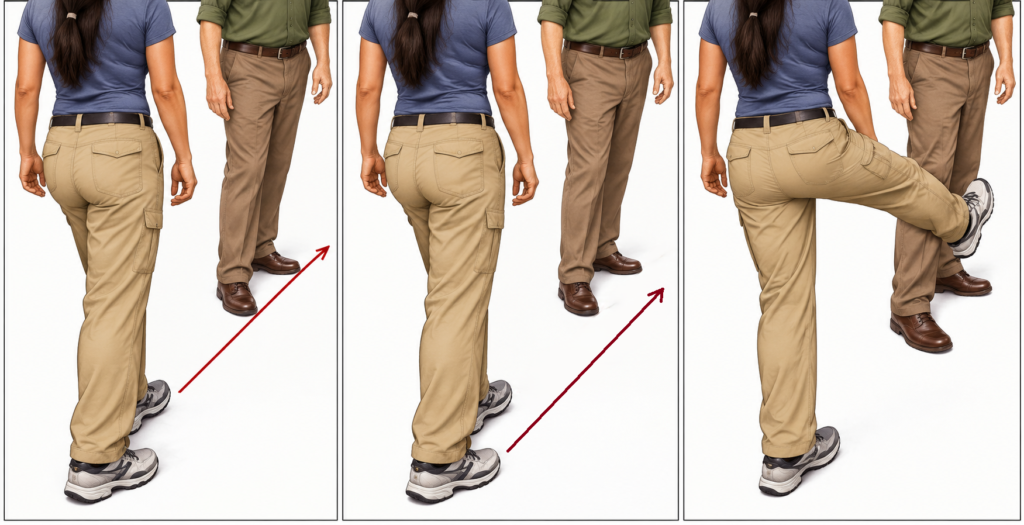
Set-up
Have the victim stand full back to the audience. Without turning the head toward the aggressor, cheat some eye contact before continuing.
The aggressor stands in profile, slightly upstage of the victim, about one and a half arm’s distance away. The aggressor’s body must not face the victim, but rather the empty space directly upstage of the victim. The downstage foot remains planted; the upstage foot—the foot furthest from the victim—performs the action.
Picture
Much like the slap, the groin kick works best when it comes as a surprise. And yet there still has to be a tiny moment that the audience can identify as a precursor to the action we want them to believe.
This can be nothing more than a small lift of the foot or a momentary shift of weight in opposition.
Action
The upstage knee rises and points toward the empty space upstage of the victim. The foot then swings out and back quickly, parallel to and upstage of the victim’s toes. Do not allow the foot to arc toward the victim.
The foot must immediately return toward its starting position. Any hang time and the audience will stop believing the illusion. This is more of a flick kick than one capable of doing serious damage, so the action must be quick, especially coming away from the apparent target.
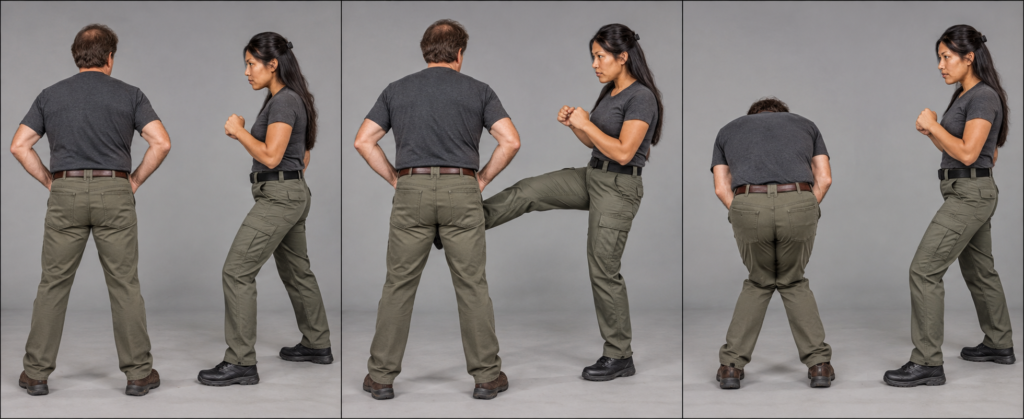
There is also a useful theatrical oddity at work here: if the aggressor’s foot actually rises to the height of the victim’s groin, the audience tends to read it as a kick to the stomach. The viewer’s mind adds a little more movement than was actually seen. So stop the foot slightly lower than actual groin level.
To give the illusion of contact, let the foot appear to bounce back from the groin like a ball bouncing off a wall. It may help for the foot to rise slightly slower than it moves on the rebound.
Reaction
The victim performs the universally understood reaction: bend the knees, stick the butt out, and lift the chin. Don’t collapse the head downward or bend over at the waist; that only confuses the illusion.
For comic effect, the knees may draw together, the vocalization may rise in pitch, and the initial shock can develop into a slow continuing collapse.
The aggressor should not bend over. Many actors—particularly men—do this in unconscious sympathy. Maintain the victorious posture.
If you want to simulate a groin strike with the knee rather than the foot, the same basic principles apply. See Knee to Stomach.
Front Kick to Stomach — Victim Standing
There are two ways of simulating a front kick, but I’m only going to describe one—the safer one. This is really the same basic illusion as the groin kick, with a few important differences.
Set-up
Have the victim stand full back to the audience. The aggressor stands in profile, slightly upstage of the victim, about one and a half arm’s distance away. The aggressor’s body must not face toward the victim, but rather toward the empty space directly upstage of the victim.
The downstage foot remains planted; the upstage foot—the foot furthest from the victim—performs the action. Establish eye contact.
Picture
The aggressor steps back with the kicking foot, bending the knee of the supporting leg slightly, as though gearing up the energy for the kick.
Action
Unlike the quick flick of the groin kick, this kick rises in a fuller arc from the ground toward the apparent target, swinging from the hip. The foot can rise somewhat higher than it did for the groin kick, but it should still remain below actual stomach level.
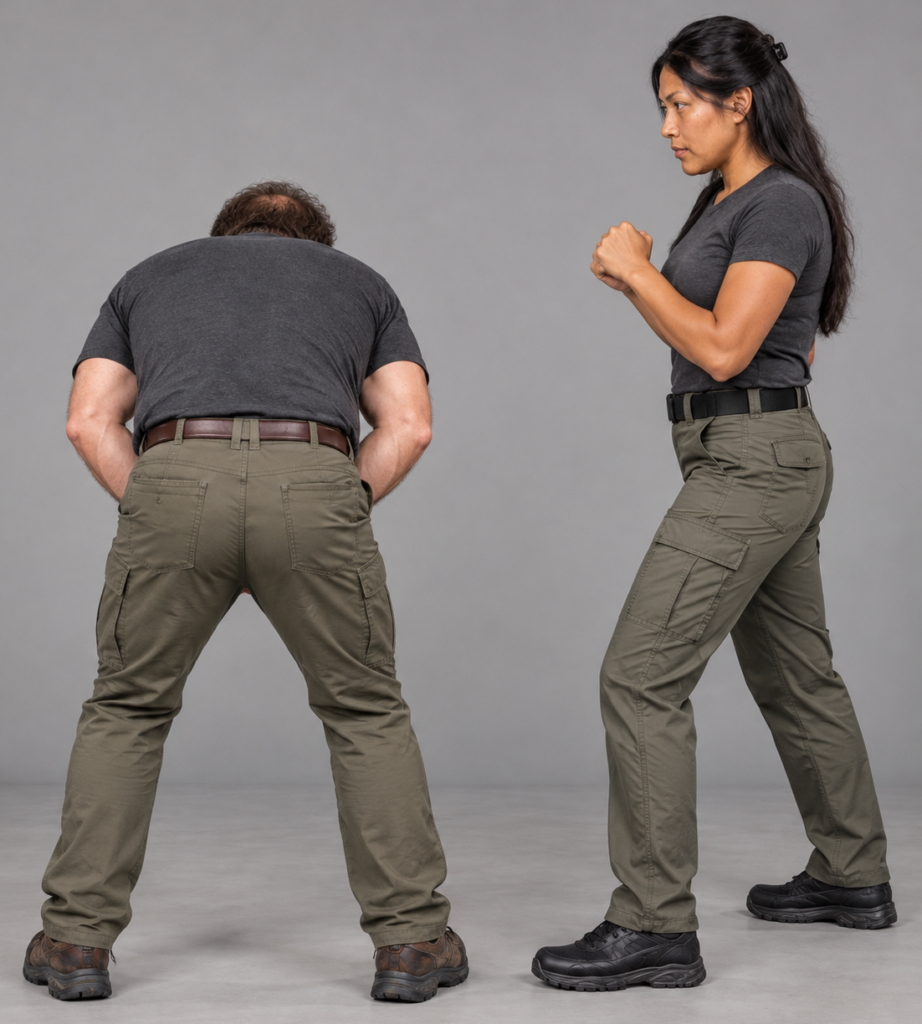
There is no reason to hook the kick toward the victim. The audience has no depth perception, and bringing the foot closer adds danger without improving the illusion.
The victim can use a free hand to pat the stomach to provide the sound of impact, but the most important sound is a large, sharp exhalation of breath.
Reaction
The reaction is quite different from that of the groin kick. Here the victim can allow the head to look down as the body doubles over.
The body can also move slightly downstage, as with a stomach punch, and may almost hop as it folds around the apparent impact. The apparent force of this strike has come upward from the ground, and the reaction should reflect that direction.
Front Kick to Stomach — Victim on the Floor
This is where the victim is already on the floor for some reason, on all fours, and the aggressor simulates a full kick to the stomach.
When this was taught to me, back in the day, I learned it as a full-contact kick. I was expected to clench my stomach muscles and simply absorb the blow. This worked well almost every night.
But there was one performance where it didn’t work well. Just before the kick, I ran out of air and needed to take a quick breath. I tried to wave off my partner, but it all happened so fast that he didn’t have time to notice my change of expression. His foot landed on my stomach just as it was relaxed enough to suck in a gulp of air.
That little bit of air was immediately pushed out of my lungs, and the force of the kick lifted me off the ground. I was left in a crumpled mass onstage with no way to continue the scene. My partner simply had to stand and wait for what seemed like an eternity until I could manage to say my next line and get the scene going again.
If you really must do this simulation, here is one way to do it that is marginally safer than what I was taught.
Set-up
Have the victim on all fours, angled roughly 45 degrees from either profile or straight. The aggressor moves in sideways but upstage of the victim, so that no matter which way the victim is pointed, the aggressor is facing quarter out, with hips and shoulders square to the victim’s stomach.
The non-kicking foot is planted about six inches away from the victim. That is your set-up.
Picture
The kicking foot steps back and the front leg bends slightly at the knee to aid in maintaining balance.
Action
This is the part that can get actors into trouble. The natural tendency is to swing the foot in too close and accidentally make contact with the victim. That is precisely what we do not want.
Instead, slowly bring the kicking foot forward to a point parallel with the planted foot. At the moment of apparent impact, pull the foot away again as quickly as possible. Slow in, fast out. And no closer than your own planted foot.
Reaction
The victim’s reaction is fairly obvious, and you may be able to sneak in a self-knap if one of the victim’s hands can be hidden from the audience.
But don’t let the aggressor make the sound by jabbing the kicking foot into the floor. It just sounds horribly not like a kick to the body.
Front Kick to Head
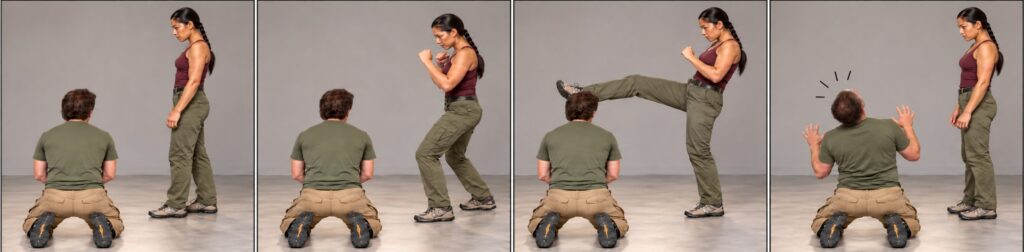
Once again, we follow the mechanics of the groin and stomach-level kicks, but in this case we have to lower the victim, since most actors won’t have the flexibility to kick much higher than waist level without risking injury. For our purposes, we’re going to use the easiest form of the kick to the head—one performed with the victim’s head only a couple of feet off the ground.
Set-up
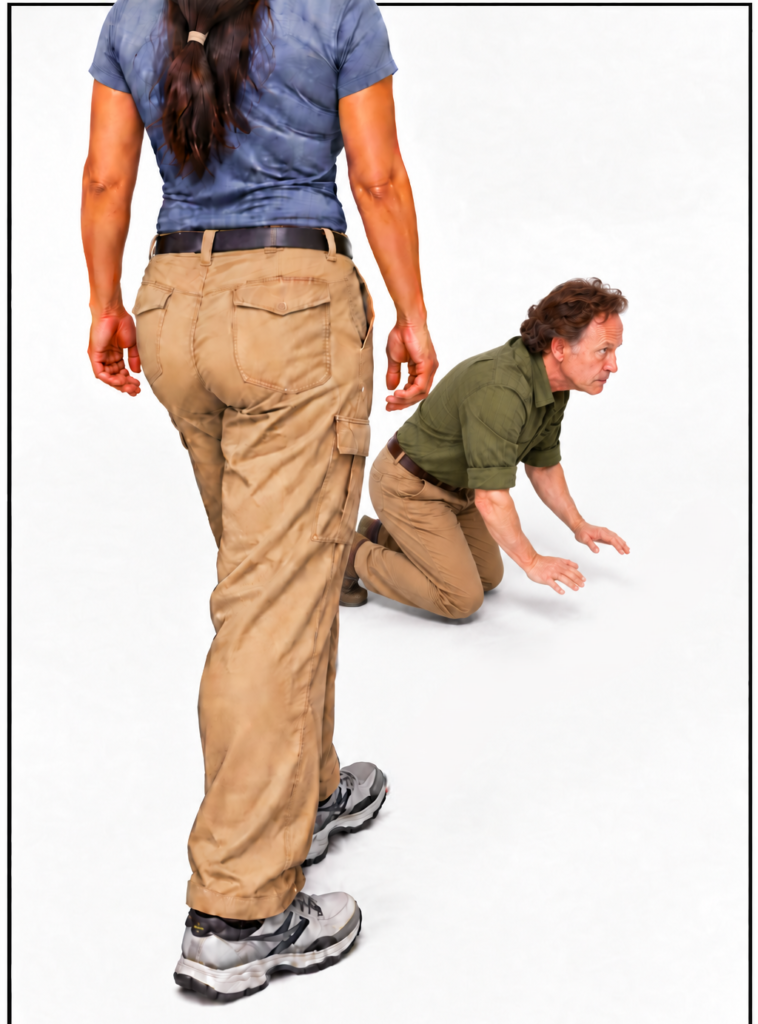
The victim is already on the ground for some reason, on hands and knees and full back to the audience. The head is held back slightly, so that the hands are farther upstage than the head.
The aggressor, standing stage left and profile right, lines up the toes of the standing foot with the victim’s fingertips.
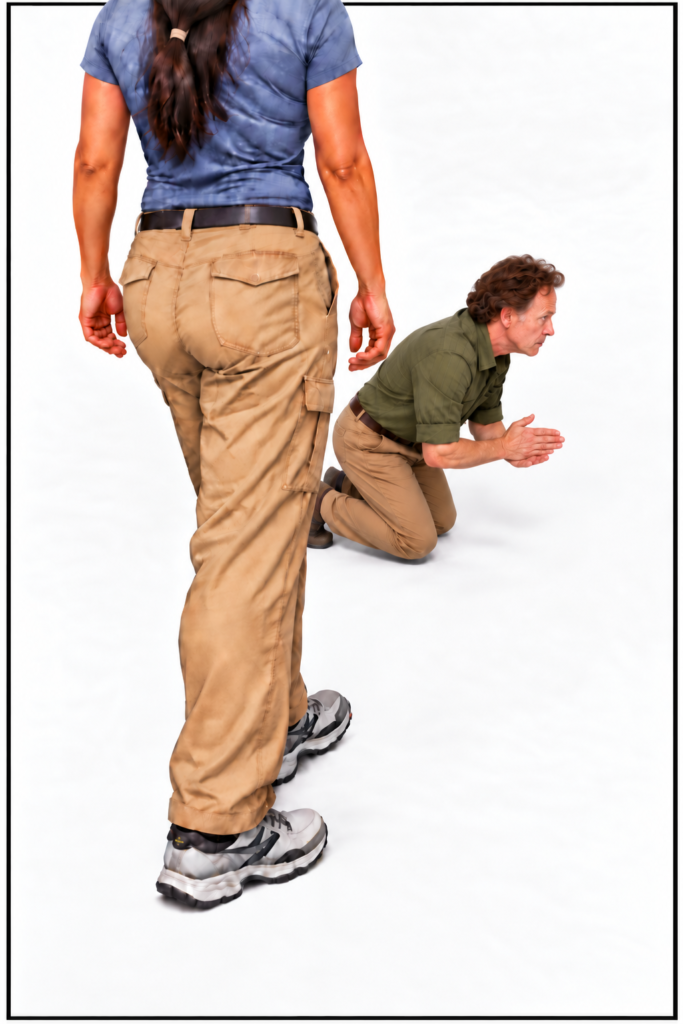
Once the aggressor is in position, the victim can rock back slightly to shift weight off the hands, freeing them to provide the knap. The hand nearest the aggressor should be directly beneath the other, ready to clap. Take care to hide this adjustment from the audience.
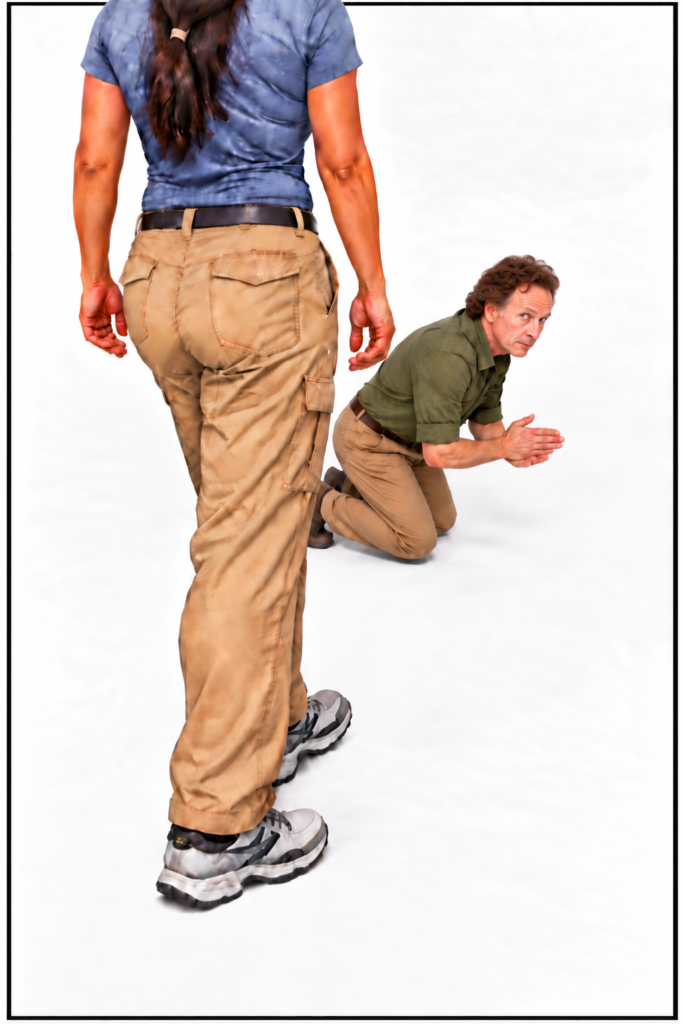
Only when everything is comfortably in place does the victim establish eye contact. That is the cue for the aggressor to begin the action.
Be patient. Don’t rush into the picture until every part of the set-up is secure.
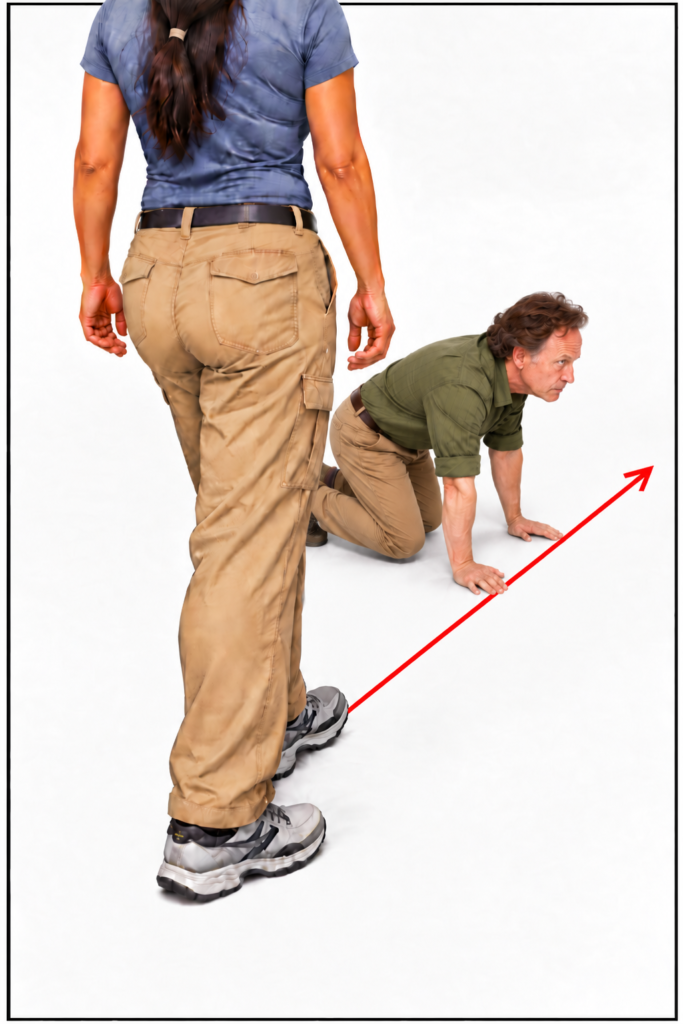
Picture
As with most kicks, the aggressor steps back with the kicking foot, bending the knee of the supporting leg slightly, as though gearing up the energy for the kick.
Action
The aggressor’s foot swings in an arc parallel to the proscenium, following the path of where the victim’s fingertips were. Unlike the other kicks, this one does not bounce back, but continues past the level of the head.
Keep the heel of the standing foot securely planted for balance.
Reaction
The victim provides the sound of contact by driving the bottom hand into the top, or target, hand, then allowing the hands to continue toward the face. Be careful not to let the elbow “flap.” The audience can
Roundhouse Kick
The roundhouse kick comes to us primarily from martial arts. The rear knee lifts, and the leg swings around in a large looping motion, with the strike traveling roughly parallel to the ground toward the opponent’s waist, ribs, knee, or head.
It can be a spectacular kick. It can also be a remarkably unforgiving one.
The combination of speed, power, balance, and the difficulty of controlling exactly where the foot will travel makes the danger level unnecessarily high for actors who have not been specifically trained to perform it.
There is very little reason to include a roundhouse kick in a stage fight unless you have an experienced instructor on site who can teach and supervise it.
For that reason, I’m not going to tell you how to do it here.
Rear Kick
The rear kick simulates kicking an opponent who is standing behind you. In basic mechanics, it is not terribly different from the front kick—the leg simply travels in the opposite direction.
The problem is control.
When kicking behind you, it is much more difficult to judge exactly where the foot is going, how far it will travel, and how close it will come to your partner. Balance is also more difficult to maintain, and the actor cannot easily watch both the path of the kick and the intended victim.
For all of those reasons, I’m going to leave this one out as well.
If a rear kick is genuinely necessary to the choreography, learn it under the direct supervision of an experienced stage combat instructor.
Knee to Stomach
Before working on this one, it may be useful to reread the Groin Kick and Stomach Punch, since we’ll borrow and modify elements from both.
The knee to the stomach is an excellent close-range simulation and can be made to work from almost any direction.
Set-up
No matter where the victim begins, the aggressor moves directly in line with and faces the victim’s right side. The victim turns out enough to show a right profile to the audience.
The aggressor places either or both hands lightly on the victim’s right shoulder. The aggressor’s left foot is positioned behind the victim’s right heel, so that the aggressor is almost straddling the victim’s right leg.
Establish eye contact.
Picture
There is no need for any visible preparation of the leg. This one rests largely on the aggressor’s body English.
Bend the knees slightly and really sell the intention of driving the knee into the victim’s stomach. If the actor believes it, we’ll believe it.
Action
The aggressor’s knee glides upward along the front of the victim’s leg and stops at about stomach level. Unlike the other kicks, the knee can and should remain there briefly.
The victim creates the apparent contact by doubling over around the aggressor’s leg, thereby closing the remaining distance. The aggressor does not drive the knee into the victim.
A full, sharp exhalation of breath provides the sound and helps sell the impact. No knap is necessary.
Reaction
The victim has apparently had the wind completely knocked out and may have taken a broken rib or two along with it. This is a fight-ender.
Staying doubled over and struggling for breath is probably all the reaction you need while the aggressor’s leg naturally drifts back to the floor.
Knee to Head
Here’s a simulation that is even more dangerous than it looks. It shouldn’t be, and if done correctly it can be performed safely. But there is no way under heaven that I would have actors attempt it without the direct supervision of a competent stage combat instructor.
When I included this in a show, I first demonstrated the action several times for the aggressor. I then had the actor go through the motions several times without a partner. Only then did I bring in the victim and have the two actors work through the action together in extreme slow motion.
Even with all of that preparation, you might be surprised at how often an actor initially brought the knee directly toward the victim’s face. I was standing right there to stop the movement, and everything was happening extremely slowly, so no one was hurt. But having seen that happen repeatedly, I have considerable trepidation about actors attempting to learn this simulation from written instructions alone.
So I’m not going to give you those instructions. If the choreography requires a knee to the head, learn it under the direct supervision of an experienced stage combat instructor.
End reminder:
If a kick requires courage, it is unsafe.
If it moves toward the partner, it is unsafe.
Illusion always beats athleticism.