
American policing did not descend from a single institution. Colonial sheriffs and watches, Southern slave patrols, frontier marshals, municipal departments, private detectives, and federal officers developed for different purposes and possessed different kinds of authority. For the theatre, the essential questions are what office the character holds, where and when he serves, and what clothing, weapons, or restraints his particular duties require.
Colonial Systems
The English colonies in North America inherited sheriffs, constables, watches, and communal enforcement from Britain, but no single system operated throughout them. Government was local, distances were considerable, and the available institutions differed according to the size and character of the settlement. New England relied heavily upon town officers and constables, while the sheriff was generally more important in colonies organized around counties.
The colonial sheriff was not yet the familiar lone lawman of the American Western. He served court documents, collected taxes, summoned jurors, took prisoners into custody, and frequently supervised the county jail. Constables performed more immediate local duties: serving warrants, bringing accused persons before a magistrate, controlling public disturbances, and calling upon other inhabitants for assistance. Neither necessarily wore a uniform or carried the equipment later associated with a professional police officer.
Larger settlements organized town or night watches. Service might rotate among eligible inhabitants, be assigned as a civic obligation, or be performed by paid substitutes. Watchmen patrolled for fire as well as crime, challenged suspicious strangers, raised an alarm, and detained offenders until a constable or magistrate could take charge. Enforcement remained communal because the officer’s authority depended heavily upon his ability to summon his neighbors.
When greater force was required, a sheriff or colonial government could call out armed citizens, a posse, or the militia. The same body of men organized for military defense might suppress a riot, pursue a dangerous fugitive, guard prisoners, or enforce the government’s authority. They brought their own military arms and organization to the task, but their temporary employment in civil order did not make them a standing police force.
Colonial jails were principally places of custody. They held accused persons awaiting trial, debtors awaiting payment, condemned prisoners awaiting punishment, and others awaiting removal or release. Long-term imprisonment was not yet the ordinary criminal sentence. Constructing and maintaining even a small jail was expensive, and the jailer commonly charged prisoners for food, lodging, fuel, bedding, and the use of restraints.
Iron collars, chains, fetters, and shackles were not standardized police equipment ordered from a central supply department. They had to be obtained, fitted, or repaired locally, generally by craftsmen capable of working iron. The expense of securing a prisoner could therefore become another item charged either to the community or to the prisoner.
The Salem witch trials provide a particularly grim example. More than 160 accused people were confined in several Massachusetts jails during 1692. Prisoners or their families were expected to pay for food and other necessities, and surviving accounts include charges for the chains used to restrain them. Some people who were acquitted or otherwise ordered released remained in jail until their fees had been paid. Innocence might save a prisoner from punishment, but it did not necessarily settle the jailer’s account.
For the theatre, a colonial constable should not automatically resemble either a British Bobby or a Western sheriff. He is more likely to appear as an ordinary member of the community carrying a warrant, staff, or other sign of office. He expects a cooperative prisoner to accompany him; if the prisoner resists, he summons neighbors, watchmen, or militia rather than relying upon a uniform, gun belt, and personal set of handcuffs.
Slave Patrols
Slave patrols developed in the southern colonies during the late seventeenth and early eighteenth centuries and continued throughout the antebellum—or pre-Civil War—South. Colonial and later state laws authorized local governments to organize white men into patrols, frequently on a rotating basis. These were legally constituted bodies rather than merely self-appointed bands, although the distinction offered little comfort to the people subjected to them.
Their principal purpose was the control of the enslaved population. Patrollers could stop enslaved people traveling away from a plantation, demand written permission, search them, break up unauthorized gatherings, inspect slave quarters, seize weapons, capture fugitives, and return prisoners to their enslavers. Within limits that varied by place and period, they could also inflict immediate corporal punishment. The patrol therefore combined surveillance, capture, punishment, and intimidation without waiting for the procedures ordinarily associated with a court.
Slave patrols were organized along paramilitary lines. They were commonly mounted, traveled in groups, and carried firearms, whips, clubs, lanterns, and other practical equipment. Service could be imposed as a public obligation, directed through militia or county authorities, and enforced by fines or loss of privileges. Their purpose was not simply to respond to individual crimes but to preserve an entire system of forced labor and prevent escape, assembly, resistance, and rebellion.
This distinguishes them from the town watches more familiar in the northern colonies. A northern watch patrolled a defined settlement for fires, theft, nighttime disorder, and suspicious strangers. Its authority could certainly be discriminatory and coercive, but its stated responsibility extended to the general order of the town. The slave patrol ranged across plantations, roads, and countryside with one population as its principal object: enslaved Black people. One guarded a place; the other policed a subordinate caste.
Slave patrols are therefore an essential part of the history of American law enforcement, particularly in the South. They were not, however, the single origin of every American police institution. Sheriffs, constables, northern town watches, municipal police departments, marshals, militias, and frontier posses developed through other lines of descent. American policing has several institutional ancestors, and not every later police department can be traced directly to a slave patrol. Recognizing that complexity does not diminish the importance of the patrols or the racial system they enforced.
For the enslaved population, a patrol represented something profoundly different from the public reassurance later associated with a policeman on the beat. The approach of mounted men at night meant questioning, search, seizure, whipping, or forced return. A pass might provide limited permission to travel, but the patroller decided whether to accept it. His authority was intended to be frightening because fear itself was one of the mechanisms by which slavery was maintained.
For the actor, the patroller should not be played as an early uniformed policeman. He is more likely to appear as an armed white civilian temporarily exercising official power, confident that the law and the other members of his patrol stand behind him. Conversely, an enslaved character does not see a neighborhood guardian approaching. He sees an unpredictable agent of a system empowered to interrupt his movement, examine his body and possessions, and inflict violence with little expectation of legal consequence.
Sheriffs, Marshals, and Frontier Law Enforcement
The settlement of the American West did not produce a single system of frontier law enforcement. Counties, incorporated towns, territories, tribal governments, and the federal courts created officers with different jurisdictions and responsibilities. Several kinds of law officer might operate in the same region without belonging to the same organization or possessing authority over the same offenses.
The sheriff was not an invention of the West. The office had descended from the English shire reeve and was already well established in the American colonies. In the nineteenth-century United States, the sheriff was ordinarily a county official, commonly elected by the people he served. His responsibilities varied according to state or territorial law, but could include serving warrants and court papers, summoning jurors, collecting taxes and fees, administering the county jail, transporting prisoners, and carrying out sentences imposed by the courts. Criminal pursuit was only one part of the office.
Sheriffs appointed deputies to act in their name, particularly when distance or danger made assistance necessary. A sheriff or other authorized officer could also summon a posse comitatus: local men temporarily required to assist in an arrest, pursuit, or preservation of order. A posse was not necessarily a standing mounted unit, nor were all of its members experienced law officers. It was an emergency means of supplying manpower where permanent personnel were few.
Within an incorporated town, local order might be maintained by a town marshal or constable. That officer enforced municipal ordinances, dealt with disturbances, and made arrests within the town’s jurisdiction. Some growing communities eventually replaced the marshal with a chief of police and a small municipal department. County and town authority therefore overlapped geographically, but the sheriff and town marshal did not hold the same office.
The United States marshal belonged to a separate federal system. Appointed to serve a federal judicial district, the marshal executed the orders of the federal courts. Much of the fieldwork was performed by deputy U.S. marshals, who served writs and warrants, arrested people accused of federal crimes, summoned jurors, guarded courts, and transported federal prisoners. In immense western districts, a deputy might travel for weeks and return with several prisoners for trial.
Manpower and equipment varied enormously. Some officers received salaries, while others depended partly upon fees paid for serving papers, making arrests, or transporting prisoners. A sheriff’s office might consist of the sheriff, a few deputies, and the county jail; elsewhere, an officer might assemble assistants only when a particular warrant had to be served. Horses, wagons, railroads, and eventually automobiles were as important to the work as weapons.
Frontier law officers generally wore ordinary civilian clothing appropriate to the community and the work. A badge or written commission could establish official authority, but badges were not completely standardized in shape or manner of display. The officer’s appearance might differ little from that of the rancher, merchant, lawyer, or traveler he encountered.
Firearms were practical equipment where an officer might be far from assistance. A revolver could be carried as a sidearm, while a rifle or shotgun might accompany an officer on horseback or in a wagon during a dangerous pursuit. There was no single firearm issued to all sheriffs or marshals, and the weapon selected depended upon availability, personal preference, local practice, and the work anticipated.
Restraints were similarly variable. Handcuffs, wrist irons, leg irons, and chains might be available at a jail or carried when a dangerous arrest or long journey was expected. A cooperative prisoner might be escorted without irons, while a person considered violent or likely to escape could be restrained for transport. Moving prisoners across great distances often required several guards, repeated overnight stops, and careful control of horses, wagons, or railway compartments.
Western law enforcement also included people largely omitted from the most familiar stage image. Black deputy U.S. marshals such as Bass Reeves exercised federal authority over white, Black, and Native prisoners in Indian Territory. Hispanic officers served throughout the Southwest, while Native nations maintained their own courts and police institutions. Tribal, territorial, county, municipal, and federal authorities sometimes cooperated and sometimes disputed one another’s jurisdiction.
For the actor, the essential starting point is the character’s actual office. A sheriff represents a county; a town marshal represents a municipality; and a deputy U.S. marshal acts under federal authority. Clothing, badge, firearm, restraints, and manner of making an arrest should follow from that distinction, as well as from the particular place and date.
Professional Municipal Police
American cities did not establish professional police departments all at once. As urban populations grew during the nineteenth century, the old mixture of constables, night watches, sheriffs, and temporary posses became increasingly inadequate. Boston’s department of 1838 is commonly identified as the first publicly funded, full-time municipal police force of the new type. New York reorganized its police in 1845, and Philadelphia followed in 1854. Other cities created departments according to their own needs, laws, and political circumstances.
The important change was not merely that certain men were paid to keep order. A permanent department could divide a city into precincts, assign an officer to a regular beat, establish station houses, and maintain supervision throughout the day and night. The patrolman became a recognizable representative of municipal authority rather than a citizen temporarily taking his turn on the watch.
Uniforms helped make that authority visible, although they were not adopted everywhere at once and were sometimes resisted as offensively military. New York’s policemen did not receive a complete official uniform until 1853. By the later nineteenth century, however, the uniformed beat patrolman—with badge, cap or helmet, dark coat, and conspicuous equipment—had become a familiar figure in American cities.
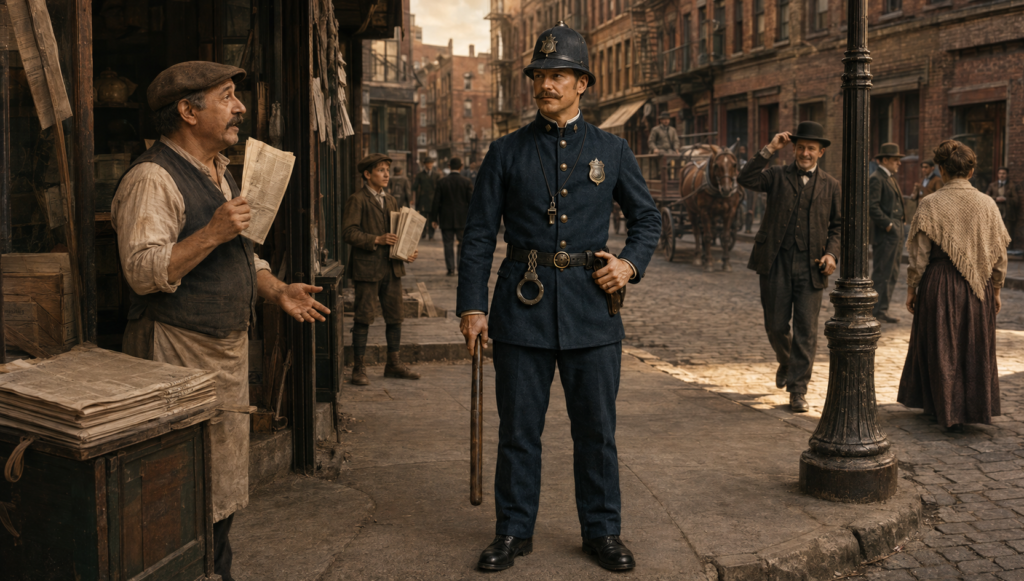
His characteristic weapon was the straight wooden nightstick. Early departments did not always provide standardized equipment, and in some cities an officer supplied his own club. The longer nightstick could be carried in a pocket made for the purpose or thrust through the officer’s belt. A rattle—and increasingly a whistle—allowed him to summon other officers, but until the arrival of telephones, call boxes, radios, and patrol cars, assistance might still be some distance away. Firearm practices differed considerably among cities and periods and are considered separately below.
Professionalization also encouraged a greater separation of duties. The patrolman watched the streets, responded to disturbances, and made arrests. Detectives investigated crimes that required sustained inquiry. Station-house personnel received and recorded prisoners, while municipal lockups and county jails held them for the courts. One officer might still perform several of these functions in a small department, but in a large city the man who made an arrest was no longer expected to investigate the entire case, guard the prisoner indefinitely, and carry out the sentence.
The beat patrolman consequently occupied two positions at once. He could be a familiar neighborhood presence who knew the shopkeepers, found lost children, reported fires, checked doors, and settled minor disputes. He was also an agent of coercive authority, enforcing laws governing vagrancy, public assembly, labor disputes, drink, and street behavior. Political machines sometimes used police employment and police power for partisan purposes, while poor, immigrant, and Black communities could experience the same patrolman very differently from the merchants and property owners whose streets he protected.
For the actor, the essential quality is possession of the beat. The patrolman is not merely walking through the neighborhood: while on duty, he is its visible municipal authority. His habitual watchfulness, knowledge of the streets, and expectation of obedience should be apparent before he ever reaches for his whistle or nightstick.
American Detectives
As municipal police departments grew, they began assigning some officers to investigate crimes rather than merely patrol streets and respond to disturbances. These men worked without uniform so that they could question witnesses, follow suspects, visit saloons and lodging houses, and conduct surveillance without immediately announcing themselves as police officers. New York formed a detective squad in 1857 and organized a formal Detective Bureau in 1882; other large departments developed comparable divisions at different times.
The municipal detective remained a police officer. He possessed the authority of his department, reported through its chain of command, and could make arrests in its name. What he lacked was the patrolman’s immediate visual authority. His badge might be carried inside a coat or vest and displayed when necessary. Handcuffs and a concealed firearm might also be carried, depending upon the city, period, assignment, and departmental practice, but neither should be treated as an unchanging part of the American detective’s costume.
Private detectives developed alongside their municipal counterparts. Allan Pinkerton established his agency around 1850, initially specializing in such problems as railway theft, counterfeiting, and crimes that crossed local jurisdictions. Private agencies also provided guards, pursued fugitives, gathered intelligence, protected property, and investigated employees. Some became notorious for infiltrating labor organizations and supplying armed men during strikes. A private detective was not automatically a police officer and ordinarily possessed no special power of arrest beyond that allowed by the law and his particular appointment.
The word gumshoe originally referred to a rubber-soled shoe and became slang for a detective who could move quietly while following someone. It eventually suggested the persistent investigator who wears out shoe leather asking questions and pursuing small clues. Nothing about the term required a fedora, trench coat, or shoulder holster.
Those familiar accessories belong principally to the twentieth-century image of the detective. A real plainclothes officer ordinarily wore the respectable everyday clothing of his place and period: commonly a suit, waistcoat or sweater, ordinary shoes, and whatever hat and outer coat the weather required. The fedora became common men’s wear during the early twentieth century, while the trench coat entered civilian fashion after the First World War. Either might therefore be appropriate in a later-period production, but neither identified its wearer as a detective. An 1880s detective should not be dressed as though he had wandered out of a 1940s crime film.
The shoulder holster likewise existed in actual use, particularly when a handgun had to be concealed beneath a jacket, but its constant association with detectives owes much to illustration, pulp fiction, film, and television. Many officers carried concealed pistols at the waist or in a coat pocket instead. The weapon selected—and whether one was carried at all—must follow the department, assignment, and date rather than the convenience of the costume designer.
American crime fiction gradually combined the municipal detective, private investigator, frontier manhunter, and hard-boiled hero into a single theatrical figure. By the film-noir era, the audience could recognize him from the silhouette alone: lowered fedora, turned-up coat collar, pistol under the jacket, and cigarette in the rain. That image is wonderfully useful on stage, but it is a dramatic convention. The historical detective’s defining equipment was not his hat or gun, but his freedom to pass through the city without the unmistakable uniform of the patrolman.
Arrest and Restraint
As in Britain, an American arrest did not originally require the immediate physical restraint of the prisoner. A cooperative person might be escorted between officers or simply directed to accompany a constable to the station. Irons were principally used when escape, violence, or a difficult journey made additional control necessary.
Early restraints included fixed-size iron handcuffs, hinged wrist irons, shackles, and chains secured by comparatively bulky locks. Because one size would not fit every prisoner, several pairs might be needed. Their weight and inconvenience made them better suited to a gaol, station house, courtroom, or planned transport than to the pocket or belt of every patrolman.
American manufacturers began producing adjustable ratcheting handcuffs during the nineteenth century. Designs associated with W. V. Adams, Orson Phelps, and John Tower replaced the fixed bracelet with a bow that could be tightened to fit the individual wrist. These restraints were more practical than the old fixed-size irons, but many still had to be opened and positioned before they could be placed upon a prisoner.
The decisive improvement came from George Carney’s 1912 patent for a handcuff with a swinging ratchet bow. James Milton Gill acquired the design and established the Peerless Handcuff Company in 1914. In the new “swing-through” arrangement, the curved bow could be pressed against the wrist, pass completely through the lock, and return on the other side. The officer no longer had to hold an open bracelet around a struggling wrist while attempting to close it. Although later manufacturers modified the locks, chains, swivels, and safety features, the essential Peerless arrangement remains recognizable in modern police handcuffs.
Smaller, adjustable, mass-produced cuffs were sufficiently convenient for a patrol officer to carry as part of his personal equipment. This changed the relationship between arrest and restraint. Handcuffs were no longer implements that had to be fetched for a particularly troublesome prisoner; they were immediately available whenever an officer decided they were necessary.
The growth of prisoner transportation encouraged their use. A prisoner walking to the station, riding in a patrol wagon, or later sitting in a police automobile had repeated opportunities to run, fight, seize a weapon, or interfere with the driver. Handcuffs reduced those possibilities and allowed fewer officers to move more prisoners. Their increasing use therefore reflected not only the dangerousness of the individual but the practical needs of an expanding police and detention system.
Hands could still be secured in front, particularly when the prisoner was cooperative or had to walk some distance. This prevented free use of the arms but did not eliminate it: the prisoner could strike with both hands, reach the lock, seize an object, or use the short chain as a weapon. Rear handcuffing offered substantially greater control and gradually became the preferred American position, particularly during the middle and later twentieth century.
The change was not made everywhere at the same moment. American policing remained divided among thousands of municipal, county, state, and federal agencies, each developing its own equipment and rules. Over time, however, academy training and written departmental procedures increasingly instructed officers to gain control, place the hands behind the prisoner, apply the cuffs promptly, check their fit, and secure the locks before beginning a search or transport. What had once been a discretionary response to obvious resistance became, in many departments, a routine officer-safety procedure.
For the theatre, the date remains important. A nineteenth-century patrolman may plausibly escort a cooperative prisoner without restraints or send for irons when they are needed. By the 1920s or 1930s, an American patrol officer can very plausibly carry Peerless-style handcuffs and apply them himself, although restraint in front has not yet become visually implausible. The familiar modern action—hands ordered behind the back and cuffs applied immediately—belongs most securely to the later twentieth century.
Firearms
Unlike the Metropolitan Police, American municipal departments were not founded around a lasting presumption that the ordinary patrol officer should remain unarmed. Practices varied from city to city, and some early officers supplied their own weapons, but handgun carriage became increasingly common during the later nineteenth century. By the beginning of the twentieth, the revolver was an established part of the uniformed American officer’s equipment.
Some of the first officially selected police revolvers were comparatively small in both frame and caliber. In 1896, for example, New York Police Commissioner Theodore Roosevelt authorized the purchase of approximately 4,500 Colt New Police revolvers in .32 caliber. He also instituted firearms practice and qualification, thereby making the weapon part of an organized departmental system rather than merely an officer’s personal precaution.
During the early twentieth century, many departments moved toward larger .38-caliber revolvers. Medium-frame, six-shot, double-action models made by Colt and Smith & Wesson became particularly common. They were durable, simple to inspect, and could remain loaded for long periods. Their fixed sights and enclosed ammunition also suited a weapon carried daily in all weather.
A four-inch barrel became a common choice for the uniformed patrolman because it provided a useful compromise between accuracy, handling, and ease of carriage. Five- and six-inch revolvers were also used, as were shorter weapons, and no barrel length was universal. Nevertheless, the four-inch .38 service revolver is a sound visual default for an American uniformed officer through much of the twentieth century.
Plainclothes detectives had different requirements. Their weapons had to disappear beneath ordinary clothing without the barrel, grip, or holster becoming conspicuous. Compact revolvers were therefore carried in belt holsters, shoulder holsters, coat pockets, or other concealed positions according to period and departmental practice. Introduced in 1927, the Colt Detective Special combined a short two-inch barrel with a six-shot cylinder capable of firing the .38 Special cartridge. It became one of the characteristic concealed revolvers of American detectives, although it was never the only available choice.
The uniformed officer normally carried his revolver on the strong-hand side, comparatively high upon the waist. This position kept the weapon secure while walking or running and allowed it to be drawn without sweeping across the body. Cross-draw holsters existed, but were generally less suitable for exposed uniformed duty and gradually became disfavored by many departments. A plainclothes officer had greater reason to compromise the ideal draw in favor of concealment; the shoulder holster, for example, is necessarily drawn across the body.
The shotgun followed a different pattern. Shorter-barreled pump-action “riot guns” were kept at police stations for bank robberies, riots, barricaded suspects, and other incidents requiring greater power than the service revolver. They were not ordinarily carried by the foot patrolman on his daily beat. Once radio-equipped patrol cars replaced much of the walking beat, however, the officer could bring heavier equipment with him. During the postwar period, the pump-action shotgun increasingly moved from the station armory into a locked rack inside the patrol car. It remained a weapon for particular circumstances rather than something worn upon the officer’s person.
The revolver continued as the dominant American police sidearm well after the Second World War. The broad transition to semi-automatic pistols occurred principally during the 1980s and 1990s, as departments sought greater ammunition capacity, faster reloading, and weapons better suited to changing perceptions of criminal firepower. Improved pistol reliability, standardized training, and the example of departments that had already adopted semi-automatics all contributed to the change.
There was no simple progression from the Colt .45 automatic to the modern 9mm police pistol. The M1911 and other .45-caliber pistols were used by some officers and agencies, but the usual predecessor of the modern police semi-automatic was the .38-caliber service revolver. Departments adopted a variety of pistols in 9mm, .40 S&W, .45 ACP, and other chamberings; Beretta, SIG Sauer, Smith & Wesson, and Glock were among the prominent manufacturers. The change occurred department by department rather than through a single national decision.
Rifles were long available to special units and for particular emergencies, but they were not traditionally part of the ordinary patrol officer’s equipment. The 1997 North Hollywood shootout, in which patrol officers armed principally with handguns and shotguns confronted heavily armed and armored bank robbers, accelerated the development of patrol-rifle programs. Many departments subsequently placed AR-15-, M16-, or M4-pattern carbines in patrol vehicles for use by trained officers. Their presence in a cruiser does not mean that every officer carries a rifle during ordinary public contact.
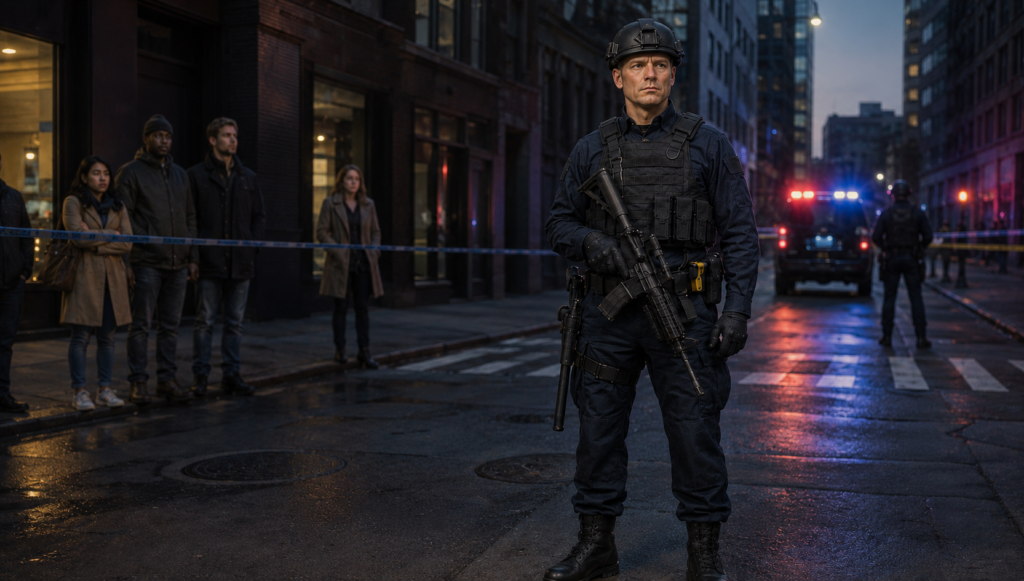
Modern police armament therefore consists of several levels. The sidearm remains immediately available on the duty belt. A shotgun or patrol rifle may be secured in the vehicle. Specialized tactical officers may deploy rifles, breaching weapons, heavier protective equipment, shields, and less-lethal launchers according to their assignment. Even in the heavily armed American system, what an officer can obtain from a station or vehicle should not be confused with what he routinely wears.
For the theatre, the most useful progression is visual and practical. A late-nineteenth-century officer may carry a personally selected .32- or .38-caliber revolver. The twentieth-century uniformed patrolman is strongly associated with the four-inch .38 worn openly at the strong-side hip. A 1930s detective may plausibly conceal a short-barreled revolver such as the Colt Detective Special. The postwar patrol-car officer adds ready access to a pump shotgun, while the later twentieth-century officer exchanges the revolver for a semi-automatic pistol. The patrol rifle belongs principally to the modern cruiser or tactical response—not to the ordinary walking beat of an earlier period.
Portraying American Police on Stage
The following is a quick theatrical overview rather than a strict line of institutional descent. These types sometimes overlap in date and function, and local practice varied greatly. They nevertheless provide useful starting points for actors and designers.
Colonial constable or watchman. The constable derives his authority from a town or local court, while the watchman is commonly a citizen taking an appointed or rotating turn. Neither necessarily wears a uniform. A lantern, staff, rattle, or locally available firearm may be appropriate according to the colony and duty. Restraints are more likely to be kept at the jail or brought for a difficult prisoner than carried routinely. A cooperative prisoner may simply be escorted before the magistrate.
Slave patrol. The patrol consists principally of armed white men serving on rotation under colonial or state authority. Ordinary civilian or riding clothes are appropriate rather than a municipal police uniform. Firearms, whips, clubs, and lanterns are characteristic; ropes, chains, or other restraints may be brought when capture and return are anticipated. may all appear. But the patrol’s central instruments are surveillance, intimidation, search, physical punishment, and the power to return enslaved people to bondage. It should not be played as a reassuring neighborhood watch or as an early version of the friendly beat policeman.
Nineteenth-century municipal patrolman. The recognizable city uniform, badge, assigned beat, and station house distinguish him from the older watchman. His principal visible weapon is the straight wooden nightstick, accompanied first by a rattle and later by a whistle. Firearm and handcuff practices depend upon the city and decade; both become increasingly common toward the end of the century. A cooperative prisoner may still be walked to the station without being restrained.
Western town marshal. The marshal enforces ordinances within a particular town and should not automatically be treated as the sheriff of the surrounding county. He generally wears civilian clothing, with a badge or personal reputation establishing his authority. A revolver is plausible, while a rifle or shotgun may be obtained for greater danger. Handcuffs or irons may be available without being used in every arrest. His treatment of a cooperative prisoner depends upon the offense, likelihood of escape, available assistance, and distance to the jail.
Early twentieth-century beat cop. By this period the urban patrolman is readily identified by his municipal uniform, badge, cap or helmet, nightstick, and whistle. A service revolver—often initially a smaller-caliber weapon and increasingly a .38—is commonly worn openly. Adjustable handcuffs are becoming practical personal equipment, while a patrol wagon may transport the prisoner to the station. Restraint is increasingly likely, but hands secured in front remain plausible.
1930s uniformed officer. The characteristic equipment is a dark municipal uniform, badge, straight nightstick, handcuffs, and a service revolver worn at the strong-side hip. A four-inch .38 is a useful general choice, although departments issued or authorized many different models. The officer may communicate through call boxes, station telephones, or police radio where available. Handcuffing has become common, but immediate rear restraint is not yet the universal visual rule it would later become.
1930s plainclothes detective. He wears the ordinary respectable clothing of his place and circumstances: usually a suit, shirt and tie, and whatever hat or overcoat the weather requires. His badge and equipment are concealed. A compact revolver such as the Colt Detective Special is appropriate, but a shoulder holster, fedora, and trench coat should not be treated as a compulsory detective uniform. He possesses police authority but may bring uniformed officers to supply visible authority, additional manpower, or prisoner transport.
Postwar patrol-car officer. The automobile, two-way radio, and duty belt now define the officer’s work as much as the walking beat once did. A .38 service revolver, handcuffs, and baton are worn on the body, while a pump-action shotgun may be secured inside the car. The vehicle allows one or two officers to cover a much larger area and transport prisoners directly. Rear handcuffing becomes increasingly preferred as departments formalize arrest and officer-safety procedures.
Modern patrol or tactical officer. The ordinary patrol officer generally carries a semi-automatic pistol high on the strong-side hip, additional magazines, handcuffs, radio, expandable baton, and some combination of pepper spray and Taser. Body armor may be concealed or worn externally, while a shotgun or patrol rifle may remain secured in the vehicle. A tactical officer is a separate figure, visibly equipped with heavier armor, helmet, rifle, specialized communications, and other mission-specific equipment. Modern procedures commonly call for immediate rear handcuffing during a custodial arrest, although policies and exceptions continue to vary by agency and circumstance.