
These actions are the ones in which we need the audience to believe that hard physical contact has been made, with a recognizable moment of impact. That moment must always be accompanied by sound – sometimes a percussive sound, but always an exhalation of breath from both participants. Whether vocalized or not, the sound of breath is necessary for the illusion to be effective. There is no exception to that rule: every strike must have a sound.
No matter what the strike, the aggressor need not do the simulation quickly. It is the victim that must sell the violent impact in the reaction. Be sure that the victim understands to not begin the reaction until he can hear the impact sound – the “knap”. Sound travels more slowly than light, if the victim moves at the same instant of the strike, the audience is going to see the victim react before they hear the sound and it will get a laugh. Remember: aggressive move, then sound, then reaction.
foot stomp
I used to be a stickler about having the foot stomp performed by the aggressor stomping the ground directly downstage of the victim’s foot. But this can also work with the stomp directly upstage; in fact it often is even more realistic. It really depends on the actors. Have the actors practice both ways and you decide which one they do more effectively. Either way, the key to make this look realistic is to bounce the foot off of the ground immediately after the stomp. If the stomping foot is on the ground for even a millisecond, the audience will see that the aggressor didn’t actually hit the foot.
Go back and practice the trip a few times and you’ll see that the two illusions are mechanically similar, just with a different set of pictures and reactions. From one thing learn ten thousand.
There are some things to make sure that the actors NOT do when performing the aggressor role. These are bad little habits that can ruin the illusion. First, most actors will want to rotate their bodies for the picture portion, instead of keeping their shoulders square to their partner. By over-rotating and pulling the punching hand behind them instead of off to the side, it can expose the handclap moment to the audience’s view.
Second, some actors will get the picture right with a closed fist, do the action correctly with an open handed clap, but then forget to close the hand into a fist again for the reaction.
lastly, actors tend to let both hands fly off in the direction of the punch during the reaction. Unless they force the knap hand to go down and low, the audience can easily figure out how the punch was faked.
elbow to stomach from behind
Warning: this is a more dangerous illusion, in that we are aiming force directly at the victim. This should be taught under direct supervision of a trained instructor.
This is the typical escape from a one-arm choke hold from behind, and is a simple variation of the above stomach punch. From one thing learn ten thousand. (I obviously enjoy that phrase. I’ve borrowed it from The Book of Five Rings, and it serves as a reminder that each technique can be modified to create countless variations and alternatives.). Since this technique is an elbow strike, the roles of aggressor and victim now reverse: the choker, who was the aggressor, becomes the victim of the elbow strike, while the person being choked becomes the aggressor. For this example, we are assuming that the choke is being performed with the right arm.
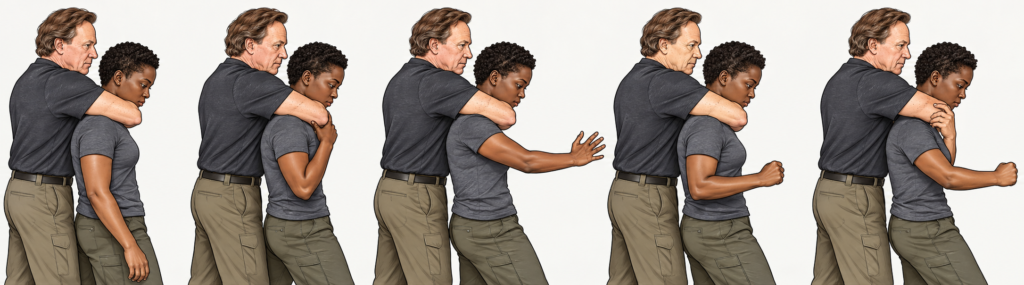
Set-up: The victim and aggressor stand full front to the audience, the aggressor slightly to the left and in front of the victim. The right heel of the aggressor is almost touching the left toe of the victim. The victim has his right arm loosely around the aggressor’s neck, and the pressure of the arm is pressing lightly down and forward. The aggressor, pretending to try to remove the choking arm, is actually pushing the victim’s arm towards his own chest, so that if he relaxes his push, the choking arm would naturally drop away. The aggressor’s chin should be tucked into the chest so we can’t see that he is not really being choked. The head of the victim must be safely looking over the right shoulder of the aggressor.
Picture: The aggressor’s left arm stays on the victim’s choking arm, while the right straightens out forward.
Action: Be careful here, because an elbow to the solar plexus can do a lot more damage than a punch to the stomach. The elbow smoothly moves into the target, which is the aggressor’s own right hip, and must not be allowed to drift further back than his own hip level. The elbow doesn’t stick there, but bounces off rather quickly. Again, the illusion of impact needs no physical contact or knap; the only sound required is a vocalization from both actors.
Reaction: The victim simply bends forward at the waist, but this time lifts the chin up so that the audience can see the reaction. The aggressor simply holds position.
elbow to spine
For the YouTube video on this, just follow this link: https://www.youtube.com/watch?v=e9vWMexflpk
We’re getting into some dangerous territory here, but I include it because I see a lot of high school students play around with their own simulations. They see this stuff on professional wrestling on TV and then try to recreate it. Ironically, they know that what they see is fake, so they assume that the simulations can’t hurt anyone. Unfortunately, it can if done improperly, and an elbow strike more than others even if done lightly. So here are some guidelines on turning a very dangerous simulation into something tolerably safe:
Set up: Usually, this simulation comes directly after a regular stomach punch, so the set-up is already implied from the final reaction – the doubling over of the victim, with the aggressor’s left hand still touching the victim’s right shoulder. The aggressor is standing very close and squared-off to the victim.
Picture: Let the left hand slide from the shoulder to a spot to the right of the victim’s spine. You’re looking for a large muscle group a little above the floating ribs but below the scapula. Let the heel o the palm rest there as the fingers lift up. The right hand shoots straight up into the air and forms a fist.
Action: The aggressor merely bends from the knees, keeping the back straight, as the right arm bends. The contact is made obviously NOT with the elbow, but with the back of the upper arm, the triceps. To add further safety, contact is not made with the victim’s back at all, but with the back of the aggressor’s left hand, just below the wrist. So that the victim can time the reaction, the aggressor uses the slightly curled fingertips of the left hand to tap the victim’s back at the moment that “strike” has occurred.
Reaction: The aggressor straightens his legs and lifts his arm slightly, giving a “bounce-off” look to the simulation. The victim should arch the back and lift the head slightly, curving into the strike, and then of course dropping to the ground is expected. This action is a fight-ender.
bite
It surprises me that people think that a lot of work has to go into this. Start with a phony grab and then the body part to be “bitten” is merely brought up in front of the mouth so that the aggressor’s teeth are blocked from audience view. The bite needs almost no movement by the aggressor besides a little facial mugging. The victim just has to sell the pain reaction. No contact, no worries.
My favorite: biting someone’s finger (especially popular in Taming of the Shrew). If you are the aggressor, use both hands to loosely grab the victim’s hand. Of the three hands involved, two should be pointing in the same direction, let’s say his right and your right. Let your hand slide underneath his, and some of your fingers slip up between some of his. Your left hand will act as a visual distraction. Then bite one of your own fingers as the victim lets out a bloodcurdling scream. There is no way that the audience is going to figure out how you did it (unless the victim is wearing colored nail polish and you are not).
face scratch
This s a simple pantomime that relies more on the victim’s reaction than on the simulation, but we still want to make sure that no one gets hurt. A real scratch to the face brings the fingers directly across and into the skin, so on stage we redirect that energy away from the victim’s face. Having the actors stagger their positions on stage helps to disrupt the audience’s focus. The right hand, say, curls in a half-fist and reaches up to the level of the victim’s left ear. A simple quick pull down and left but towards the aggressor’s left hip makes for a convincing scratch. So the energy of the “scratch” actually moves away from the victim, not across the victim’s face. As with most of these small moves, it’s the victim’s reaction that creates the believability to the action.
head to wall
This is usually performed as a compound series of separate actions: the aggressor grabs the victim by the hair, drags him over to a wall, and slams his head into it. Three distinct actions that combined look very scary but can actually be done very safely.
The hair pull has already been discussed, as has the concept of the aggressor making it appear that she is dragging the victim across the stage, when actually the victim is leading all of the action. The aggressor is merely pantomiming the pulling while moving ahead of the victim. As the ending location is going to be a wall, let the audience see the aggressor do the hair pull first and then make the decision to go to the wall. Here is where actors start to muddy this simulation.
Actors want to run into the wall nonstop. That cannot be done safely, so don’t let them try. Instead, they have to cross to the wall first and then do the head to the wall bit. First complete one, then do the other. Once they have finished the drag/cross, only then can they perform the following:
Set-up: Assuming for now hat the aggressor has been pulling on the victim’s hair with his right hand, it means that he will be to the left of the victim as he stops in front of the wall. The victim can stand square to the wall, but for additional balance and control, one foot might actually be pushed against it. The aggressor could turn to face the victim, who is facing the wall with legs bent and a bit bent at the waist (coming naturally from having been pulled by the hair). It will be difficult to make eye contact, so the aggressor has to be completely relaxed and apply no pressure whatsoever to the victim.
Picture: The victim keeps the knees bent, and arches back to the point where the head has fully raised up. Completely let go of the aggressor’s hand.
Action: The victim pivots the head quickly down to where it was at the set-up, and then immediately snaps it back up as though it has bounced off of the wall. As he does so, his own hands will slightly lead the way, and with one open palm smartly rap the wall for the impact sound. The hands must then drift down, away from head level. As the hands are leading the movement, and the smack to the wall is done at head level, there is no worry that the victim will hit the wall with his own head, for his hands will get in the way. Important note: don’t ever let an actor kick a wall in order to make the sound of impact. The audience can see that a mile away and it just looks horrible.
The aggressor’s hand does not follow the head as it arcs down, but moves in a straight line towards the wall and parallel to the floor. At the moment of impact, the hand can flair up a bit. The aggressor’s hand should not get too close to the wall or the audience will think that she had something to do with making the contact noise.
Reaction: The victim should keep the knees bent but the rest of the body should be fairly upright, with the hands continuing to drift down instead to going back to the head. We want the audience to forget that the hands were involved in any of this.
head butt
Too dangerous to use for most theatre companies. I tend to stick this one into The Three Musketeers as a comedic payoff, but it is a close-in simulation that can cause a lot of damage. Include it only if you have a very trusted choreographer working for you. There are two ways of doing this, depending on the placement of the actors, but I’m not going to go into specifics. It’s simple and quick, and if I’m there to guide the actor’s head with my hands, I teach it. But otherwise, stay away from it. This is not only extremely dangerous but also looks amateurish if done poorly and detracts from the show.