
British policing did not begin with Robert Peel, nor did it develop as a single national service. Parish constables, town watches, specialized London forces, municipal police, county constabularies, and the Metropolitan Police developed at different times and under different authorities. For the theatre, however, the Metropolitan Police created the most familiar British image: the uniformed civilian constable whose authority was visible even though his firearm was not.
Peelers and Bobbies
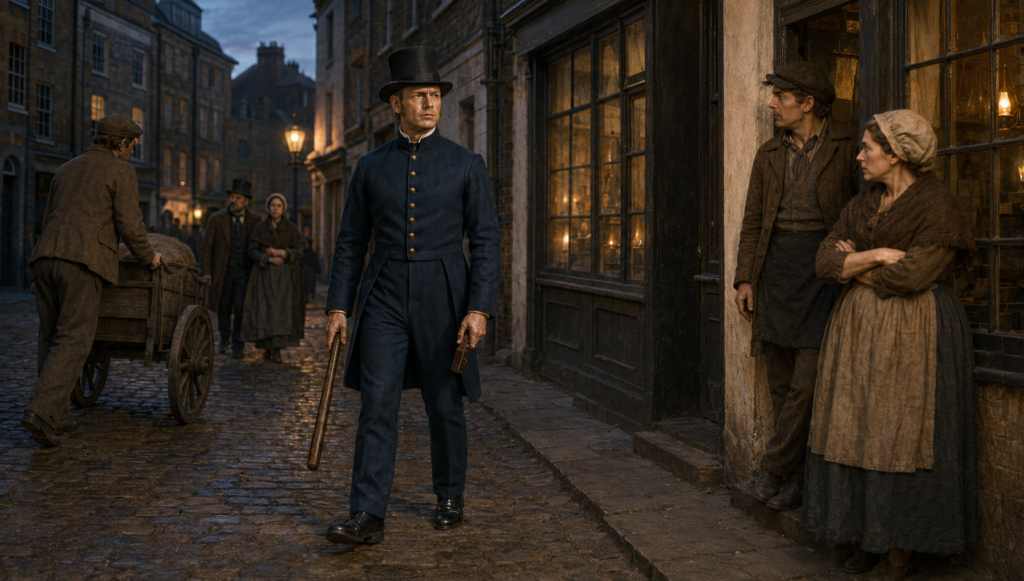
Sir Robert Peel did not invent the police. London already had parish constables, night watches, the Bow Street Runners, and the Thames River Police, while several Scottish towns had established salaried police forces of their own. What the Metropolitan Police Act of 1829 created was a large, centrally directed body of uniformed, salaried constables assigned to patrol the rapidly growing capital continuously. The new officers soon acquired two names derived from Peel: “Peelers” and “Bobbies.”
Public suspicion of a standing police force was considerable. Many Britons associated uniformed agents of the central government with soldiers, political spies, and the continental gendarmerie. The Metropolitan Police were therefore presented as civilians rather than troops. Their dark blue coats distinguished them from the red associated with the British Army, while their top hats resembled civilian headwear rather than military helmets. Their organization and discipline might be military in character, but their visible identity was deliberately not.
The ordinary constable was not routinely armed with a firearm. His defining equipment was a long wooden truncheon and a wooden rattle with which to summon assistance. The truncheon could be concealed in a deep pocket in the tail of the coat, making the officer’s authority less overtly threatening until force was actually required.
Handcuffs and manacles were available, but neither their carriage nor their use should be treated as automatic. Arrest and physical restraint remained separate decisions. A cooperative prisoner might simply be escorted to the station, sometimes between two officers. If resistance or escape was anticipated, restraints could be brought or carried by one of the constables assigned to assist with the arrest. The officer who announced the arrest was not necessarily the officer who carried or applied the manacles.
The appearance and equipment of the Bobby gradually changed. In 1863 the top hat and swallow-tailed coat gave way to the custodian helmet and tunic. In 1884 the cumbersome wooden rattle was replaced by the police whistle. The truncheon remained, becoming one of the most recognizable symbols of British policing.
The Metropolitan Police policed London, not the whole country, and even within London the separate City of London retained its own force. Other borough and county forces developed under subsequent legislation, creating a network of local police organizations rather than a single national police service. Nevertheless, the Metropolitan Police supplied the enduring theatrical image of the British Bobby: dark uniform, helmet, whistle, truncheon—and, to the continuing surprise of many American audiences, no revolver at his hip.
Detectives and Scotland Yard
The Metropolitan Police of 1829 was built principally around visible, uniformed patrol. Its constables were expected to prevent disorder through their presence, interrupt crimes they encountered, and take offenders into custody. Investigation after the event remained a comparatively undeveloped part of police work. In 1842 the Metropolitan Police therefore established a small Detective Branch devoted specifically to investigating crimes, gathering information, tracing suspects, and recovering stolen property.
These first detectives worked in plain clothes. That made discreet observation and inquiry possible, but it also revived the public suspicion that police agents might become government spies. Unlike the uniformed constable, the detective carried no immediately recognizable announcement of his office. He might identify himself verbally, produce official identification where appropriate, or arrive accompanied by uniformed constables who made his authority unmistakable.
The name “Scotland Yard” referred originally to the location of the Metropolitan Police headquarters at Whitehall Place, whose rear entrance opened onto Great Scotland Yard. The name soon became shorthand for the Metropolitan Police itself and particularly for its detectives. Following a corruption scandal involving senior detectives in 1877, the Detective Branch was reorganized the following year as the Criminal Investigation Department, or CID.
The distinction between constable and detective was primarily one of assignment rather than legal authority. The uniformed officer patrolled openly, maintained order, and responded to trouble. The detective generally appeared after a crime had occurred, interviewing witnesses, following information, conducting surveillance, and assembling evidence. When an arrest was anticipated, uniformed constables could accompany him to provide recognizable authority, physical assistance, and any equipment required to secure the prisoner.
For the theatre, a British detective should not automatically be dressed as an American private eye. He wore ordinary clothing appropriate to his period, social position, duties, and the weather. A Victorian detective might wear a frock coat, overcoat, bowler, top hat, or soft felt hat; his twentieth-century successor might wear an ordinary lounge suit and overcoat. A raincoat would be worn because it might rain and removed upon entering a house like any other outer garment. The fedora, permanently worn trench coat, shoulder holster, and “gumshoe” manner belong chiefly to the visual language of American crime fiction. Plain clothes did not mean a prescribed detective costume, and employment by Scotland Yard did not place a revolver beneath every detective’s coat.
Arrest and Restraint
To arrest someone was to place that person under legal authority; it did not necessarily mean overcoming him physically or fastening his wrists. A prisoner who submitted might simply be escorted to the station, sometimes walking between two officers. Restraint became a separate practical decision, determined by the likelihood of resistance, escape, violence, or difficulty during transportation.
Early police restraints were descended from older iron manacles. The familiar British “Darby” pattern consisted of two rigid wrist rings connected by a short chain and secured with a screw-operated lock. Because the rings did not readily adjust, several sizes were needed. A pair large enough for one prisoner might be insecure on another, while a smaller pair might not fit at all. They were heavier and less convenient to apply than modern handcuffs, particularly to someone actively resisting.
Such restraints should not be imagined as part of every constable’s daily equipment. They might remain at the station until required, be carried by an officer responsible for transporting prisoners, or be brought when a difficult arrest was anticipated. Even then, the officer who formally made the arrest was not necessarily the officer carrying or applying the manacles. A detective might announce the arrest while uniformed constables provided the manpower and equipment needed to take the prisoner away.
Adjustable ratcheting handcuffs appeared during the nineteenth century and developed into lighter designs capable of fitting a much wider range of wrists. Their greater portability and speed eventually made routine carriage practical. British police nevertheless continued using older screw-locking patterns well into the twentieth century; the existence of more modern handcuffs did not cause every earlier design to disappear at once.
The position of the prisoner’s hands was also a matter of circumstance rather than an unchanging rule. Hands secured in front of the body are entirely plausible in a nineteenth- or early-twentieth-century British setting, particularly when using chain-linked manacles. Restraining the hands behind the back offered greater control, but was not yet the automatic procedure that modern audiences may expect.
Indeed, even modern British police do not regard handcuffing as an inevitable consequence of every arrest: its use must be justified by the circumstances. The familiar theatrical sequence in which every prisoner is immediately handcuffed behind the back belongs to later police practice and modern screen convention. It should not be projected indiscriminately into earlier periods.
For a planned arrest in a British play, the most plausible arrangement may therefore be unfamiliar to an American audience. The detective makes the arrest and supplies the legal authority. One of the uniformed constables brought to assist carries the manacles only because resistance has been considered possible. Another constable might be brought along to provide additional physical support. If the prisoner submits, the restraints may never appear; if he resists, the officer carrying them applies them, and the detective may take control only when the arrest begins to go wrong.
Firearms
The Metropolitan Police were founded upon the presumption that ordinary civilian police officers would not carry firearms. This did not mean that the police possessed no guns. From the beginning, firearms could be kept in reserve for exceptional dangers. Sir Robert Peel authorized the purchase of a small stock of flintlock pistols for emergencies, but their presence at a police station did not make them part of the constable’s daily equipment.
During the 1880s, the shooting of officers working in London’s more isolated outer divisions reopened the question. Rather than arm the entire force, the Metropolitan Police permitted selected constables on outer night beats to draw revolvers. An officer could receive one only if a senior officer considered him capable of using it safely and with discretion. The weapon was issued from the station for the particular shift and returned afterward. This was controlled, temporary carriage—not a general right to wear a revolver whenever on duty.
Even this limited practice was never universal. Many eligible officers did not carry a weapon, and the arrangement had largely fallen out of use by the end of the nineteenth century. The fact that the authorization technically remained in force tells us very little about whether a particular constable would actually be armed.

The Siege of Sidney Street in 1911 exposed a different problem. London police confronting heavily armed criminals found that the weapons available to them were badly suited to the encounter and eventually called upon soldiers for assistance. Following the siege, the Metropolitan Police purchased one thousand compact Webley & Scott .32 self-loading pistols. The City of London Police adopted the same model the following year.
Once again, purchase did not mean routine carriage. The new pistol entered the police inventory so that an effective firearm would be available when armed opposition was expected. It was not placed automatically beneath the coat of every detective or upon the belt of every constable. Weapons were held at stations and issued according to the perceived danger of a particular duty.
In 1936 the remaining authorization for constables in the outer districts to carry revolvers on night patrol was formally withdrawn. This did not disarm the Metropolitan Police in every circumstance or remove firearms from police stores. It ended the old standing permission associated with those isolated beats. Firearms could still be issued for a specifically anticipated armed encounter, protection duty, or other exceptional danger.
Over time, this exceptional response developed into specialist firearms units. Modern British forces select and train particular officers as Authorised Firearms Officers. These officers may protect vulnerable sites, travel in armed-response vehicles, or attend incidents in which firearms are believed to be present. Their weapons and training are attached to a specialist assignment; they do not establish routine firearm carriage throughout the police service.
For the theatre, the distinction is crucial. A Scotland Yard detective investigating a murder should not automatically be given a pistol merely because the crime is serious. Murder describes what has already happened; it does not establish that the suspected murderer is armed or that an armed confrontation is expected. A detective arriving to question or arrest a suspect might carry no firearm and might instead be accompanied by uniformed constables. If reliable information suggested that the suspect possessed a gun and intended to resist, firearms could be issued or armed officers assigned. The weapon follows the anticipated danger, not the detective’s rank, the gravity of the charge, or the dramatic preferences of a later American crime story.
Portraying British Police on Stage
These are practical starting points rather than universal rules. Equipment varied by jurisdiction, assignment, and exact date.
Medieval or Early-Modern Watchman
Appearance and authority: No standard uniform. A badge, lantern, civic livery, staff, or the presence of fellow watchmen identifies a townsman temporarily exercising public authority.
Equipment and arrest: He may carry a club, bill, spear, or staff, but probably no firearm or personal set of manacles. A cooperative prisoner is escorted under guard to a gatehouse, gaol, or appropriate official.
Early Nineteenth-Century Constable
Appearance and authority: Civilian clothing, a watch coat, badge, tipstaff, or staff of office. Before uniformed police forces became widespread, the staff might be the clearest evidence of his position.
Equipment and arrest: A wooden truncheon is likely. Iron manacles may be available at the watch house or brought for a troublesome prisoner, but are not automatically carried. A cooperative prisoner is expected to walk with the constable or accompanying watchmen.
Victorian Bobby
Appearance and authority: Dark blue uniform, with a top hat and swallow-tailed coat before 1863 and a custodian helmet and tunic thereafter. He carries a rattle until 1884 and a whistle after that date.
Equipment and arrest: A long wooden truncheon is standard. Darby-style manacles may be carried when needed. Firearms are exceptional, although selected constables on isolated outer night beats could draw revolvers during the later nineteenth century. A cooperative prisoner may be escorted without restraint.
Victorian or Edwardian Detective
Appearance and authority: Ordinary respectable clothing appropriate to his class, duties, and the weather. He establishes his authority by identifying himself, presenting official credentials where appropriate, or arriving with uniformed constables.
Equipment and arrest: A truncheon or manacles may be carried, but neither should define his appearance. A firearm is issued only when an armed encounter is anticipated. A cooperative prisoner is informed of the arrest and escorted away, often by uniformed officers.
1930s Uniformed Constable
Appearance and authority: Dark tunic, trousers, custodian helmet, and whistle, with a greatcoat or cape in poor weather. The uniform itself provides unmistakable authority.
Equipment and arrest: He carries a wooden truncheon. Older screw-locking manacles remain plausible, although their carriage and use are discretionary. He is not routinely armed. A cooperative prisoner may simply be escorted to the station.
1930s Scotland Yard Detective
Appearance and authority: An ordinary lounge suit, shirt and tie, seasonally appropriate overcoat, and whatever hat a man of his position would normally wear. A raincoat is worn because it might rain, not because it is a detective’s uniform.
Equipment and arrest: He need not carry a visible truncheon, manacles, or firearm. During a planned arrest, accompanying constables may provide both restraints and physical assistance. Unless the suspect is believed to be armed, the detective makes the arrest and expects the prisoner to submit and accompany the officers.
Modern Unarmed Constable
Appearance and authority: Recognizable police uniform, usually with protective vest, radio, identification, body-worn camera, and equipment belt or vest. Details vary among forces.
Equipment and arrest: An expandable or rigid baton and adjustable handcuffs are normally carried; a separately trained officer may also carry a Taser. There is no firearm. A cooperative prisoner is searched and restrained only as circumstances and the officer’s risk assessment require.
Modern Authorised Firearms Officer
Appearance and authority: Police uniform or specialist tactical clothing, generally with ballistic protection and clear police identification. The visible firearm indicates a specialist assignment, not superior rank.
Equipment and arrest: The officer carries a sidearm and may carry a carbine, along with a baton and handcuffs. Because armed officers are normally responding to an identified danger, a prisoner is more likely to be searched and handcuffed, even when cooperative.
The modern entries describe ordinary policing in England, Wales, and Scotland. Northern Ireland and specialist forces such as the Civil Nuclear Constabulary and Ministry of Defence Police follow different practices regarding firearms.