
face punch
These come in two broad varieties, either the cross or the jab. The cross starts from as close to the body of the aggressor as possible, travels to the impact point and beyond. It gets its name because the natural trajectory of the fist will cross from one side of the body to the other. (If the punch doesn’t cross to the other side but merely moves through the victim but on the same side that it started, it is called a straight punch). As the body weight is usually moving along with the punch, the cross usually has a lot of force behind it. The jab, on the other hand, usually causes less damage. It travels just from the shoulder straight to the target and then back again without committing the body. Therefore the jab is much faster that a cross, but also does less damage. In either case, this fist must form a straight line with the forearm: don’t let the actors curl in at the wrist unless you are trying to show that the character has no experience in fighting.
That’s the reality. Now let’s look at the illusions.
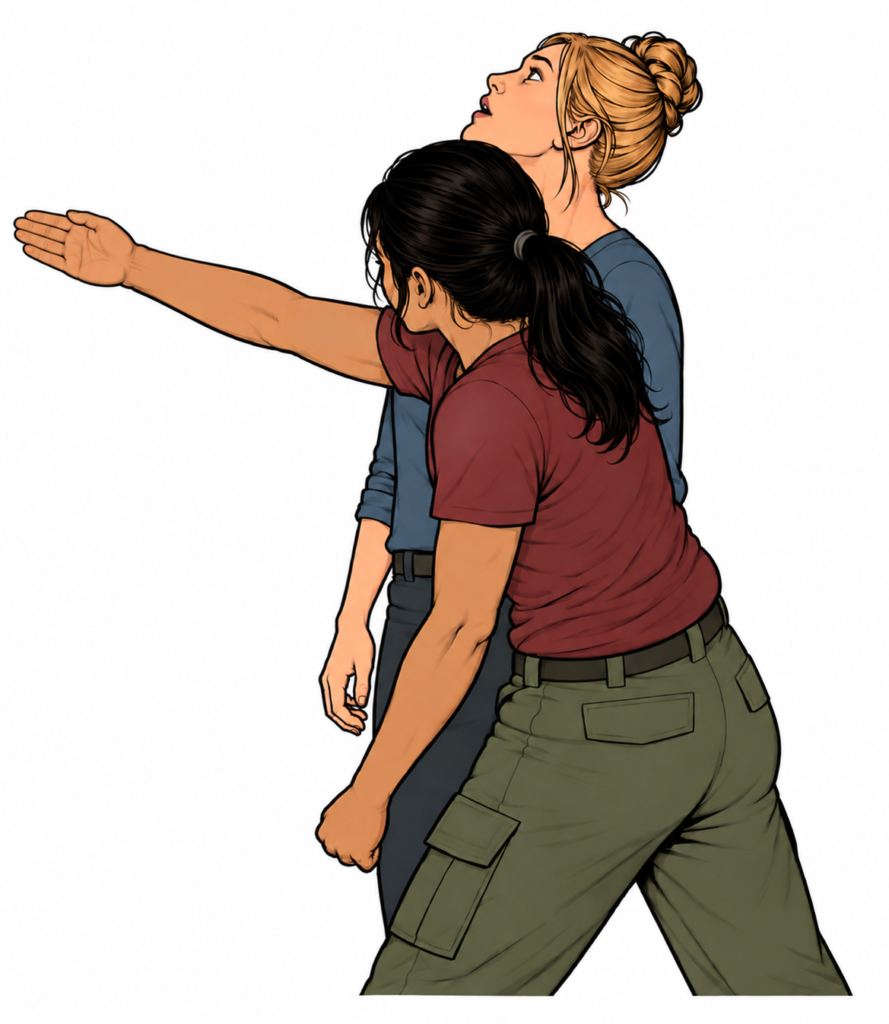
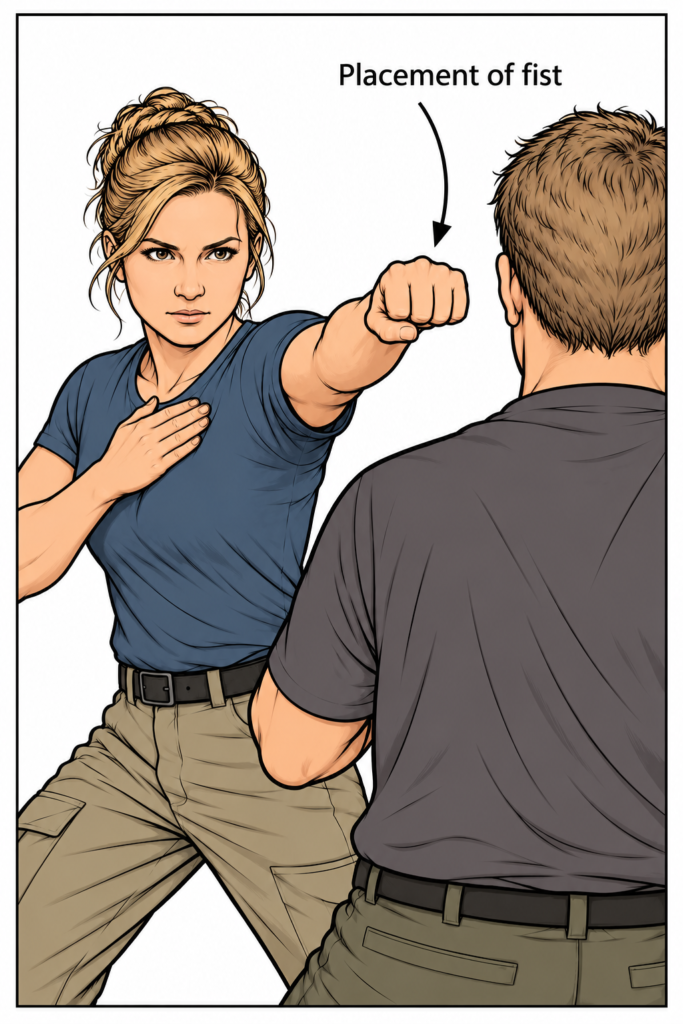
Directors usually like to have actors facing each other in quarter right and quarter left stances. However, for this first face punch we are going to have the actors placed so that the aggressor is full-back and the victim is full-front and directly upstage of the aggressor. This means that just before the punch, the aggressor’s face and body front will not be seen by the audience, and most of the victim will be blocked from view as well.
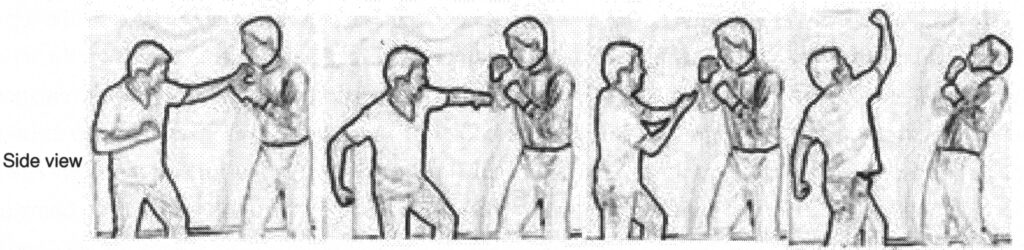
Right Cross: Side View
Careful: Actors feel that they already know how to do a fake punch, so the most difficult aspect of this is in having them perform the illusion rather than the reality of a real punch.
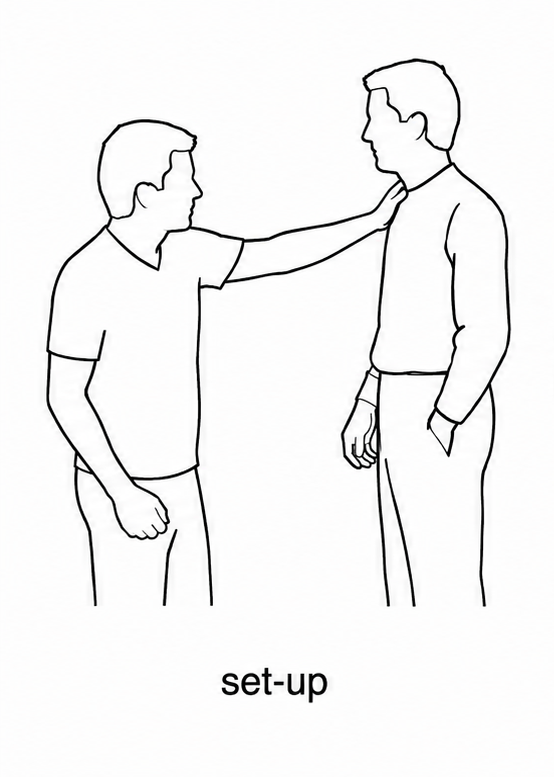
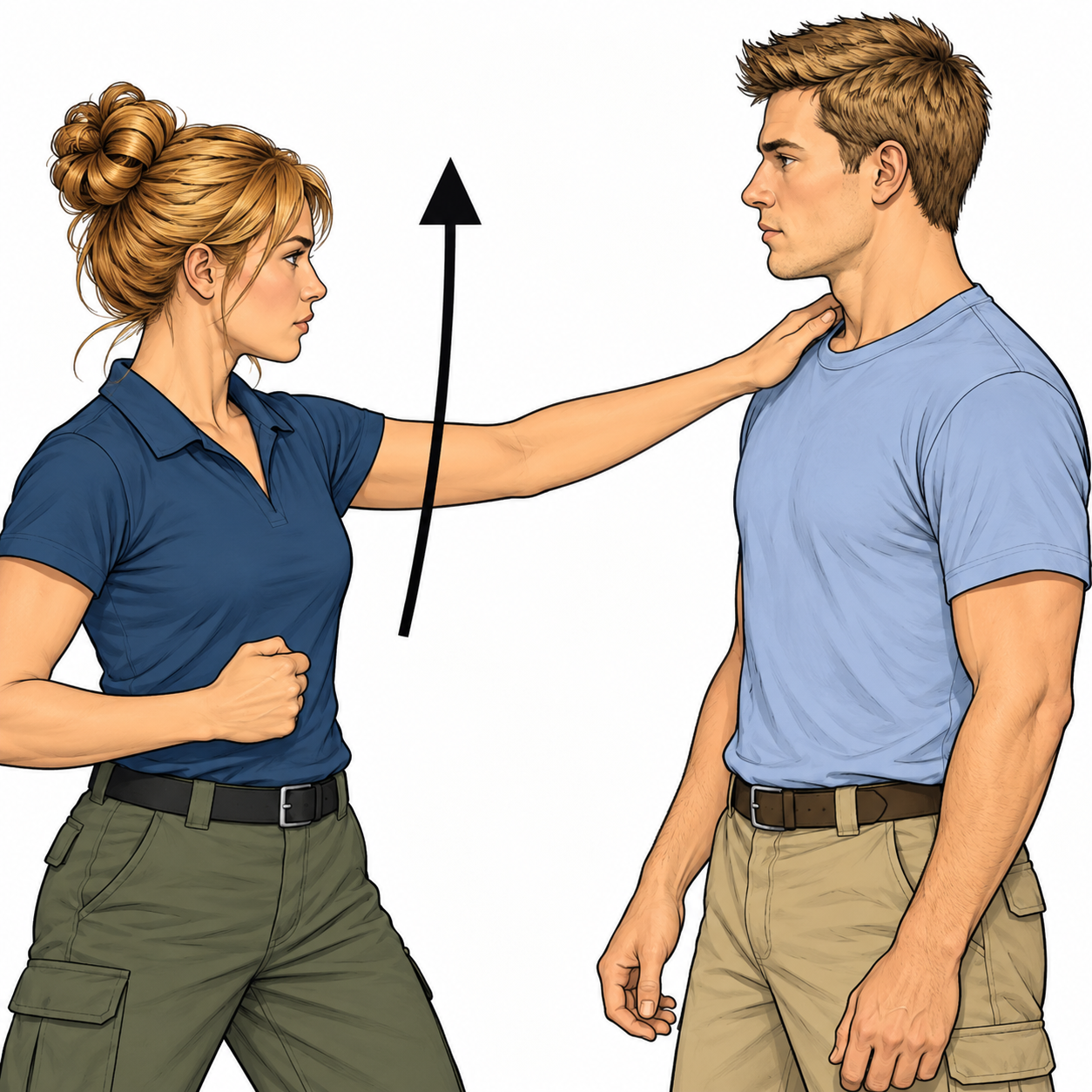
We need not only the verbal cue for the violent action, but also a physical one, perhaps noticed by the audience but not necessarily part of the violent act itself. For this punch we are going to have the aggressor put his left [non-punching] hand on the victim’s shoulder [the set-up]. The reaching arm should be almost fully straight, creating as much distance as possible between the two actors. This can be justified as, let’s say, preventing the victim from turning away or grabbing at the victim’s lapel, whatever, so long as it flows from the character choices and the scene. Once this touch occurs, the actors are not allowed to move their feet. Eye-contact is established between the actors – not the characters. If the victim dislikes anything about the body placements, or if eye-contact is not established, he or she merely steps back away from the aggressor [victim stays in control].
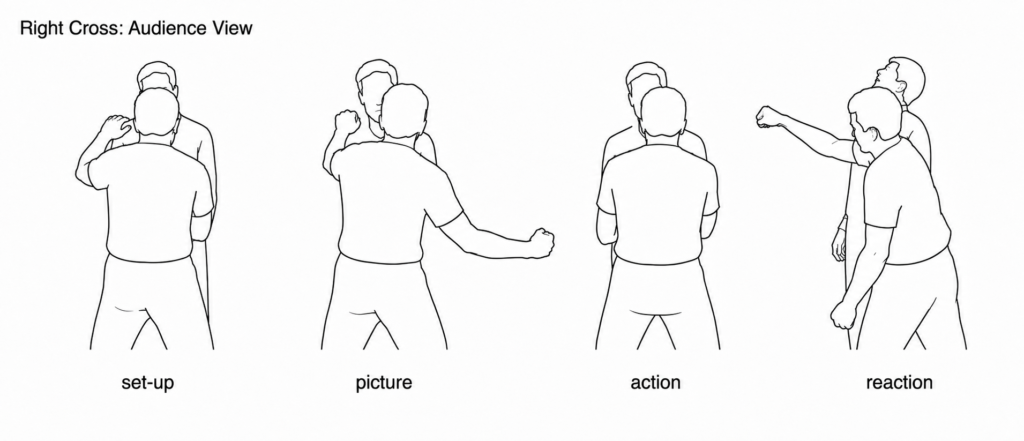
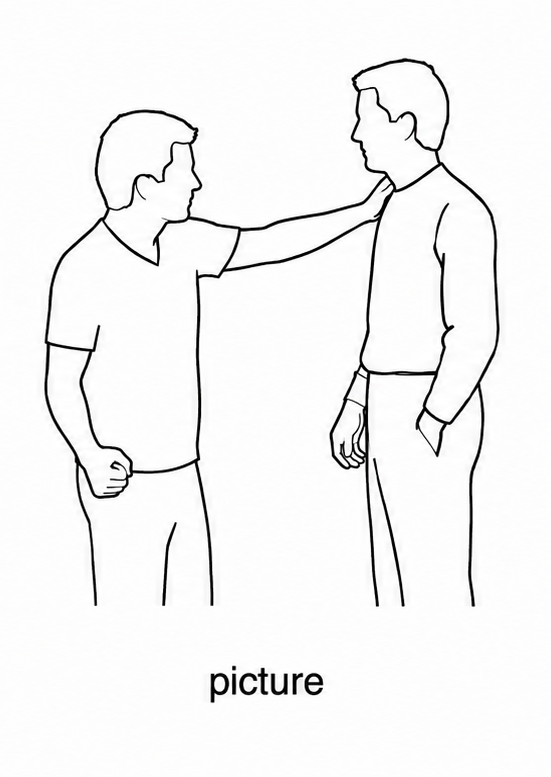
Keeping the hips and shoulders square to the victim, the aggressor places his right fist out to his right side, showing the audience that a punch is about to occur [the picture]. The aggressor must not move his feet nor twist away from the victim; he merely presents a two-dimensional view of the preparation for a punch to the face. The picture does not have to take more than an instant, but it does have to be clear.
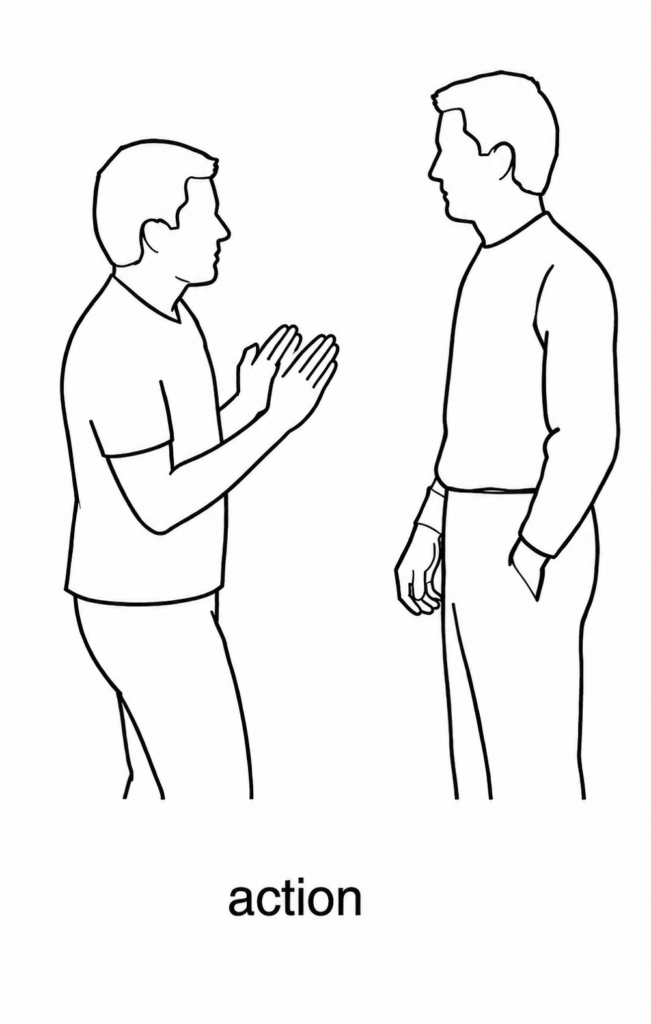
Now the aggressor gently brings both hands together, making a clapping sound so as to give the sound of fist striking face [the action]. Don’t punch the right fist into the left hand: that merely hurts the hand and makes a poor sound. Once the fist disappears from the audience’s view, simply create an openhanded clap, and then make sure to create the fist again as soon as you hear the sound. This is called a slip hand knap for only one hand is moving, the other merely being a static target, although it did have to move to get into position.
The fist will never approach the victim’s face in this simulation. Make sure that the aggressor understands that the right fist doesn’t actually loop around toward the victim’s face, but rather that both hands make a beeline directly to a spot three inches away from the aggressor’s chest. Clapping the hands by the aggressor takes place in a prayer position, below shoulder level – never near the victim’s face. The audience has no depth perception, so there is no reason to move the fist towards the victim, but instead it travels across the front of the victim well below the level of his chin [aim off-line]. We perform a two-dimensional straight line reality, and allow the audience to imagine a three dimensional looping fiction. The feet of the aggressor stay planted on the ground, and the torso doesn’t lean into the punch, but merely pivots like the agitator in a washing machine.
The knap, however performed, provides the percussive sound of the impact, but it is not the only sound that the audience needs to hear. Far more important is the natural forced exhalation that comes from both participants in a violent action. These exhalations may or may not be vocalized, but in one degree or another must accompany every move in the fight. That’s why I had you inhale during the set-up. To ignore the exhalations in a fight is to rob the audience of their most critical cues to believing your simulation.
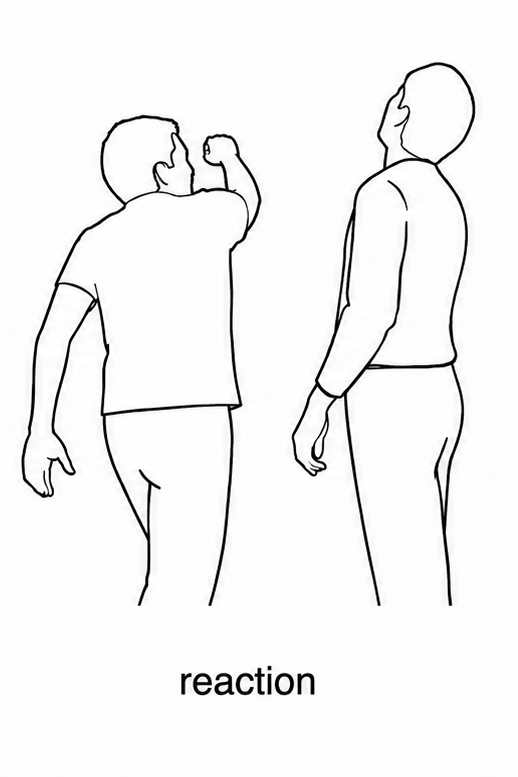
Only after the sound has been heard should the actors respond to the punch [the reaction]. Sound travels, so in a large house the victim must not react until he consciously hears the clapping sound, or else the back third of the audience will see the physical response before the sound of the punch has reached them. Also, actors tend to jump the gun when it comes to reacting, so making them wait until they hear the sound helps clean-up the action. The victim will move the face and right shoulder back and to his right, following the impetus of the imaginary traveling fist. In a larger reaction, the body might travel one or more steps, after the head reaction, but again back and to the right, increasing the distance between the actors. This reaction must match exactly the amount of impact which has been transferred by the punch from the aggressor to the victim, so all of the laws of physics must be obeyed [interactive flow of energy] The aggressor will finish his reaction not by sending the fist over the victim’s shoulder, but simply continuing the straight line started during the action, in other words, moving harmlessly in a safe line parallel and between the two participants.
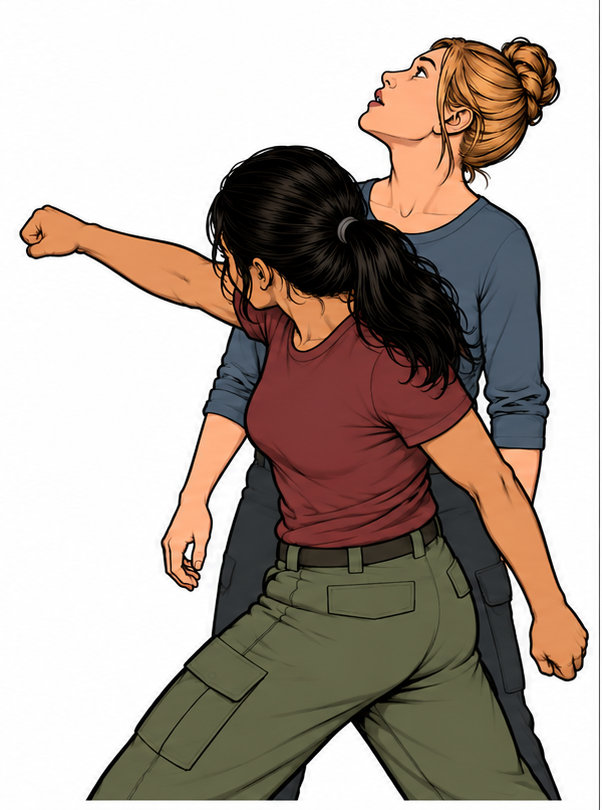
The reaction is largely overlooked or given short shrift by the actors, but it is the only part that can impart realism to the simulation. The set-up, picture and action can be learned in a matter of minutes, but the reaction can take every bit of rehearsal time that can be spared. For the aggressor on this simulation, he should know that in all likelihood his character is experiencing an extraordinary adrenaline rush. The heart is pounding, the breath rate is increased, the muscles have tensed. The increased bloodflow includes that to the eyes, so much in some cases that the belligerent literally “sees red”. Pain may not be noticed in such circumstances, but quite a bit of damage can be caused to the punching hand, especially a number of fractures in the finger bones and knuckles, often a sprained or even broken wrist. This may not matter to the character immediately, but at some point the actor should incorporate the pain and stiffness when we see the character in other scenes.
The victim has just as much work to do. The simulation must include a realistic depiction of the transmission on energy that travels in a straight line through the victim, for as it travels it will affect each body part in turn. Let’s say that one of the moves is a face punch. If so, the victim must carefully decide exactly where on the face the fist has landed. If on the left side of the jaw, for instance, the lower jaw will be shunted violently to the right, the force of which will spin the head also to the right, but with the top of the head slightly trailing the jaw. The ligaments of the left side of the neck will begin to pull, stretch and tear, but also finally to draw the left shoulder around to the front. At this point the momentum will cause the top of the head to tilt suddenly to the right. Combined with the left shoulder turn, it will move the victim’s center of balance off of the left foot and back over the heel of the right foot, causing the body to move to the right and back. And that is merely one possibility.
Physiological changes for the victim include perhaps watery eyes and runny nose at least, perhaps slight shock as well. The extent of damage can include a broken lip, broken teeth, dislocated or broken jaw, certainly some tendon and ligament damage to the left side of the neck.
How much damage has been inflicted and how far the body will travel depends on how much force was behind the punch. Both actors must work together on every rehearsal to pay close attention to this, for not only must the victim modify the reaction so that it matches the apparent force delivered, the aggressor must make adjustments in body placement so that the path the victim takes after the punch makes sense.
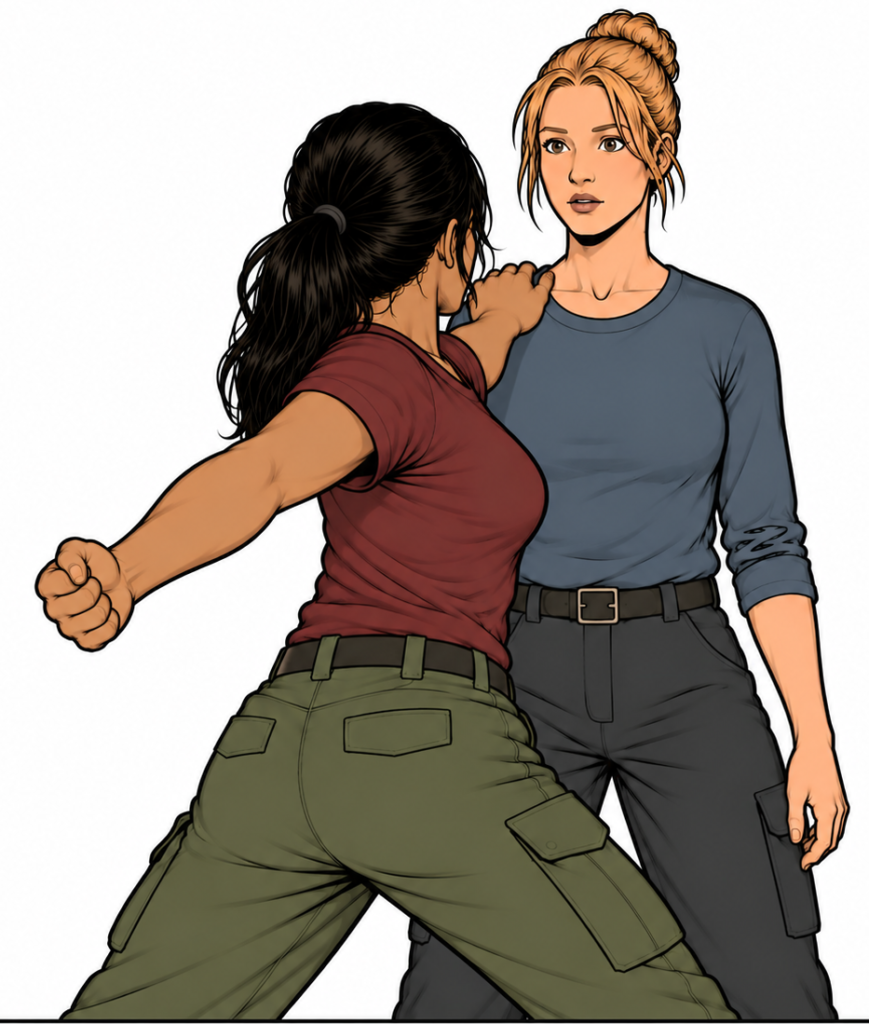
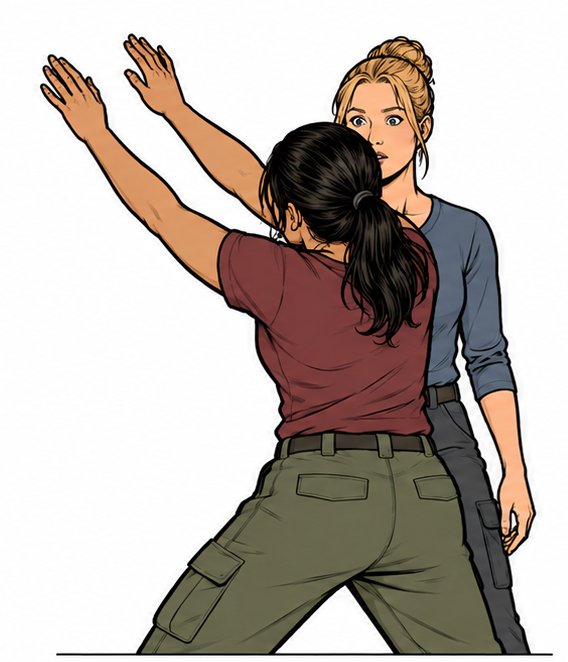
There are some things to make sure that the actors NOT do when performing the aggressor role. These are bad little habits that can ruin the illusion. First, most actors will want to rotate their bodies for the picture portion, instead of keeping their shoulders square to their partner. By over-rotating and pulling the punching hand behind them instead of off to the side, it can expose the handclap moment to the audience’s view.
Second, some actors will get the picture right with a closed fist, do the action correctly with an open handed clap, but then forget to close the hand into a fist again for the reaction.
lastly, actors tend to let both hands fly off in the direction of the punch during the reaction. Unless they force the knap hand to go down and low, the audience can easily figure out how the punch was faked.
jab
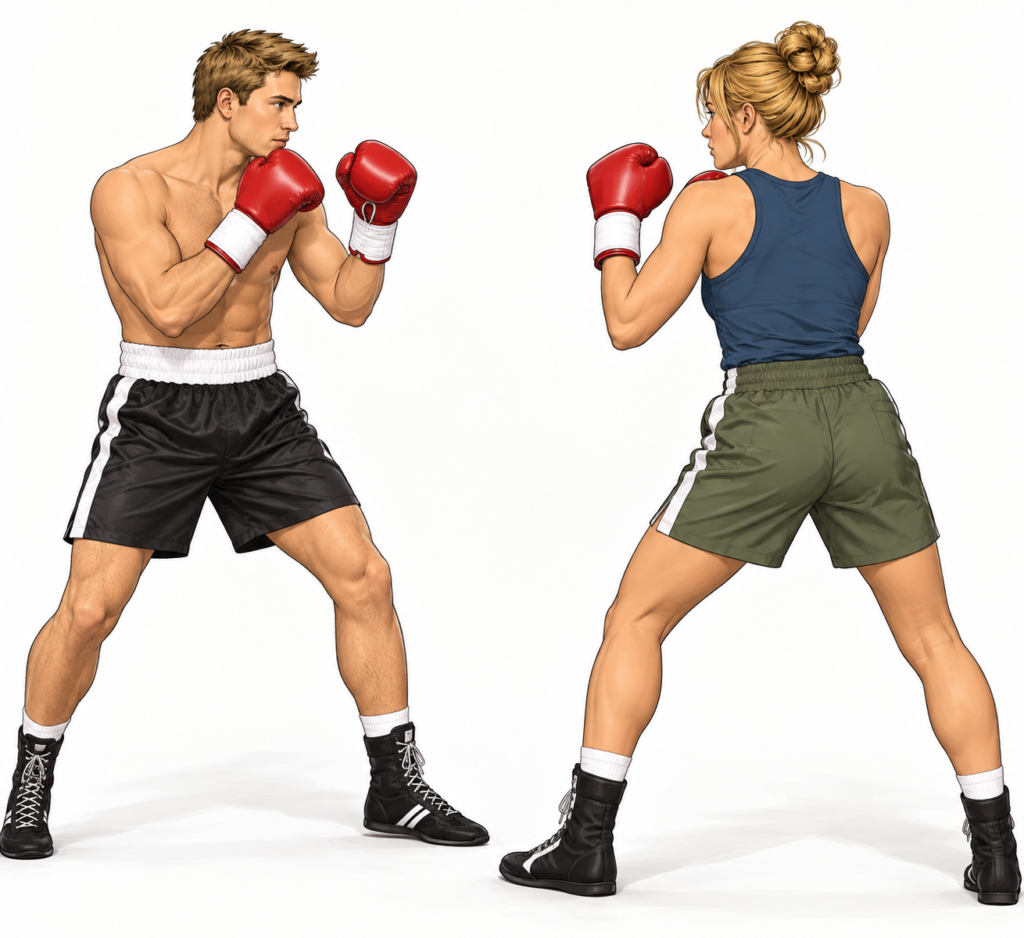
I love the jab, for it looks so real to the audience, even when they are right on top of the action. But it depends on a very narrow visual field, making it best suited to a proscenium stage. On thrust, arena, or other open configurations, some audience members may see through the illusion.
A jab is a straight quick punch, usually to the head, delivered from the leading hand We are going to assume a jab coming from the aggressor’s non-dominant hand, and that both actors have assumed a boxing stance. For most people, that means left foot forward and left hand forward. The jab is a set-up punch, causing pain but probably not enough to stop an opponent. It is usually used with the left hand to wear down an opponent’s defenses before a knock-out punch with the right hand.
Set up: actors stand facing each other, arms bent. Left fists are extended slightly from the body and held at shoulder or face height. The right fists are held close to the body at solar-plexus level. Both actors are leading with the left foot, and the shoulders and hips are turned sharply to the right to give the thinnest target to the opponent. In this combat stance the actor stage right will be half profile left, and the actor on stage left will be in three-quarter right. As opposed to many of the other simulations, that are performed just out of contact distance, the actors here must be in-distance, close enough for the wrist to reach the other’s shoulder.
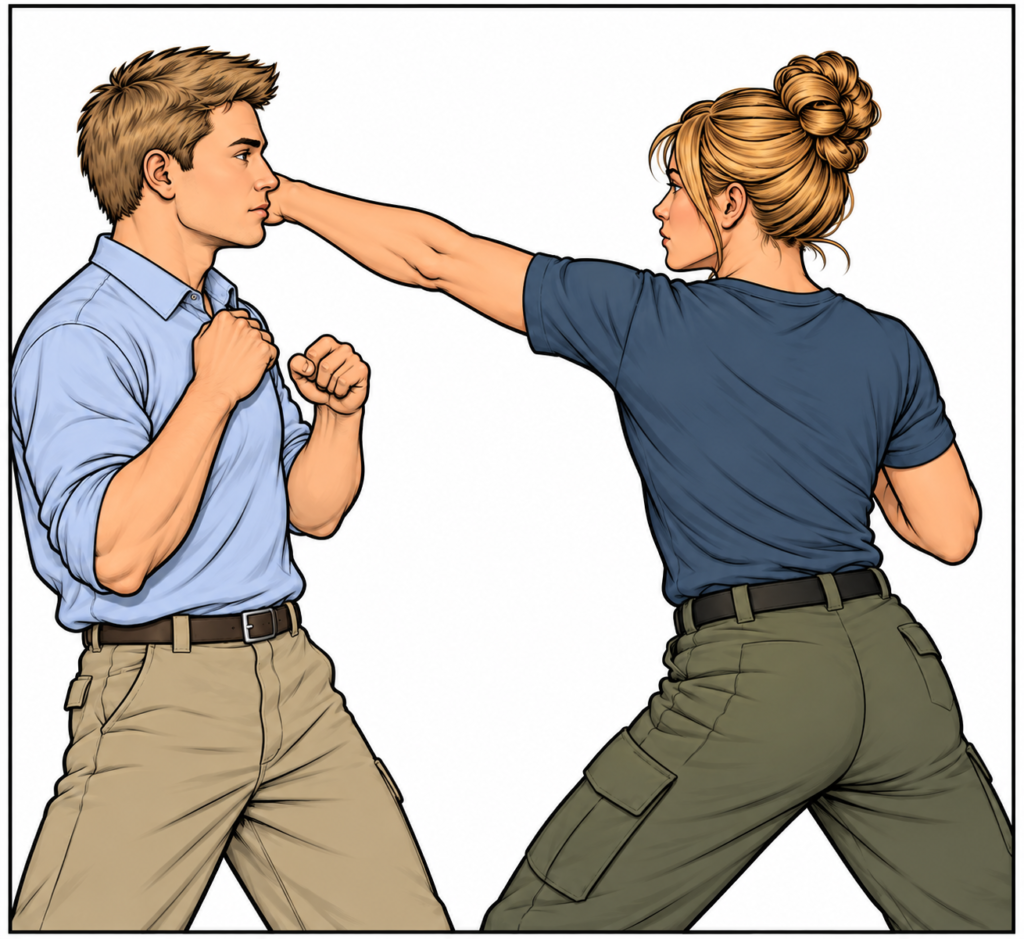
Picture: In this case, there is no other picture needed or desired, for the movement must come as a surprise to the audience.
Action: There are two possible actions here depending on the position of the aggressor.
If he is standing stage left that means that the front of his body, therefore his right hand, is not visible to the audience. The left hand shoots out to a spot directly upstage of the victim’s upstage ear (disappearing for a split second behind the victim’s head) and immediately snaps back. At the same time, the right hand opens and makes a nice popping knap against the chest.
If the aggressor is stage right, than of course that right hand is visible, but the victim’s is hidden. In that case, it is the victim who needs to make the knap. In other words, the hand the audience can’t see at any particular moment is the one you use to slap. Either way, be sure not to twitch at the elbow when slapping the chest, or the audience will know how you made the sound.
Reaction: The victim’s head snaps up and down once in a slight whiplash reaction. A lot of actors want to follow the direction of the aggressor’s hand and turn the face slightly up-stage, but the simulation here is of being hit flush on the nose, so the face must not turn sideways at all or the illusion is ruined. The aggressor needs no reaction, as the jab causes minimal damage to the tight fist.
By the way, the same basic mechanics can be used to simulate a punch using the trailing hand. In that case it is called a straight punch, not a jab, and we do have to make one slight modification. Instead of having the actors stand with their shoulders square to each other, we have to off-set the actors, with one of them standing slightly more upstage than the other. That way the straight punch can travel upstage of the victim’s head without the aggressor having to twist the torso. Otherwise the simulation looks like a right cross, not a straight punch.
So remember: three hands are visible, so the one that isn’t does the sound. And no matter which hand you use, the punch always goes upstage of the victim’s head.
upper cut
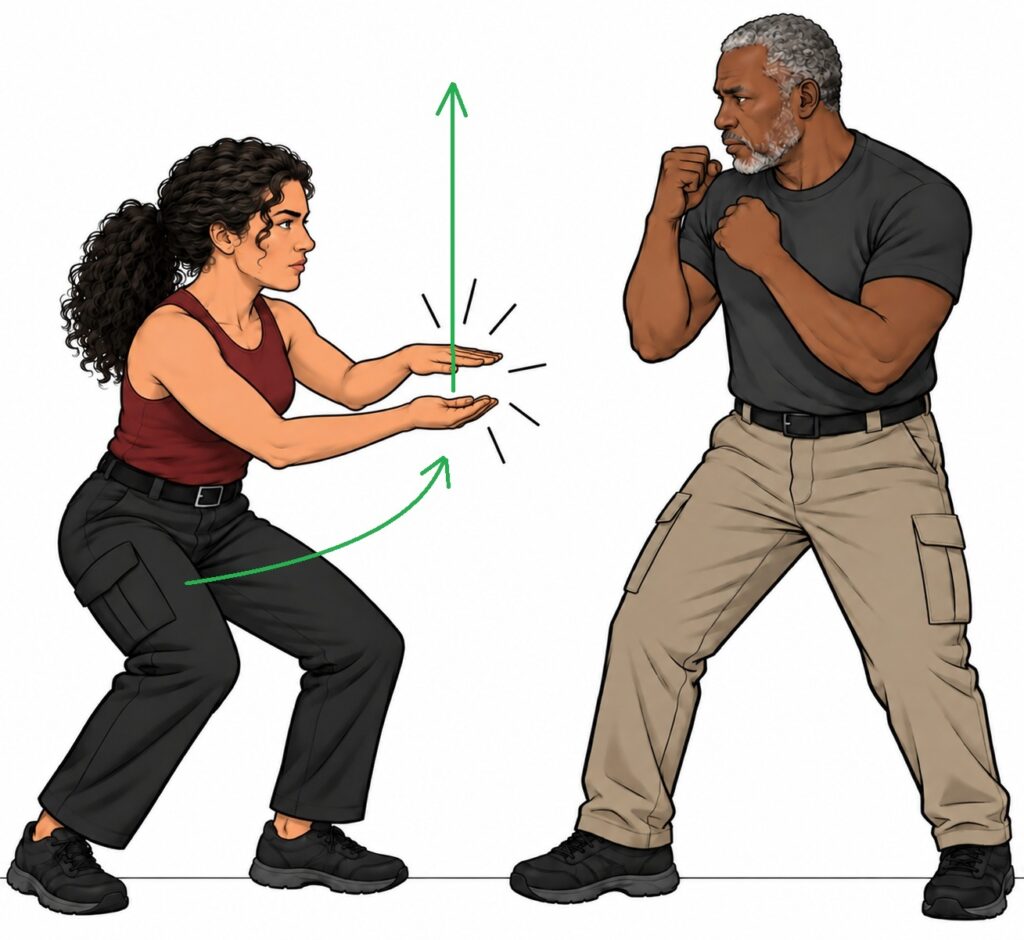
A simple illusion. Full-back to the audience for the aggressor, full left arm safety distance touch to the victim’s shoulder, and then the left open palm dropping back to the solar plexus as the target for the knap. Keep the torso straight, but bend the knees so as to give apparent strength to the coming punch. The right hand goes down as a fist to as low as comfortable to the right side, then drives up in a straight line to the target [left] hand. As in the right cross, open the fist so as to clap hands, then close into a fist again as it drives up to forehead level or higher, finishing the simulation. Naturally, if the actors are standing in reverse position, the victim can provide the knap. Either way, never let the aggressor’s fist move in a curve toward the victim’s face.
Victim full-back to the audience, or aggressor full-back to the audience? Doesn’t matter, so long as the clap and the point of impact are hidden from their view.
Remember that an upper cut delivers terrific damage, and boxers know that even with gloved hands if it connects it can be a one-punch knockout move. Save this move for the end of a fight, or at least for a point where the victim is going to remain severely disabled or disoriented. A broken jaw, severed tongue, double concussion (the brain slamming against first the front of the skull and then against the back), even a broken neck are all real possible consequences of this punch.
hook punch – face level
The hook punch travels toward the opponent on a short, curved path, with the punching arm bent at the elbow. Unlike the relatively straight path of a jab or cross, the hook appears to come around the side of an opponent’s defenses and strike the side of the head. The movement is driven not simply by the arm, but by rotation of the aggressor’s body.
For stage combat, the hook must remain tight and controlled. It does not follow through, but must appear to “bounce off” the opponent’s head. As with the jab, the easiest way to provide the knap is to have the aggressor smack his own chest with his left hand. The victim’s reaction is to throw the head sharply to the right or left, with the body following the movement. Care must be taken not to have the victim twist only at the neck, which creates a different visual effect.
The trajectory of the actual punch must, of course, carry the fist to a safe point between the two combatants rather than into the victim’s head. For this reason, the illusion works only when the actors are properly stacked for the audience, never when they are seen in profile. Because the curved path of the punch requires particularly precise control of trajectory, timing, and audience sightline, the hook punch should be considered an advanced technique.
pile driver
Although this looks as powerful as the above upper cut, the damage is actually less, since the top of the head is a very hard object to strike. The simulation, on the other hand, is much the same except for the direction. If the victim has his back to the audience, with the hands hidden from view he can make the loudest clap possible without moving the elbows. If the aggressor has his back to the audience, then he will make the knap as he did for the right cross face punch. The aggressor’s arm starts high, and simply drives the hand in a straight line to the ground, of course going nowhere near the victim’s face. The victim matches the action with a clap, being careful not to move the elbows. If possible, have the victim get lower than a natural full upright stance, for we need to see the aggressor rise up on his toes and then “lower the boom”, the body dropping into the punch.
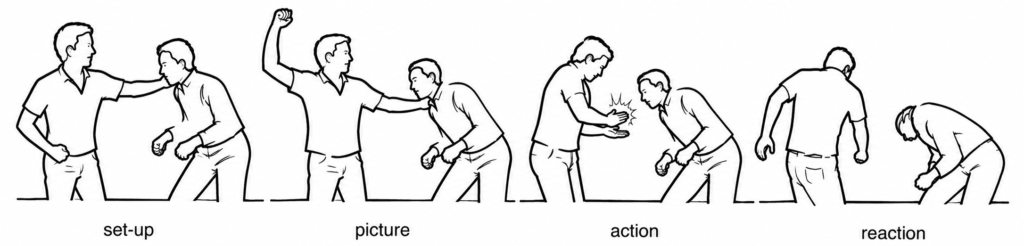
The reaction for the victim is a little counter intuitive, so you’ll have to trust me on this. The path of the pile driver naturally has a slight angle to it, and contact is usually around the near eye socket. So instead of following the path of the fist, the face will twist not only down but also sharply to the side. Think of it as an angled billiard shot.
Luckily, this is a simulation which works with either the victim’s or the aggressor’s back to the audience, so long as we can hide the knap and the moment of impact.
The reaction for the aggressor is pretty straight forward. Many of the bones of the hand will be broken. If it is necessary that the character not sustain that damage, consider simulating the punch using a hammer punch, that is to say a strike using the bottom of the fist, the little finger side.
backhanded punch
Not to be confused with the backhand slap, this has more in common with the jab in that the strike is quick and has no body weight behind it. But because of the arc of the striking hand, it is much more dangerous. With the fist traveling directly toward the victim’s face, we’ve broken the rule about making sure that all energy is directly off-line. Attempt this simulation only under the guidance of a trained instructor.
Set up: both actors on the same plane and parallel to the proscenium, both full back, victim stage right, aggressor on the left, although this simulation can work in almost any angle. A pre-touch should establish a one arm length’s distance.
just the picture: downstage (audience) view sideways view upstage view
Picture: The aggressor’s left elbow rises up and points four inches downstage of the victim’s nose, as the right fist, slightly curled in, rests in front of his own right shoulder. The right arm gently crosses in front of the chest in a ready position, with the fingers of the open right hand near the let fist.
just the action: downstage (audience) view sideways view upstage view
Action: Making sure that the aggressor’s elbow doesn’t drift upstage, the upper arm remains immobile as the fist travels in a horizontal arch until almost fully extended and then immediately returns to the original position. The fist must go no further than that spot directly upstage of the victim’s upstage shoulder (it’s hard to see, but note the arrow on the illustration above. That’s as close as the fist ever gets to the victim’s head). The fist snaps out and back like a whip at the fullest point of the extension, and the act of pointing the elbow will keep the fist away from the victim. Be very careful not to hyperextend the elbow when performing this action.
By the way, the back of the hand is not the striking surface in a backhand punch. Just like any regular punch, contact would be made with the front of the fist, so we have to include that reality in this illusion. That means the wrist must curl out at the last part of the swing so the audience can believe that this was a punch, not a closed-fisted slap.
The knap for this is similar to that for the jab, in that the palm of the right hand quickly slaps the space between the right shoulder and pectoral muscle. This works even in full view of the audience so long as the left hand moves as one unit with the arm – no separate movement at the wrist, and certainly no flapping at the elbow. And this isn’t a big move – you should be able to get a decent knap with the arm traveling only an inch or two. The toughest part is to not bounce the slapping hand off the chest after making the sound (the extra movement will give away the illusion) The punching hand can’t “stick” in the air – it has to bounce right back to the ready position.
Reaction: Only the victim need react here, and it is a relatively small “whiplash” reaction with perhaps the subsequent realization that the nose has been bloodied. The simulation will not work if there is even a hint of reacting too soon, so it is absolutely critical to hold the reaction until you hear the knap.
stomach punch
(I know, I know, a hit to the belly misses the stomach entirely, but no one uses the phrase “small intestine punch” ; neither will I.)
Every cast seems to have some young idiot, usually a young male, who insists on showing everyone how to do a contact stomach punch by getting someone to punch him in the belly with full force, at which point he clenches his stomach muscles and takes the hit. In my youth, I was the young idiot. There is actually a way to do a relatively safe contact stomach punch, but it’s neither as easy nor as dangerous as the one our young actor would have us perform. A stage contact punch doesn’t require any stomach clenching on the part of the victim, and feels like a light tap, but only let an experienced fight person teach it.
We’re going to learn a non-contact technique. I love this one because once you get the hang of it, it can be performed at almost any angle.
From a safe distance … right foot crosses to right foot … then left foot to behind victim … then do the punch.
Set-up: The victim stands stage right, profile left, the aggressor stands stage left and profile right but slightly downstage of the victim. The right feet of both are almost touching. The aggressor takes a big step forward with the left foot, actually past the victim, and the hips have turned slightly closed. The aggressor should be able to see the victim’s back. When the actors are this close, the victim’s stomach is hidden from the audience’s view. At the same time, the aggressor’s left hand touches the victim’s right shoulder. At this point there is still no movement of the punching arm.
Picture: The aggressor slightly bends at the knees, closes his hand into a fist as the right arm arches back into the view of the audience.
Audience view Side view
Action: The punching arm quickly moves into the target, which is a spot downstage of the stomach, right into that clear gap between the two actors. Since the aggressor can’t see the target, I like to have him aim for his own right hip – easy to find and it keeps the victim safe. To make clear, I repeat: the target is not the victim’s stomach. Don’t let the hand stick in place. In order to sell the illusion of hitting the stomach, the fist must appear to bounce off of the target, so this is a quick out-and-back punch.
The percussive sound of contact is not necessary so long as both actors exhale with a slight vocalization. An actual punch doesn’t sound like much, so there is no reason to create a hidden clap.
No need to aim for the stomach. The fist is aimed between the two actors.
Reaction: The victim simply bends forward at the waist. But don’t lead with the head; that’s not natural. The bend happens as a wave, with the stomach contracting first, then rolling the shoulders in as the butt moves back slightly, and only at the very end will the head look down. The aggressor should do the opposite, that is to say stand up even more straight. (For some reason, sometimes the aggressor doing the punch wants to bend at the waist too. Strange.)
Unarmed Fighting Styles
Most real fights occur between people who have reached a point of rage in which they no longer are acting rationally, so any training they may have had goes out the window. I’ve seen this happen to otherwise skilled fighters who get caught up in either fear or anger. For these combatants, the moves tend to be circular, wild, uncontrolled both in execution and in balance, the tendency being to throw the combatant off-balance whether or not he actually makes contact. There is very little effective defense, and what little there is is simply the instinctive curling up of the body as both forearms come up to protect the face. Untrained fighters also tend to use the same one or two moves over and over again regardless of effectiveness. The person who falls down first invariably ends up as the loser.
Among trained fighters who are able to keep their wits about them, there is a greater variation of moves both offensive and defensive, with an attempt to bring into play combination moves designed to establish distinct lines of attack and take advantage of perceived weaknesses. However, what the audience will notice most of all is the “on-guard” position which trained fighters will drop into when a threat is identified. Invariably the dominant foot and hand step back, providing a slightly reduced target to the opponent. The elbows both tuck in slightly to be ready to protect the stomach and flanks. The dominant (right) hand goes to shoulder level and stays fairly close to the body, while the left fist rides higher, just under eye level, and extends further towards the opponent. This allows both hands to protect the face. The ribs are protected by the elbows.
We know from art on excavated pottery that boxing goes back at least to the ancient Greeks, and it seems that the stances and guard positions would be instantly recognizable at any gym today. There is, however, a very distinct boxing style that developed during the mid-nineteenth century and flourished though to the 1930’s. You have probably seen photographs of prize fighters with handlebar mustaches, with the fists tightly curled in and the head held stiffly back. The opponent would see the back of the fighter’s hands instead of the little finger side of the fist. This is the era of bareknuckle prize fighting, the Marquise of Queensbury rules, the birth of the “sweet science”. The seemingly unnatural stance is actually quite practical for the style of fighting performed. No grabbing or kicking was allowed, winner was declared by knockout only, and up through the turn of the century a round was counted not by the clock but with each instance that someone was knocked down. This was brutal exhibition fighting, and with no timed rounds or points given, the only strategy was to survive the punishment and inflict as much damage as possible.
In this style of fisticuffs, some moves needed to be modified. Punches that land with the flat face of the fist can deliver great force, but the delicate bones of the fingers can easily break, so constant jabs with the left can quickly ruin the hand. A better jab for bareknuckle fighting is to turn the fists in so that the back of the hand faces the opponent, the knuckles all pointing toward the opponent’s face and the hand held directly above the elbow. From this position the fist can be quickly snapped out and down onto the bridge of the nose of the opponent. The knuckles might fracture but the hand was still capable of attacking. Either hand could jab, and to hide the attack the hands could roll in a vertical circle, providing an ever shifting presentation of fists. Alternately, the lower fist could quickly rise up, thrusting in for an upper cut to the chin or to the stomach. A fist could always attempt a quick looping roundhouse to break the cartilage of the ear, a hook punch to the ribs, and if the opportunity finally arose, go for the straight right cross for a knock-out punch to the chin or nose. My point here is that just because something looks funny to our modern eyes doesn’t mean that it wasn’t extremely effective.
The defense matched the offense. The forearms could slightly extend to either side to deflect the attacks to the face, but it was more important to keep the head leaning back and away from the extension of the attacking fists. The stomach and ribs were protected by the elbows. Because the punches had to cause damage in order to win the fight, dancing around in the modern boxing style was unknown and the feet were more firmly planted on the floor, always providing a solid foundation for the knock-out punch. Throw a punch while you’re on your toes and you’ve dissipated all of its power.
As you know, boxers no longer fight that way. Why? Modern boxing is a much more controlled sport than it was a hundred years ago, and in order to try to reduce the damage to the fighters three changes in the sport changed every technique: 1] Winner by knockout was replaced with a point system. 2] rest periods only after knock-downs were replaced by timed rounds 3] and bareknuckle was replaced by padded gloves. Since modern boxers no longer need to knockout the opponent but rather can win by points scored, the number of jabs as opposed to solid punches has gone up dramatically. The moves are lighter and faster, with more emphasis in landing a greater number of points and a greater willingness to stay close in, since receiving the jab from a padded glove, though painful, usually cannot end the fight. Now the head can drop in closer to the hands, the center of balance shifts higher up into the torso instead of the hips, the weight shifts from the heels to the ball of the foot, and the fist strikes with the metatarsals rather than from the knuckles.
All of this means that the look of a stage fight will be very different if set in 1895 compared to 1995, but what never changes is the way that a stage combat technique is performed. A jab is a jab, a stomach punch is a stomach punch. The set-up and the picture might change due to the period specifics and the character choices, but the careful calculation of the action must conform to the safety needs of each simulation.
Putting together the moves.
No reason to go into choreography here (I’ll get to some basics at the very end of the chapter), but there is a certain natural progression in the types of moves that might be developed in a fight that shouldn’t be ignored. Mainly it comes down to damage sustained and adrenaline produced. A fight progresses only so long as the combatants can continue to sustain damage. When someone connects with a strong punch, it’s usually a fight ender. A connected punch to the stomach at best will knock the wind out of you, at worst will cause broken ribs and a ruptured spleen. A punch to the face will leave you at best with a runny nose and inflamed eyes, at worst with broken bones, a concussion, shattered eye, even death. To extend a fight into a barroom brawl where every punch continues to connect but doesn’t break a bone insults the audience. They will go along with a longer fight so long as the consequence of each action is not forgotten. Which in turn means that many strikes and kicks are going to have to miss or be effectively evaded or blocked on a longer fist fight.
As the movements are memorized, the actors must also add the character’s intention and reaction to each of the moves. Any fight scene is also an acting scene, so just as one can only say the lines as fast as the audience can understand them, the fight moves can be only as fast as the audience can follow the story that goes along with the moves. And just as we also nuance the delivery of our lines so as to add layers of interest in our characters, so must we go far beyond the mere performance of the fight in technical terms. So forget the idea of too fast or too slow. Think instead in terms of clarity, believability of intent, and emotional connection.
There are many instances in which your show will be better off by hiring someone as fight instructor rather than as choreographer. I mentioned before that the fights should be rehearsed as early as possible, but for many shows we have to amend that slightly to make sure that they are rehearsing the right thing.
For many modern shows, I don’t like to stick my nose in too early. I’ve found that as soon as I mention anything to the actors in terms of specific moves, even if only as a suggestion, they immediately latch onto it as though it were scripture. If on the other hand, the actors work their way into the scene and find out where their own impulses take them, the “fights” become more organically tied to the story that they are presenting.
I usually like to step in after the director and actors feel good about the nature of the emotional responses that are drawn out in their playing of the scene. That way I can take their impulses (“now I want to throw him to the ground”), and show them how to do it safely. But if I tell them that someone should be tossed to the ground before they themselves come up with that idea, that moment becomes a technical one for the actors instead of part of their creation. So for at least the first blocking, I prefer to let the actors rush to each other and even gently lay hands on each other, and then grunt or squeal or yell what they want to do. If nothing comes up on the first rehearsal, then maybe they’ll need more time to understand their characters. But I don’t like to have them or the director feel that we need to rush to get the fight blocking down too early. Better to have a brief fight and fully realized characters than a longer fight that is only an interruption of an exciting story.