
Introduction to the Quarterstaff
The quarterstaff is perhaps the most versatile of weapons, and one of the least frequently seen on stage, simply because there aren’t many plays that specifically require one.
But quarterstaff techniques are directly applicable to halberds, spears, and other hafted weapons. So, apart from the obvious Robin Hood and Little John encounter, there are many period plays in which the same techniques can be used. Even modern-setting plays can benefit from them. Assuming you can find props sturdy enough, these are much the same movements a soldier might use when fighting with a long musket or a rifle fitted with a bayonet, or a janitor with a broom.
The quarterstaff is unusual in that either end can serve as the attacking end. Unlike a sword, it has no fixed blade, point, or hilt. The hands work together to direct the weapon, and the end that leads one movement may become the trailing end in the next.
There are two principal methods of handling the staff: shortform and longform. Shortform uses opposing push-and-pull movements of the hands to produce attacks and defenses that are relatively compact and easy to control. Longform uses changes of grip and sliding movements to extend the weapon’s reach. Both have their place in stage combat, and mixing the two within a fight can provide exciting changes in distance and rhythm.
Although the basic movements are often quite intuitive, the length and momentum of the weapon demand particular attention. There is always a considerable amount of staff traveling around, above, and behind the performer, often outside the field of vision.
If you find yourself putting together a quarterstaff fight without the benefit of expert help, keep the movements as simple as possible. A mistake with one of these things can hurt considerably more than a similar mistake with a stage broadsword. As with every form of stage combat, simplicity, control, and a clear understanding between partners are far more important than the apparent complexity of the fight.
Core Safety Principles
Even the simplest quarterstaff attacks carry a great deal of momentum. Unlike a sword, which concentrates most of its weight near the hilt, the staff carries mass along its entire length. Once the staff begins to rotate with you near the center, that mass creates considerable leverage, and a small error in alignment can quickly bring the striking end into the defender’s body line.
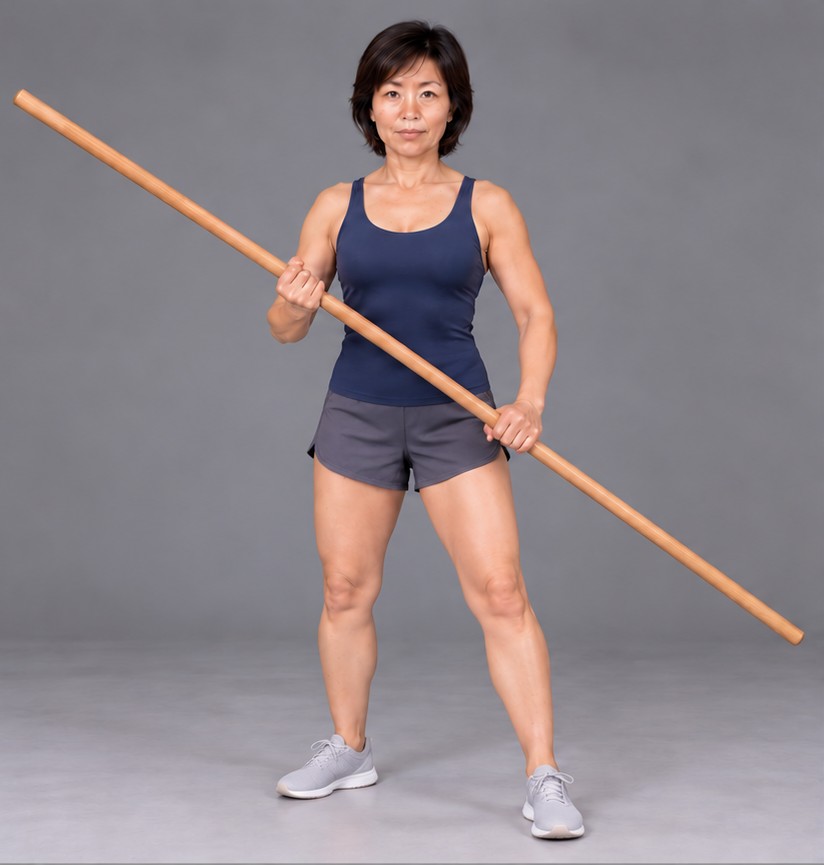
The first rule is to keep your shoulders square with those of your partner. Any additional turn of the torso into the attack brings the weapon into the plane of the defender’s body, increasing the risk of injury. By keeping the shoulders square, we can direct the apparent force of the attack toward the defender while keeping the actual movement safely outside the defender’s space.
As with the sword, cutting attacks are intended to finish approximately one inch outside the plane of the body. The job of the aggressor is to convince the audience that the weapon is aimed at the exact center of the defender’s body, between the navel and the solar plexus, while directing the actual energy safely outside that space. This distance is a choreographic reference, not a tolerance to be left to chance. Both actors must know exactly where the weapon will stop.
The quarterstaff presents another difficulty: maintaining safe distance is a 360-degree problem. There is always a considerable length of weapon traveling around, above, or behind the performer, often beyond peripheral vision. It isn’t enough to know where the attacking end is going. You must also know where the other end is traveling, and whether it might endanger your partner, another actor, or anyone nearby.
This becomes especially important when changing grips, reversing the direction of an attack, or moving from shortform to longform. A movement that is perfectly safe in isolation may become dangerous when performed too close to another actor or a piece of scenery.
Disarms require particular care. Whenever possible, direct a released weapon toward upstage rather than downstage. If control is lost, the weapon should travel away from the audience, not toward it. The release, flight, and landing of the weapon must all be choreographed and rehearsed; merely aiming upstage is not sufficient protection.
Finally, remember that the block is part of the illusion, not a substitute for control. The aggressor must be capable of completing the attack safely even if the defender fails to make the interception. We never depend on a partner’s block to prevent an injury.
These principles apply to every technique that follows, whether the movement is a simple shortform cut, a longform attack, or a more elaborate exchange involving binds and disarms.
The Nine-Square Grid
As with sword fighting, the quarterstaff can deliver both cuts and thrusts, although the cuts are really more a matter of bashing than slicing. The principle, however, is much the same.
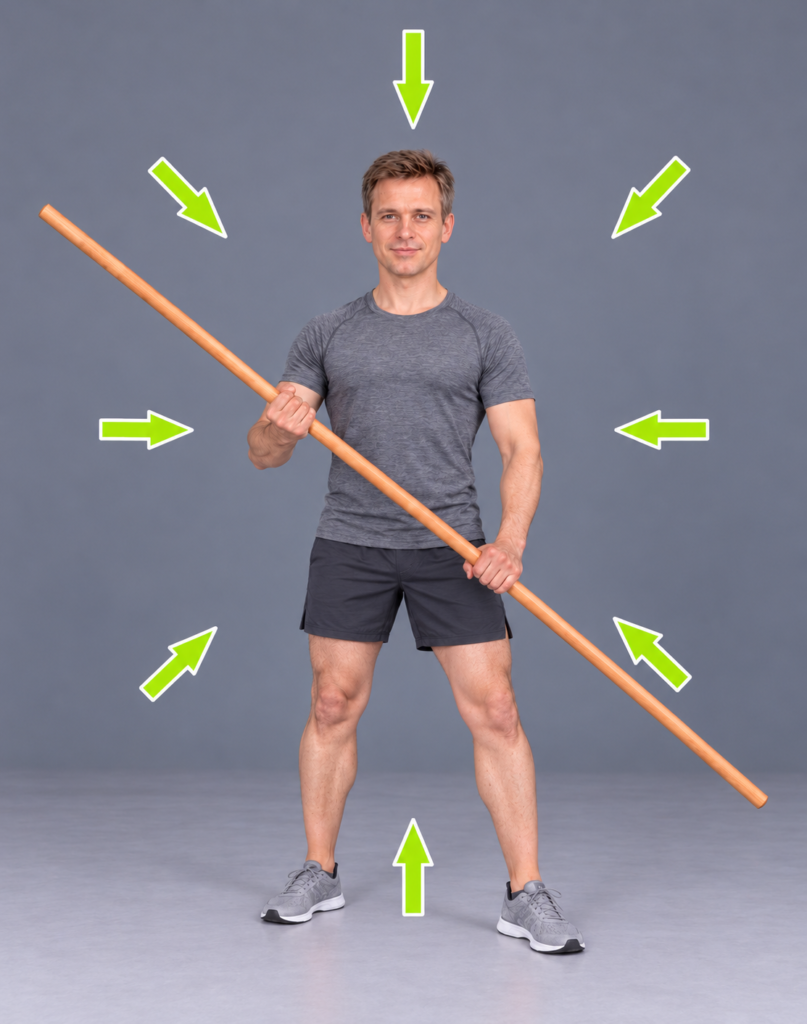
Because the staff can attack from either end, and because its movements can approach from above, below, or either side, we will use a nine-square grid to simplify and identify the various lines of attack.
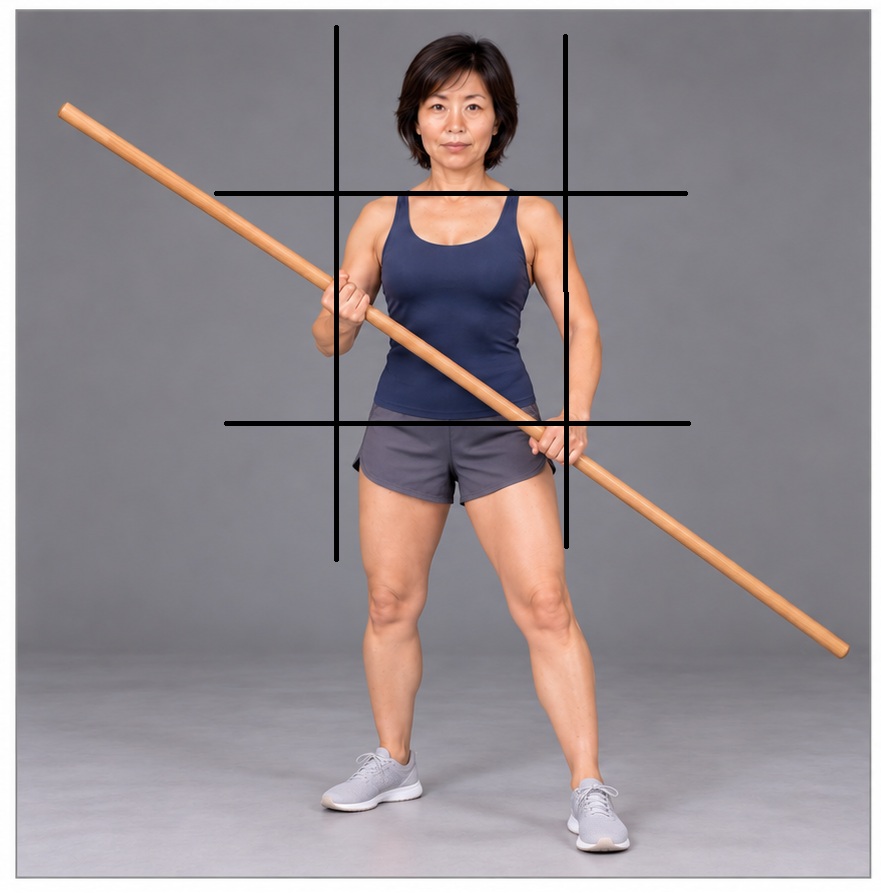
Imagine a tic-tac-toe grid superimposed on the body of your opponent. This divides the available attack lines into nine easily recognized areas.
The four corner squares represent the diagonal cuts: high left, high right, low left, and low right. The squares directly to either side of the center represent the left and right flank cuts. The upper center square represents the vertical head cut, while the lower center square represents the upward crotch cut.
That gives us eight basic cutting attacks, all of which we will examine individually.
The ninth square, at the center of the grid, represents a direct attack to the body. In our choreography, we generally reserve this position for payoff moves, such as punches, kicks, trips, and other actions that interrupt or conclude an exchange of weapons.
There is one important distinction between the apparent target and the actual movement of the weapon. Although we identify an attack by the square from which it approaches, the intended target of all eight cuts is the exact center of the defender’s body, between the navel and the solar plexus. The aggressor creates the illusion of attempting to strike that center, while the actual movement of the staff travels safely outside the defender’s body.
The same grid also identifies the corresponding defenses. A high-left attack requires a defense against that line; a low-right attack requires a defense against the low-right line, and so forth. The attacking and defending actions are therefore two parts of the same system.
Thrusts use a somewhat different range of apparent targets, including both flanks, shoulders, and thighs. We never direct thrusts toward the head or knees. We will examine these separately.
Throughout the following sections, the nine-square grid will provide a common reference for describing attacks, defenses, and eventually the notation used to record an entire choreographed phrase.
Shortform: Grip and Mechanics
There are two principal ways of holding and using the quarterstaff: shortform and longform. We will begin with shortform, which is simpler, more intuitive, and particularly well suited to stage combat.
To establish the shortform grip, divide the staff approximately into thirds and place your hands at those points. This leaves a length of staff extending beyond each hand, with the center third between them. For clarity, we refer to the end of the staff closest to the intended target as the fore end, and the end farthest from the target as the butt end. Because either end can become the attacking end, these designations will change repeatedly throughout a fight.
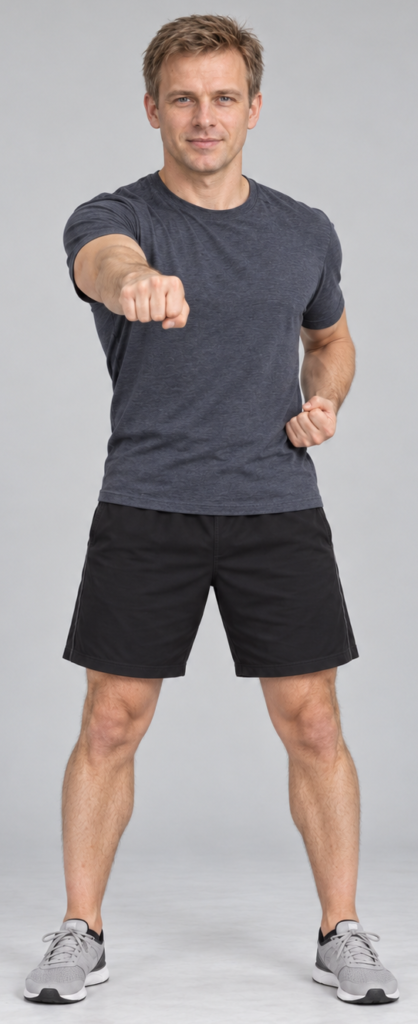
The basic mechanics are remarkably simple. One hand pushes while the other pulls. Push with the right hand and pull with the left, and you have a right-handed attack. Push with the left and pull with the right, and you have a left-handed attack. Compare this push-and-pull action to the concept of chambering discussed in our section on unarmed martial arts. As one arm extends toward the opponent, the other withdraws toward the body. The two actions work together, giving the movement its apparent power.
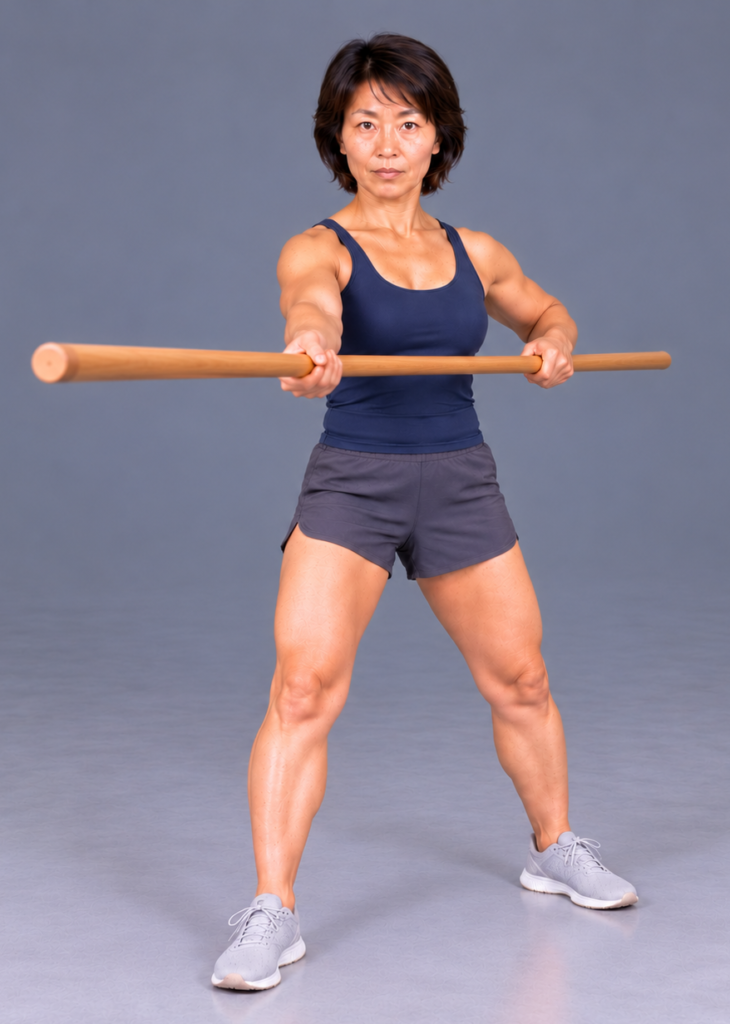
In shortform, the hands remain relatively fixed in their positions along the staff. Unlike longform, there is no need to slide the hands up and down the shaft during each movement. Instead, the staff pivots and changes direction through the coordinated extension and withdrawal of the arms.
The position of the withdrawing hand is particularly important. Depending upon the attack, it may return to the ribs, hip, shoulder, or armpit. These positions are not arbitrary. They determine the angle of the staff, the direction of the apparent attack, and the point at which the movement comes to a stop. For example, if you extend the right arm toward your opponent while drawing the left hand firmly back to your ribs, you create a sweeping attack toward the right flank. Reverse the actions of the hands, and the attack travels toward the opposite flank.
By changing the height of the extended hand and the position of the withdrawing hand, the same basic push-and-pull action can produce all eight cutting attacks shown on our nine-square grid.
Shortform also provides an important measure of control. As the withdrawing hand approaches the body, the movement of the staff is naturally limited by the performer’s own anatomy. This helps create the appearance of a powerful blow coming to an abrupt stop, although the aggressor must still control the weapon independently and maintain the established safety distance.
There is no need to force the movement or add an exaggerated turn of the torso. Keep the shoulders square to your partner and allow the opposing actions of the arms to produce the attack. Shortform is simple and intuitive. Once you become comfortable with the relationship between the extending and withdrawing hands, the eight basic attacks become variations of a single mechanical principle.
The Eight Shortform Attacks
Now that we understand the push-and-pull mechanics of shortform, let’s apply them to the eight cutting attacks shown on our nine-square grid. These are nearly intuitive movements, but let’s go through them individually.
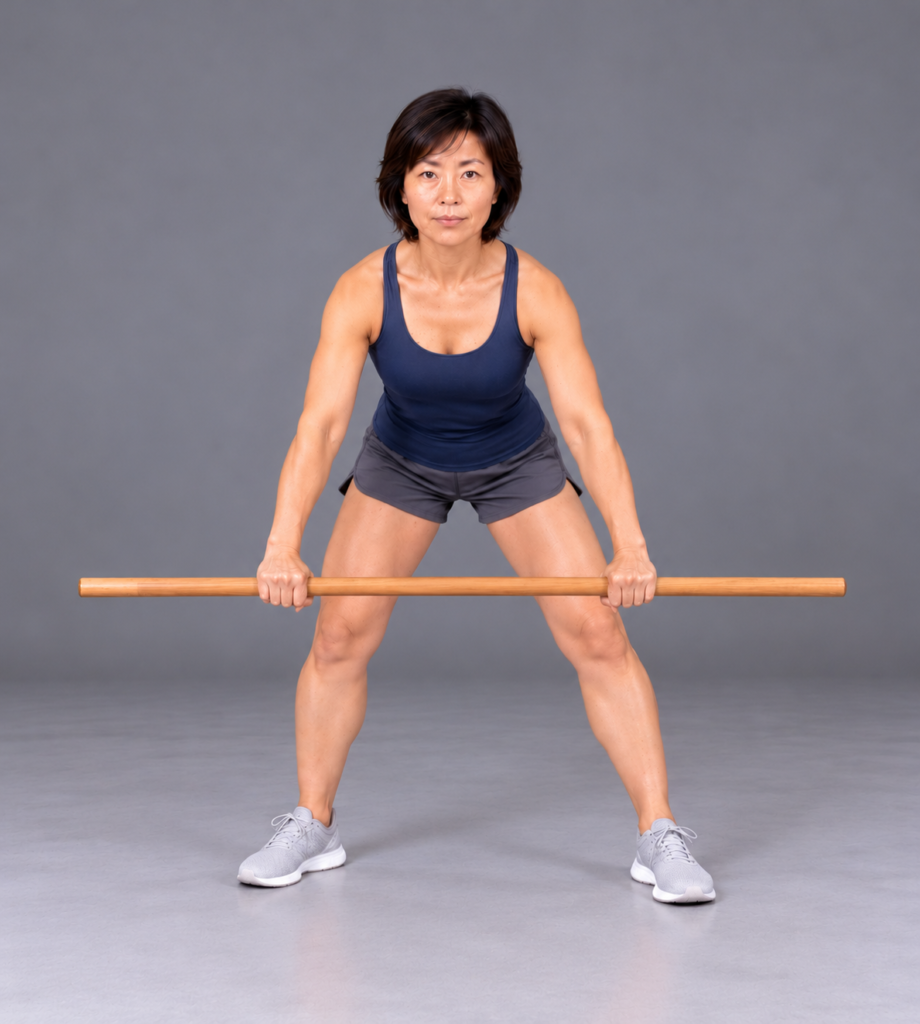
Begin with the staff held in front of you, approximately parallel to the floor, with your hands dividing it into thirds. Keep your hips and shoulders square to your partner. As one hand extends, the other withdraws toward the body, establishing the angle and direction of the attack.
Remember that the apparent target is always the center of the defender’s body. The eight attacks differ in the direction from which the staff appears to approach that target, not in where we actually intend to make contact.
Horizontal and Vertical Cuts
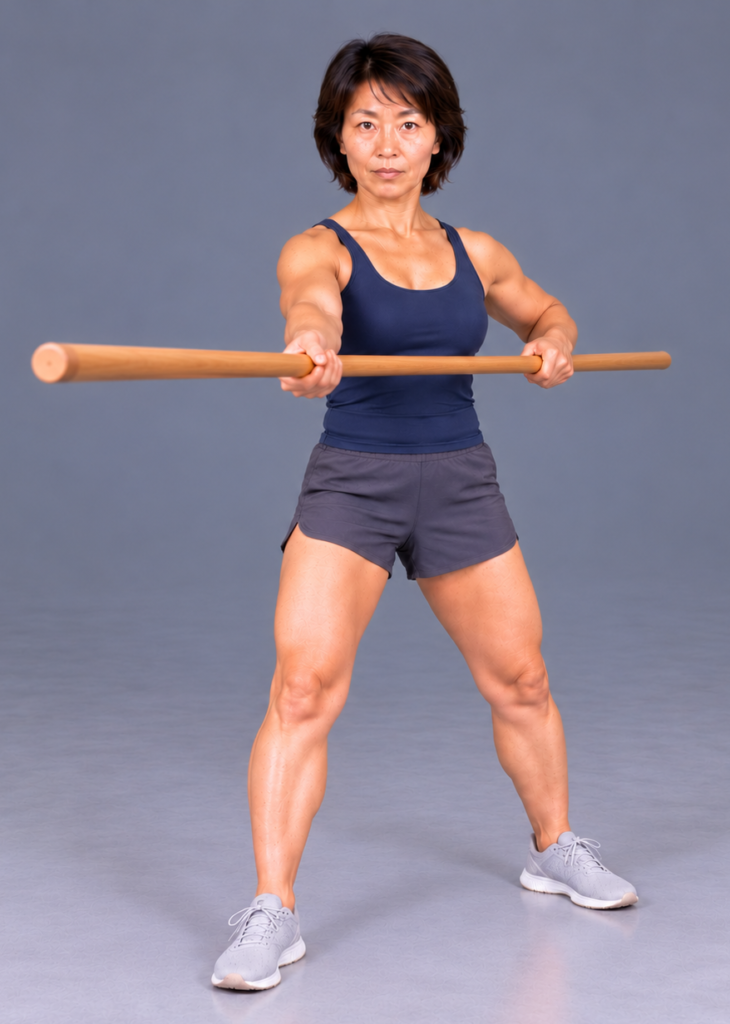
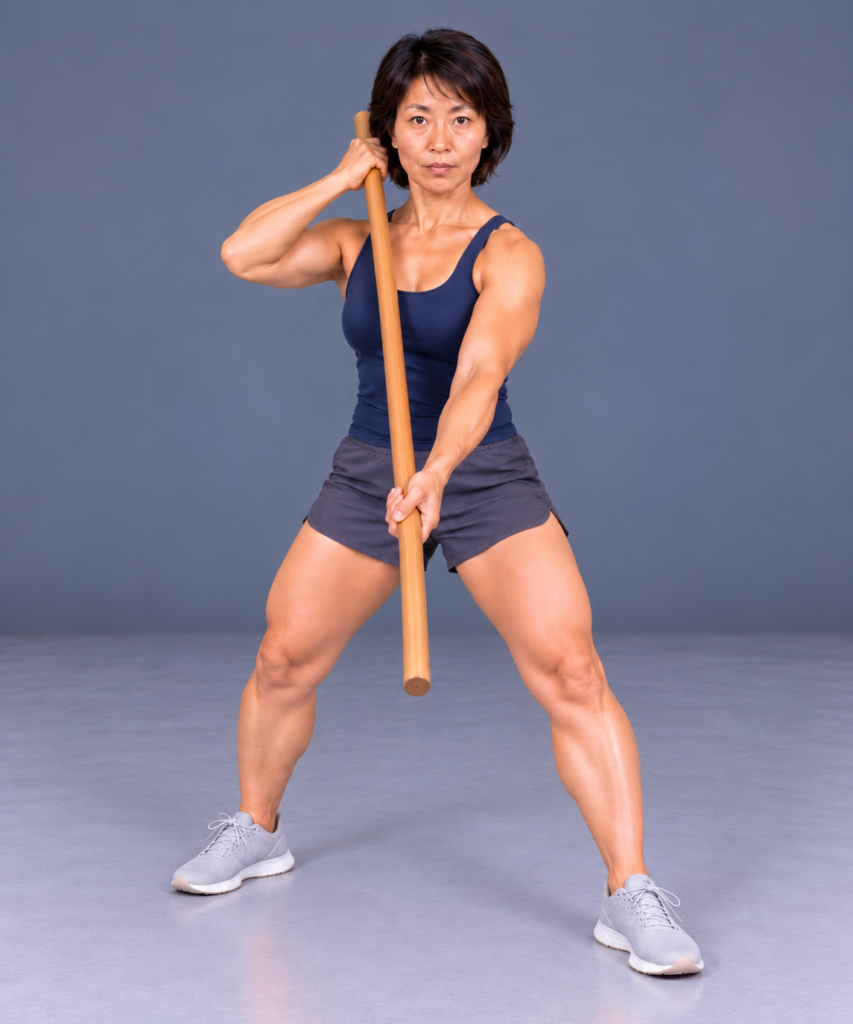
Right Flank: Push your right hand straight out while pulling your left hand back to your ribs. Keep the staff approximately parallel to the floor.
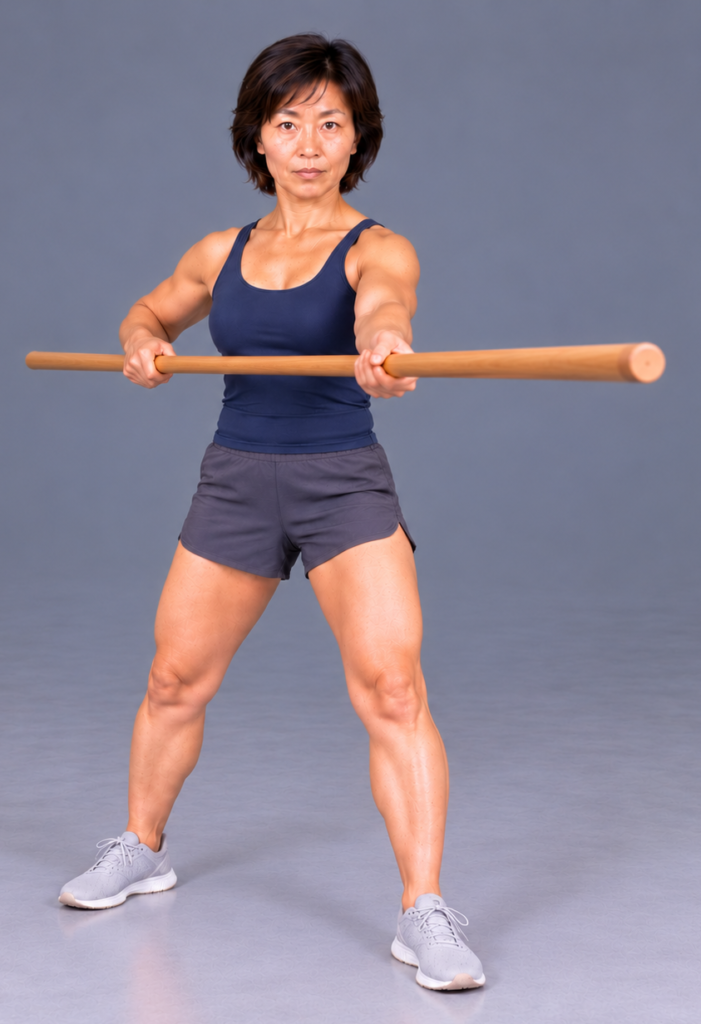
Left Flank: Reverse the action. Extend your left arm straight out while pulling your right hand back to your ribs.
Crotch Cut: The crotch cut is an upward scooping attack. Either hand pushes forward and upward toward the apparent target, while the other draws back, bringing the trailing end of the staff alongside the ear on the withdrawing side.
This movement requires particular attention to the path of the staff. If the withdrawing hand or trailing end is allowed to travel across the face instead of beside it, the performer may strike themselves in the forehead (yes; it happens). Keep the movement clear of the face and rehearse the complete path slowly before bringing it up to performance speed.
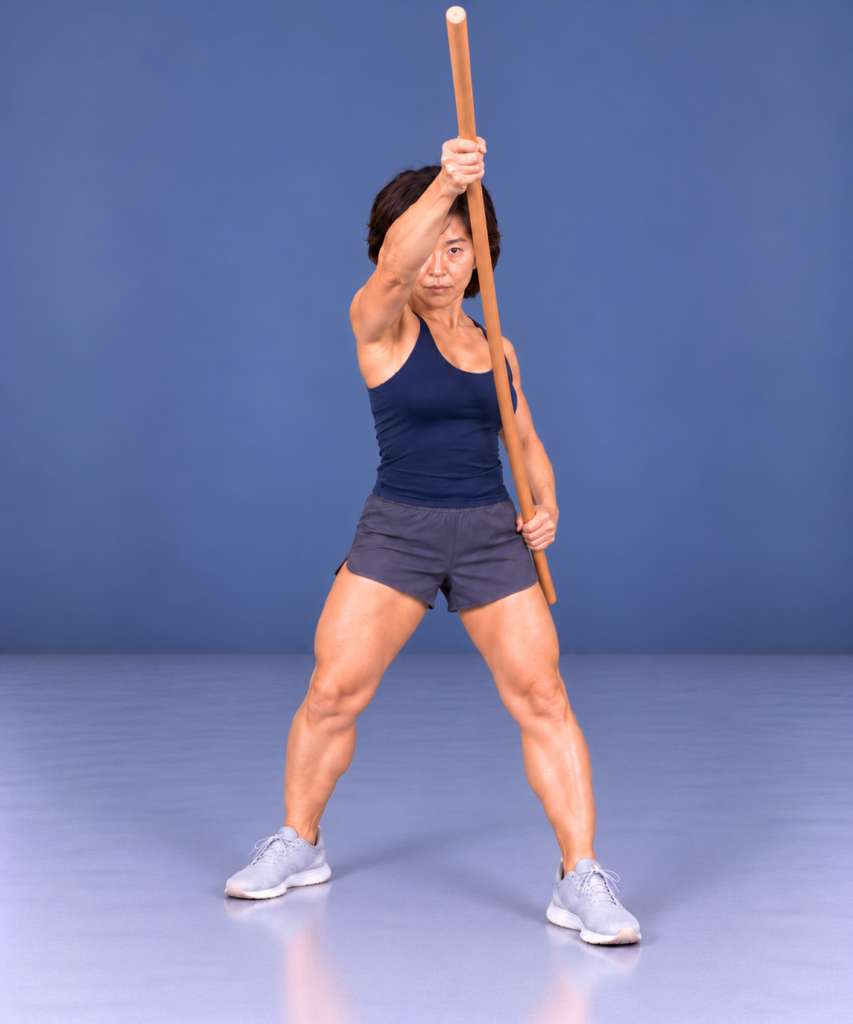
Vertical Head Cut: This attack differs somewhat from the others because we must create the appearance of a powerful downward blow without actually bringing the staff down onto the defender’s head. The attacking hand extends the fore end toward a point just above the defender’s forehead, while the withdrawing hand draws tightly back toward the armpit.
The important consideration is the angle of the staff. We want the audience to see a descending cut, not a straight punch directed at the defender’s face. To create that picture, elevate the trailing end so that the staff assumes the appearance of a weapon descending toward its target. The lead hand remains high, while the withdrawing hand stays close to the armpit rather than rising above the shoulder.
The movement must be stopped under the aggressor’s control, with the staff remaining outside the defender’s head space. The apparent downward force is an illusion created by the angle of the weapon and the performer’s action, not by allowing the staff to fall toward the defender.
These sweeping attacks can look remarkably powerful when they come to an abrupt stop. The withdrawing hand and arm help arrest the movement, creating the illusion that a powerful block has stopped the blow.
The Four Diagonal Cuts
The diagonal attacks use the same opposing hand actions, but vary the height of the extended hand and the position of the withdrawing hand.
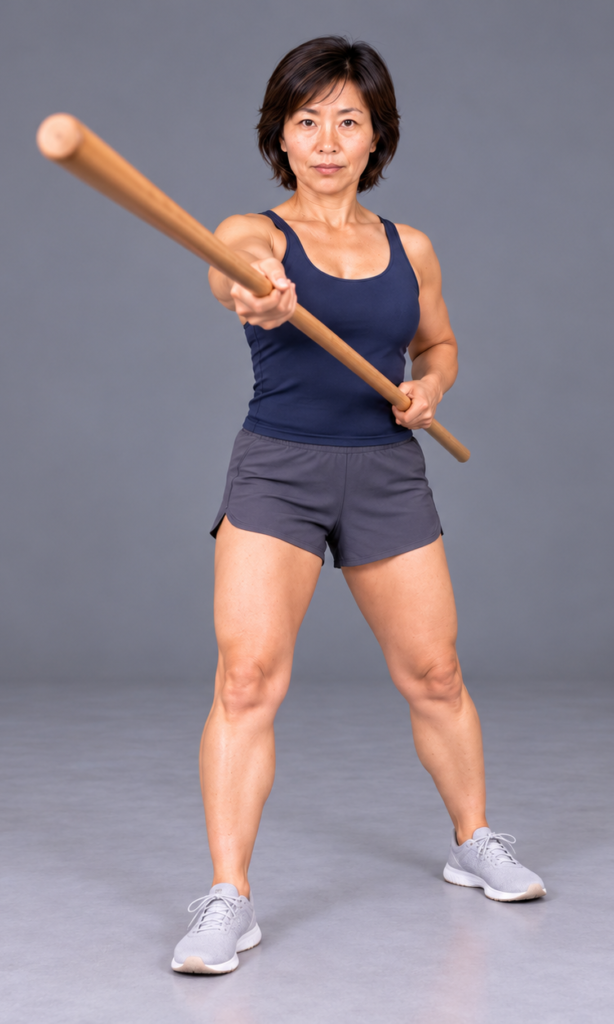
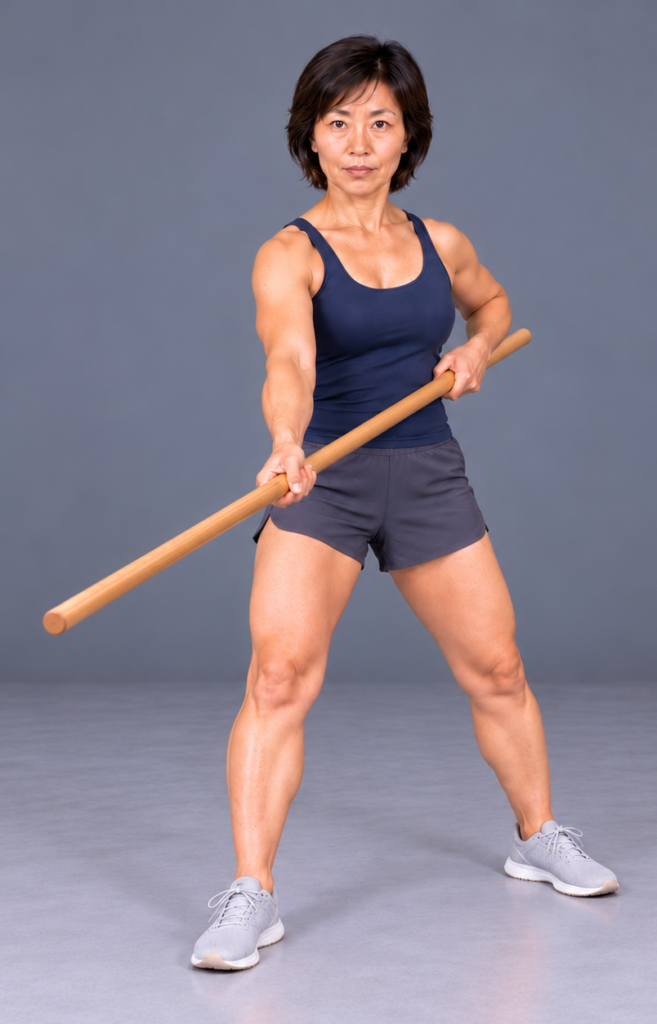
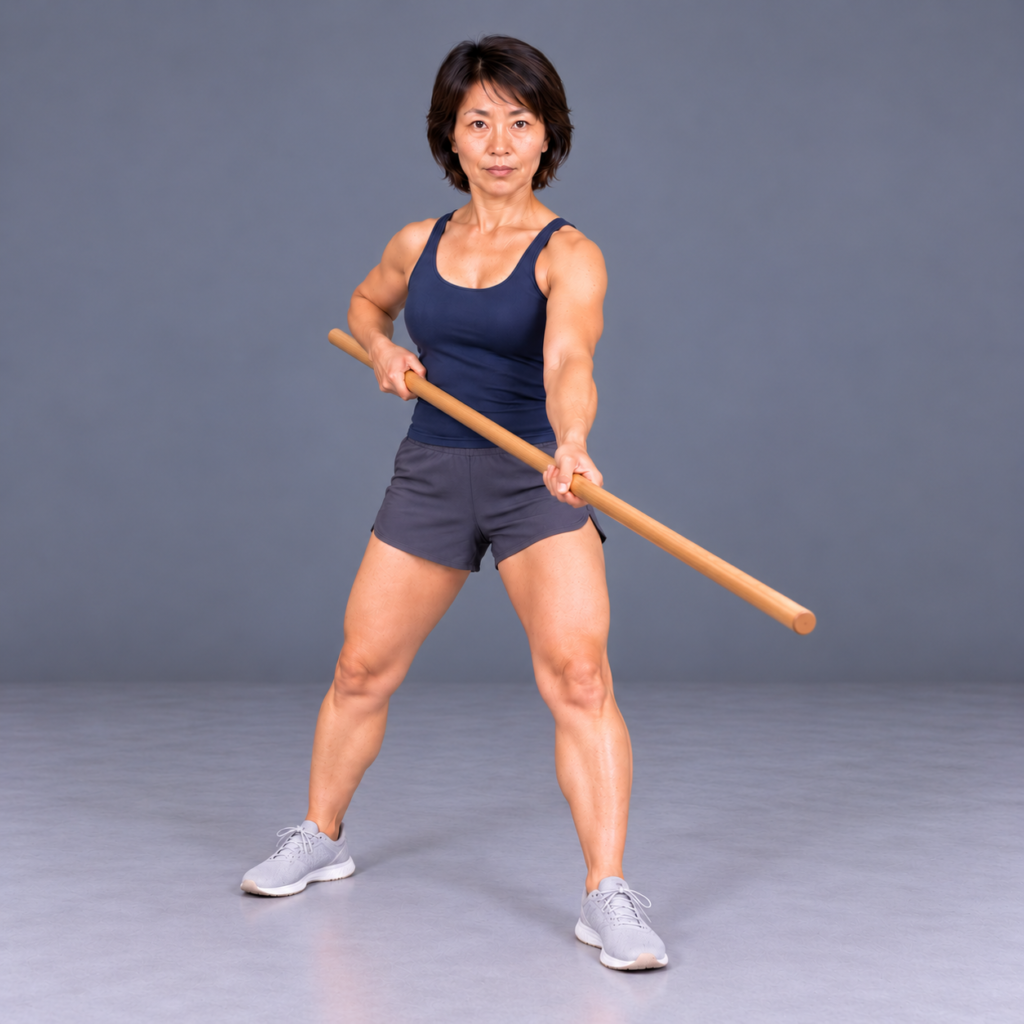
Right High Diagonal: Push your right hand out to shoulder level while pulling your left hand back to your left hip.
Left High Diagonal: Push your left hand out to shoulder level while pulling your right hand back to your right hip.
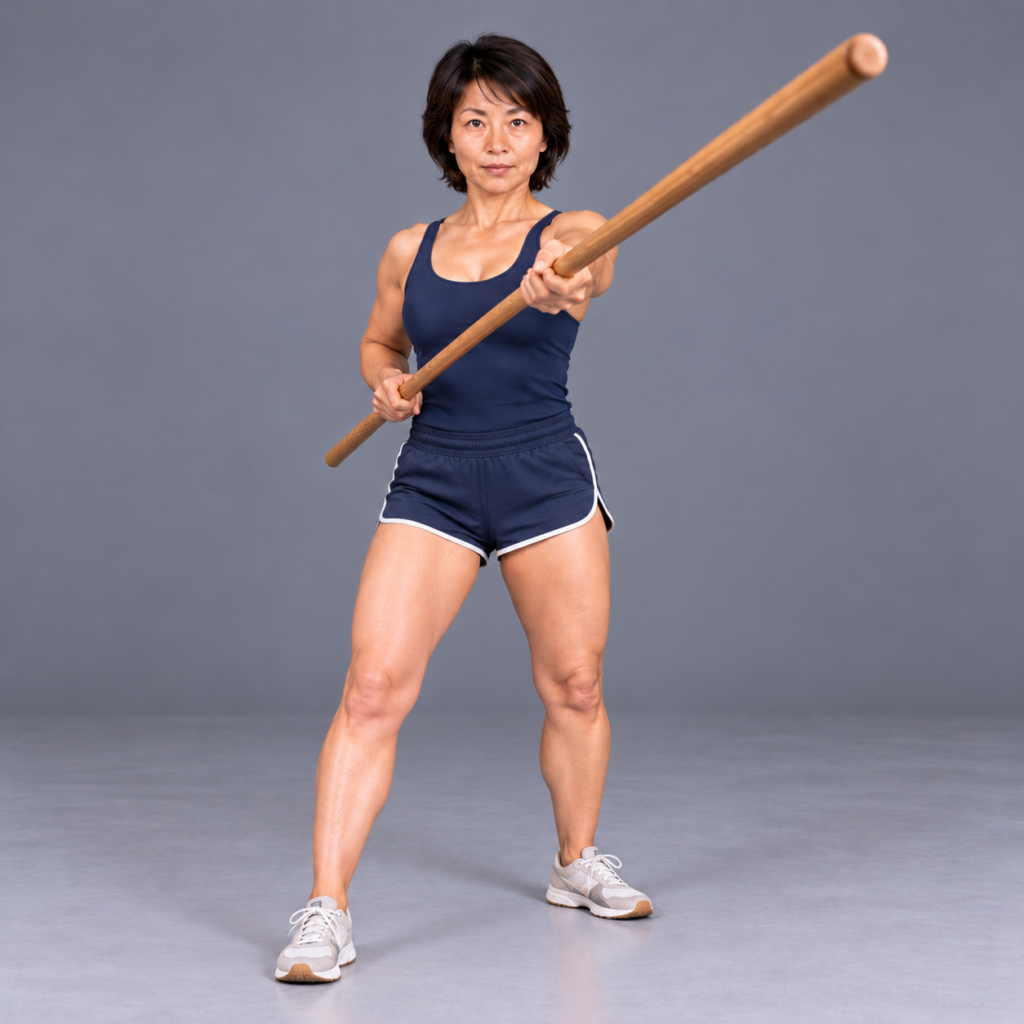
Right Low Diagonal: Push your right hand out toward thigh level while drawing your left hand back toward your left shoulder.
Left Low Diagonal: Push your left hand out toward thigh level while drawing your right hand back toward your right shoulder.
Notice how little the fundamental mechanics change. We are still extending one arm and withdrawing the other. The different positions of the hands determine the angle at which the staff approaches the defender.
A Final Observation: All eight attacks are built upon the same principle: one hand pushes while the other pulls. The position of those hands changes the angle of the staff, allowing us to present eight different lines of attack without learning eight entirely different mechanical actions. Practice each attack slowly, paying particular attention to the final position of the hands and the direction of both ends of the staff. Once those positions become familiar, the movements can be connected into a flowing series of attacks without sacrificing control.
Shortform Defenses
Since the attacks are intended to appear as though they are directed toward the center of the body, the defenses begin at the center and move outward to intercept them. The nine-square grid that we used to identify our attacks serves equally well for the defenses, and we can use the same eight positions without introducing an entirely new system.
There are two basic methods of blocking in shortform. The first uses the center portion of the staff, between the hands, to intercept head, crotch, and flank attacks. The second uses one of the projecting ends of the staff to intercept the four diagonal cuts. These are not hard-and-fast rules, but they provide a logical and easily learned starting point.
Defenses Using the Center of the Staff
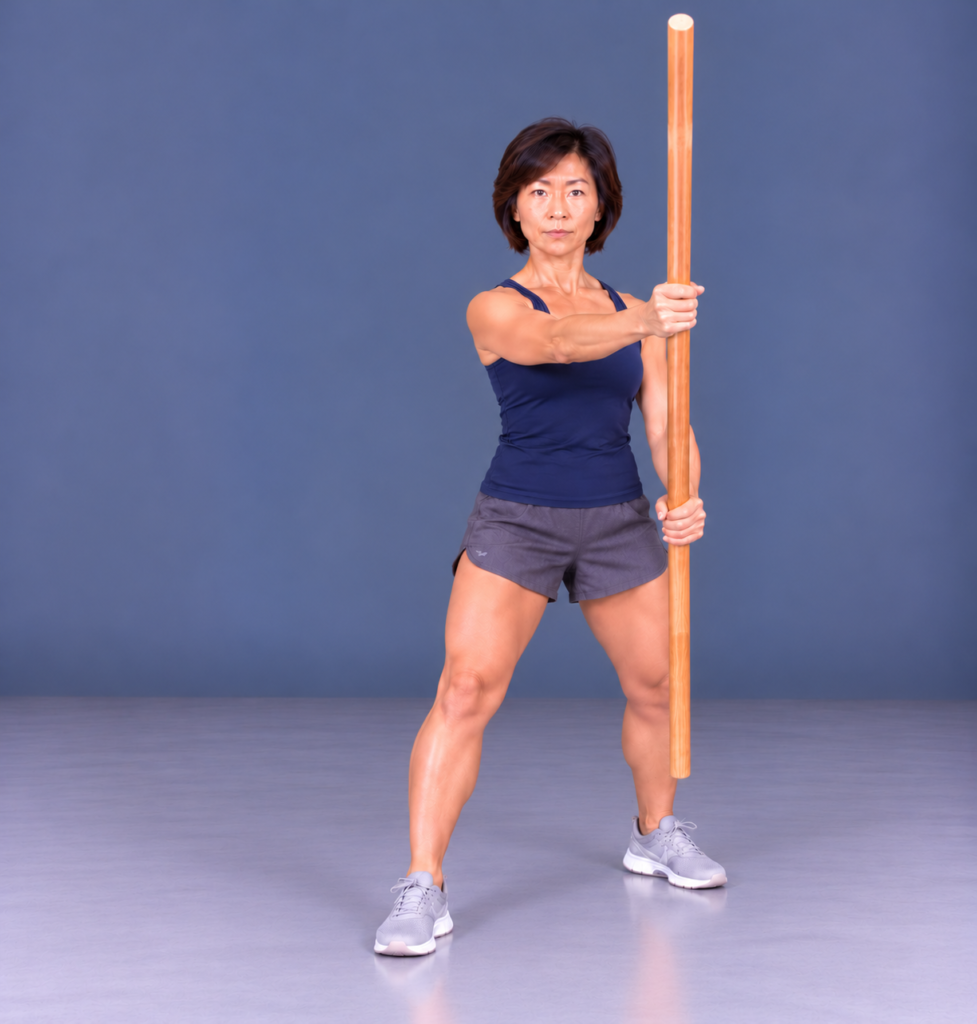
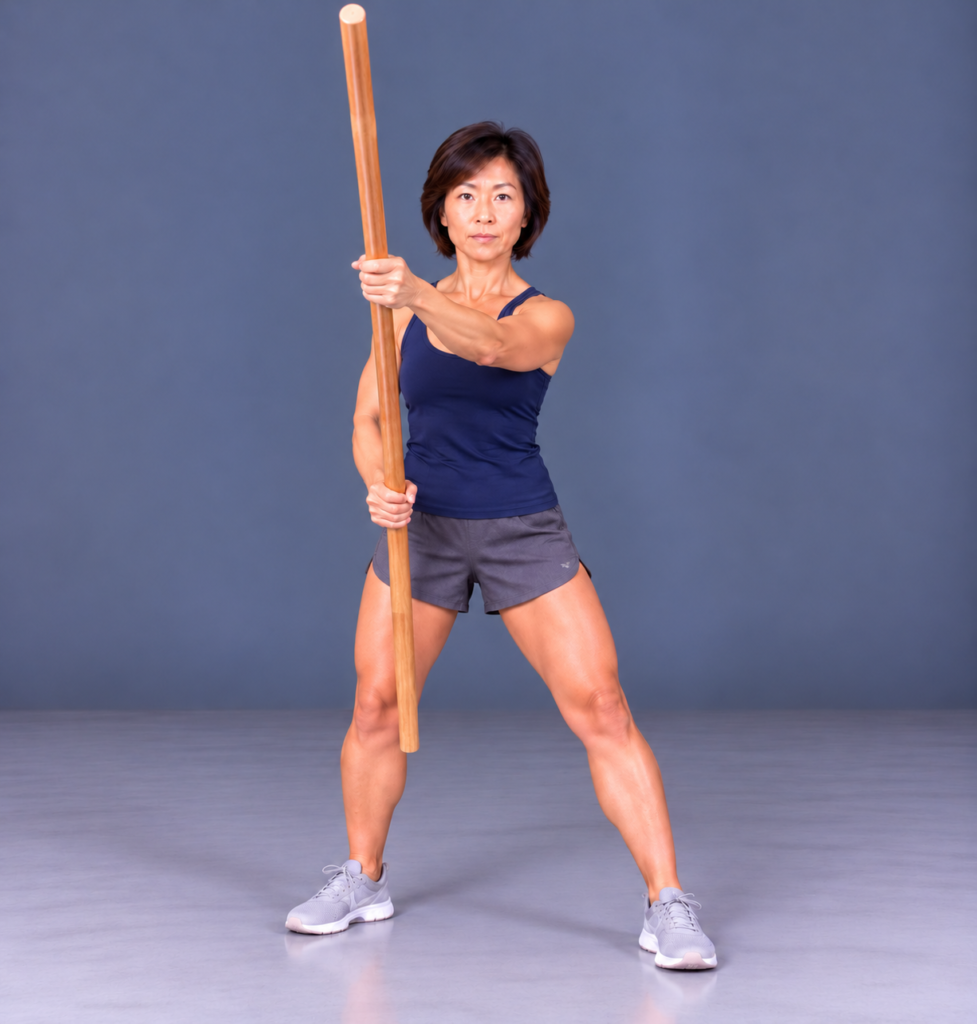
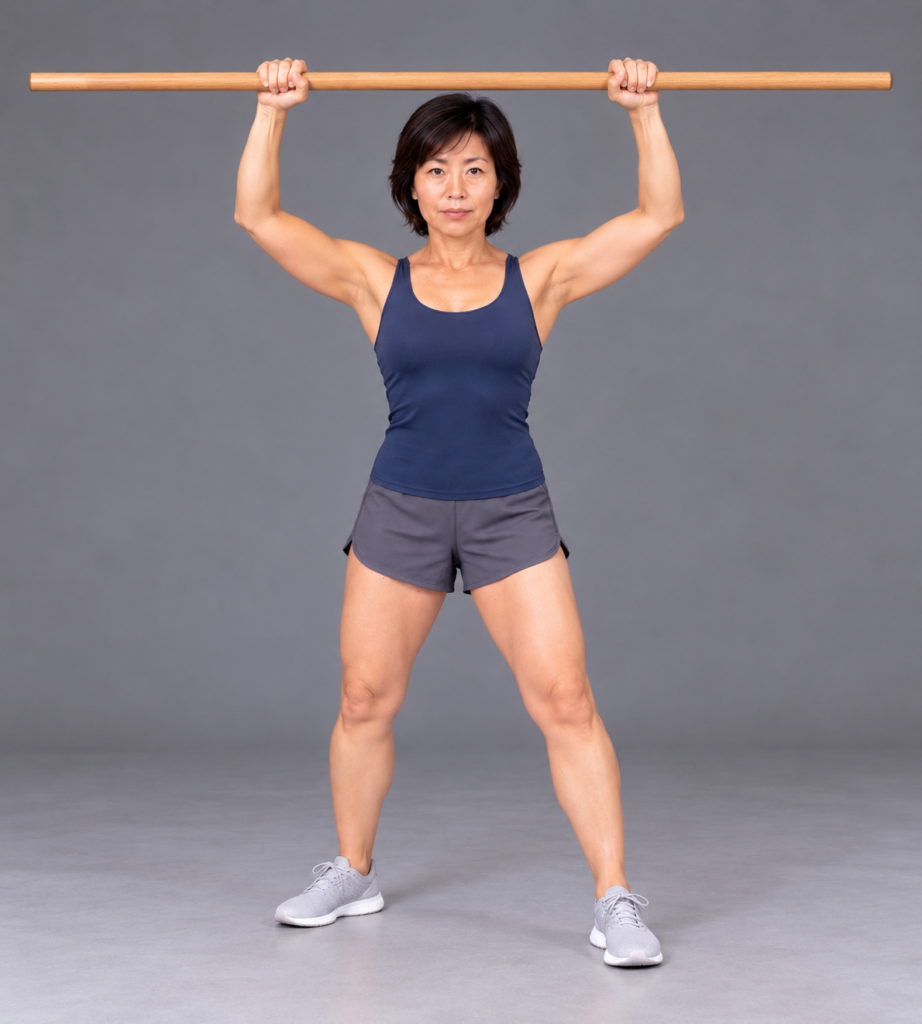
When using the center portion of the staff, both arms extend in the direction of the incoming attack, presenting the section between the hands as the blocking surface. Think of the staff as a large sliding door. For flank attacks, the staff remains approximately vertical and moves from side to side. For head and crotch attacks, it remains approximately parallel to the floor, rising or lowering to intercept the incoming weapon.
The important consideration is that the staff, rather than the hands, must receive the apparent impact. Because the defender’s hands are separated along the shaft, there is a temptation to position the interception too close to one of them. This should be avoided. The point where the weapons meet must remain clear of the fingers, with sufficient separation to accommodate the movement of both staffs.
The movement should also remain compact. We want the audience to believe that the defender is protecting the body against an attack that would otherwise strike home. If the arms reach too far outward, the interception may occur so far from the body that the attack no longer appears threatening. The defender should move only as far as necessary to establish a convincing block at the rehearsed point of intersection.
Defenses Using the Ends of the Staff
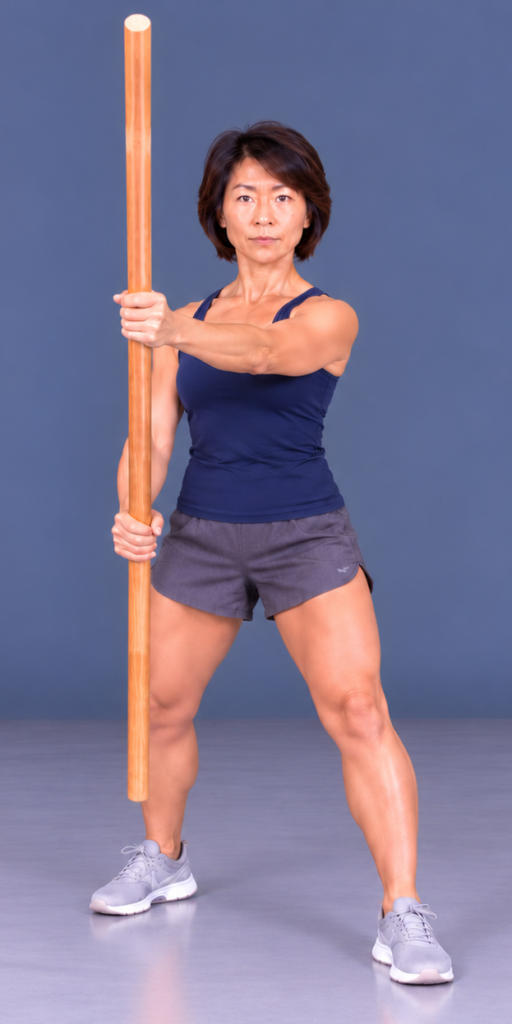
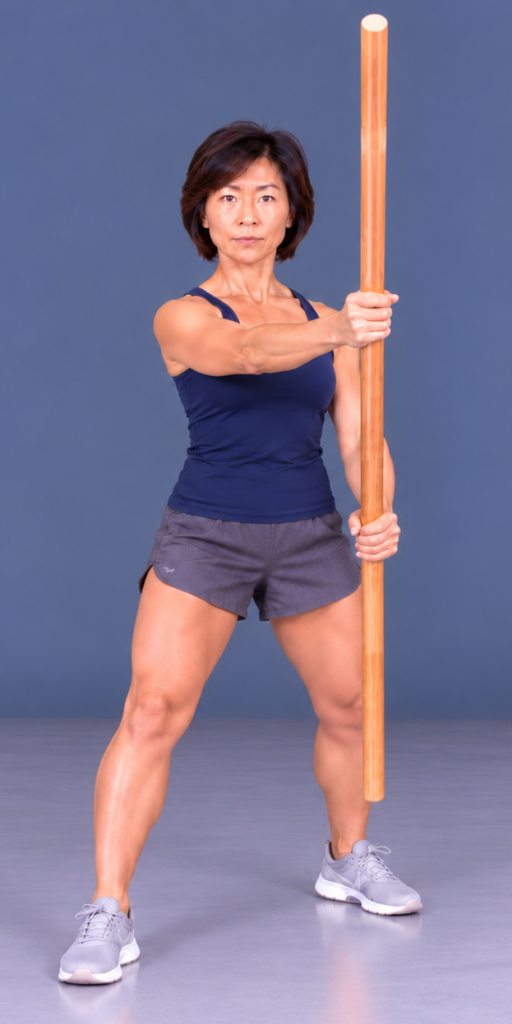
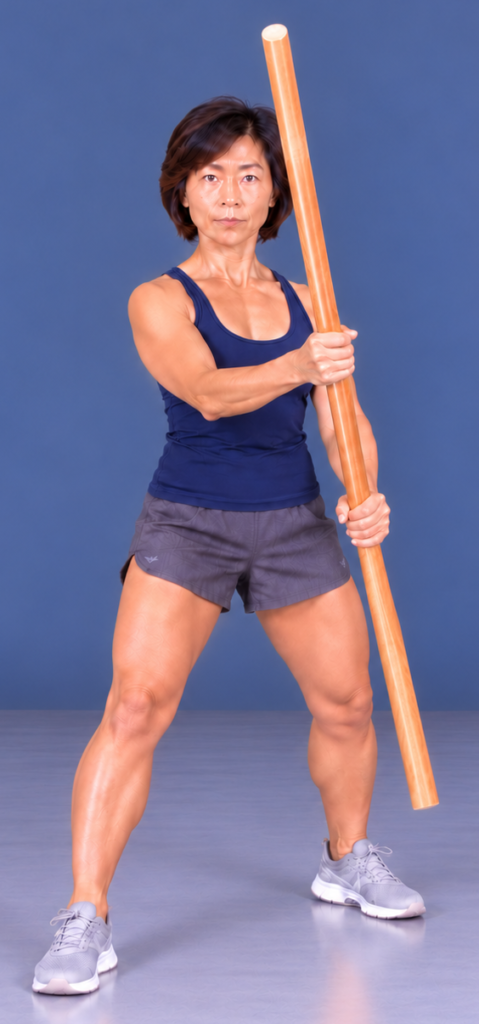
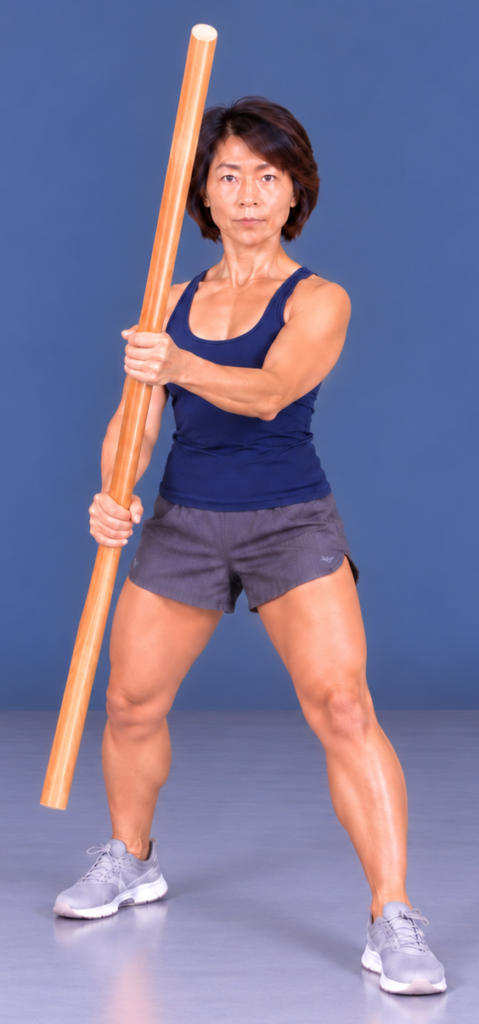
For the four diagonal attacks, we generally use one of the projecting ends of the staff rather than the section between the hands. These defenses are closely related to the diagonal attacks we have already learned, but with one important mechanical difference: the leading arm bends at the elbow instead of straightening.
As the attack approaches, the hand on the side from which it is coming draws inward toward the body, while the opposite hand moves across the front to position the projecting end of the staff for the interception. The crossing action brings the weapon into the appropriate quadrant without requiring a large turn of the shoulders or an exaggerated reach.
For a high diagonal attack, the near hand withdraws toward the hip while the far hand crosses in front of the body. For a low diagonal attack, the near hand withdraws upward toward the shoulder while the far hand makes the corresponding crossing movement. In each case, the bend in the leading elbow allows the staff to remain relatively close to the defender while presenting the appropriate section of the weapon to the incoming attack.
These movements should feel familiar because they use much the same relationship between the hands as the diagonal cuts. The difference is in the final position of the leading arm and the purpose of the movement. In an attack, the arm extends to carry the weapon outward. In a defense, the elbow bends to bring the interception closer to the body.
Making the Block Convincing
A successful stage block depends upon the coordination of both performers. The aggressor must deliver the attack along its rehearsed path and bring it under control independently of the defender’s action. The defender then supplies the visible interception, making it appear that the incoming blow has been stopped by the opposing staff.
The point of intersection should be established during rehearsal and repeated consistently. It should be sufficiently close to the defender to create the illusion of danger, but never so close that a slight variation in timing or alignment could carry the weapon into the body. Both performers must know where the staffs are intended to meet, and neither should attempt to compensate for an inaccurate attack by reaching unexpectedly into its path.
For blocks against cutting attacks, the defending staff must be seen to sweep across the body’s centerline. It is not enough simply to place the staff at the predetermined point of intersection and wait for the attack to arrive. The audience must see the defender actively moving the weapon into the path of the incoming blow, creating the impression that the staff is protecting the center of the body. This crossing action is what makes the movement read as a genuine defense rather than two weapons meeting at an agreed point in space. The sweep need not be large or forceful, but it must be sufficiently clear to establish the defensive intention, while remaining controlled and within the rehearsed choreography.
A quarterstaff block can produce a remarkably convincing picture with very little actual force. The sound of the staffs meeting, the sudden arrest of the attack, and the defender’s physical response can combine to suggest a much heavier impact than has actually occurred. There is no advantage in striking the weapons together with unnecessary force, particularly when repeated impacts may damage the props or compromise the performers’ control.
Once the eight attacks and their corresponding defenses are familiar, they can be assembled into longer exchanges. The essential mechanics remain simple: the aggressor presents a clearly defined line of attack, the defender positions the staff to intercept it, and both performers maintain control throughout the movement.
Thrusts
So far, we have concentrated on the eight cutting attacks represented by our nine-square grid. The quarterstaff can also be used for thrusting, allowing either end of the weapon to be driven forward toward an opponent. Unlike the cuts, which travel through an arc, a thrust moves in a straight line along the length of the staff.
To execute a thrust, the attacker first points the appropriate end of the staff toward the intended target, bringing the entire weapon into alignment with that line of attack. The staff is then withdrawn in a straight line and driven forward along precisely the same path, much like a pool cue. The movement must remain linear throughout; any sweeping or sideways movement changes the nature of the attack.
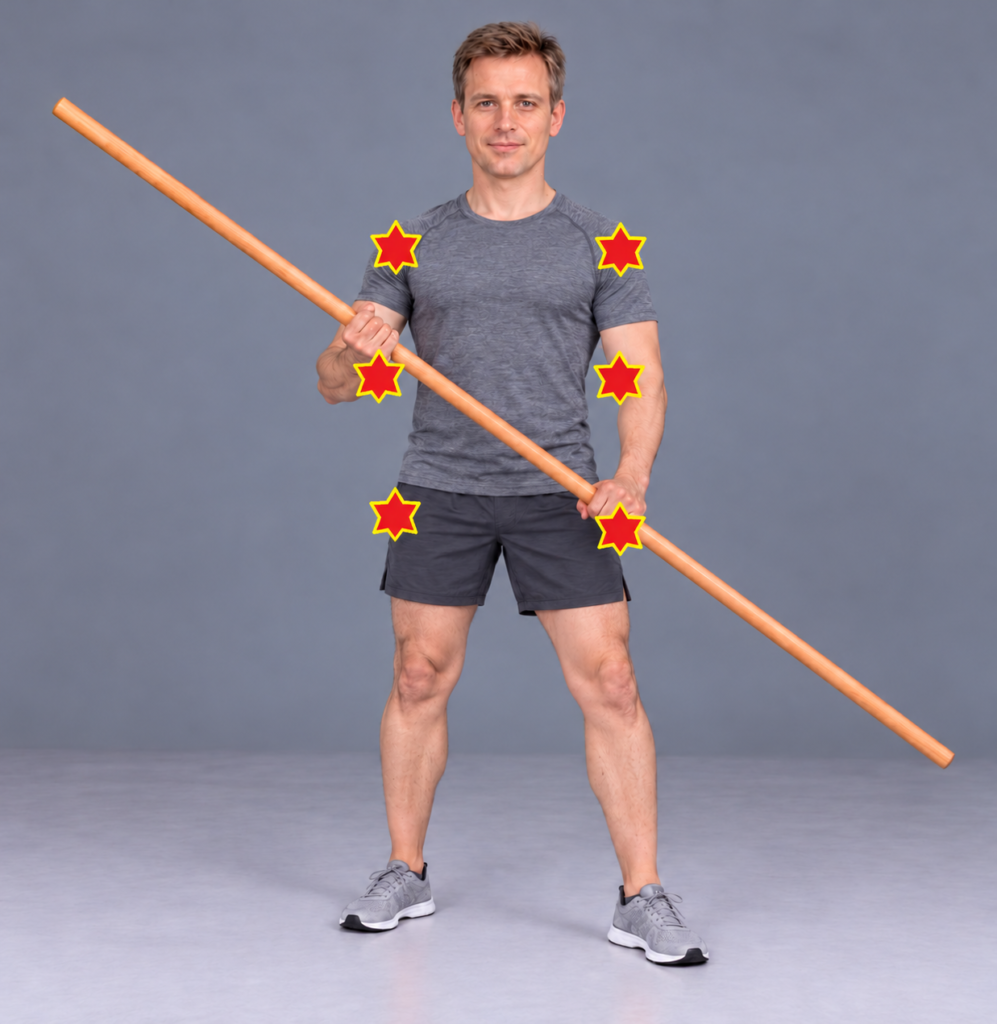
Unlike the eight cutting attacks, thrusts are limited to six apparent targets: the right and left shoulders, flanks, and thighs. We do not thrust toward the upper center (head) or lower center (crotch), nor do we direct thrusts toward the knees. Because the weapon advances directly toward its apparent target, particular care must be taken to establish a line of attack that passes safely outside the defender’s body. The defender’s reaction completes the illusion of impact.
Mechanics of the Thrust
In short form, we retain our established grip, with the hands dividing the staff approximately into thirds. To prepare for a thrust, we first point one end of the staff directly toward the intended target, bringing the weapon into alignment with the line of attack. We then withdraw the staff along that same line, keeping it pointed at the target throughout. From this chambered position, we drive the staff straight forward, much as we would a pool cue, but with both hands. Unlike a cutting attack, which travels through an arc, the thrust moves directly along the staff’s own length. The weapon must remain aligned with its target throughout the withdrawal and forward movement.
The direction of the thrust is determined by the position of the extending hand and the alignment of the staff. By altering the height and angle of the weapon, we can create the appearance of attacks directed toward the shoulders, flanks, or thighs without changing the fundamental relationship between the hands.
It is important that the aggressor establish the final position of the thrust before bringing the movement up to performance speed. Unlike a sweeping cut, which presents a length of staff to the defender, a thrust concentrates its apparent force at the end of the weapon. Even a relatively small error in alignment can therefore become dangerous if the staff is allowed to travel toward the defender’s body.
Directing the Thrust
As with our cutting attacks, the apparent target and the actual destination of the weapon are not the same. A thrust that appears to be aimed at the chest or abdomen must travel along a carefully established line outside the defender’s body. The performers should determine that line during rehearsal, taking into account their relative positions and the audience’s viewing angle.
The illusion depends largely upon perspective. From the audience’s position, a staff that passes safely beside the defender may appear to be traveling directly toward the torso. The defender’s reaction can complete the illusion by acknowledging the apparent attack, even though the weapon has never entered the body’s actual space.
For this reason, we should resist the temptation to improve the picture by directing the staff closer to the defender. A well-aligned thrust, performed at the proper angle to the audience, is more convincing than one that relies upon a dangerously narrow margin of error.
Defending Against Thrusts
A thrust can be intercepted or redirected with the defending staff, using movements related to the shortform defenses we have already learned. Rather than attempting to stop the full force of the advancing weapon, the defender presents the staff along the rehearsed line of interception, creating the appearance of turning the thrust away from its intended target. In other words, it has the feel of a deflection rather than bashing.
As with cutting defenses, the point of contact must remain clear of the hands. The defender should not reach across the path of the advancing tip or attempt to catch the staff between the fingers. The aggressor remains responsible for controlling the thrust and bringing it to a safe conclusion, whether or not the defending weapon makes contact.
Because thrusts appear to travel directly toward the body, they can provide a useful contrast to the broad sweeping movements of the cuts. Alternating the two allows the choreographer to vary the rhythm and visual character of a fight without introducing unnecessarily complicated techniques.
Longform: Grip, Movement, and Distance
Longform is the second principal method of handling the quarterstaff. Whereas shortform relies upon the opposing push-and-pull actions of hands that remain relatively fixed on the shaft, longform allows the hands to slide along the staff, extending its reach and changing the distance between the combatants. It offers a greater variety of movements, but requires considerably more practice before the actions become comfortable and reliable.
To establish the basic longform grip, take hold of the staff at approximately its center with one hand and at the quarter point with the other. This leaves a greater length of weapon extending beyond the forward hand than we would ordinarily have in shortform. The additional length gives the attacker greater reach, but also makes the staff more difficult to control, particularly when changing direction or recovering from an attack.
Draw and Slide
Longform technique is all draw and slide. As you do the moves, just keep repeating: draw and slide, draw and slide.
Just to start, hold the staff with your right hand at the halfway point and your left hand at the quarter point. For now, simply hold the staff parallel to the ground. Pull your left hand in to your left hip and extend your right arm, just as in shortform, and you have executed an attack to the right flank. And at quite a distance, since now you can strike a target about four feet away.
But for the next attack, you can’t simply pull the right hand back and push with the left, because your left hand is holding onto the stubby end of the quarterstaff. So, if you want to strike the opposite flank, you’re going to have to draw and slide.
Leave your right hand where it is, extended in front of you, and loosen your grip. With your left hand, draw the staff back until your right hand can grasp the far quarter. Tighten your right-hand grip and pull it back toward your right hip. At the same time, relax your left-hand grip and push your left hand forward, allowing it to slide along the staff until it reaches the center. And there you have it: a left-handed longform attack to the opposite flank.
Now keep your left hand extended and try another flank attack back to the first side. Your right hand draws the staff back, your left hand grasps the far quarter, and then, as the left hand pulls toward the left hip, the right hand pushes forward while sliding to the center. Voilà! A longform attack to the right.
Practice this several times, moving from one flank to the other. Draw and slide, draw and slide; quarter and center, quarter and center. The movement will probably feel awkward at first, particularly as you alternate which hand is controlling the staff and which is allowing it to slide. But once the sequence becomes familiar, the hands begin to exchange their positions almost automatically.
Try going to the other targets on our nine-square grid. You’ll find that attacks to the lower diagonals may bounce off the ground at first, and that the crotch shot is nearly impossible to perform in a direct line, but you’ll get the idea. The basic mechanics remain the same, even though some attacking lines require adjustments to the angle and path of the weapon.
The essential difference between the two methods should now be apparent. In shortform, the hands remain relatively stationary along the staff while the arms extend and withdraw. In longform, the hands continually exchange their positions between the quarter and center, allowing a much greater length of staff to be presented toward the opponent.
Changes of Distance
One of the principal advantages of longform is the opportunity to change the apparent distance of the fight. An exchange of shortform cuts may bring the performers into relatively close proximity, after which a transition into longform can create the impression that one combatant is attempting to regain distance or force the other backward.
The reverse can be equally effective. A longform attack may be followed by a change into shortform as the performers close the distance between them. These transitions can provide exciting changes in rhythm and visual scale, particularly when they are coordinated with the performers’ footwork.
The transition itself must be choreographed as carefully as the attacks. Sliding the hands, reversing the staff, or changing the distance between them can alter the position of both ends of the weapon. The performers should therefore establish precisely when the grip changes and where the staff will be during the transition, rather than treating the movement as an incidental adjustment between attacks.
Longform Defenses — and Their Limitations
Technically, longform movements can also be used to perform defenses at greater distance, and is quite common in SAFD-influenced quarterstaff training. But for theatrical purposes, or even for real fighting, we should ask what the additional distance actually accomplishes.
If the point at which the staffs meet is two to four feet in front of the defender, who is actually being defended? Whether the block succeeds or fails is irrelevant, because the attacking weapon was never close enough to threaten the defender in the first place.
There is no reason to defend against an attack that cannot reach you. If the attacking weapon is going to miss by several feet, the defender can simply ignore it. A block serves no practical purpose when there is no threat to intercept, and the same is true on stage. If the audience can plainly see that the attack was never going to reach its target, the defense becomes a meaningless gesture. To create a convincing fight, the attack must appear capable of striking the defender, and the block must appear necessary to prevent it.
And if the aggressor is close enough to create a convincing threat, the extended longform defense becomes impractical anyway, leaving the shorter, more compact defense as the more believable choice. For this reason, I prefer to use longform only for attacks and all defenses are in shortform. This is not an absolute prohibition against longform blocks, but a practical judgment about what produces the strongest illusion of danger.
Combining Shortform and Longform
There is no reason to restrict an entire fight to one method of handling the staff. Indeed, some of the most interesting choreography comes from combining them. Shortform provides compact, easily controlled attacks and defenses, while longform introduces changes of reach and a greater sense of movement through space.
A transition from shortform to longform might suggest an attempt to keep an opponent at bay, while a return to shortform could accompany a sudden advance into closer quarters. The changing grips and distances then become part of the dramatic action rather than an exhibition of technique.
Longform requires considerably more training than shortform, particularly when the sliding movements are performed at speed. Begin slowly, establish the path and final position of each movement, and introduce changes of distance only when both performers can repeat the sequence reliably. The greater reach of the weapon should expand the choreographer’s possibilities without compromising the simplicity and control upon which convincing stage combat depends.
Additional Techniques
Now that we have explored the basic attacks and defenses in both shortform and longform, we can begin combining them with other actions to create more varied and interesting fights. The quarterstaff is particularly well suited to this because it can be used at several different distances, either end can become the attacking end, and the section between the hands can be used to control an opponent’s weapon.
These additional techniques include binds, disarms, body strikes, trips, and other close-quarters actions. Most are not especially complicated, but they do require careful coordination between the performers. As always, the objective is not to demonstrate how effectively one actor could defeat another, but to create the appearance of a struggle in which both performers remain completely in control.
Binds and Engagements
A bind occurs when the two weapons meet and remain in contact rather than separating immediately after a block. Once the staffs are engaged, the performers can create the appearance of pushing, resisting, turning, or attempting to gain control of one another’s weapons. The bind can become a brief moment of struggle before the next attack, or it can provide the transition into a disarm or another close-quarters action.
The simplest bind begins with an ordinary attack and defense. Instead of immediately withdrawing the weapons, both actors maintain contact at the established point of intersection. From there, one performer may appear to press against the other, forcing the opposing staff aside or downward. The illusion of resistance comes primarily from the performers’ coordinated body movements rather than from the amount of pressure actually exerted through the weapons.
Because the quarterstaff is held with both hands, there are several ways to change the relationship between the weapons during a bind. The performers can raise or lower the engaged staffs, rotate them around their point of contact, or change the angle of their bodies to suggest that one combatant is gaining an advantage. These movements should be planned as carefully as the attacks themselves, with particular attention to where the hands will travel and whether either end of a staff might swing unexpectedly into an actor’s body.
A bind is especially useful for changing the rhythm of a fight. After several quick attacks and defenses, a moment of apparent resistance allows the performers to slow the action without losing the sense of conflict. It also gives the audience an opportunity to understand the relationship between the combatants before the fight changes direction.
Disarms
Disarms provide one of the most useful ways of changing the circumstances of a fight. A combatant who loses a staff may have to retreat, attempt to recover it, or continue fighting unarmed. The disarm therefore serves a dramatic purpose beyond simply demonstrating another technique.
There are several ways to create the illusion of one staff being knocked or wrenched from the other’s hands. The important point is that the actor being disarmed releases the weapon voluntarily. The apparent force may come from a bind, a sweeping movement, or a sudden change of direction, but the release itself must be choreographed and controlled by the performer who is losing the staff.
The direction of the departing weapon is particularly important. As discussed in our safety principles, disarms should ordinarily be directed upstage rather than toward the audience. Whenever possible, the staff should remain under the performer’s control until it can be placed or released into a predetermined clear area. An uncontrolled flying staff is not an acceptable substitute for a convincing disarm.
We should also consider what happens immediately after the release. A dropped staff may become an obstacle underfoot, particularly if the performers continue moving around the stage. Its final position must therefore be established as part of the choreography, along with any subsequent attempt to retrieve it.
Body Strikes
Although we generally think of the quarterstaff as a weapon used at some distance, it can also be incorporated into close-quarters fighting. When the combatants move too close for a conventional sweeping cut, the choreography may shift to shorter movements using either end of the staff, strikes with the shaft itself, or punches, kicks, and other unarmed actions.
A butt-end strike can be particularly effective. Rather than using a broad cutting motion, the aggressor presents the short projecting end of the staff as though delivering a sharp blow at close range. The movement should remain compact, and the actual path of the weapon must be established outside the defender’s body. As with our other attacks, the defender’s reaction supplies much of the apparent impact.
We can also strike with the length of the staff rather than either end. By holding the weapon with both hands and presenting the section of the shaft between them, the aggressor can create the appearance of delivering a powerful horizontal blow across the opponent’s chest or abdomen. The action resembles a two-handed shove, with the staff serving as the apparent striking surface. The aggressor controls the movement and stops the staff short of the defender’s body, while the defender supplies the reaction. This can be particularly effective at close quarters, where there is insufficient room for a conventional cut but ample opportunity for the combatants to appear to struggle against one another.
We can also use longform to create a broad, sweeping body strike, much like swinging a baseball bat. Rather than driving the end of the staff directly toward the opponent, the aggressor sweeps the length of the shaft across the apparent target, creating the illusion of a powerful blow to the torso. This can actually be safer than a thrust with the tip, since the weapon is traveling across the defender’s body line rather than directly into it. The aggressor must still establish a safe path outside the defender’s body and control the full arc of the swing, including the movement of the trailing end. The broad movement can be especially effective when accompanied by a strong reaction from the defender, suggesting an impact far greater than the controlled action actually delivers.
The staff can also become part of the picture during an unarmed strike. One performer might appear to pin the opponent’s weapon aside before delivering a punch, or release one hand from the staff to perform a choreographed blow. These actions require careful attention to what the remaining hand is doing. A performer who concentrates entirely on the punch may inadvertently allow the free end of the staff to swing into an unsafe position.
The center square of our nine-square grid is particularly useful here. We have generally reserved it for direct body actions rather than the eight cutting attacks, so these additional movements can be incorporated into our existing system without introducing a new set of target numbers.
Trips and Sweeps
The length of the quarterstaff makes it a natural choice for creating the appearance of an opponent being tripped or having a leg swept from beneath them. In stage combat, however, we do not use the weapon to remove the defender’s support. The falling action belongs to the performer portraying the victim, who must remain in control of their own balance throughout the movement.
A trip can be suggested by positioning the staff near the defender’s leg while the defender performs a rehearsed stumble or fall. Similarly, a sweeping movement may appear to carry the legs out from under an opponent, although the actual path of the weapon remains clear of the knees, ankles, and supporting leg. The illusion depends upon the timing between the visible movement of the staff and the defender’s response, not upon physical contact sufficient to disturb their balance.
These actions can be especially effective when they follow a bind or a change of distance. The audience sees the combatants struggling for control of their weapons, followed by an apparent opportunity to attack the legs. The resulting fall or stumble can provide a natural conclusion to the exchange or create an opening for the next movement.
Other Close-Quarters Actions
The quarterstaff also lends itself to pushing, pulling, and other movements that do not fit neatly into our eight cutting attacks. For example, a performer may appear to use the staff to force an opponent backward, turn them aside, or hold them momentarily at a distance. These actions are generally variations of the pantomimed impulses discussed in our unarmed stage combat section, with the staff serving as the visible connection between the performers.
The same principles apply. If one actor appears to push with the staff, the other actor supplies the movement by responding to an agreed cue. If the action appears to involve pulling, the performer portraying the victim controls the forward movement. The staff should not become a lever through which one actor physically controls the other’s balance or direction.
Changes of grip can be incorporated into these movements, particularly when transitioning between shortform and longform or when shifting from a weapon exchange into an unarmed action. Such transitions are most convincing when they appear to arise naturally from the circumstances of the fight rather than being inserted simply to display another technique.
Putting the Techniques Together
The purpose of adding these movements is not to make the choreography more complicated. It is to provide a greater vocabulary from which the choreographer can construct a fight that tells a story. A sequence of cuts and blocks may establish the combatants’ abilities, but a bind can suggest a struggle for advantage, a disarm can change the balance of power, and a trip or body strike can bring the encounter to a conclusion.
None of these actions needs to be elaborate to be effective. Often, a simple movement performed with clear intention and an appropriate reaction will create a stronger theatrical impression than a complicated maneuver that the audience cannot easily follow. The techniques should serve the dramatic circumstances, and every performer must understand not only what movement comes next, but why it happens.
With the fundamental attacks, defenses, and additional techniques established, we now have the vocabulary needed to assemble a complete quarterstaff fight. The next step is to develop a practical notation system for recording those movements so that they can be rehearsed and reproduced consistently.